Category Archives: Christianity

Love – in Small Doses for the Sin Sick Soul #3


And we are put on earth a little space, 

That we may learn to bear the beams of love.
William Blake

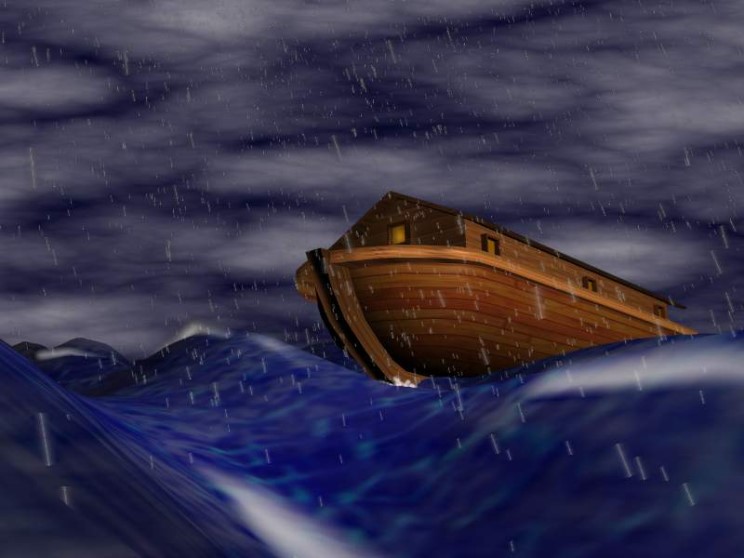
NoahsArkPitch

The Flood

It crept up slowly.

You did not notice at first,

though your feet were always cold ,

socks soggy.

Accustomed to the damp

you pulled on galoshes

then hip waders.

You didn’t know why

you were always so tired

like walking against a strong current, you’d say.

By the time the force of the tide

sucked  your heart

out by the roots

it was too late.

You plunged

into that dark torrent

gasping for air

clawing

for something to hang onto.

The ark you

unbelieving

had refused

rocked  above the waters.

The old man leaned

over the side

extended  a wooden

beam.

I see you are ready now, he said.

Grab on,

there is room for one more.

__________________

Is something threatening to drown you, which you keep ignoring?
What keeps you from reaching out for help?
If you are safe in your arc, is there someone out there who needs a hand up into the boat?
What are you waiting for?

______________________________

Note to readers:  This blog is part of a series of Lenten “short takes” on the themes of lent, which follow more or less the lectionary Scripture lessons for this season. Like a note you find tucked under the bark of a tree, a lozenge to let melt in your mouth, an amulet to wear around your neck, I hope these little reflections may hold a small dose of truth or comfort  or challenge for your life on the way to Easter.

In the abundance of words which inundate us daily, it is easy for the message of redemption to be buried under the latest disaster, outrage or scandal. Likewise the familiar stories and passages of lent may grow dull and trite to ears and hearts already stuffed with words. 

I have noticed in my work as spiritual director that it is hard for many of us to take in the goodness and grace, as well as the challenge of the story of Jesus and God’s redeeming love. Perhaps we need to titrate the gospel. Sometimes a well- timed, tiny dose, carefully administered, may be what the Physician orders for our healing. And so slowly we build up our tolerance for love and more and more joy finds the faith in us through which to invade our being.

Dose titration:  adjustment of the dose until the medication
has achieved the desired effect

Love – In Small Doses for the Sin Sick Soul # 1


Crosswalk

Wait

for the sign

to change

step off the edge

For your reflection: What signs in your life have changed, which  call you to step off the edge of certainty and comfortable beliefs?

Note to readers:  This blog is part of a series of Lenten “short takes” on the themes of lent, which follow more or less the lectionary Scripture lessons for this season. Like a note you find tucked under the bark of a tree, a lozenge to let melt in your mouth, an amulet to wear around your neck, I hope these little reflections may hold a small dose of truth or comfort  or challenge for your life on the way to Easter.

In the abundance of words which inundate us daily, it is easy for the message of redemption to be buried under the latest disaster, outrage or scandal. Likewise the familiar stories and passages of lent may grow dull and trite to ears and minds already stuffed with words.

I have noticed in my work as spiritual director that it is hard for many of us to take in the goodness and grace, as well as the challenge of the story of Jesus and God’s redeeming love. Perhaps we need to titrate the gospel. Sometimes a well- timed, tiny dose, carefully administered, may be what the Physician orders for our healing. And so, slowly, we build up our tolerance for love and more and more joy finds the faith in us through which to invade our being.

Dose titration:  adjustment of the dose until the medication has achieved the desired effect

A Prolonged Hesitation – Meeting God in the Spaces

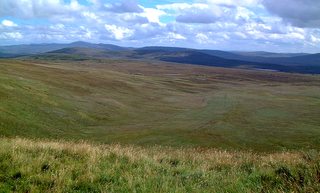
Ireland Upland

Silence is God’s first language. – John of the Cross

Spaces captivate me. The spaces between things – pauses, silences, rests between notes, empty rooms, expanses of prairie, moors, and highlands.  A friend of mine from a large urban center once came to Kansas for a visit. I drove her out west on I70. The empty space terrified her. She much prefers the human made canyons of New York City, than places where the land itself dominates the environment and asserts its untamed, mysterious vitality.

In my work as a listener to the stories of others, I find the spaces between the words, the sudden silences, or the time a person takes for thinking to be where the treasures lie, where holiness abides.

flintyhills3

I recently found a friend in the poet, Rilke. I drove south through the stunning space of the Flint Hills to Wichita to The Magnificat Center. This haven of hospitality and spiritual nurture hosted a retreat led by Mark Burrows, scholar of medieval Christianity. Mark had recently translated some of German poet, Rainer Maria Rilke’s early poems.  Prayers of a Young Poet, Paraclete Press.

For an evening and a day Professor Burrows opened up Rilke’s poems like small packets of compressed holiness. Once set free by Burrows’ translation and our imagination, the poems awakened us to the immense and voluminous God this young poet had discovered.  In the spring of 1899 God had wooed Rilke during the Russian Orthodox holy week services at Moscow’s Cathedral of the Dormition.  By the end of our brief time together I felt the room we gathered in enveloped by presence and I, too, felt holiness pulsing in me.

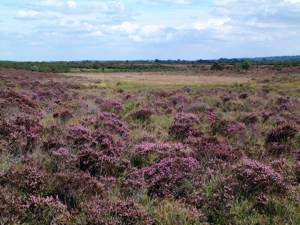
The resonance of Rilke’s images and Mark Burrow’s masterful interpretation slowed me down, and ushered me into in the mystery of Rilke’s God. I was taken out beyond myself and the horrible cold I had brought with me to a more spacious place. The image Rilke used to express his desire to touch into God’s immensity was heath, the open, treeless landscape of moor and bog.

Whatever you yearn for, my soul, say it
Be heath, be heath, be wide.
. . . .
Be heath, be heath, be heath

Prayers of a Young Poet, translated by Mark Burrows, p 30.

Heath view

What is it in us that allows God to meet us with fullness, depth, and beauty? The potential is always present. Love or loss of love may do this, preaching may do this, sacraments, art, music, nature, beauty, may do this. Yet we must offer the space, the openness, the inner heath or expanse of Kansas Flint Hills to become the altar for this dancing God.

As the psalmists, prophets and Jesus knew, poetry may offer such an altar for the sacrament of presence.  Paul Valéry defined a poem as “a prolonged hesitation between sound and sense.” That is also not a bad definition for a parable. Parable and poem both dis-orient, surprise, stop us in our tracks, and expand our awareness beyond our previously known world.

Poetry invites, even demands that we hesitate, off balance, scratching our heads, to teeter between sound and sense. Most things which reveal Transcendence (that which is beyond our selves) require us to enter the unfamiliar and wait on the edge of not knowing, without having to rush in and fill the moment with a refutation, argument, praise, or anything to end the awkward, uncomfortable “dead” space. It seems to me that good art makes us hesitate and allows what we may perceive as dead to rise up before us. Surely good preaching, celebrating sacraments, and prayer ought to do the same.

Moor
Yet hesitation is seen as a flaw, a lack of confidence, or making someone have to wait. Thomas Merton wrote that we live in a time of no room, in which we are “obsessed with lack of time, lack of space, saving time, conquering space, projecting into time and space the anguish produced within [us] by the technological furies of size, volume, quantity, speed, number, price, acceleration.” Thomas Merton, A Book of Hours, ed. Kathleen Deignan, p 32 

We live in a time of no room with no space for a soul’s edges to roll out, unconfined by agenda. Hemmed in by a culture which has convinced itself that time is a commodity, of which there is great scarcity, our souls become cramped, stunted, and deformed by the crushing weight of  having to produce and fill every moment with sound and human activity.

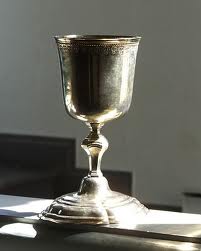
communion cup

Time is the sacred vessel of encounter with divine presence.  Where else do we think it is going to happen, if not here, now in this moment? We put little, if any, space between and within the words we speak to one another. We have little available “random access memory” in our minds.  Words pile upon words. Life is reduced to thirty second sound and image bites. Minds are crammed and obese with knowing, calendars booked solid, days filled with activity, and hearts full of oneself.

Who among us will be bold to hesitate, to linger in the land of uncertainty on the shore of wisdom?   Who will offer shelter for silence to collect itself, curl up and hum to itself in the sun? Who will be heath?

________________________

Please note Praying Life Readers: I will be leading a retreat at the Magnificat Center in Wichita, Kansas on March 22-23, 2013.  For more information and to register: Retreat led by Loretta F Ross  It would be great to see you there!

Appliance Violence

SEEKING A MORE EXCELLENT WAY

refrigerator2My first exposure to appliance violence was an article I read years ago in The Holton Recorder, the newspaper of Holton, Kansas. The headline read: Hunter bags fridge. The story was about a rural Whiting woman whose refrigerator stopped running. According to the article “a repairman found the cause. A bullet had passed through a refrigerator wall at a critical point. The slug, from a high powered rifle was found in a drawer at the bottom of the refrigerator. Not only had the bullet struck the refrigerator, it had passed through two walls (including an outside wall) of the house and two pieces of stuffed furniture.”

The local sheriff said “the shot that killed the woman’s refrigerator was not a criminal act,” but warned, “People need to realize that some of those high powers (bullets) go three miles.” I saw the article as a cautionary tale for people who live in rural areas and hunters, and laughed over the clever headline.

That was before Sam told me about the darker side of appliance violence.

First I want to tell you about the award Sam gave me. Then I will tell you why he is quitting his job of four years as an appliance repair worker.

When I met him at the door, I liked Sam right away. Tall and lanky in his neat uniform, toolbox at his side, he impressed me as a young man who was on his way up.

I welcomed him in, led him down the steps, and introduced him to my dryer. He was here on a routine maintenance call. In a weak moment I had purchased a protection plan from a persuasive salesman. This was against my principles. I believe manufacturers should make things that won’t break. But I was weak. The salesman had kids to feed. And after he told me about the horrible fires dryers cause, I caved. Since I had paid for the darn thing, I figured I ought to take advantage of the annual maintenance check.

Sam laid out his tools, pried up the top of the dryer and set to work. When I returned half an hour later he said, “I have never in four years of servicing appliances ever seen a dryer as clean as yours. There was not any lint. I even lifted off the bottom plate to check under there – spotless.”

I demurred, “Well there is just me and I don’t do big washes.”

“Oh no!” he assured me. “I have been in homes with single people whose dryers are dirty within six months. This one has not been checked for two years.”

“No dog hairs?” I asked. “Spiders, crickets? I had a lizard down here last summer and mice this fall.”

“Nope,” shaking his head. “I have never seen anything like this.”

I need tell you this made my day. One has to grab for any accolades that are offered in this life, and a clean dryer award from a repair man is all that I need to smile for the rest of the week.

“You must see I lot of things in your job, coming into people’s houses, their basements, moving out their refrigerators…? “ I ask.

“Oh yes,” Sam said. “It’s awful. People  threaten me. They are so mad their appliance is broken. They are mean. I have had people pull guns on me. One woman shot at me. Hit my truck. Put a hole in the side, as I was walking around to come up to her house. Sometimes I have to leave and go drive around the block out of sight and call the police. I even put in to work in customer satisfaction, but it was just as bad there. And they don’t pay as much.”

I wanted to be sure I had heard him right. “People draw guns on you over their appliances?”

“Yes. All the time. They get so mad. I am not going to do this work anymore. It’s not safe. My fiancé wants me to quit.” He went on to tell me of the two job offers he had.

I live in Topeka, Kansas, where some people still have a Wild West swagger and hold fiercely to their right to bear arms and to protect their property. However, I cannot understand how someone could feel so threatened, or so powerless, that he or she would feel a right to draw a gun on the appliance repair man.

I have been thinking about the people who shoot at repairmen, those who take aim at the random person in the mall, or shoot to kill the guy stealing their TV. Sometimes they are mentally ill. Sometimes they feel threatened. Sometimes they are just really pissed off.

Here are questions the current gun debate in our country poses for me:

What do I do, if I do not get what I want or need?
What do I do, if I do not get my own way?
What do I do, if I get so mad I can’t stand it and want to kill someone?
What do I do, if I feel so afraid and powerless that I want an arsenal of weapons to protect myself?
What do I do, if I suffer grief, frustration, oppression, or injustice?

I am not saying weapons never have a place. I am not against weapons, but I am for people having a wide range of options for handling conflict, frustration, fear, and pain. When my only option is threatening someone else’s life with a gun, I have reached a radical impoverishment of intellectual, emotional, social, and spiritual resources. My freedom and dignity as a human being, as well as that of the one I perceive as my enemy, are deeply compromised.

There appears to me, to be in some citizens, a gaping lack of the personal resources to handle strong emotions, manage anger, frustration, disappointment, fear, and threat without resorting to violence.

I am thinking about the guy out on Croco Road sitting in his cold house waiting for the furnace repair truck to drive up. I am thinking about the woman who walks into the Quick Stop and shoots the clerk to get fifty dollars. What sort of despair, sense of powerlessness, and desperation breed these acts?

A sign of the maturity and social development of a culture is not the size of its arsenals and fire power or access to weapons, but the depth of its restraint and the richness of its citizens’ internal and external resources for coping with the inevitable frustrations and sorrows of being human.

Through our faith traditions, science, medicine, our community resources, art, and our open hearts, we as a culture have a treasure trove of resources to help us deal with the agonies of being human. There is more help available than ever before, for when we do not get our own way or what we need.

Christian writer, Dallas Willard, has suggested that –

perhaps too much time has been spent by Christians trying to smooth over hurt feelings and even deep wounds, given and received, and to get people to stop being angry, retaliatory, and unforgiving. But suppose, instead, we devoted our time to inspiring and enabling Christians and others to be people who are not offendable, and not angry, and not fearful, and forgiving as a matter of course. p. 303, The Divine Conspiracy, Dallas Willard

Willard reminds of a story I heard years ago.

A warlord stormed with his troops into a Buddhist monastery and came before the abbot waving his sword. The abbot stood firm and calm. “Don’t you know I can run you through with this sword without batting an eye?” the warlord thundered at the abbot.

The abbot replied, “Don’t you know I can be run through without batting an eye?” At those words, the warlord put down his sword, bowed before the Abbot and left with his troops.

There is a more excellent way. We have great arsenals for peacemaking stockpiled in the teachings of our spiritual leaders, saints, and the faiths of world. We know how to teach our brains to be more compassionate and lower our blood pressure. We know how to help those among us who are mentally ill. We know how to be there for one another in tough times. We understand what breeds desperation and despair.

My friend Sam is headed for bigger and better things. But no one has a right to bear arms over his broken dishwasher. And no one in this nation ought ever to have to feel so unable to get his needs met that he must have a gun in order to do that. No one should have to carry so much pain inside she can’t stand it.

We can do better than this.
We are better than this.

Faith and Fear

A two part series on giving birthddddxxxxx CDC zf
to redemption in your time and place.

Part Two – Conceiving the Inconceivable

A-annuncia_Fra_Angelico

Mary takes hold of,
seizes
the inconceivable.

The purity and faith of the virgin
penetrate the illusion and falsity
that surround her,
and she offers her whole being –

intellect, imagination, heart, and body-

to deliver redemption into her world.

She claims her power
as the mother of redemption
and joins with God in a dance of saving love.

That same dance has the power to transform Cousin Carl in his fake angel costume and Aunt Edith with her hair in curlers into the heavenly hosts,

and you and me into bearers of Christ.

Do you see the mutuality in this exchange of love
between a mortal and the Holy One?

The prophet Zephaniah calls Israel to rejoice
because God is in her midst;
he further proclaims that this God in her midst is rejoicing over her with gladness (3: 14-18).

Israel rejoices over God.
God rejoices over Israel.
God chooses Mary.
Mary chooses God.
We long for peace and wholeness.
God longs to give us peace and wholeness.

What prevents more of this dancing in our lives and world?
A significant impediment must be our fear.

In the story of Christ’s birth several of the players are exhorted not to fear – Zechariah, Mary, Joseph, the shepherds. The gospel writers over twenty times show Jesus admonishing others not to fear.

Fear may be seen as one of the indicators of the presence of God. Fear of God, which is the human response to God’s overpowering majesty, glory, and power, is an appropriate and desired reaction. In contrast, fear of the world, fear of self and others is seen as counterproductive to God’s action in our lives.

Beatrice Bruteau writes of faith as an attitude of the consciousness that is participating in divine activity, God’s creative work in the world. Faith is “the disposition which Jesus declared to be a condition for the realization of his works. The doer of the work had to have faith, and the receiver of the work had to have faith.”

Brutear considers faith as “not only the consent of the intellect to the reality of something that does not appear immediately to the sense, but it is the consent of the imagination and the affective faculties attached to the imagination.”
– Beatrice Bruteau, Prayer: Insight and Manifestation, in Contemplative Review, Fall 1983

Thus, the new thing God is doing enters this world –

as we agree something better is possible,

as we are able to vividly envision the new thing,

as we feel in our hearts the joy and delight of that yet unborn promise,

as we persevere in that vision in the face of fear and threats,

and as we live expectantly as if the vision is accomplished.

Fear keeps us stuck in the present reality, constricted and paralyzed by the very thing God is setting about to redeem. Fear distracts us from watching and waiting eagerly for the in breaking of God’s promises into the world. Fear turns our eyes away from the coming bridegroom to become mesmerized by the horror of a realm that does not know God.

Fear, then may be seen as faith in your enemy.

The danger, as Ian Matthews writes, “is of folding in on oneself. Pain does that, and the temptation is to look for a both/and:

both staying with the new setting, and feeding on nostalgia for the old one.

Unhappily this both/and tends to backfire. We cannot both indulge self-pity and make the most of a new situation.”
– Ian Matthews, The Impact of God – Soundings from St. John of the Cross

Simply put, our faith, as does Mary’s consent, allows Christ to enter the world.

Think for a moment.
How do you feel when someone expresses faith in you?
When another trusts you and has faith in your gifts, are you not enlarged, empowered, and more willing to offer your gifts?

Perhaps the reason why Jesus urges his followers to have faith, why he shakes his head in dismay at the disciples doubts and fear, is that their faith in Jesus empowered Jesus.

So, as Annie Dillard writes: “Faith, crucially, is not assenting intellectually to a series of doctrinal propositions; it is living in conscious and rededicated relationship with God.” Annie Dillard, For the Time Being.

Further, faith is not a vague and wispy sense that God is out there somewhere looking on us with a benevolent eye, nor is it an exercise of philosophical proofs.

Faith is the means by which God enters and changes our reality.

Faith is an interactive experience, a dance of mutual love between a mortal and God in which both parties are needed, affected, and changed for the benefit of the whole world.

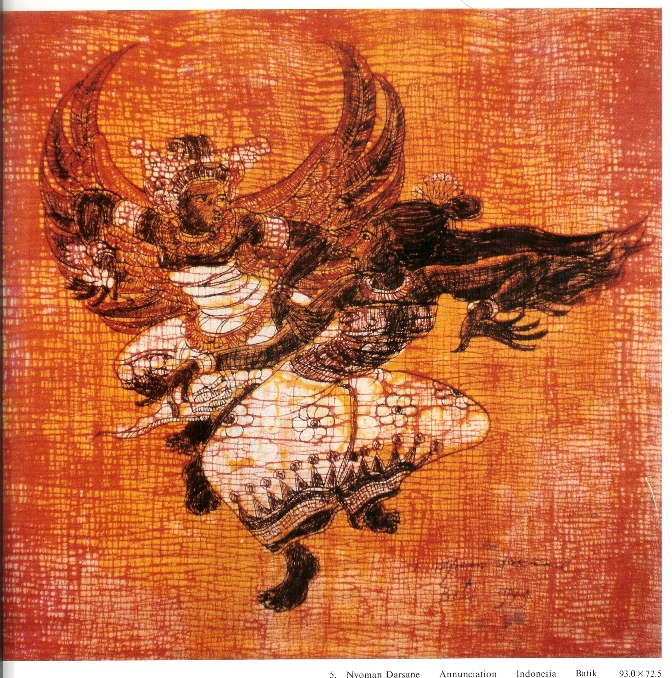
Annunciation, Nvoman Darsane

Annunciation, Nvoman Darsane

Rejoice, Daughter Zion! Shout, Israel!
Rejoice and exult with all your heart,
Daughter Jerusalem.

The Lord has removed your judgment;
he has turned away your enemy.
The Lord, the king of Israel, is in your midst;
you will no longer fear evil.
On that day, it will be said to Jerusalem:
Don’t fear, Zion.
Don’t let your hands fall.
The Lord your God is in your midst—a warrior bringing victory.
He will create calm with his love;
he will rejoice over you with singing.
Zephaniah 3:14-18 (CEB)

Adapted from my book, Letters from the Holy Ground – Seeing God Where You Are, Chapter 38

Faith and Fear

A two part series on giving birth
to redemption in your time and place.

Part One – Mary and Cousin Carl

A-annuncia_Fra_Angelico

Most every epiphany or showing of God in scriptures is met with fear. When the angel Gabriel comes to Mary saying,  “Rejoice, O highly favored one. The Lord is with you,” Mary does not break out in ecstatic bliss. Instead she is greatly troubled at the saying. As Luke tells it, she considers in her mind what sort of greeting this might be. And well she might. It was probably not the first time some itinerant ladies’ man claiming to be an angel had come on to her.

The angels in the Bible get some of the worst lines. They are hard to pull off with any authenticity. Enter one angel Gabriel with a flourish of wings and heavenly splendor who must make believable both his incredible presence and the words: “Rejoice, O favored one.”  Smile, God loves you. This is your lucky day! Any virgin with an ounce of sense might consider in her mind, “Right sweetie. Have I ever heard that one before.”

The immensity of the heavens is about to invade Mary in a mysterious and awesome conception that will defy rational explanation and accomplish an incarnation that ushers in the redemption of the world. Yet before Christ is born, Mary must face her fear and make a choice. And so it is with us. When God’s cheery messenger meets us with the news that we will conceive and bring forth the fruit of salvation, fear rather than joy is likely to be our first response.

A-Annunciation_da_MessinaMessengers sent by God to announce God’s saving love often wear camouflage. They have a hundred disguises. Can we trust that they are who they say they are? This seed of hope they want to place within us, dare we believe it, receive it? What if we are mistaken and this is all a dream or a product of our own egotistical imaginations? What arrogance makes you think you can bear sacred saving gifts into the world? This is no angel, but Cousin Carl dressed up in Aunt Edith’s chenille bathrobe with some tinfoil wings and a halo made out of a pie pan!

In real life angels rarely look like the ones in paintings. And yet, does it matter if the angel really is Cousin Carl? To me, what matters is that we believe that holiness and salvation are afoot, whatever ridiculous disguises they wear.

Prior to the advent of God’s redeeming love in our lives and world comes a courageous act of faith. The birth of Christ is contingent on the belief of a young girl with an imagination creative enough to envision the impossible and a sense of her worth strong enough to defy fear and anxiety. She places her whole being in jeopardy as she lays out her life and all that she holds dear on the gamble that there is a God in the heaven who might have some business to do with her.

We are to rely on faith rather than evidence, Ian Matthews writes in his interpretation of St. John of the Cross. Yet, here’s the kicker: the danger St. John warns of “is not so much that we shall trust in the wrong thing, but that we shall stop trusting at all; that, while we may never say it in so many words, we shall cease to believe that we are factor in God’s life.”

Matthews continues:
Survival demands a certain skepticism. We are trained to cope as social beings by keeping our desires within realistic limits. But where God is concerned, the problem lies in our desiring too little, and growing means expanding our expectations; or rather, making [God’s] generosity, not our poverty, the measure of our expectations.  – Ian Matthews, The Impact of God – Soundings from St. John of the Cross

Mary, sizing up her heavenly visitor, is moving from the rather safe place of conventional norms into a new realm where few of the old rules will make much sense. No one else can judge for her the validity of that grinning angel holding out joy like Aunt Edith’s peanut brittle. Should she take a bite? She hasn’t forgotten that incident in the garden with the serpent. What is truth? How can she be sure this is an invitation from God?

There are no books she can read, no wise men and women she can consult. She alone must determine and act on her own truth. How will Joseph or her village ever believe what is happening to her? Yet what others will think is not her ultimate concern. Her concern is obedience to the living God, to hope, to the possibility of wonder that lies beyond what the eye can see.

Joseph and the others must come to their own conclusions. They, along with the rest of us, are given that freedom. In W. H. Auden’s poem, “For the Time Being”, Joseph says to Gabriel:

All I ask is one important and elegant proof
That what my Love had done
Was really at your will
And that your will is Love.
Gabriel responds:
No, you must believe;
Be silent and sit still.

Weighing the odds, Mary asks one question, “How shall this be since I have no husband?”

“No problem,” guarantees the angel. And citing the case of barren Elizabeth, he assures her that with God nothing is impossible. Mary’s question raises a far from minor point. The participation of a male is a basic ingredient for conception. When God sends a divine messenger to us announcing that we have been chosen to bring forth some saving work, it may appear that some major components for success have been omitted. How shall this be since I have no money? Since I have no work? Since I have no education?

“No worry, it’ll be a cinch,” says Cousin Carl, snapping his fingers. “The Holy Spirit will come upon you.”

Finally it is up to Mary. The redemption of the cosmos is resting on the consent, the free choice of this mortal woman to have faith, to believe that what she is experiencing is true, and to claim and live out her experience of that truth by conceiving the fruit of salvation.

What will be your answer to Cousin Carl?


A_Annunciation_Collier

_______________________

 To be continued ~ watch for part two of this two part series. Will Mary say yes?  And what’s faith got to do with it?

This post is adapted from my book, Letters from the Holy Ground – Seeing God Where You Are, Chapter 38

Special Offer for Readers of The Praying Life Blog

Holy Ground, a quarterly reflection, serving up spiritual food that sticks to the ribs for twenty three years.

Holy Ground, a quarterly reflection, serving up spiritual food that sticks to the ribs for twenty three years.

                       Back issues of this little newsletter can be found in every stack of papers in my house – I move them from my desk to the kitchen counter to the pile of mail on the dining room table, until they eventually become dog-eared and fall apart. I just can’t seem to throw an issue of Holy Ground away.
                    Why? Because Loretta Ross, an ordained Presbyterian clergy woman and a fine writer, puts equal amounts of inspiration and whimsy into every issue. Even though Holy Ground is a thin little folder – 7 or 8 pages, one essay, really – it’s always refreshing, renewing,; an awakening of sorts.
                                     Review by Susan Jelus in A New Song May, 1999

Take advantage of this  special offer
for Praying Life Readers and their friends

I want to thank you for all your support, shares, comments, follows, and subscriptions to the Praying Life blog over the past three years. You continually call me to deeper truth, deeper prayer, and better writing. You are each a gift in my life.

Here’s the deal: Subscribe to Holy Ground and get the first two issues of a new series of issues on contemplation FREE!

What is Holy Ground?
Before I started writing the Praying Life blog I had been publishing a quarterly reflection on the life of prayer called Holy Ground for over twenty years. In 2000 Sheed and Ward published the best of those essays in the book, Letters from the Holy Ground –Seeing God Where You Are. I occasionally feature excerpts from this book here.

Who are you really and why should I invest in a subscription to Holy Ground, even if I get two free copies?
Many of the subscribers of Holy Ground have been reading this little publication since its beginning. The writing in Holy Ground is similar to what you find in my blog here, except that each essay is a lengthier consideration of some aspect of our life in God. Many Holy Ground issues make their way to Bible study classes and prayer groups.

As with The Praying Life blog, the writing is informed by my thirty years of listening deeply to the stories of others about their faith lives. As a spiritual director I have spent thousands of hours listening  and learning of the struggle, the suffering, and the beauty of growing in the likeness of Christ. My ministry as a pastor, as well as personal study and training in theology, scripture, and faith formation also shape my understanding of the church in this tumultuous time. I am accountable to a Board of Directors, a member of Spiritual Directors International, and an honorably retired member of the Presbytery of Northern Kansas. I take very seriously the access others give me through my writing and seek to be held accountable by other professionals and my church.

Finally and most important, is my commitment to prayer. Setting aside a day of solitude and prayer weekly, is the only credential I offer of any lasting value. For twenty five years I have focused my ministry on prayer first, last, and always. This is the core of who I am.

In the words of Oswald Chambers, “ I am called to live in such a perfect relationship with God that my life produces a yearning for God in the lives of others, not admiration for myself. … God’s purpose is … getting me to the place where God can use me. Let God do what he wants.” My Utmost for His Highest.

For me prayer is the process of continued surrender into the will of God. I am not my own, but belong to One greater than I, whose purposes for me I generally resist, but ultimately seem to surrender to.

So Tell Me More about Holy Ground
This new series of Holy Ground issues is on Contemplation and the first issue of the series, which you get free with our offer, is a general overview of contemporary contemplation and a consideration of several definitions of this somewhat obscure word.

The second issue of the series, which you also get free with our offer is a long, loving look at what it means to pay attention.

Here is an excerpt from the first issue:

One learns a lot from the disciplined practice of the present moment, or mindfulness, as it is sometimes called. As I watch the fleeting shadows of my mind’s picture show, I encounter my restlessness and my estrangement from my deepest self, where Holiness abides.

Day after day my ego strides with a flourish to its pulpit to justify, defend, or convince imagined audiences of its own certainties. Persistent and untiring, it plants its elbows on the podium and tightly grips the sides. Posturing and pontificating, it attempts to prevail against the horror of its diminishment and disappearance in the embrace of what is beyond our naming.

We sit still as stones as love stalks us, waiting just beyond the edges of our awareness to pounce upon its prey and carry us off between its teeth into the divine depths of each moment. . . . .

The past thirty five years we have seen a tremendous growth and flourishing of contemplative practices world wide. Understanding and appreciation of contemplative prayer have grown in many faith traditions.

The hunger for communion with God and the development of the spiritual aspect of our being has spilled out from churches, synagogues, mosques, and temples to PBS special documentaries, internet, coffee shops, retreat centers, and hundreds of programs in faith formation world wide, as well as secularized versions in business and the sciences.

So what is this contemplation? …

Excerpted from Vol. 23, No.2 Summer 2012 of Holy Ground, copyright©2012 Loretta F. Ross

By subscribing to Holy Ground, you will get more encouragement for your journey. A year’s subscription is $35.00, which with our offer includes six issues, instead of the usual four. That is a 50% savings.

Subscribe today. Click here. You will soon will receive in your email copies of the first two issues in the series on contemplation. You will be glad you did. And you will help us keep offering serious rib stickin’ soul food. If you would prefer the printed snail mail version, check that option in the drop down box and we will get your free issues in the mail right away.

If you have any problems or questions, leave a comment here, look for the facebook page The Sanctuary Foundation for Prayer, or email me at lross@fromholyground.org.

Again, dear ones, thank you from the bottom of my heart for carefully tending to your own souls and including this blog in your diet. If you already subscribe to Holy Ground, thank you so much! How about giving a gift subscription to a friend, or passing this post on to someone you know?

What Readers  Say about Holy Ground
Holy Ground essays sustain long after the rise and fall of scandal, political wranglings, and the garish blare of media sound bites.

This issue is one of my favorites. Thank you for the call to contemplation. I especially liked your sharing of the process, the distractions, even related thoughts that are not in the present. I’ve experienced all of those! M.T. August, 2012

Wow, Loretta, you went all out for your Autumn Holy Ground. I received it yesterday and read it this morning. Really, for me, one of the most powerful things you’ve written since I’ve been receiving your reflections. It was truly inspired. I am grateful for this gift that resulted from your deep prayer life. Thank you, thank you – for sitting, for waiting, for praying.It is really an incredible reflection. – S. P. Dec. 2009

Hi Loretta – I am an avid and appreciative reader of Holy Ground. It waters my spirit without fail. Thank you for sharing your gift of spiritual insight and ability to express it in words and white space. H. E. Dec. 2011

Volume 18, No 2 arrived this week. It is poignant, and hits a mark in all of us. But what I want to say here is thank you for your continuing transparency, and your courage to share your deep self with all of us. Not only your ministry, wisdom and insight, but your willingness to share yourself with so many, is a great gift. P.M. August 2007

Your newsletters are always so deep and challenging, the most profound Christian spirituality around. Thank you, love, C. M. Dec. 2009

I am so glad Holy Ground was forwarded when I moved from Topeka to Cincinnati. The messages are among some of the most life giving ones that are out there. Thank you for this opportunity to keep receiving it!!! L.O. Oct. 2007

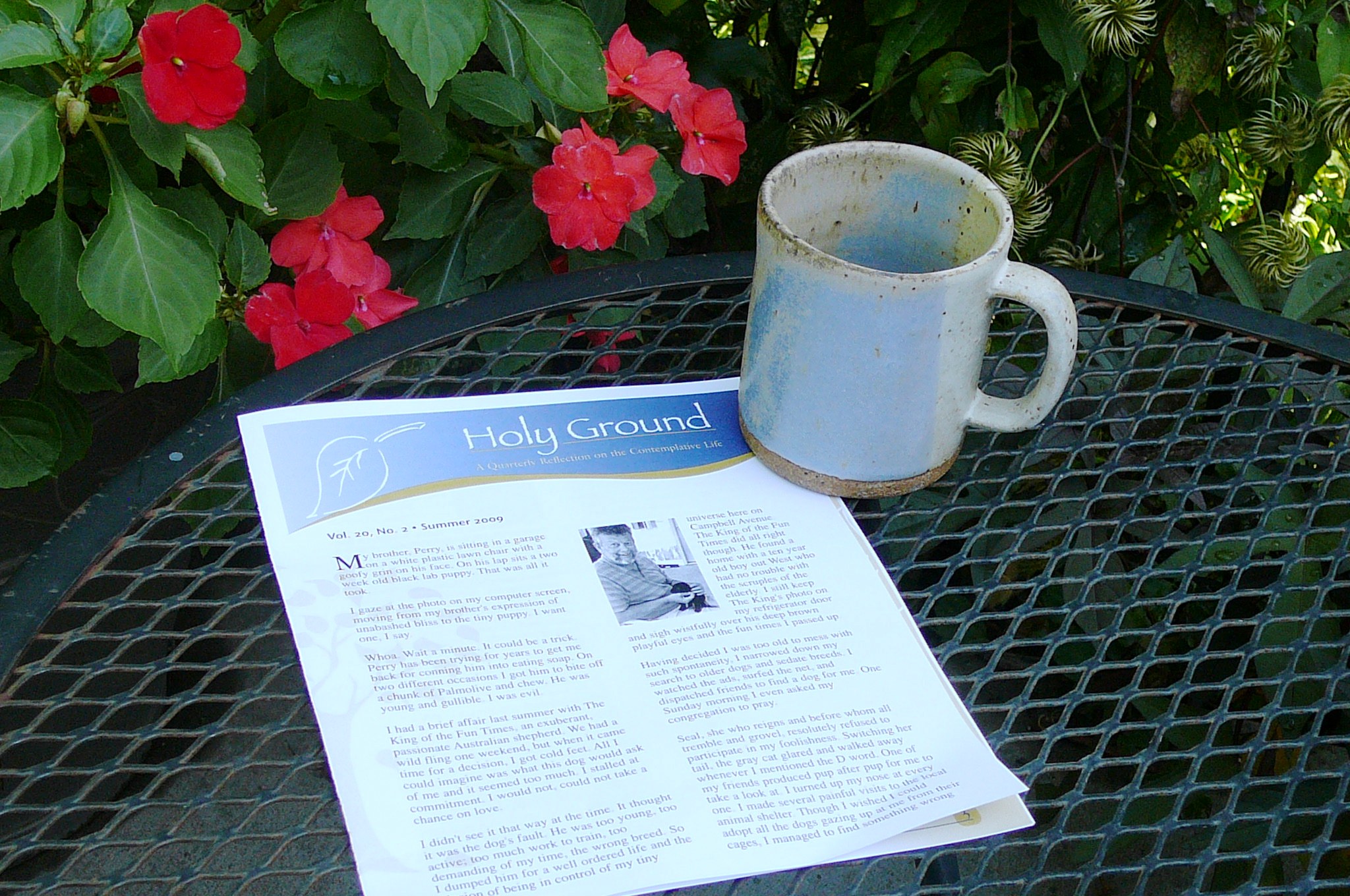
Summer 2009 HG

Holy Ground.  goes great with a cup of coffee!

Morning News Pre-Empted by Older Story

Today while listening to the morning news, I heard an old hymn edging its way between the story on the election and the update on survivors of the hurricane.

I will tell you what it was in a minute, but first I offer you my Op-Ed.

I am not counting on my vote getting the leadership I want us to have. Nor am I counting on getting my views on our responsibility to the suffering of others to prevail.

What I count on and lay down my life for, is the goodness of a Reality larger than politics, economics, global warming, war, and corporate interests. I am putting my support on a Being greater and more graceful than the tiny brains of human beings. My candidate is the invincible  Substance of things hoped for, which sees beyond what is, yet dwells in the midst of our chaos and sings in the human heart.

Under my fears I can hear the wondrous freedom song that nothing can separate us from the love of God, not human sin, stupidity, or weakness, not death or life, not angels or rulers, not present things or future things, not powers or height or depth, or any other thing that is created. (Romans 8: 38-39 CEV)

The Holy One dwells as ground beneath our feet in astonishing humility – wiser, brighter, and kinder than we are – who will hold us up and see us through.

In this season of distress, polarities, and uncertainty, I am banking on the hidden connections among our species, those channels of mercy that run deeper than ideologies and seep into the crevices of our vulnerability, which is both our great flaw and our greater glory, penetrating down into the solid rock of compassion, imagination, and strength.

The world does not need our anger, our outrage, our fear, or our grasping need to get others to believe as we do. I believe the world needs our humility and our faith.

For my part I can think of nothing better to offer this little piece of history than these simple gifts of the soul.

Now, here is the hymn which intruded into my morning news:

On Christ the solid Rock I stand,
All other ground is sinking sand;
All other ground is sinking sand.
                                          Edward Mote

The Visitor

I hear you,
muffled
by the clamor of my mind
stomping the snow off your boots.

The little cloud of steam
your breath makes
seeps through the cracks
of my door.

Where have you been –
walking to and fro in the forest
gazing into the eyes of the doe
leaving traces of your countenance
wherever you go?

You tap softly.
Why do I keep you waiting?
You bring,
tucked into your sleeve,
the bunny with a missing leg
the sparrow with a broken wing.

You wait.
I do not see the silver dagger
gleaming
like a flame in your pocket.

I am cozy in my chair
wrapped in my reverie,
lulled, at ease, and insular.

Abruptly I recall the man
coming this morning to give
an estimate for repairing my fence.
Get dressed!

I will let you in after that.
But task leads on to task
breakfast, mail, the phone.
The fence man comes and goes.
So does the sun.

Later, I think of the bird and the bunny.

Did you find a warm place
for the weak and broken ones
you carried?

In the night turning over in my sleep
I wake,
bent double and breathless,
pierced by the stab
of your two-edged sword.

I do not know when
you took it out of your pocket
or when it neatly penetrated
between joint and marrow
separating the thick sinew
of self from will.

I only know I am so sorry
here in the dark
and so slow

to learn that opening the door to Life
means the death of me.

. . . God’s word is living, active, and sharper than any two-edged sword. It penetrates to the point where it separates the soul from the spirit and the joints from the marrow. It’s able to judge the heart’s thoughts and intentions. No creature is hidden from it, but rather everything is exposed to the eyes of the one to whom we have to give an answer. Hebrews 4: 12-13 CEV


You Will Die Before You Finish This Prayer

“I think what is going to help you most when you start your prayer – and it doesn’t matter whether it is long or short – is to make quite sure that you are certain that you will die by the time it is ended, that you will finish before your prayer does!” cheerfully advises the fourteenth century English author of the Epistle of Prayer.

The author, most likely a country parson, is writing to a young person, who asked for advice on how to control the mind when saying prayers. This is a request I often hear. Some things never change in the praying life.

I recently tried the parson’s advice and it about did me in. I attempted to make certain I would die before I completed my prayer, and learned that there is little like death to focus the mind:

The world rushed in with her fetching beauty, her clear blue sky, and yellowing maple leaves, waving, “Don’t forget about me, and me, and the red bird house, and the wren, and the dragonfly and the glaciers gripping the ground, and the wild horses pounding over the plains. The wind, whooshing leaves down the street, sent a shower of glimmering memories – babies, kitchens, ginger snaps, story books – I gave thanks for galoshes to help me wade through all the goodness. I will be ancient or dead before I finish stringing the pearls of this gratitude.

After the gratitude came the love, flowing up to the porch, running under the door, pooling at my feet and rising, slowly to my knees. I climbed up on the table and the love still mounted. Love is the color of spring and snow and fire. It moans and sings and weeps. It tastes bittersweet, smooth and creamy, warm and rich as hot chocolate. Then I grew bold and dared to believe that I could breathe in it, could breathe under-love, and that I would not drown or melt in it. So I slipped off the table and swam a few strokes around the room, then let the love sweep me out an open window into the world, buoyant and giggling.

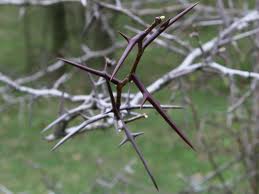
When I came across the English parson, I had been feeling little gratitude and not the least bit buoyant. Instead of gratitude and this exuberant love, sorrow and longing for God had occupied my heart. My praying life had honed down to a narrow naked ache, like a thorn, for several weeks. I hurt. I went to sleep with the thorn and woke with it, a stab of incompletion and desire, lodged like a fish hook in the center of my being. There was no one thing I could name that would satisfy or heal this pain, but only the one whose name was above all names, who was before there were names.

The thorn was part grief and a prickly call to deeper freedom. As I grieved recent and old losses in the midst of many present blessings and considerable gladness, I was being weaned from some of the things of this world, which are lesser than God. And it hurt. I sensed there was something I was to let go of, but I couldn’t quite see what that was, though it seemed to have to do with some of my mental constructs, attitudes, ways of naming and holding what I knew as reality. It seemed to have to do with who I thought I was and how I held myself together. And this felt really, really scary.

So I prayed, meditated, read holy words, exercised, talked with friends, listened to and felt deep compassion for others. I also played a lot of mindless solitaire on my phone.

I went to the Antiochian Orthodox church down the street, where, except for the jean clad worshippers, I felt I had stepped into an ancient Syrian synagogue where Paul might step out and begin preaching any moment. I let the tonal chants in four part harmony wrap around me, as the icon saints gazed out from all four walls. Each word and act in worship was directed, not to audience appeal, market demographics, or video screens, but to the Holiness that filled the space. It was clear most of the people, as well as all those saints with their sorrowful eyes, also had thorns of longing love in their hearts too.

I have had periods of prayer like this before and trusted God was at work somehow. I know that uncertainty, alienation, and disorientation are part of growing in faith. The temptation during such times is to turn in disgust on oneself, dredging up failures, mistakes, weaknesses, and falling into a dark pit of self-negation. Yet I have learned over the years, that it is precisely, when we feel the most pitiful, that we are most in need of our own tender compassion and love.

During this time I gobbled up The Cloud of Unknowing, another fourteenth century English classic I first read years before. The writer affirmed what I was experiencing and assured me that it was God at work in me. He counsels “to reconcile yourself to wait in this darkness as long as is necessary, but still go on longing after God whom you love. … Your whole life now must be one of longing… And this longing must be in the depths of your will, put there by God, with your consent.” Rats, there seems to be no escape, short of solitaire or The Voice.

I recently realized with relief that the thorn was gone. The longing remains, but the acute pain is gone. This was a few days after I imagined that I would die before I finished my prayer. I have no idea why or how it left. I am just grateful to not feel so gripped and mournful reaching out to the heavens. Living in the cloud of unknowing and uncertainly is difficult to those of us who take pride in our intellect, our ability to be in control, to know things, and manage our own destinies.

Some religion is all suffering and damnation. Some religion is all sweetness and happy thoughts. Mine is sorrow and love. In the painful friction of sorrow and love new life ignites, leaps forth, and gives light in the darkness. Lately the words to When I Survey the Wondrous Cross have been singing themselves in my mind. So much of Christianity is mystery and wonder to me. I am clueless. I go walk around the block with my dog, praying that God make something holy of my life. I do not care what it is.

When I Survey the Wondrous Cross

See, from His head, His hands, His feet
Sorrow and love flow mingled down
Did e’er such love and sorrow meet
Or thorns compose so rich a crown?

Were the whole realm of nature mine
That were a present far too small
Love so amazing, so divine
Demands my soul, my life, my all.
– Isaac Watts

Have you ever found yourself wandering in the cloud of unknowing without a prayer, but the longing of your heart, the aching desire for God?
If you wish, share a little of your experience here.