Tag Archives: faith

Is It I, Lord?

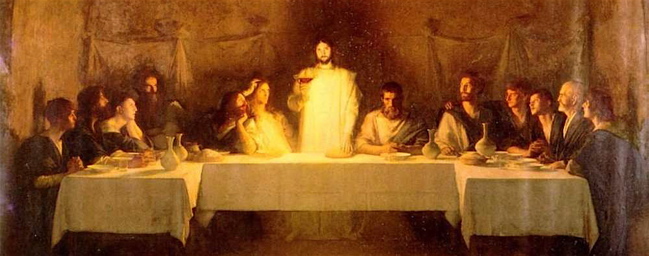
“One of you will betray me.” The question hangs in the air.
The followers look at each other. And back at Jesus.
This week, I will share a few voices from that evening as the disciples
ponder this alarming accusation.

SIMON

This is a meal of liberation, and he speaks of a betrayer? What is wrong, my Lord?
Here I am, your Simon. You are the one who bids us to joy and laughter. Such long faces!
This sobriety does not befit the one who gives us mirth and life. Being with you is just so much fun.

Before you, I never knew such exuberance and high spirits. My foot was heavy, weighed down with many cares. Now, I run lightly. I laugh until my sides ache. I no longer worry about what others think of me. You cut loose all the voices within that condemned and taunted me. Fear vanished. Every day is a new adventure. I once thought happiness was a dream known only to children. I hoped only for a good living as I grew old. Now, I have grown younger in your presence, bolder, and full of joy. Sometimes, I just can’t stand so much happiness and weep for its sheer beauty.
But, my Lord, come smile, lift the cup. My brothers, he must be joking.

JAMES, The LESSER

The wind blows through the open window.
Somewhere, an animal screams.
A wolf leaps for the lamb’s throat.
The hawk soars across the moon’s passive face.

So he is betrayed. Will the Earth note it? Care?
Will I, James?
Betrayal is the way of things.
Whoever said the universe is trustworthy?
Thieves and murderers wait by the roadside.
Lovers are unfaithful. Children deceitful.
I should have known it would come to this.
For a few moments, I hoped he could change things,
had begun to believe there was safety in creation.

Yet, look at me, a creature myself.
How many times have I been false?
How many times have I sold out, given up, turned
away in anger, disappointment, or jealousy, and given
those around me to the powers of death,
the beasts and executioners who reside in me?

I am numb.

Oh Christ, don’t let them kill you!
I came with you, believed
staked all I had on you.
Lord, it is I who am betrayed!

PHILIP

He sits there so calmly with his arms outstretched. I hurt to see the pain in his face. His palm is open, accepting. There is no anger, no bitterness, no revenge, no resistance. He is like a lamb going to slaughter. I see only great sorrow.

What kind of man would announce to his betrayer the knowledge of his treachery? He loses all advantage. He may as well open his chest to the knife.
What kind of man is he? How is it that after spending so many days and nights together, he is still somehow a stranger? Despite his commonness and accessibility, he remains mysterious, ineffable.

What am I doing here? How did I get mixed up with these people? I am in over my head. I never thought it would go this far, get this out of hand. Someone is apt to get killed. I want to run back down the roads and valleys, run through the crowds, the villages, along the shores. I want to run back in time and space to where the word betrayer does not hang like a noose over this table.

Is It I, Lord first appeared in 1986 in the Presbyterian Survey.

This liturgical drama was initially commissioned by Westminster Presbyterian Church in Topeka, KS

Copyright 1994 Loretta Ross. All rights reserved.

Lent 2   The Body of Our Humiliation 

For many live as enemies of the cross of Christ; I have often told you of them, and now I tell you even with tears. Their end is destruction, their god is the belly, and their glory is in their shame; their minds are set on earthly things.But our citizenship is in heaven. It is from there that we are expecting a Savior, the Lord Jesus Christ. He will transform the body of our humiliation that it may be conformed to the body of his glory by the power that also enables him to make all things subject to himself. Philippians 3: 19-4-1 

One of the most painful experiences a person may encounter is humiliation. We do all we can to escape the possibility, let alone actual experiences of humiliation. You may remember a few occasions of humiliation and shame. These memories stick around.  Humiliation may be a moment of embarrassment or deeply soul crushing. 

Humiliation assaults our sense of worth and dignity. It signals the limbic part of our brain, which is self-protecting, and tells us to fight, flee, or freeze in the face of our disgrace.  

Dignity violations leave deep wounds. The scars of ridicule and scorn may disfigure us. Jesus’s choice to endure such humiliation is remarkable. He chose the most painful path, which appeared to be the total failure of his mission, to show his followers that humiliation is not the last word.  

Our culture has become a global forum of blaming and humiliating each other. We are hardwired to retaliate to such indignities. We have little appreciation of the depth and breadth and tender goodness of the human heart. So many times, it has been scorned, mocked, beaten and tossed in an alley. 

We seek success, wins, the “Greatest of All Time,” to be the best and the first. We do all we can to keep our failures hidden in filtered selfies and struggle to find our sense of self-worth.   

Who do we think we are fooling? 

Our egocentric experience is only a small slice of reality. This is why we need each other and to learn from each other. “Alongside the protection reaction of fight or flight, we are also hardwired for primal empathy, an emotional connection that fosters openness to others and is needed to take in each other’s experiences at the core of healthy social development.
Donna Hicks, Dignity – Its Essential Role in Resolving Conflict, p 23. 

Humiliation both challenges our innate dignity and opens a door to humility.  In the painful sacrifice of our egos, we are liberated from our pride and desperate need for esteem, control and fame. Here in the heart of our disgrace – we may discover new freedom to be simply ourselves, our raggedy, messed up, imperfect, beautiful selves. Here,as Paul tells the Philippians, our body of humiliation is conformed to the glory in the body of Christ. 

In your midst I will leave a humble and lowly people; those who remain will seek their refuge inYahweh. Zephaniah 3:12

BREAKING NEWS

The first week of Lent begins with a Liar

The Father of Lies has been given a holiday of his own! Long neglected and maligned, The Great Deceiver will also be honored with a month of remembrance and celebration of the overlooked history of liars. The Fraudster, also known as Satan, the Devil, the Accuser, Beelzebub, and Lucifer, has been treated unfairly and harassed by so-called Biblical scholars and the media.

Chaos, Contempt and Control have been hired to plan the special events. Falsehood, Fabrication and Deception will be catering the food. The keynote speakers, Slurs, Smears, and Slanders will offer tips for the latest frauds, cons, and embezzlement schemes.

If they show up at all,  (We all know how they are.) Fibs, Duplicity, and Menace will provide musical entertainment. And the eau de parfum, Essence of Arrogance will be infused throughout the venue to inflate further the egos of all who attend!

Small Print:
Of course, the event will be prepared for the enemy: Mercy, Love, and Compassion. We expect them to be in them to be in the streets with their signs: Integrity for Americans. Tell the Truth. They will have soap and water to wash out the mouths of any repentant liars and put out any fires in the liars ‘ pants.

The devil, that proud spirit can’t bear to be mocked. – Martin Luther

After his baptism, Jesus spends forty days in the wilderness. Here the Devil meets Jesus and tempts him. Each temptation is a bid from Satan for Jesus to grasp for power, control, and saving his own skin.(Luke 4: 1-13) Temptation targets our egos, which want to know everything, control everything, and be right. In the wilderness scene with the Father of Lies, Jesus demonstrates that any power he might have is not used to show off, control others, line his pockets with gold, or use force.

Because you compete with others
Others will compete with you. Tao De Ching

How might my ego get in the way of sharing the gifts God has given to me?
What tempts me to lie or misuse the gifts I have been given?

See you next week! Love and peace, Loretta

Sighs Too Deep

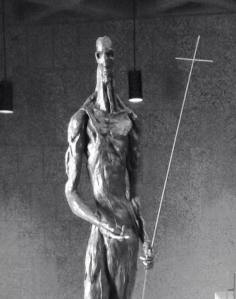
You have to get past the miraculous son of Zechariah to get inside. The tall, gaunt figure looks down on you from his hollow eyes as you enter  St. John’s Abbey Church in Collegeville, Mn. Lean, muscular, and Spirit-haunted, the Baptizer brandishes a cross and is scary as all get out. He gestures with a gnarled hand toward the Baptismal Font.

John Baptist 4

If you think you are coming in here, wash up first. Repent!
Go under the flood. Die before you die.

The old priest, John’s father, did not believe the angel who showed up when Zechariah entered the Holy of Holies to burn the incense. The lot had fallen to him to step into the place so sacred that one might easily be consumed by the Furnace of Love. Gabriel’s wings fanned the smoke. His voice penetrated the old man’s mind, that rickety cupboard, where he kept jars of truth, possibility, impossibility,  reason, and a near empty cruse of hope.

“How shall I know this? For I am an old man, and my wife is advanced in years,” said Zechariah, scratching his head. His barren, wizened, Elizabeth have a child? The priest quibbled, doubted, split hairs, as those trained as religious professionals often do.

So Gabriel tied his tongue to the floor of his mouth and sewed his lips shut. This fellow could not be trusted with the truth of God. Hard to say how he might mess up the whole plan of salvation.

Messengers from God often do this to the people they visit. They press the mute button and enforce silence for a while.

Six months after Elizabeth conceives, Gabriel makes an announcement even more incredible to Mary. She asks one question, then tells Gabriel okay, whatever you say. I am God’s servant. Pondering the angel’s words, she holds her tongue, and departs to speak with her old cousin, Elizabeth. Joseph is left to get the news on his own through a dream. Mary remains with her cousin for three months in the hill country of Judah.

Advent invites us to withdraw and close the door to distractions and doubts. Will you allow yourself to be bound by silence? This ability to tie up all the strife, hunger, gossip, and turbulence, and keep one’s mouth shut is required of servants of God. One needs to allow new growth, ideas, projects and seeds to incubate and ripen. Talk may dissipate the necessary accumulation of energy and unconscious incubation to bring actions to maturity and achieve God’s fullest purpose and intent for our lives and work.

One must be discerning about to whom and when to speak of the visions we see, the words we hear, and what grows within us in order to protect both ourselves and the promise within us from exposure to threats to its development.

Do you have a bright idea or a promise developing within you?
Don’t prematurely tweet your transformation.

There will be plenty of time to raise a ruckus after the truth gets out, as old Zechariah soon found, when the Holy Spirit opened his mouth and he burst into song for his son:

… and you, child, will be called the prophet
of the Most High;
for you go before the Lord to prepare his way
to give knowledge of salvation to his people
in the forgiveness of their sins,
through the tender mercy of our God,
when the day shall dawn upon us from on high
to give light to those who sit in darkness
and in the shadow of death,
to guide our feet in the way of peace. Luke 1: 67-7

Likewise, the Spirit helps us in our weakness;
for we do not know how to pray as we ought,
but that very Spirit intercedes with sighs too deep for words. Romans 8: 26

Subscribe to Holy Ground here. And it makes a great Christmas gift for a friend!

Donate or Pay for Services 

Tax Deductible Donation to The Sanctuary Fund

More information about the The Sanctuary Foundation for Prayer

Love – in Small Doses for the Sin Sick Soul #8


And we are put on earth a little space, 

That we may learn to bear the beams of love.
William Blake

 A page from a 14th century German Haggadah

Pasach – Passage, No. 1

After we were passed over
we passed over.

When the waters split
drew back
a shimmering wall
seething strength, waves
smacking, spitting above us

some of us hesitated
to weigh the odds
consider and debate.
Was it more magic?
Who was this son of Abraham
with his stave of almond wood?

Crippled from scrabbling straw in the fields
mixing mortar for the man
meeting his quotas
we dawdled on the shore.

Others, children especially, ran out
skipping over the coral
through the sea grass
past the shipwrecks
and green turtles
raising their mottled beaks, amazed.

We heard hooves pounding,
shouts, thunder of chariot wheels.
Death before, death behind.
Better to drown
than die by the hands of those bastards.

The kids, though,
did not flinch,
tossing up fistfuls of sand,
diamonds in the sun,
playing on the seabed
like shrimp.

We hobbled over,
leaning on each other,
fearful, fretting.
Seems when a soul is crushed
it takes a long time to rinse out the slave.

Though at Pasach, when we gathered,
it would all come back.
We would shake off another chain
see more clearly
sip liberty
like wine.

Pasach – Passage,  No. 2

The night we celebrated Pesach –
what did he say, what did he mean
leaving and that we knew
the way to where he was going?

I was trying to work it
out when another sea split open
not waters humping up like steel cliffs
but a great scythe slashing
through the middle of everything
and him falling, tumbling down into the rift.

A passage
where there had been none before
death leering from either side.

I heard the soldiers coming
swords clanking at their sides.
In the acrid air lungs burned, eyes stung
flames draped from clouds.

And while they dragged him off
blood blossomed
on the vast lintel and door posts
of the writhing world
and dribbled down
like tears.

*Hebrew (Pasach) also spelled Pascha for Passover or passage. The verbal form means to protect and to have compassion as well as pass over. Exodus 12 -14; John 14-19


______________________________

Note to readers:  This blog is part of a series of Lenten “short takes” on the themes of lent, which follow more or less the lectionary Scripture lessons for this season. Like a note you find tucked under the bark of a tree, a lozenge to let melt in your mouth, an amulet to wear around your neck, I hope these little reflections may hold a small dose of truth or comfort  or challenge for your life on the way to Easter.

In the abundance of words which inundate us daily, it is easy for the message of redemption to be buried under the latest disaster, outrage or scandal. Likewise the familiar stories and passages of lent may grow dull and trite to ears and hearts already stuffed with words. 

I have noticed in my work as spiritual director that it is hard for many of us to take in the goodness and grace, as well as the challenge of the story of Jesus and God’s redeeming love. Perhaps we need to titrate the gospel. Sometimes a well- timed, tiny dose, carefully administered, may be what the Physician orders for our healing. And so slowly we build up our tolerance for love and more and more joy finds the faith in us through which to invade our being.

Dose titration:  adjustment of the dose until the medication
has achieved the desired effect

Love – in Small Doses for the Sin Sick Soul #7


 And we are put on earth a little space,
That we may learn to bear the beams of love.
– William Blake

 Palm Fanfare

Passion Sunday

They fought on the way to church
this time ugly.  

Was it the tone he took,
or her throbbing resentment
that kicked in the door
like a demon repo man
turning up to repossess their souls?  

Mud rushed in
a roaring sludge
of sorrows, lashes
rebukes, scorn
bitterness, betrayal
heaping up
burying the light.  

The back seat was silent.  

In the sanctuary they stood mute
in the crowd of flourished palms
hosannas fluttering like petals
watching their kids in the happy throng
pass by with pain in their eyes.  

Across town the detective
poured herself another cup of coffee
scanned reports from last night
homicide, hit and run
three break-ins, some domestics.  

Robert rolled over,
knees up to his chin, gripping the covers.
He hurt so bad. He couldn’t get those feelings
for Andy to go away, nor the horror
in the cafeteria when they snickered and laughed.  

Lester sat at his kitchen table, thumbing through his Bible.
He got the diagnosis the day before.  
The words didn’t make sense.
He looked around.
Everything seemed tilted sideways.
Does cancer cause this? he wondered.  

Alice in a back pew waved her palm like a white flag.
During the week she goes into a house full of roaches
and mice to treat the baby of a twelve year old girl.
People so desperate, so much pain. Plse pray,
she texts her friend and waves harder,
counting on this Jesus to make a difference.  

Nations thrash and groan. Politicians rage.
The bomb ticks in the parked car.
Seas haul homes and lives
out to watery oblivion.  

Some peasant playing a fool on a donkey
rides into town saying he is the King.
He is going to turn things around,
unseat the emperors,
release the grasp of greed,
cure the lust for money,
and heal the virus.
Sure enough the fool gets himself killed.  

Everyone is looking for a goat to carry off
that mudslide of shame, regret, and responsibility.

For a while we can pimp up the peasant,
wave some foliage, call him king
as the bullies and the haters
the fear mongers and the betrayers 
the self- righteous and the proud hitch
a ride on his back like fleas.
Then we can go home, relax
watch the ball game and root for our team.  

But the peasant with pain in his eyes
on the donkey has his own agenda.  

I am not your Palm Sunday ornament,
a wonder super hero
your ticket to respectability
a card to play in your political games.  

Look again. I am you.
I am you riding high into town.
I am you awash in disgrace and humiliation.
I am you having done the unthinkable
and there is no way you can repair the damage you caused.  

I am you, holiness, hawking yourselves day and night
in the holy places you have turned into markets.
I am you, holiness, stuck
right down in the middle of a profane life in a profane world.
I am you, holiness, betrayed by a sneer, or the grab for influence.
I am you, holiness, trampled on and defiled.  

Will you duck out now
skip those other services
and only show up year after year
in your new clothes
to see the lilies and hear the music?  

Or will you come back
to listen to my commandment 
to let me wash your feet
and drink to a new covenant?  
Will you stay awake with me
and with yourself one hour in our suffering?
Will you say, not my will, but thine?  

Will you face your betrayer, see what you need to see 
become truth in the face of authority?
Will you strip off all your disguises, costumes
facelifts, masks, and self-deceit?
Will you hand over your assets for others to toss the dice?  

Will you watch at our dying?
Will you thirst?
Will you feel your own pain?
Will you cry out why has God forsaken us?  

Will you rest in the tomb
that silent womb of mystery
dead with me?  

Will you come early on the third day?


Lily

Lily (Photo credit: amitkotwal)

______________________________

Note to readers:  This blog is part of a series of Lenten “short takes” on the themes of lent, which follow more or less the lectionary Scripture lessons for this season. Like a note you find tucked under the bark of a tree, a lozenge to let melt in your mouth, an amulet to wear around your neck, I hope these little reflections may hold a small dose of truth or comfort  or challenge for your life on the way to Easter.

In the abundance of words which inundate us daily, it is easy for the message of redemption to be buried under the latest disaster, outrage or scandal. Likewise the familiar stories and passages of lent may grow dull and trite to ears and hearts already stuffed with words. 

I have noticed in my work as spiritual director that it is hard for many of us to take in the goodness and grace, as well as the challenge of the story of Jesus and God’s redeeming love. Perhaps we need to titrate the gospel. Sometimes a well- timed, tiny dose, carefully administered, may be what the Physician orders for our healing. And so slowly we build up our tolerance for love and more and more joy finds the faith in us through which to invade our being.

Dose titration:  adjustment of the dose until the medication
has achieved the desired effect

Love – in Small Doses for the Sin Sick Soul #6


And we are put on earth a little space, 

That we may learn to bear the beams of love.
William Blake

Thin-Ice


Thin Ice

The interviewer probes,

so do you think the economy will get better?

Fear leaps up from the gut


climbs to her throat


voice shakes, melts into tears.


Fifty two,


back in her bedroom


at mom and dad’s

turning over at night

she sees the puzzles, rock collection,

Girl Scout Handbook

stacked on the shelf beneath the window,

teeters between now and then

on the brink

of circumstances beyond her  control.

Better to practice walking on thin ice 

before we find ourselves there.

How does one learn 
to trust

your life will bear your weight?

The grey sheet shrinks from the shore.

Dark water laps milkweed stubble,

slopping over hoof-pocked mud.

Could she step over the translucent border

to opaque surface a few feet further out?

Oh to put her future in a box,

tie it with a pretty bow

and place it next to high school

yearbooks on the shelf.

The fortune tellers circle,

bracelets jangling, bright skirts swinging,

leaning over their tea leaves crying out:

Alzheimer’s, incontinence, poverty, ruin!

After millions heard her cry on public radio,

after her immersion into choking humiliation

possibility awoke.

She saw what they had seen

and loved it now.

Come, she said,  as she took her nakedness

into her arms like a lost child,

a beautiful melody.

I will teach you how to walk on thin ice.

Let us go to the spring woods

and learn to pull uncertainty and loss 

to our chins like a blanket of oak leaves,

sweet pine needles, mushrooms,

and the milky blooms of May apples.

All the best and most beautiful things

are willing to go under at any moment

and take us with them into the dark

to be carried back again,

laughing sheaves of light.

Child of my heart, listen.

Don’t turn away from my face.

Nothing perishes

when born by the arms of grace.

May apple flower

Don’t ponder ancient history
Look! I am doing a new thing. Isaiah 43: 14-21

Restore our fortunes, O Lord,
like the watercourses in the Negeb.
May those who sow in tears
reap with shouts of joy.
Those who go out weeping,
bearing the seed for sowing,
shall come home with shouts of joy,
carrying their sheaves. Psalm 126: 4-6 NRSV

______________________________

Note to readers:  This blog is part of a series of Lenten “short takes” on the themes of lent, which follow more or less the lectionary Scripture lessons for this season. Like a note you find tucked under the bark of a tree, a lozenge to let melt in your mouth, an amulet to wear around your neck, I hope these little reflections may hold a small dose of truth or comfort  or challenge for your life on the way to Easter.

In the abundance of words which inundate us daily, it is easy for the message of redemption to be buried under the latest disaster, outrage or scandal. Likewise the familiar stories and passages of lent may grow dull and trite to ears and hearts already stuffed with words. 

I have noticed in my work as spiritual director that it is hard for many of us to take in the goodness and grace, as well as the challenge of the story of Jesus and God’s redeeming love. Perhaps we need to titrate the gospel. Sometimes a well- timed, tiny dose, carefully administered, may be what the Physician orders for our healing. And so slowly we build up our tolerance for love and more and more joy finds the faith in us through which to invade our being.

Dose titration:  adjustment of the dose until the medication
has achieved the desired effect

Faith and Fear

A two part series on giving birthddddxxxxx CDC zf
to redemption in your time and place.

Part Two – Conceiving the Inconceivable

A-annuncia_Fra_Angelico

Mary takes hold of,
seizes
the inconceivable.

The purity and faith of the virgin
penetrate the illusion and falsity
that surround her,
and she offers her whole being –

intellect, imagination, heart, and body-

to deliver redemption into her world.

She claims her power
as the mother of redemption
and joins with God in a dance of saving love.

That same dance has the power to transform Cousin Carl in his fake angel costume and Aunt Edith with her hair in curlers into the heavenly hosts,

and you and me into bearers of Christ.

Do you see the mutuality in this exchange of love
between a mortal and the Holy One?

The prophet Zephaniah calls Israel to rejoice
because God is in her midst;
he further proclaims that this God in her midst is rejoicing over her with gladness (3: 14-18).

Israel rejoices over God.
God rejoices over Israel.
God chooses Mary.
Mary chooses God.
We long for peace and wholeness.
God longs to give us peace and wholeness.

What prevents more of this dancing in our lives and world?
A significant impediment must be our fear.

In the story of Christ’s birth several of the players are exhorted not to fear – Zechariah, Mary, Joseph, the shepherds. The gospel writers over twenty times show Jesus admonishing others not to fear.

Fear may be seen as one of the indicators of the presence of God. Fear of God, which is the human response to God’s overpowering majesty, glory, and power, is an appropriate and desired reaction. In contrast, fear of the world, fear of self and others is seen as counterproductive to God’s action in our lives.

Beatrice Bruteau writes of faith as an attitude of the consciousness that is participating in divine activity, God’s creative work in the world. Faith is “the disposition which Jesus declared to be a condition for the realization of his works. The doer of the work had to have faith, and the receiver of the work had to have faith.”

Brutear considers faith as “not only the consent of the intellect to the reality of something that does not appear immediately to the sense, but it is the consent of the imagination and the affective faculties attached to the imagination.”
– Beatrice Bruteau, Prayer: Insight and Manifestation, in Contemplative Review, Fall 1983

Thus, the new thing God is doing enters this world –

as we agree something better is possible,

as we are able to vividly envision the new thing,

as we feel in our hearts the joy and delight of that yet unborn promise,

as we persevere in that vision in the face of fear and threats,

and as we live expectantly as if the vision is accomplished.

Fear keeps us stuck in the present reality, constricted and paralyzed by the very thing God is setting about to redeem. Fear distracts us from watching and waiting eagerly for the in breaking of God’s promises into the world. Fear turns our eyes away from the coming bridegroom to become mesmerized by the horror of a realm that does not know God.

Fear, then may be seen as faith in your enemy.

The danger, as Ian Matthews writes, “is of folding in on oneself. Pain does that, and the temptation is to look for a both/and:

both staying with the new setting, and feeding on nostalgia for the old one.

Unhappily this both/and tends to backfire. We cannot both indulge self-pity and make the most of a new situation.”
– Ian Matthews, The Impact of God – Soundings from St. John of the Cross

Simply put, our faith, as does Mary’s consent, allows Christ to enter the world.

Think for a moment.
How do you feel when someone expresses faith in you?
When another trusts you and has faith in your gifts, are you not enlarged, empowered, and more willing to offer your gifts?

Perhaps the reason why Jesus urges his followers to have faith, why he shakes his head in dismay at the disciples doubts and fear, is that their faith in Jesus empowered Jesus.

So, as Annie Dillard writes: “Faith, crucially, is not assenting intellectually to a series of doctrinal propositions; it is living in conscious and rededicated relationship with God.” Annie Dillard, For the Time Being.

Further, faith is not a vague and wispy sense that God is out there somewhere looking on us with a benevolent eye, nor is it an exercise of philosophical proofs.

Faith is the means by which God enters and changes our reality.

Faith is an interactive experience, a dance of mutual love between a mortal and God in which both parties are needed, affected, and changed for the benefit of the whole world.

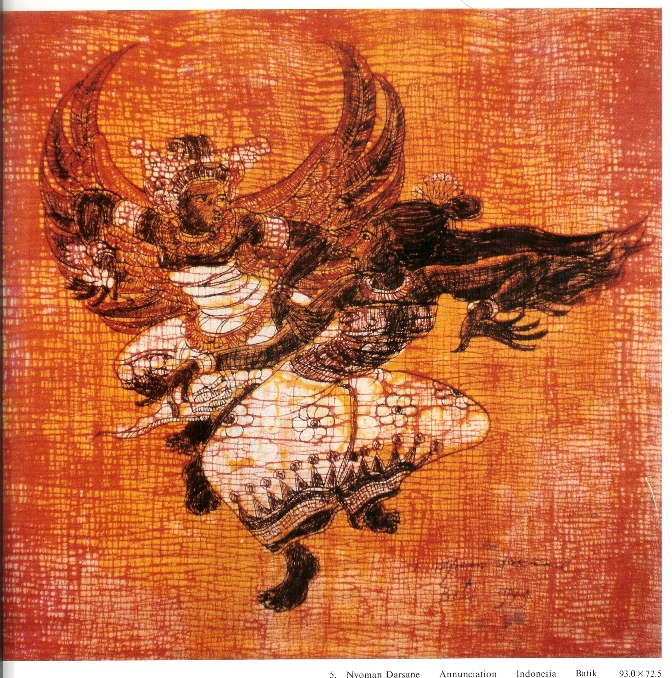
Annunciation, Nvoman Darsane

Annunciation, Nvoman Darsane

Rejoice, Daughter Zion! Shout, Israel!
Rejoice and exult with all your heart,
Daughter Jerusalem.

The Lord has removed your judgment;
he has turned away your enemy.
The Lord, the king of Israel, is in your midst;
you will no longer fear evil.
On that day, it will be said to Jerusalem:
Don’t fear, Zion.
Don’t let your hands fall.
The Lord your God is in your midst—a warrior bringing victory.
He will create calm with his love;
he will rejoice over you with singing.
Zephaniah 3:14-18 (CEB)

Adapted from my book, Letters from the Holy Ground – Seeing God Where You Are, Chapter 38

It Begins with a Howl – Redux

shepherds 001blue

It begins with a howl

a muffled sob at midnight
a “Help me!” filling the dark alley
with terror
a fist banging on the door
a blank stare and a hand clenching
a ball of tissue
a sudden lurch and collapse, face down in the open field.

This is how it begins, what we call Christmas.
Salvation is summoned by its negation.

The raw expression of the creation’s need calls out its savior –

the scream
that rises from the soul shattering collision

of what is with what should be.

Christmas begins when God hears

And God heard the voice of the boy… Genesis 21:17

I have heard their cry on account of their taskmasters. Exodus 3:7

Do not be afraid, Zechariah, for your prayer has been heard. Luke 1:13

Christmas begins when God sees

 I have observed the misery of my people who are in Egypt.  Exodus 3:7

My tears will flow without ceasing, without respite until the Lord from heaven looks down and sees. Lamentations 3: 49-50

She answered God by name, praying to the God who spoke to her, “You’re the God who sees me!”

“Yes, he saw me; then I saw him!”
That’s how the desert spring got named God-Alive-Sees-Me Spring. Genesis 16: 13-14

Christmas begins when the earth turns,
writhes, and convulses in its lamentation.

When the protest of the human heart joins its sorrow
with the heart of the One acquainted with grief,

Holiness steps out of the forest
into the clearing

“Here,” bending over our
our small shaking bodies
our hopeless cynicism
our little hands grasping at straws

“Here is my answer,” Holiness says,
and places in those hands
a child
wet and wild.

“And the name of the child shall be Love.”

This post is an edited version of a post which was first published
November 29, 1011.

This post is an edited version of a post which was first published
November 29, 1011.

Morning News Pre-Empted by Older Story

Today while listening to the morning news, I heard an old hymn edging its way between the story on the election and the update on survivors of the hurricane.

I will tell you what it was in a minute, but first I offer you my Op-Ed.

I am not counting on my vote getting the leadership I want us to have. Nor am I counting on getting my views on our responsibility to the suffering of others to prevail.

What I count on and lay down my life for, is the goodness of a Reality larger than politics, economics, global warming, war, and corporate interests. I am putting my support on a Being greater and more graceful than the tiny brains of human beings. My candidate is the invincible  Substance of things hoped for, which sees beyond what is, yet dwells in the midst of our chaos and sings in the human heart.

Under my fears I can hear the wondrous freedom song that nothing can separate us from the love of God, not human sin, stupidity, or weakness, not death or life, not angels or rulers, not present things or future things, not powers or height or depth, or any other thing that is created. (Romans 8: 38-39 CEV)

The Holy One dwells as ground beneath our feet in astonishing humility – wiser, brighter, and kinder than we are – who will hold us up and see us through.

In this season of distress, polarities, and uncertainty, I am banking on the hidden connections among our species, those channels of mercy that run deeper than ideologies and seep into the crevices of our vulnerability, which is both our great flaw and our greater glory, penetrating down into the solid rock of compassion, imagination, and strength.

The world does not need our anger, our outrage, our fear, or our grasping need to get others to believe as we do. I believe the world needs our humility and our faith.

For my part I can think of nothing better to offer this little piece of history than these simple gifts of the soul.

Now, here is the hymn which intruded into my morning news:

On Christ the solid Rock I stand,
All other ground is sinking sand;
All other ground is sinking sand.
                                          Edward Mote