Category Archives: Christianity

Where Miracles Occur

Bristlecone Pines, California

The tension in my shoulders is melting. The tightness and ache in my jaw and throat are releasing. The constant, exhausting, mental jabber is growing silent.  The resolute soldiering on, pushing forward without awareness, without seeing anything, but a goal which constantly recedes over the horizon, is giving way to being    here      now.

The tunnel vision squint and laser focus are opening and broadening to a wide spacious plain that keeps revealing more and more. Reality unfolds like an undulating wave continuously turning up complexities, beauties, grace, and both harsh and comforting aspects of what is really going on.

I have been decelerating and decompressing over the past several weeks.  This process is not over, for it is the work of a lifetime. I need more time to shed the brain debris and external and internal clutter. I need to continue to tame the habit of acceleration, and restrain my inner harpy, that merciless harridan of self aggrandizement.

Though I have tried to practice and teach this for years, I feel like a rank beginner. And, as is the way of the Spirit, I am being shown how far I have to go. I am watching my many-faceted resistance, as I begin the slow, groaning, screeching grind to a halt. For ironically, in order to go further on this journey, I have to stop.

Sabbath means, literally, to stop. I am aiming for a Sabbath life, a life lived contemplatively, steeped in the awareness of the presence of the Holy, which initiates, and infuses my work and play. I like the broader definition of Sabbath, which Donna Schaper offers:

Sabbath sense is anything that makes spacious what is cramped. That makes large out of small, simple out of complex, choice out of obligation. Sabbath sense is anything that reconnects the necessities of drudgery to the marvelous uselessness of beauty. Sabbath sense is acknowledgment of the presence of Spirit in the petty and the profound.

In this time of beginning and transition, of halting and rest, I have discovered a different kind of urgency, than the urgency of schedule, production, and accomplishment. This is the urgency of a compass, a magnet, an urgency so primal it is like breath itself. This is the urgent love of the Maker of All honing into each particle of creation, boring into us and drawing us inexorably to itself.

"Tarfala Valley"

I have always been attracted to sparse, barren, open spaces – the high alpine tundra, and the edges of the tree line. There for over five thousand years the bent and twisted Bristlecone Pines dance their gnarled tango with the howling storms and eye the prize for the oldest continuous living residents on this planet. I look at maps for the wind-scoured boulder fields, the isolated islands, and the endless expanse of ice sheets at the poles. These places both fascinate, and frighten the wits out of me.

In a lovely blog, Being Poetry, I came across this quote from poet William Stafford:

Each poem is a miracle that has been invited to happen. I must be willingly fallible in order to deserve a place in the realm where miracles occur. 


Stafford, pacifist and formed in The Church of the Brethren, grew up in the semi arid high plains of western Kansas. He was also formed by those windswept plains, where you can see for miles. In these recent weeks I have been unwillingly confronted with my fallibility, my utter inability to live and be all that I desire. I hear Stafford advising, “Forget about overcoming anything. Embrace it all and live honestly from it.”

So I am heading out to the edges of my infallibility, that terrifying point where I and all I can think and do and figure out and hum to myself ends, and God begins.

Today I say that to live a life of prayer, I must go out to the edges of myself and my security. I must go beyond my ego to the outer banks, to my own fallibility, where the edges of the sea of God wash over my toes and beg me to fling myself into that deep Immensity.

I do not want to be safe. I do not want any part of a faith or a God or a religion that is safe. I want to stand in the barren field of the world, strewn with boulders, with only our wounds and fallibility, and without a prayer, a blog, a book, or a penny in my pocket, but the brooding mercy of God.

It is not a comfortable, quiet life of ease that God is calling me to, here in my retirement. It is to a life of surrendered love, where my meat and drink, and every breath are drawn from the grace of God. I am fearfully and gratefully being towed through fallibility to a place in the realm where miracles occur.

You come too.

English: Bristlecone Pines on a spur ridge bel...

The Star Stopped – Part Two

Joy: Our Chief and Highest End

When they had heard the king, they set out;
and there, ahead of them went the star that they had seen at its rising in the east, until it stopped over the place where the child was.
When they saw that the star had stopped, they were overwhelmed with joy. Matthew 2:9-10

Once there was a man who played with Jesus a kind of peek-a-boo and hide and seek, asking to see him while he walked.  I go now where the man prayed and Jesus is everywhere, sitting in the trees, hanging upside down from the hawk’s nest, swinging his arms up ahead along the cow path, turning in wide circles in the heavens, glinting under the silver wings of geese.

“Jesus, get out of here,” I say.  “I have work to do, prayers to pray, fears to nurture, pain to bear, miles to go before I sleep.”

He just grins, riding down the back of the willow leaf. You bet,” he says, “who do you think is in charge here anyway? I came that you might have life abundant.”

“Yes, but there is so much suffering and sorrow in the world. I have survivor’s guilt.”

“Deal with it, sweetheart, joy is your burden to bear.”  Then quoting scripture, “‘Do not be like a horse or a mule without understanding, who must be curbed with bit and bridle, or else they will not stay near you.’  (Psalm 32:9)  Daughter, you are forgiven for being happier than some of the others.  In your joy is my joy made complete.”

____________

What is the chief and highest end of humankind?” asks the Larger Catechism.
Humankind’s chief and highest end is to glorify God and to fully enjoy God.

A friend of mine died after a long debilitating illness. Before he died he told me, “Life is funny. You know, I used to say life is messy. Now I say life is funny. God must be laughing his head off at us, saying, ‘Don’t they get it?’ I have no complaints. Life has been very good to me. I just try to enjoy.”

To enjoy:  to put into a state of or to be in joy – to indwell rejoicing. Joy is the emotion provoked by well-being, success, or possessing what one desires.

How strange that little teaching in the church has to do with helping us to be faithful to our highest end. We know how to read and interpret scripture. We understand the dynamics of church growth. We can conduct things decently and in order. We can do mission. We are even beginning to understand our spiritual life and prayer. But how many of us can state precisely how it is that we glorify and enjoy God as individuals and as a community of faith? When many of us start to enjoy we feel guilty. To claim that anything I might do actually glorifies God may sound arrogant. To seek enjoyment of God seems hedonistic and wrong.


It takes courage to risk joy. The older we get, the more we know of the ravages of life and sin, and the woeful limitations of the flesh. My dying friend, weak and suffering, says, “I just try to enjoy.” Perhaps that is when joy is born the truest, when we are firmly fixed in the limits of humanity, held by the teeth of our extremity with no illusions. Maybe you won’t get better. Maybe your friend will die. Maybe your heart will be broken. Maybe the divorce will be final. Maybe the worse that can happen will happen.

Now here, just when you thought it was all over

here

stop

where the star has stopped and let joy in.

It will take a mile if you give it an inch. Watch how it eases a hand and foot through the crack – pushing in a shoulder and hip, and flinging the door wide open on bliss.

What did you think would make the star stop, if not the sad song of mortal need?

A lot depends on the way the yellow willow leaf swims like a slim minnow downstream to rest in the musty shallows of earth.

Now it turns, spins in circles, now it dips and glides, now stops, still in the air, then drops like a sigh.

A lot depends on such surrender, but even more depends on someone noticing.

Jesus, help us to love you
more than the search for you.
Give us hearts of merriment and gratitude.
Teach us to tolerate goodness, to stable delight.

And Merciful Savior of loss and defeat,
bestow upon us the wit to trust
and to consent to contentment
that your joy and our joy be made complete.

Mirable Dictu (Wonderful to Behold) Harvey Bonner


Excerpted and adapted from Letters from the Holy Ground – Seeing God Where You Are, Loretta Ross (Gotta), Sheed & Ward, 2000, chapter 23.

Cover of "Letters from the Holy Ground: S...

Cover via Amazon

The Star Stopped – Part One

Joy: Our Chief and Highest End

The Magi Journeying

When they had heard the king, they set out;
and there, ahead of them went the star that they had seen at its rising in the east, until it stopped over the place where the child was.
When they saw that the star had stopped, they were overwhelmed with joy. Matthew 2:9-10

The star stopped.

Did they slam into one another like dominoes – camels, gifts, magi all in a scrambled pile before the manger?

They had been seeking joy for so long; and they knew more about traveling than arriving, more about need, than about fulfillment.

The star stopped.

The momentum of the journey, the habit of search, sent us lurching forward even as we beheld the prize. Like ones on a long auto trip riding over the flat stretch of prairie, we lie still at night in our beds feeling ourselves hurtling along phantom highways, our flesh imprinted to motion.

So we arrive at our destination, yet act as if we are still on the way. We shuffle on unsteady legs to the doorway where the light glows, the breath of cattle steams, and something makes a low choking coo. We are overwhelmed with joy, a sublime apprehension of the beauty and perfection of what lies before us under the stars and that we need travel no longer.

It doesn’t get any better than this:

the glad dog bounding gleefully after the yellow cat in the sun

the clutter in the child’s room – a still swirl of hair brushes, dirty socks, ribbons, Tootsie Rolls, and crayons

you and your friend laughing over lunch in the cozy diner

your own wrinkled hand and all it has grasped and caressed, pushed, smoothed and manipulated


You think you need to get busy. Accomplish something today. Wild-eyed John in his camel’s hair is out in the pasture yelling to get with it. “Bear fruit worthy of repentance, you brood of vipers,” he shouts. There is so much to do, so far to go. You think this or that thing has to be done. You think joy is up ahead, when you have reached some goal, satisfied that hunger.

We ought not to pray for things, as to pray to live as though we had the things we pray for. We ought to discover just what it is we think these things will give us, to consider carefully what is the sub text of our desire.

The star stopped.


Did they pile into each other like keystone cops? Was a screeching cosmic brake applied? Or was it so silent as was hardly noticed in the din of rising galaxies and earth teeming with the shrill frenzy of life and death? Perhaps it was a gentle slowing pressure in the heart, an impulse to do something unfamiliar, maybe a sudden press upon the shoulders to bend the knees and halt midway down the stairs absorbed in Joy.


The star stopped and cast its radiance like a neon arrow:

Exit now. Food. Gas. Lodging.

Here this is it. You need go no further.

The star stopped and they were overwhelmed with joy, writes Matthew.Well, how long did that last? How long before they began to fret, to glance anxiously at their watches and their bank balances, and worry about the future, recalling Herod and their disturbing dreams. There would be the trip back home by another road, and how they would explain the dishes still undone, the laundry piled upon the floor, the unpaid bills.How long before they would begin to doubt their own eyes – that they had seen what they had seen? “Perhaps I was mistaken, it all seems so unreal. It was long ago. I was ill, or grieving, young and foolish. We’d better keep on looking, just in case.”


O immaculate tenderness, O sweet hay in the wind, ground of our beseeching, joy of our desiring, we meet and greet you, kneel to adore and leave our gifts, then what? You are too much for us – you in your completeness, sufficiency. We, overwhelmed with joy, cannot bear the light and back out of the radiant stable to return to the familiar world of anxious fear and endless seeking.


The tension of incompletion fuels our lives and impels our action. Consummation is hard for us to take. People shouldn’t be so happy. “I’m sorry mom, but I just can’t keep my smiles down,” confides the eight year old apologetically on her eagerly awaited trip to the ice skating rink.


If we get too satisfied, won’t there be no striving, no invention, no creativity, no urge to improve, discover, move on? Won’t it be boring? Won’t it be dull?


Our capacity for satisfaction is much less than our capacity for hunger.

Who dares to take a vow of stability?
Who dares declare that this is it
this broken down stable of a life
this very life in shambles shelters Joy?

What most characterizes American culture, poet Richard Wilbur has said, “…is not unity, but rather a disjunction and incoherence aggravated by an intolerable rate of change.”

I gaze in bewildered nostalgia at old photographs of myself and loved ones. Motion is an essential property of things. Everything at one level of its being or another is in motion and change.

Is there anything in the universe that is absolutely still? The earth heaves, crumbles, splits, powders. The flesh pulses, sighs, and dies in the slow dance of decay. Electrons careen around nuclei. Five-flavored quarks flash in kinetic quick-step.

A lot depends on the way the willow leaf turns in the wind and curls to a dry crisp under the bird feeder, but even more depends on someone stopping to notice.


Our awareness gives birth to Christ. Seeing that the star has stopped and climbing down from the camel to kneel before the holy child dwelling in the heart of matter with innocence and salvation is what opens the door for God’s entry into our world.

The child yearns to be noticed. The child waits in the crib of creation for us to stop and pick it up and deliver it to the world by virtue of our own seeing.

Christ is born by our consent.
It all depends on someone saying, “Let it be to me according to thy word.”

Then a still small soul magnifies the holy one, and, like a mirrored prism, bends light into multicolored beams of joy.

~ to be continued in next post

Excerpted and adapted from Letters from the Holy Ground – Seeing God Where You Are, Loretta Ross (Gotta), Sheed & Ward, 2000, chapter 23.

There’s a Limit and It’s Good

“There’s a limit!” Mom yells up the stairs. My brother and I are throwing plastic race cars at each other. It is bedtime, and we have been arguing and annoying each other for half an hour. Mom yells again. “If you kids don’t settle down, I am coming up there with a stick with a bee on the end of it.”

That usually did it. The thought of the miraculous power of our mother, who could coax a bee, stinger and all, onto the end of a stick, and stride up the steps, wielding the buzzing weapon, aiming it  at our bottoms,

sobered us right up.

Mom, ninety eight, now lives at Pleasant Manor Care Center and chuckles when I remind of her ability to settle us down.

Her words, there’s a limit, have been coming back to me lately. As I watch the news, listen to the pundits and politicians, and observe my own little world, I hear her saying in that no nonsense way, “There’s a limit!”

There is a limit – to what people can stand, when their boundaries are violated. There is a limit to what people can bear, when their basic needs are unmet, or they are unable to meet them themselves. There is a limit to the foolishness, whining, blaming, and fighting people can take. There is a limit to what the seas, rivers, forests, and the creatures that make their homes in them can survive. There is a limit to human ability to repair, mend, and change. There is a limit to how much suffering, how much trauma a person can endure before he loses hope, meaning, and his mind.

There is a limit. And limits are good.

There are places in creation which dare not be plundered, usurped, or penetrated. These virgin territories of purity and goodness, by definition need to remain separate, apart, and whole in themselves. There is a holiness, which dwells in the core of individuals, communities, and the creation itself. Respect for the singular distinctions of creation lies at the heart of reverence for life itself.


IN PRAISE OF BOUNDARIES

Glory be to God
for bounds and limits.
Thanks be for fences
and for barbed wire
pad locks, bolts
and abrupt unmoving
dead ends

for stop signs
ramparts
split rails
outlines
outskirts
contours
confines
borders
margin, hedge and rim
shore, bank and brow.

Blessed art Thou
for shalts
and for shalt nots
for oughts and shoulds
for prohibition
inhibition
and command.


I praise Thee

for enclosure
circumference, courtyard
croft, crib
corral and coop
pen, balustrade
and fold
for chamber
hutch and manger
paddock, cote and stall
for palisade and parapet
trellis, enclave, wall.

“To be properly bound
is to be properly free,”
said Luther of his God.

So blessed be Thee
for bindings, wraps
and swaddling cloths
for all quilts, covers,
comforter and counterpane
for lids, roofs, tents
hulls, shell, and pod
and all that partitions
holy from profane.

Thank you,
kind and gentle God
for edges, parameters,
and the delicate beauty
of borders thin
that separate this
from that
yes from no
the skin
from the juice
and Thou, sweet Trinity,
from me.

Oh Mighty Fortress,
glad hosannas raise to Thee
for the secret custody
of houses, stable,
shrine and temple
for garden locked
and fountain sealed
where Love tabernacles
under Thy bright wing
in shielded sanctuary.

Praise and laud
forever unto Thee.
Oh Thou art
a most exalted Canopy!
In thy strong shelter
sleeps the virgin
safe and free.


 All creatures great and small,
be wary!

Spineless Christians and the Courage to Be

Courage is being scared to death – but saddling up anyway.  John Wayne

“Church people are too nice to each other. They need to grow spines,” a friend said to me the other day. My friend was commenting on the surface relationships, which exist in some faith communities, where we all want to get a long at almost any price and work really hard at being nice. A member’s problematic behavior is tolerated, at the expense of developing a healthy community. Neither the deep needs of the member, nor the needs of the community as a whole, are addressed, and both suffer.

Perhaps you have heard someone comment about a member who is overbearing, controlling, or in some other way hard to take, “Oh that’s the way he is. That’s just how he does things. He means well. Don’t take it personally.”

From my vantage point of thirty years of pastoral ministry and thousands of hours spent listening to church members and pastors in spiritual direction sessions, people do take it seriously, when they are run over, ignored, or otherwise misused. They take it very seriously. I have watched new people walk away and never return after a hurtful encounter. I have seen older members pull back and clergy stymied by power struggles. I have observed churches stuck in relational impasses for years.

Why does no one speak up? Why does a church system seem to harbor and implicitly support bad behavior in the body of Christ? Where did we get the notion that following Jesus meant that we were supposed to be nice? The word nice originates in a Latin word meaning ignorant, literally, not + knowing. In its original use in the thirteenth century nice meant foolish, stupid, or senseless. Today nice means agreeable, pleasant, or satisfactory.

Jane Austin captured the tired, feeble sense of the word in this passage from Northanger Abbey:

“I am sure,” cried Catherine, “I did not mean to say anything wrong; but it is a nice book, and why should I not call it so?” “Very true,” said Henry, “and this is a very nice day, and we are taking a very nice walk; and you are two very nice young ladies. Oh! It is a very nice word indeed! It does for everything.”

When Christianity is reduced to being nice people, it loses its spine and the energetic power of Christ among us.

Many factors may foster spineless Christians. Maybe I am related to the irritating individual or live with him. Perhaps the person has influential friends, or contributes a lot of money. We keep still, because we are afraid of offending others, or being attacked, or rocking the boat.

 We also may be enmeshed as integral parts of a codependent church system in which we find ourselves manipulated by another. Codependency is a psychological condition, which develops when one’s behavior is controlled or determined by another, who is ill with an addiction to a substance or a behavior.

In such cases we walk on eggshells, work behind the scenes, have parking lot conversations, protect, and placate the person in question, while the system stays stuck. We help perpetuate the dysfunction and become sick ourselves.

Most people do not like confrontation. We shy away from speaking the truth as we see it, because it doesn’t seem safe. Instead we swallow our truth, question our own perceptions, try to make do, and from time to time acquiesce to bullies.

Of course, there are times, when we have good reason to be afraid. And, likewise, there may be occasions, when it is best to not confront someone, who contributes to problems in congregational life. There are times to step back, pray, and wait on the Holy Spirit to resolve impasses. There are times for us to grow in our understanding of ourselves and others. We always will see only part of what is going on, and our particular analysis may be incorrect.

Further, it is important to note that the so-called problem is not with the so-called problem person. The issue is not what we need to do about him or how we can control or manipulate her. The issue is ultimately with us, who are experiencing it. The issue rests with my particular and limited view, and my responsibility and willingness, not to change someone I do not like, but to share my perspective with humility and love in service to the greater community.

My responsibility is to be an expert witness to my reality and experience. Such witness might sound like this: when Susan does this or says that, I feel like this – angry, controlled, sad, hurt, left out, etc.

Such responsible truth-telling with love and humility may open doors of deeper understanding and freedom for everyone.  Fear can grip an individual, a family, or a community in such a way that the fear becomes a lie, which obscures or distorts a larger truth. Such a lie may seriously compromise the mission of a church. Whenever fear and its expression in “being nice,” become a bigger motivator, than love and honesty, something is seriously amiss.

Jesus offered a different answer to a religious establishment and an empire, which used fear, threat of ostracism, and power to control its members. Instead of becoming terrorized, or becoming a terrorist, Jesus “set his face like flint,” as he turned to Jerusalem to look fear in the eye, calmly grounded in a sense of something larger, more loving, more powerful, and stronger than fear, which would sustain him and the whole world with him.

And then he said to those who watched, “Follow me.”

What would the world look like, if we were motivated by faith and love, instead of fear?  The fear response, lodged in the brain stem, is primal and necessary to survival. Yet what does fear motivate us to do – circle the wagons, huddle together, adopt a world view of scarcity, and become rigid, defensive, offensive, and suspicious?  Such postures hinder generosity and imagination. Faith, which requires trust in the unseen, is blocked by fear. Without faith, the flow of the Spirit through hearts in love with God is obstructed.

I am not sure that we know how to speak our truth and disagree without resorting to anger, blame, and attack. I am not sure we really believe there is a common ground beyond our dissent. Deeper truth is revealed as smaller truths are shared with courage and love. Discovering God’s will for our communities requires all parties to surrender to something greater than their individual points of view. We need, both to hear individual perspectives, and to bow to a larger more encompassing vision, which asks something heroic of each one of us; namely, to give up our way, even our lives, for the larger good of the whole.

I believe there are Christians with spines and with the courage to be Christian, who create spaces where the bullied and the bullies, the controlling and those who feel controlled, the powerful and those without power come together in mutual appreciation and surrender to the One beyond fear who offers abundance and sanctuary to all her children.

We all need to hear and be heard, to listen and to speak. The Holy Spirit with her bright wings dwells in the naked soul of each member of the body of Christ. We dare not silence any voice. It only takes a few divinely inspired souls to change the course of history or the climate of a local church.

May we all find the courage to set our faces like flint against the ghostly shroud of fear, which diminishes us and turns our spines to Jell-O.  Then let’s saddle up and head out toward the Reign of God with possibility, love, freedom, and justice for all.

Trapped? Got a Noose around Your Neck?

You know the feeling: the noose slowly tightening around your neck, or that heavy ball and chain around your ankle, which you drag through the day.

Or, perhaps for you, it is the windowless room of your mind with that mean interrogator under the bare bulb, harping all day long and into the night: “You will never . . . You will always . . . You can’t … Who do you think you are?”

When I first heard the phrase, “areas of unfreedom,” I didn’t understand my teachers. (My spell checker doesn’t understand either.) I was just beginning to learn about the dynamics of spiritual growth, what in a simpler time we used to call discipleship or sanctification. “Huh? I’m free,” I thought. “This is the USA.”  The Spirit had yet to show my inner prison.

My jailors were the assumptions, unexamined beliefs, and negative thoughts which operated below my awareness. This gang of ignorant, fear mongers, and liars had formed a portion of my self identity, that is, who I thought I was, and what I could, or could not do with my life.

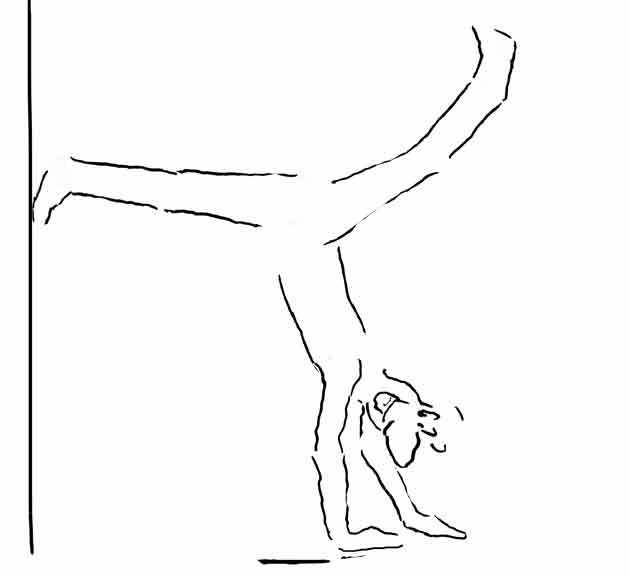
The other day one of these creepy little sadists gave me a swift kick in my solar plexus. Our teacher asked us to put our hands on the floor and kick our legs up into the air against a wall and balance on our arms.  “Just try it,” she said, urging us on, “like when you were a kid. Your arms are strong enough to hold you.”

“Oh, yes. I can do this!” I thought. I have done many head stands and arm balances in my life. “Now just bend over, straighten your arms, and kick yourself up against the wall. No problem.”

As I took a few steps toward the wall, a dark, choking fear suddenly rose up in me and stopped me in my tracks. I was stunned. It had been over twenty years since my last hand stand, but I had stayed in shape and my arms were stronger now than ever. Where had this fear come from? I was safe here. There were people to catch me, if I fell or stumbled. I was dumbfounded. How did this happen in me?

“You’re too old,” my jailor sneered. “You can’t do things like this anymore. Pay attention to me or you will hurt yourself.”

Most of us have places of impasse in our interior world, where we feel stuck, fated, or chained to a particular understanding of ourselves, which limits our future unnecessarily. Sometimes these aspects of how we see ourselves are unconscious. Though not apparent to us, such beliefs may deeply affect our lives.

I have a little pile of quotations and scripture verses above my desk. The other day I pulled this one out and put it on top.

And the day came when the risk
to remain tight in a bud was more painful than to bloom.

This is a poem by Anais Nin, a woman whose life I do not entirely recommend, but certainly demonstrates that wisdom is not the property of only the straight-laced and conventional.

The path of spiritual growth calls us to break out of the constraints of our tight little buds. There is a point where the risk of opening to an unknown possibility is less than the pain of remaining bent over in the tight room of a constraining self conception.

Nin’s words remind me of Jesus’ urgency to break the boundaries of his ministry and his own chosen human mortality with his words:

 I’ve come to start a fire on this earth—how I wish it were blazing right now! I’ve come to change everything, turn everything right side up—how I long for it to be finished!                   (Luke 12:50 Message)

Jesus expresses the urgency of his desire to burst beyond the expectations of his disciples and followers to fully express his purpose on the cross. There was so much more he had to offer than the healings, miracles, and teaching along those dusty roads and little villages.

The process of spiritual transformation confronts us over and over with those places of unfreedom in ourselves, which have us tied in knots, weighed down, or locked into a tiny cell. With a punch in the gut the Spirit may reveal how we are imposing limitations on ourselves, which have nothing to do with God’s will for us, but a lot to do with what others have told us, or assumptions we have picked up from the culture.

Paul reminds the Galatians, who were caging themselves with religious rules, “Christ has set us free to live a free life. So take your stand! Never again let anyone put a harness of slavery on you.” (Galatians 5:1 Message)

I am standing about six feet from the wall in my living room. My teacher thought I could do this. I know there are people older than I who do this. I have a choice. I can stay in the tight bud of my fear and be safe and be too old for this. Or I can keep trying until I do it.

Your goal might not be a handstand. For that matter, mine may not be a handstand either. I just whacked my foot on a piece of furniture, giving it another try.

However, more is at stake here than gymnastics. Spiritual growth requires flexibility, strength, and elasticity of soul. What might be keeping you in a constrained and incorrect conception of what you are capable of?

Simply recognizing the fear, or the faulty belief, allows it to dissipate. The sun is shining. Come on, sweetie, you know you can no longer resist its warming rays. You can do this.

I am yours, kicking up my heels, here in Kansas.

If would like to try a hand stand yourself, click here for a little help.

Somebody Driving You Nuts? Try This

I am indebted to insufferable stinkers for a good deal of the understanding I possess. The people I dislike the most, usually have the most to teach me.

I enjoy nearly everyone I meet, but I have come across some corkers. I think this is because God has so much to teach me about myself and love. When I hit a learning plateau, the Almighty with a sly grin sends a new teacher into my life to help me over the hump.

I work in a profession where my job description is to love everyone, including my enemies. Such an expectation holds one’s nose to the grindstone, as the Holy Spirit sets out to polish and refine her servants in the friction of human relationships.

I am grateful that love is deepened in us in this way, because if I could have discounted the difficult, or avoided the boring I would be far more difficult and boring myself. So I give thanks for all the needy, self-centered, mean-spirited, self-pitying, abrasive, annoying, and crazy, scary people, whom Christ places before me to welcome and love.

Without these opportunities I never would have discovered how much I have in common with such lack luster, irritating souls. I would have felt no responsibility to change my impression of them or curiosity about the source of my aversion. I would have missed out on the wealth of gifts they bring to me in their outstretched arms and infuriating ways.

I think you know the sort of people I am talking about: the ones who enrage you, disgust you, upset you, or frighten you. Among these are people who are so easy to dislike, that you may take a perverse joy in dwelling on their shortcomings and talking with friends about just how awful they are.

Forbearance is a word seldom heard these days, except in its legal sense as an agreement to delay a mortgage foreclosure. As the word appears in the Greek scriptures, to forbear means to refrain from doing something and refers to patient endurance and self-control. Forbearance is the virtue of bearing with another’s sins and weaknesses. Forbearance is more than refraining from saying what is on the tip of your tongue, rolling your eyes, or wringing someone’s neck. Love enables us to bear with one another;  and disciplined prayer and self-examination help us to love.

Sometimes my negative response to another may involve my unconscious projection of some unattractive attribute of myself, which I have not fully accepted. We tend to see our own flaws more clearly, when they show up in others. The offending party mirrors my own vexing habit. Or perhaps the negative feelings I carry for some other person in my life become attached to the person before me, who has some resemblance to my nemesis, and the unwitting soul must endure my unconscious dislike of him.

Or maybe – I just do not know the whole story.

He stopped me at the end of the meeting. He was the kind of person who, if you were in a hurry, you might duck down a hallway to avoid one of his tedious monologues. The man took forever to get to the point and gave you a whole lot of details that didn’t seem all that important and led to long, winding digressions.

As I listened, I felt the impatience and irritation rising up in me. Yet, because I was called to love and accept him, I took a breath, prayed and listened. I watched my internal irritation, wondering what it might have to tell me about the man and about myself.

I began to see that what I was feeling was instructive and likely how others felt listening to him. How hard that must be for him. What was going on here? Why was it so hard for him to be clear and concise?

I sensed in myself anxiety. Was he anxious too? Yes, I could see that now. He was anxious to be heard, fearful of being dismissed, of being devalued, or ignored. I recognized that needy feeling to be approved and valued in myself.

Who had made him feel this way? Where did it come from in me? That was when, in a flash, I glimpsed his suffering and all I wanted to do was give this man my total attention and acceptance. I realized that it didn’t really matter what he was saying as much as receiving someone’s caring attention.  There might be a time later to explore the roots of his digressions. For now I wanted him to know how it felt to be heard without worrying the person you were talking to was eager to walk away.

Compassion rearranged my calendar, and I had all the time in the world to listen.

Rudy Rasmus is the pastor of Houston’s, St. John’s Downtown, a church with one of the most culturally diverse memberships in the country. Speaking to the United Methodist Kansas East Conference in 2010, Rudy said, “The kingdom is big enough for all the people you are afraid of, or think are wrong, or that you can’t love.”

Of the 9000 members at St. John’s 3000 are or were formerly homeless. Part of Rasmus’ success is due to his ability to help his members learn to move past judgment to compassion. In his address last year he asked his audience to practice compassion. His exercise went like this:

With attention on the person [you are judging] say to yourself:

Just like me this person has known sadness, loneliness, and despair in his or her life.

Just like me this person is trying to avoid suffering in his or her life.

Just like me this person is learning about life.

Then he shared what his Auntie used to tell him, “Rudy, people only do what they know to do.” The safer and more valued a person feels in my presence, the more they share of themselves and the more compassionate I become, as I grow in understanding and appreciation of the child of God before me.

The words of Oswald Chambers have helped me over and over to listen, to be curious, and open my heart to another, even when I don’t feel like it:

“Of every person there is always one more fact of which you know nothing.”

Put up with each other,
and forgive anyone who does you wrong, 
just as Christ has forgiven you. Colossians 3:13

Disclaimer: Any resemblance here to former or current church members, clients, friends, relatives, or dear readers of this blog is purely coincidental.
All the corkers I have known are now dead or live on Mars.

Stepping Back from the Glib Café

I have been dining at the glib café too frequently.    I have been listening to too many bitter, angry, paper-hearted ones, locked in their own glare. I am turning from the table of TV dinners of MSNBC, CNN, and POX News – that alphabet soup of garish headlines,  cynicism, blame, and eternally breaking bad news.

Instead, I am taking in the words of scripture. Poet and scholar, David Rosenberg  exposes anew the dive of imposters, held captive in their own minds. His translation of  Psalm 1 feeds me with the truth of the word of the infinite.

Psalm 1

Happy the one
stepping lightly over
the hearts of men

and out of the way
of mind-locked reality
the masks of sincerity

he steps from his place at the glib café
to find himself in the word
of the infinite

embracing it
in his mind
with his heart

parting his lips for it
lightly
day into night

transported like a tree
to a riverbank
sweet with fruit in time

his heart unselfish
whatever he does
ripens

while bitter men turn dry
blowing in the wind like yesterday’s paper

unable to stand in the gathering
light

they fall
faded masks
in love’s spotlight

burning hearts of paper
unhappily
locked in their own glare

but my Lord opens
his loving one
to breathe embracing air

David Rosenberg, A Poet’s Bible

Oh won’t you meet me there for dinner in that living word
and embracing air?

Shall we together part our lips lightly for this feast?

Midsummer Tragedies

In the midst of life we are in death.
Earth to earth, ashes to ashes, dust to dust.
Book of Common Prayer, Burial Service

He carried the news gently in his mouth. I took the gift from between his soft lips and mourned. The black retriever had scooped the lifeless, winged thing from under the bird feeder. 

The night before I stood on the glider and peered into the nest, hidden in the leaves. Two naked heads with open beaks peeped softly.

We discovered the nest, while trimming the trumpet vine, which covers the trellis around the patio. We put down our clippers and traded gardening for bird watching. For the past three weeks we delighted in the cardinal couple and their chirps and whistles. They took turns guarding and sitting on the nest and often perched on the trellis or on the glider under the vine.


What had happened? Mom and Dad had vanished and the other fledgling as well. The nest was vacant. The air was empty. Gone was purdy, purdy, purdy; chip, chip, chip; and the what-cheer, wheet, wheet, wheet, songs and calls.

We glowed under the blessing of their nearness. I wanted to see the youngsters learn to fly. Did a blackbird, blue jay, or that bold squirrel, who kept coming up close to the patio cause the tragedy?

I was going to write a blog about the fruitfulness of summer. Instead I buried the bird in the garden next to the zinnias and wondered where the cardinals had flown and how they were doing. I hope they begin again in a safer place than my backyard has proved to be.

It has been a tough week. A seventeen year boy was killed in a car accident. A family gathered to remove life support from their beloved. A woman, whose organs have begun to shut down, makes a last journey home to be with family. Twenty seven people die in an Afghan hospital when a bomb explodes. In Minot, North Dakota, the Souris River rises to snatch its prey – over 4000 homes flooded, eleven thousand residents have evacuated.

You know. You know. In the midst of life we are in the midst of death. A squirrel carrying off a bird is in the way of things. And so hearts, breaking from love and loss, are in that same way of things – life ending, people and things we love being destroyed, wearing out, wasting away.

So I say look while you can. Pour out the precious oil of your loving attention on what is before you. Allow yourself to be anointed ahead of time for the deaths you will witness and mourn, including your own. Hold your dear life close with open arms. You can always trim that trumpet vine later.

Oh, Ick, a Christian


“I don’t like telling my friends that I am Christian,” she told me. “I always have so much explaining to do.”

Maybe you have felt patronized, judged, or violated by someone’s attempt to evangelize you. Others may know the discomfort of identifying yourself as Christian and watching people stiffen, bristle, and look for an easy exit from a conversation. I cringe when news media sum up Christianity with a one dimensional sound bite, which shrinks nuance, metaphor, and a 2000 year history of religious thought and lived expression to nail clipping snippets.


The image of Christianity in the United States has suffered a major setback in the past twenty years, and not without good cause. Dan Kinnaman and Gabe Lyons call this “a growing tide of hostility and resentment toward Christianity.” From the beginning Christians have disagreed about interpretation of faith. They have treated one another terribly in the process, as well as many non Christians, who have crossed their path over the centuries.

Yet outsiders in the twentieth century held a favorable view of the disparate followers of Jesus. In 1996 eighty five per cent of the people on the outside looking in at Christianity had widespread respect for Christianity. However today, only fifteen years later, younger people outside the faith, as well as some inside the faith, have lost much of their respect for Christianity.

Among the twenty four million outsiders (agnostics, atheists, and persons of other faiths) who are age sixteen to twenty nine, thirty eight per cent have a bad impression of present day Christianity. One-third say Christianity presents a negative image with which they do not want to be associated. Seventeen per cent maintain very bad perceptions of Christian faith. (David Kinnaman and Gabe Lyons, Un Christian – What a New Generation Really Thinks about Christianity  … and Why It Matters, Baker Books, 2008, pp 24-25.)

Clergy today are held with suspicion and even contempt by some people. Professional misconduct, the flagrant abuse of those entrusted to their care, scandals, and fraud have left a bad taste for all of us, and deeply scarred many.

I recently heard about a congregation which observed a day of repentance for the sins of Christians against others and against the earth. I like this idea so much that I think it ought to be incorporated in church calendars – a day of atonement for sins committed in the name of religion.

Once in a while I come up against hostility in thoughtful, intelligent, open minded people and am stunned to find a bigot.  At such moments I give thanks I am not in Rome when Paul was, or other places today where Christians are persecuted and killed. And in such moments I get a glimpse of what Muslim brothers and sisters must endure from those who perceive them as potential terrorists.

I also realize with a sigh that I have a lot of explaining to do, if I want to do the work of developing a more intimate and honest relationship with this person. This is not because I think the person needs to be saved, but because Christianity so deeply defines me, that for us to have an authentic relationship, we both need to be known as we are.


So why am I Christian? I will do a little explaining. My mother was a Quaker and my father, Mennonite, and faith was as common and sustaining as the air they breathed. When they got married, they joined the Presbyterian Church and there I was raised. Unassuming faith, which never had a conflict with science or a searching mind, was woven into our lives and led my parents to take stands to protect the environment and to respond to injustice.


In my early twenties I stepped back from the faith of my father and mother and did some exploring. Then in my early thirties I had a crisis of faith. It was not a crisis in my faith in God. No. It was a crisis in my faith in myself. I painfully discovered that I could not find wholeness and peace by how smart I was, how good I was, by how hard I worked, by what people thought of me.

In the giddy 1970s psychology and the human potential movement were going to save us. I remember clearly the day when I came up against the endless striving of my ego and saw the emptiness and futility of all my efforts to establish my well being on what I could do, or know, or possess.

I began to discover that peace and joy seemed to hinge more on my capacity to love and forgive others, my willingness to risk my personal well being for another’s well being, and to help those who suffered.

For as long as I can remember, Love has burned in my heart, as a nameless yearning, an aching desire for more, for expansion, and connection. Love has opened my heart to its breaking, driven me to the limits of my hope, my intellect, and my strength over and over. Love continues to draw me beyond myself, and my known world, toward what I can neither fully name, nor live without.

Because of this Love, which will not let me go, I want to live well, even nobly, while I am here on this earth. Faith helps me to do that. I suppose, given all the bad press and worse behavior of some Christians, if I could avoid it, I wouldn’t be a Christian, but it is the best way I know to be whole and free and full of joy.

My friend, Jeff Bean, recently posted this on his Facebook page:

Why do I love the Lord? To learn to love my wife better. Why do I love my wife? To learn to love the Lord better. Life is about perfecting our love.

Like Jeff, life is for me is about perfecting my ability to love, and boy do I need help. This is why I am a Christian.

The Christian faith helps, even makes it possible for me to strive toward that perfection and to love well. A relationship with Love, which remains ever beyond my possession and control, who will not become anyone’s brand or commodity, who stands always beyond in the mystery of Being itself, informs and shapes my relationship with the universe and everything that is in it.

Being a Christian invites me to forgive, which is the only way I know to bring lasting peace. It calls me to be more than I am, more caring, more compassionate, more honest and transparent. It exposes my brokenness and sin – my greed, selfishness, lust, envy, pride – and asks me to take responsibility for it.

Christianity  bows before a Power beyond my coercion to whom I am accountable for how I live my life. Christianity offers a community to support, teach, challenge, and love me into greater love.

Christianity gives me a story, a narrative of the journeys and wisdom of others who have struggled and learned to love. In their stories I mine my own story, like a vein of gold woven into the layers of the lives of other people, who have responded to and resisted Love’s call and demands. The multivalent resonance of the Bible, echoing, reflecting, and revealing truth and meaning, connects me with a purpose and a reality larger than my own tedious little drama.

The group of believers, the church, (and yes, sometimes they drive me crazy) asks me to trust in the wisdom of a community as the church keeps forming and reforming itself. Since its beginning the church has been falling down and getting up again, which gives me courage and hope, because I fall down all the time.

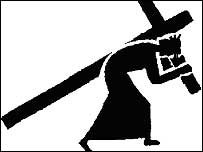
Christianity takes me to the extreme limits of my self identity, who I think I am, and draws me through the narrow channel of the cross of suffering to the death of parts of myself, which impede or block the flow of love.

Gina Beukelman, Topeka, KS The World Race Mission Volunteer

Christianity asks me to go places I want to avoid, to love people I don’t want to love, and to live with integrity and purity of heart in the midst of a world awash in deceit and greed.  My faith requires me to resist evil, in all its guises – empires, systems, and institutions – and to commit myself to work for justice and peace.

As a person of faith I discover my security not in what I own or who I know or how much power I possess, but rather in how many possessions and how much power and status I give away.

Finally, in the despised and rejected Palestinian Jewish peasant, who called himself the Son of Love, I am met by a most unlikely lover of my soul, who unfurls endlessly before me, the way, the truth, and the life.

I find in Jesus, who was the enemy, both of religion, and the oppressive empire, the grace to make us one. Here I find the generosity, compassion, and freedom to love even the icky ones – Christians, pagans, Muslims, atheists, Jews, rednecks, republicans, democrats, and my own icky self.

Stay in Touch:  lross@fromholyground.org

Like on Facebook