Tag Archives: Religion and Spirituality

A Spare, Bare Love

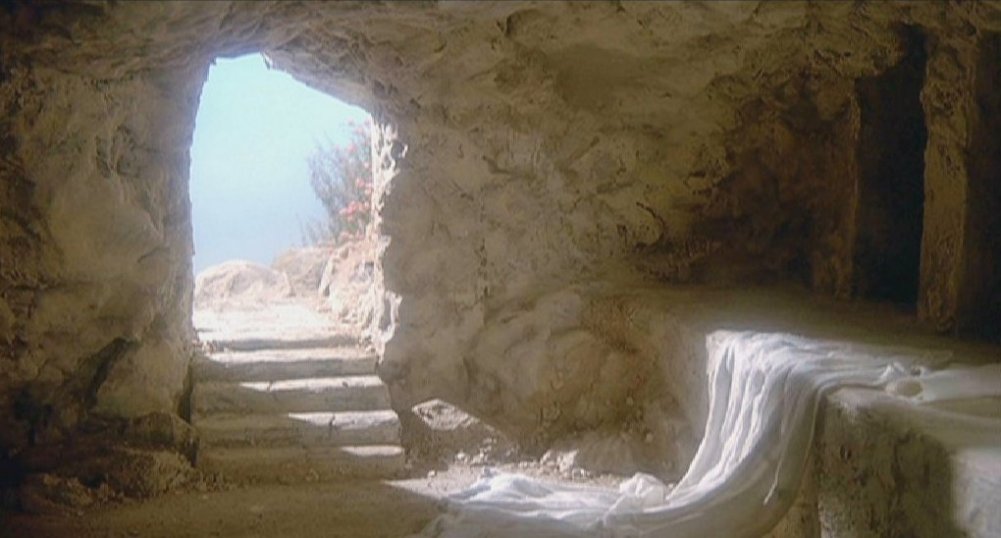
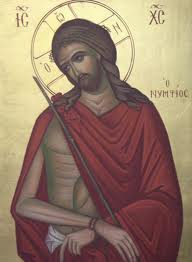
Spring is coming, maybe. A man, whom much of the world will declare is God, is making his way inexorably to death. He is going to do that ordinary thing people do everyday: he is going to suffer and die.

What makes this different is that it is God, who is doing it, and God overcomes the sting of it all by being God, by being One who attains victory, not by escaping evil or by beating it to a pulp, but by surrendering to it and going right through the heart of it, while remaining God.

As we watch Jesus walking toward the cross, we call out: “Don’t do it. Don’t go that way. And for heaven’s sake, don’t ask us to do it, too.” But he, who has set his face like flint, will not hide from the insult and spitting. No, the amazing claim is that this gray day, this aging body, this meager life, this broken world houses glory. And our reluctant following after Jesus is grounded in the slim hope that somehow, some way, this is true.

Spring doesn’t come from some far distant place like an eagerly awaited guest bringing exotic presents.  Spring recoils, bounces up from the heart of winter, and jiggles before us like a jack-in-the-box. The joke is on us.

We strain to turn the crank that sets free joy, and just when our guard is down and we think life is only a meaningless turning to an idiotic tune, out pops Jesus, winking his eye. “Now, die!” he says. We, who thought we were chasing joy and were hot on its trail, find ourselves swallowed up by Life and dwelling in the inner parts of the God who creates joy.  . . .

Amazingly, God wants to be with us and has gone to great lengths to get our attention, even condensing divinity to fit into a mortal being.  And that is almost more than we can bear. What do we know about being company for God? For thousands of years we have been trying to get it right.
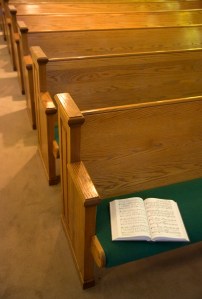


 Someone hears a Word from the Lord and says: “Here do it like this. Here are the answers we are seeking.” We give names to Truth. We compose prayers, and rituals. We sew up little suits for Truth to wear. Over time Truth grows beyond the suits. Its legs stretch below the pant cuffs. Shirt sleeves ride up to the elbows. We try to stuff Truth back in its tearing clothes. We sew patches here and there. We get into fights about the right color of patches. We pay more attention to the clothes than to Truth.

Truth condescends to wear the forms we give it, only briefly. Jesus bursts the wineskin of the tomb we called death. The church shudders, draws in its breath and exhales, bursting its seams. Some panic. Some become weary and simply turn away.

When Truth as we have known and cherished it begins to grow beyond the forms which have mediated it for us; that is, language, institutions, and rituals – we may shrug our shoulders and walk away, feeling betrayed.

For a good part of the journey our relationship with the Holy is largely self serving. We seek God for our and others’ benefit. Then during this tedious lent we go seeking help and find a forlorn God carrying a cross.


Jesus asks, “How long have I been with you and you still do not understand? I want to be with you – not just to bring you peace, joy and good, but even more, because I need a place to lay my head.  Will you stay with me one hour?”

“We usually begin our acquaintance with God from the outside in. Jesus is external, beyond us.  I learn about God from the historical record, the witness of the church, scripture – through forms, rituals, disciplines, words, symbols. Could it not also be possible to know God from the inside out? To experience God from God’s interior reality, a reality which the forms seek to represent or express?  “Where are you staying?” John’s two disciples ask Jesus. “Come and see,” he says. And they went and saw where he lived and remained there with him that day. (John 1: 38-39)

How would it be for you to live in the place where Christ lives? To eat and sleep and move about in his home?

The shift from knowing Jesus from the outside in to the inside out may be perilous. The structures of meaning, categories for naming and holding one’s experience and truth, begin to disintegrate. They no longer work to contain one’s experience of self and Christ. We may feel confused. What was certain and absolute seems less so. We may feel abandoned by the God of our past experience. We may think we are losing our faith.

Spiritual growth may involve the pain of withdrawal we feel, as God is yanking our cherished means of knowing Divine Reality away from us. Our spiritual sense is still too unrefined and accustomed to spiritual glitz to appreciate the more subtle flavor of pure faith. Hence we may feel aridity and dullness. 


As God calls us away from familiar ways of knowing God what is left? Nothing but loss and a cross on hill with a dead man hanging from it? Stay there a bit longer. Wait. Be confused. Consent to not knowing or understanding.

Something you cannot even conceive of is preparing to spring up. Something so new, so radically different your mind cannot name is sending out roots in the silent darkness. Tiny tendrils are thrusting through the heavy earth, threading their way around stones to living water. Wait some more.


Oh, it’s hard to bear the ambiguity, the urge to plow up the soil and rip out the root, to hold it to the light, dissect it, name its parts and feel that secure sense of power and control where we can say this is this and that is that. Yet we can wait. We can trust until it stands before us in the morning sun. Then we reach in joy to touch once more our Beloved.

      “Don’t cling to me,” he says. (John 20:17)

Here is a spare, bare love. All that is left is a man walking alone carrying what will kill him, the merciless weight of mortality. Here is only a naked soul surrendered to God, slung from the pillar of its own predicament.

If God could enter into our humanity with humble love, can it be too much for us to do the same? There is no other way into the Kingdom.

Here this is what is so:  we all screw up. We all are limited and frail. And we can rejoice, because we do not have to lie about it anymore. 

Spring tenses in the roots of the pear tree. And all who were ever carried off in the teeth of jealousy or simply in the way of things, all innocence defiled, all vulnerability exploited sink with a sigh into a white dawn that stretches like a shroud wound round the world.

“Come follow me,” the Dawn whispers. And we are invited to take another step into that place beyond knowing, beyond feeling where everything really is all right.

Excerpted and adapted from Letters from the Holy Ground, by Loretta F. Ross (Ross-Gotta)

The Sanctuary Foundation for Prayer
Read more about prayer www.fromholyground.org,
Contact the author lross@fromholyground.orgwww.fbook.me/sanctuary
Follow at http://twitter.com/lfross

Homeless

Black grackles and speckled starlings,
with yellow beaks and rusty throated chatter
clatter up and down the branches
gleaning the leavings of winter’s suet cakes.

A pile of must-read books
litter my desk and the chair before the window
where I come to pray.

Wisdom and knowledge at my fingertips,
and the perfect YouTube video of a good life,
forwarded from friend to friend,
promises to change everything.
Click here now.

How long do you stand on the street corner,
listening to the preachers and barkers?

How long do you slurp up the news,
opinions, and seductions of others?

How long do you sit on the couch
of the world consuming secondhand notions,
lies, and rumors?

When will you sit down before mystery
and invite it to come rest in your lap,

your lap, I mean, your heart and singular, scintillating body?

When do you stop singing somebody else’s song
and chasing somebody else’s god
and coveting somebody else’s experience?

When, oh when,
dear, irreplaceable you,
will you lay
yourself down in your own true,
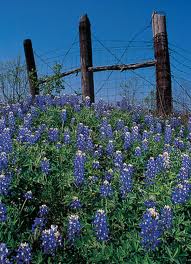
blue bonnet strewn field of a life?

And say to the starling –
Here come, with your little orange feet and strange black eye.
How precious you are in that freckled jacket.

And I ask you,
how many prayer breakfasts,
committee meetings, and strategy sessions,
how many well-intentioned,
and not so well-intentioned,
soldiers of truth
gathering to plot their version of a perfect world
must we salute?

Just how long will it take, do you think,
for us to be safe enough
and gentle enough
and humble enough

for the shy weary God to come and lay his head? 


Jesus replied, “Foxes have holes and birds of the air have nests,
but the Son of Man has no place to lay his head.” Matthew 8:  18-22 


A YouTube video on Matthew 8: 18-22

The Sanctuary Foundation for Prayer
Read more about prayer www.fromholyground.org, www.fromholyground.wordpress.org
Contact the author lross@fromholyground.org, www.fbook.me/sanctuary
Follow at http://twitter.com/lfross

Not Knowing and the Crucifixion of the Intellect

He went out, not knowing where he was going.
Hebrew 11:8

Waiting in the check out line, I indulge in my guilty pleasure – scanning the headlines of the National Enquirer. BILLY RAY RAGE: DISNEY DESTROYED MILEY CYRUS! GAGA-MADONNA WAR ERUPTS! I resist pulling an issue of Celebrity News off the rack to catch up on Tom and Katie. I save that for the beauty salon, when I am less apt to run into someone I know.

Back home as I haul in the groceries, my dog gives me a good sniffing, reading me front and back like a newspaper full of local scandals. All of us critters seem to be created with curiosity, as we wave antennae, bounce sonar, phosphoresce, and sniff out the news of our world and of one another, often shamelessly poking our snouts in our neighbor’s crotch.

Such knowledge – lurid, informative, or life saving – may empower, entertain, set us free, or provide our supper. Knowledge opens doors to invention, opportunity, and innovation.

The Bible understands that the highest kind of knowledge is knowledge, not of my neighbor’s stupid acts and reckless behavior, but of God. Knowledge of God is not for sale in the supermarket check-out line, but is given free through growing intimacy with Holiness. Knowledge of God flows from creation, scripture, people, even, sometimes, the check out line at Savemore, but, most significantly, from companionship and personal communion with the Holy One. Such knowledge and understanding develops through the exchange of love in the experience of a life shared with Christ through prayer. Like my dog, Elijah, one begins to know God, because I have sniffed at God long and often enough to recognize his scent.

Understanding of God is arrived at by literally standing under, that is to say, by lowering and humbling oneself. We stand beneath God, looking up, aware that we see only a portion of what is there. In faith we surrender to hints and intimations, glimpses and sudden dazzling displays of grace.

But inquiring minds want to know! We yearn to know where our lives are headed and to grasp with our minds what is and what shall be. We hunger to secure ourselves. We hitch ourselves up to institutions, college degrees, causes, and ideas. We cinch ourselves into relationships of aggression or hate, boredom or lust, dependency or bullying. We set our agendas and bind them to our foreheads.

Yet, deepening knowledge of God always asks us to trust. As we know God more, faith becomes the consent to knowing less and less about most everything else. As Oswald Chambers wrote, “God does not tell you what he is going to do – he reveals to you who He is.” Such not knowing is almost certain to make us really anxious.


Have you ever been asked to crucify your intellect, to kill that inquiring mind that has to know everything, understand and control everything, and be right all the time? Your life experience may lead to the painful crucifixion of your intellect. On this Golgotha, pinned by the circumstances of your own experience, you find that nothing you can figure out or find out or do can move you out of this impasse. You, left hanging there, can only wait, trust, and abide in love not knowing.

In a time of such acute unknowing we are likely to be filled with an overpowering panic and rising anxiety to secure ourselves with certainties, assurances, undeniable truths, and absolutes. 


Now the Lord said to Abram: “Go from your country and your kindred and your father’s house to the land that I shall show you.” Genesis 12: 1

Seventy five year old Abram and his wife, Sarah, showed a great deal of courage heading off on a journey on the word of the Lord alone without a clear destination. They had no maps, realtor photos of their new home, or contracts to wave before the querulous neighbors. They headed out in obedience under the cold moon and starry skies into a great unknown.

Though I doubt if it happened this way, I like to think of the old couple heading down the road to nowhere, waving their hats, urging the camels forward, and hollering, “Let ‘er roll!”


You are closer to glory
leaping an abyss than upholstering a rut

James Broughton (Little Sermons of the Big Joy)

The Sanctuary Foundation for Prayer
Read more about prayer www.fromholyground.org,
Contact the author lross@fromholyground.org, www.fbook.me/sanctuary
Follow at http://twitter.com/lfross

Legends of Elijah, the Tishbite, Prophet Dog

The Early Years

Wake, O wake, and sleep no longer,
For he who calls you is no stranger.


Elijah was up bright and early, alert and expectant. He barked sharply before the door of his mistress. She, however, failed to rouse from her slumber. So the little prophet chewed away his frustration at the zipper on the cover of his bed until it fell open the whole length. Poking in his snout, he bit off a hunk of the white foam inside. He diced it up into nice small pieces and strewed the bits across the kitchen floor. Then he barked a while.  His mistress stretched, yawned, turned over, and went back to sleep. Elijah bit off another hunk. By the time the sleeper awoke, an inch of foamfall covered the entire kitchen floor.


Imagine Elijah’s astonishment, when shooed outside, to find the whole backyard and as far as he could see, covered in white stuff like the foam in his bed. Only this was better. He could wet his throat with it and roll in it and leave his tracks. By chewing up his bed he had not only made his mistress awake, but changed the world! His heart swelled with the power of the Spirit within him.


This would be the first of many miracles in the prophet dog’s career.


Later, on that great day, he would tell Seal, the cat, “What you do inside in the kitchen has the power to change the world!” The feline, however, having been around the block a time or two, told him to save his preaching for the ravens. In one of her nine lives the old cat was Queen Jezebel’s kitty. Seal made it a policy to never worship anything.


She did vaguely remember cuddling up to the Goddess Asherah, but she hadn’t seen her for a long time, and how the stinky dog could ruin a perfectly good napping spot was beyond her.


Inquiring minds may want to read I Kings: 16-17


The Sanctuary Foundation for Prayer
Read more about prayer www.fromholyground.org,www.fromholyground.wordpress.org
Contact the author lross@fromholyground.org, www.fbook.me/sanctuary
Follow at http://twitter.com/lfross

The Amaryllis and the Evangelist


Painting by Dorothy Frager


To Look

 at

Any Thing

To look at any thing,
If you would know that thing,
You must look at it long:
To look at this green and say
‘I have seen spring in these
Woods,’ will not do – you must
Be the thing you see:
You must be the dark snakes of
Stems and ferny plumes of leaves,
You must enter in
To the small silences between
The leaves,
You must take your time
And touch the very peace
They issue from.   ~  John Moffit

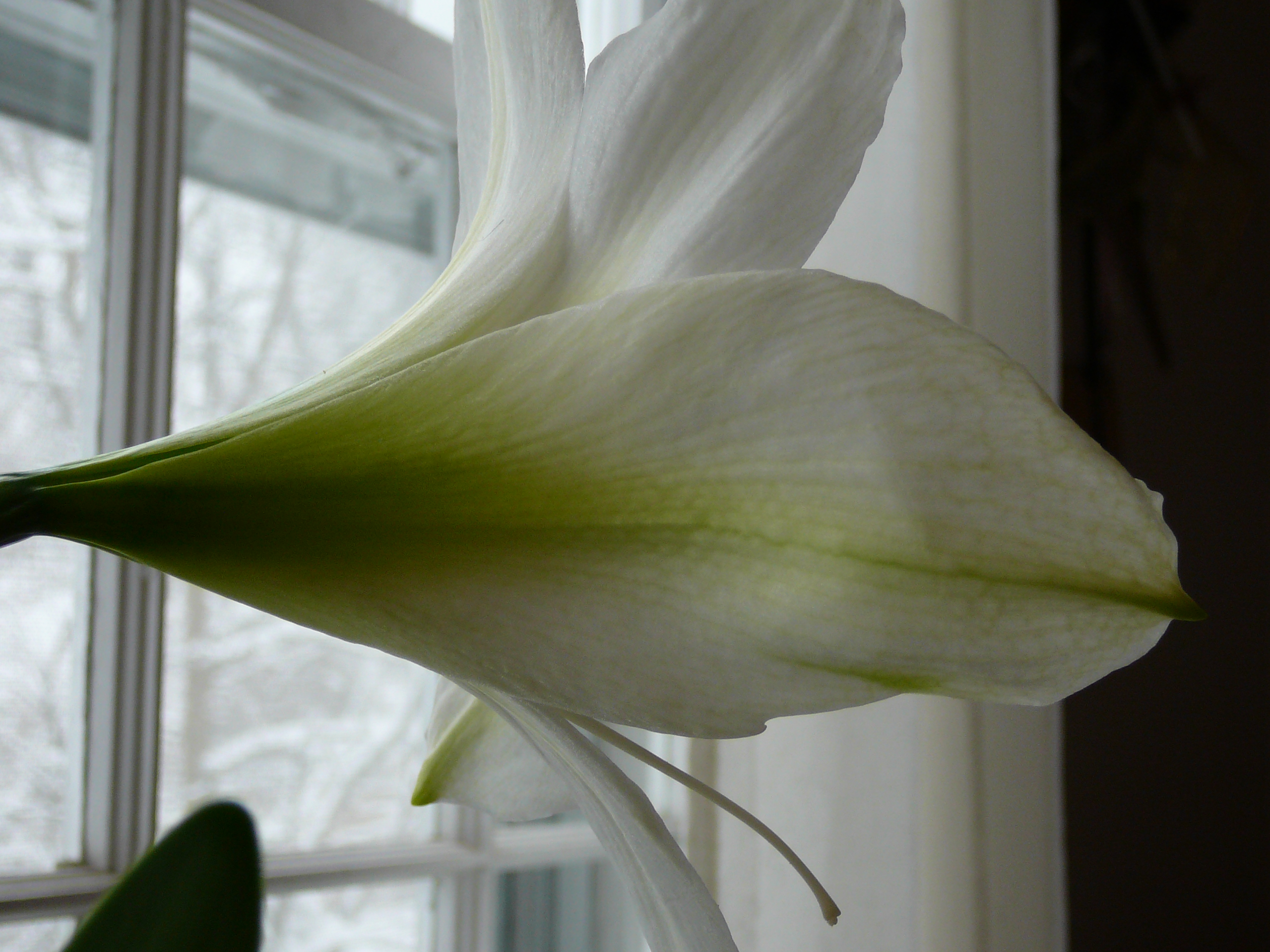
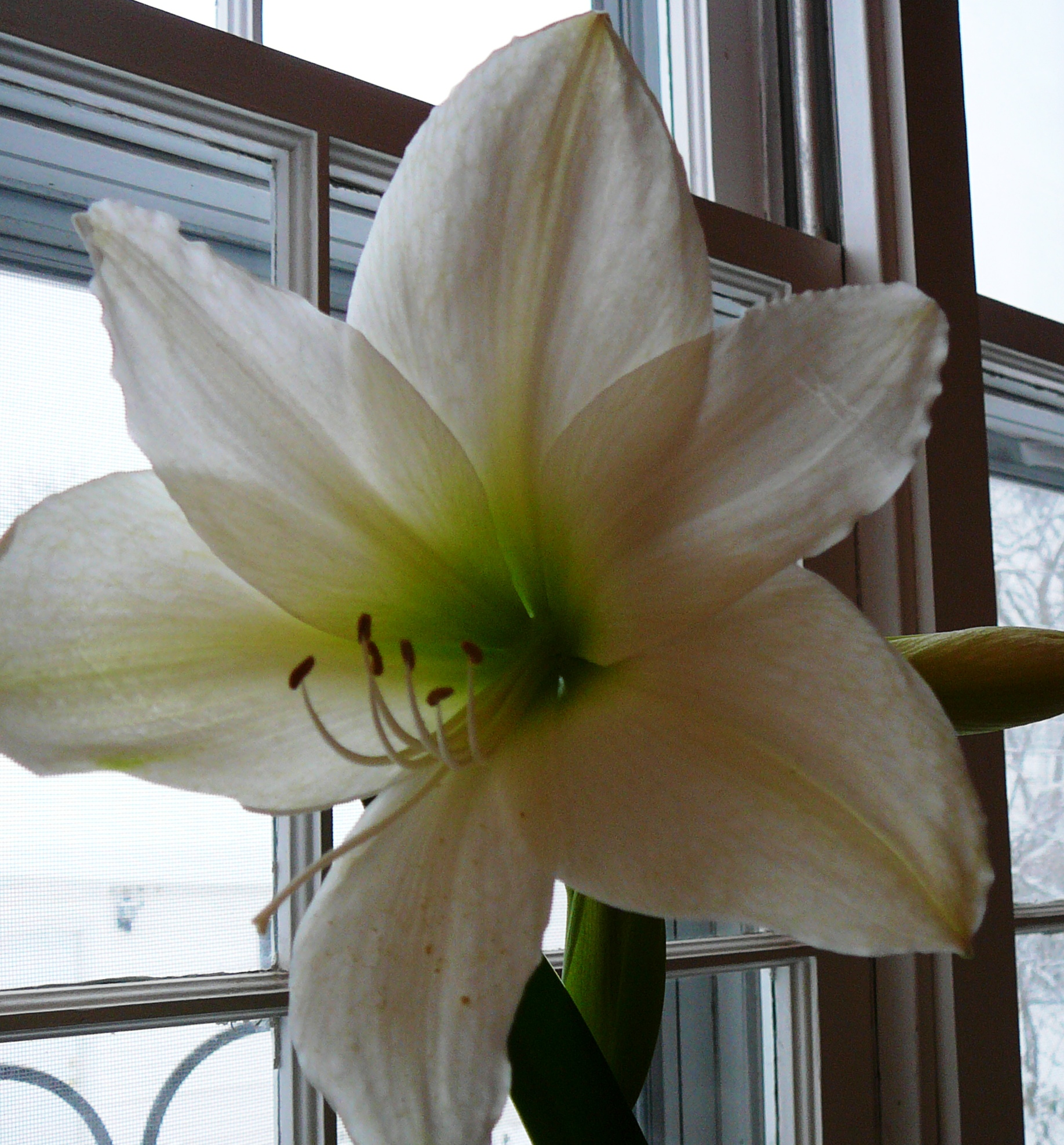
I am looking at the blossom of a white amaryllis, rising on a thick green stalk before my window. Outside it is snowing hard.

A woodpecker drills at the suet cake, swinging from the feeder. A brown squirrel plows down the power line, shoving clumps of snow to the ground. I am looking long at the amaryllis and that green seam shading into pale yellow tracing along the underside of a blossom.

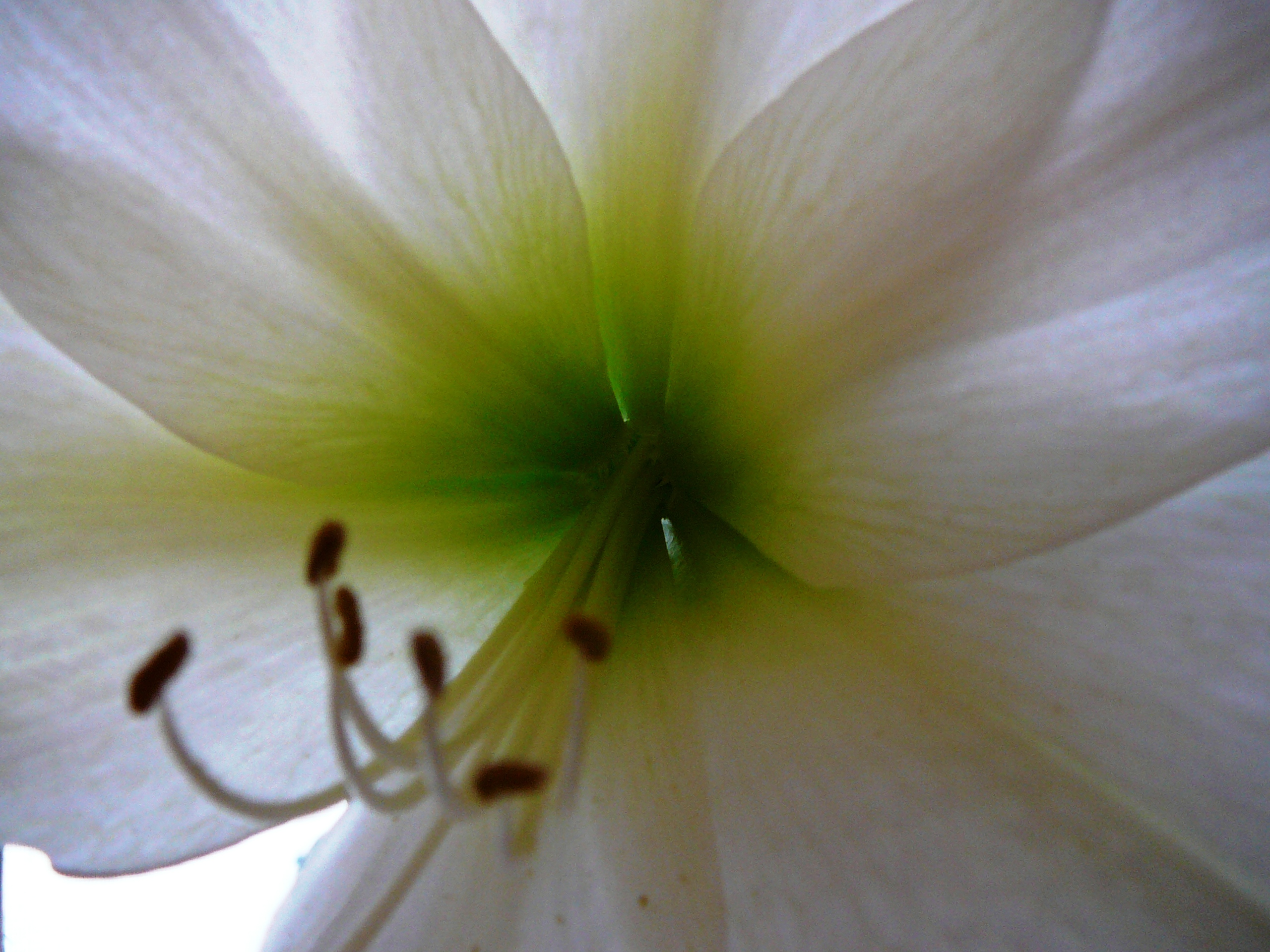
I look and look – at the milky, translucent petals, the flared green heart of the blossom, the seven curved stamens with their golden haired anthers, the fluted, serrated fringe at the tip of the petals, and that tiny pale shoot rising up between the two large petals – the pistil and three legged stigma. I look at the split sheath covering of the three large blooms. The two pieces now hang limp, shriveling, spent from such sundering.


And I am

breathless

with the wonder

and beauty.


Last evening my home was filled with teenagers. Thirteen kids crowded into my tiny den to watch a video about faith called Beyond Our Differences. Earlier we took a pared down version of a survey conducted by the Pew Research Forum on Religion and Public Life. The survey, conducted last year, measured Americans’ knowledge of their own religions and their neighbors’ religions. On average Americans got only sixteen questions out of the thirty two correct.

The teens and I are learning about different religions this year in our desire to build understanding with our neighbors on this planet, discover points of common ground, and to become clearer and more articulate about our own beliefs.


On January 6 many Christians celebrated Epiphany, the visit of the wise men from a far away land with their gifts to the infant Jesus. Now we enter the stretch of Sundays after Epiphany that carry us all the way to Ash Wednesday and the beginning of lent.

Epiphany means a showing, a revealing and was applied early on in the Church to this event in Jesus’ life. The previously obscured and hidden God of the Jews unveils his divinity for all people in the Christ child, and folks from a long way out of town show up to see it.

The themes of the scripture readings which carry us through the next eight Sundays focus on the mission of the church as making disciples and reaching out into the world as evangelists. Some churches also use this season as an opportunity to foster fellowship, to repent of our sins of bigotry, hatred and prejudice, and work toward healing the divisions in church and society.

Soon after his birth Christ is introduced to his first cross cultural, interfaith experience in the form of the visitors from afar.  Next, fleeing Herod’s wrath, he and his parents become aliens, refugees,  in a foreign culture in their escape to Egypt.

History is full of stories of the church’s awkward, failed, and sometimes brutal and horrendous attempts to share what they have seen at the manger. History also is full of astounding stories of love, forgiveness, freedom and justice as the gospel has been shared.


At the beginning of Advent the youth group read Isaiah’s prophecy of the coming messiah:

He grew up before him like a tender shoot,
and like a root out of dry ground.
He had no beauty or majesty to attract us to him,
nothing in his appearance that we should desire him.                                                             Isaiah 53: 2

I held up a dry, flaky amaryllis bulb with a wad of pale spindly roots. This is where advent begins, I told the kids. This is where God begins to come into our world –through something ugly and apparently useless that you may think ought to be thrown out in the trash. God arrives as things appear hopeless, beyond repair, and we are realizing that there is no way we can figure this out and make things right on our own. When we realize we need help, we are ready to meet Jesus.

A few days later I planted the bulb in a green ceramic pot my daughter made. She would be embarrassed to see it in this pot. Not up to her standards, the pot has some flaws. I love it.

A month later, gazing at the blooming beauty heals my soul. I wonder what it would be to become those long smooth fleshy spears of leaves. I have been busy the past week with numerous contacts, encounters, preparations, and meetings. I have gazed into the pure white petals of many souls. Each person was stunningly beautiful and deserving of longer attention than I had time to give.

 Today I gaze long upon the white amaryllis. A prayer wells up for those thirteen young people and for their parents and grandparents. I love them all like the mother rabbit I saw in a video once. The rabbit was chasing a snake away from her nest. She followed and pounced and picked it up, thrashing in her mouth, until the snake escaped and slithered up a tree. I want no harm to disturb the growth of these souls. I tremble too, at the responsibility entrusted to those engaged in the care of the souls of others.

I am not absolutely sure what it means to be an evangelist.  I do think it has to do with telling the stories of what we have seen. We need to share with one another those epiphanies which bring us to our knees, call us to make long journeys, and inspire us to give away our precious treasures.

I also believe that being an evangelist has to do with offering the gold of our time,

with inviting the poor and needy into our lives,

and looking long and hard at each other

until we touch the very peace we issue from.


 Thank you to Dorothy Frager, who looks long and hard,  for permission to use her painting!

 The Sanctuary Foundation for Prayer
Contact the author: lross@fromholyground.org  www.fbook.me/sanctuary
Follow at http://twitter.com/lfross


Returning

For thus said the Lord God; the Holy One of Israel:

In re
turning
and
rest
you shall be
saved;
in quietness
and in
trust
shall be
your strength.  Isaiah 30: 15

The verse was not what I expected or hoped for. I wanted a word from the Lord, which was snappier with more glory and fortune cookie flair. For example, “So the Lord restored Job’s fortunes and doubled all his possessions. … and all his brothers and sisters and former acquaintances and friends gave him a sheep and a gold ring.” Job 42: 10-11

Instead, Isaiah 30:15 dropped into my consciousness almost before I had finished my request: Holy One, give me a verse of scripture to guide me in the coming year. I need a point of true north to align myself with and measure my life against, a place of solid ground in the midst of chaos.

One of my Facebook friends took suggestions for her verse from friends, who offered rich verses for her to reflect on in 2011. She came up with her own: Paul’s lovely advice to the Philippians: “Finally, beloved, whatever is true…, honorable…, just, pure, pleasing, commendable, if there is anything worthy of praise, think about these things.” Philippians 4: 8. There is enough in these words to keep one’s head on straight for a whole year.

I got unbidden, rushing in even before I could think of something better or ask my friends, this humble little verse, from Isaiah. No Sweetie, no high drama, livestock, or gold rings for you. Turn back. Sit down. Be still. There you will find all you need.

I chaff with this because I have already carried (or been carried) by this verse for years. Haven’t I gnawed all the meat off it and sucked it dry of all its juices? Apparently not. So in obedience to the one I serve, in 2011 from time to time I will post about some aspect of this unpretentious verse.

Today, we start with the first two words – In returning. Around 734 BCE the prophet, Isaiah, spoke these words to the people of God as part of a scathing denunciation of the blindness and incompetence of their leaders. He was speaking to those who relied on their own resources rather than the power and wisdom of God. He pointed out their pride, idolatry, and greed. Rather than trusting in God, they trusted in deceit and oppression. The remedy to this path of destruction began with a returning to something once known, but tossed aside in a frenzy of anxiety and lack of faith.

Returning, turning, going back is what I have been doing a lot of the past year and will continue to do in the year ahead. Every month or so I go back to the small town in Iowa, where I grew up, and gather with my brother and sister to sort through over sixty years of accumulated household goods and memories in my parents’ home. I turn over the remnants of our lives together, lift them out of dusty boxes, and sweep cobwebs away. I pull down an aged, wooden Kraft Cheese box tucked under the eaves in the garage. I  unfold yellowed, newspaper clippings and read letters I sent to mom and dad from Cedar Falls, Iowa; Ann Arbor and Kalamazoo, Michigan; and Louisville, Kentucky.

I gaze at a photo of myself I had not seen before. Who is that little girl sitting on the chair? I peer at a snapshot of mom and dad at some fancy dinner, both dressed to kill, vibrant and smiling. In one Father’s Day card we found, mom wrote, “You are a wonderful husband, lover, and father.” We whooped and giggled.

At week’s end I arrange the piles and boxes, run the sweeper, turn down the furnace, and lock the door. Elijah, my black lab, and I walk to the car. He jumps into the back seat, littered with rawhide chews and toys, and we return to Kansas, driving west across southern Iowa to catch I35 south down to Missouri, and then turning back west on I70 to Topeka.

I do not know how many more returns I will make before the auction is over, the papers signed, and the house keys turned over to a new owner. In such returning the prophet promises salvation, healing, some kind of cure for his nation’s disease. In such turning back and turning toward, life unwinds and furls us out, then draws us back again to lie curled round some center like the string of a yoyo.

Isaiah tells the people, flinging themselves toward their own devices, that it is the Lord they are to return to. The question is where in our turning do we find that hidden manger, that center, that core of unnameable, untameable truth? Is in the Tupperware, breeding plastic cartons on the floor of the pantry, or the stack of Styrofoam cups mom washed and saved? Is it in the notebooks, where dad recorded the dates when he replaced the faucet washers, changed the oil in the car, or put in a new furnace filter?

The other night, back here in Kansas in my bed, I heard my cat scratching outside my door, wanting to return to me and rest on my bed, where she likes to lay as close to my face as possible and tickle me softly with her whiskers. Somewhat allergic to cats, I rarely let her in. Having been alone, except for the boy who comes to feed and water her, she reached her paw under the door, pulling a throw rug and making an insistent ruckus.

In the morning I held her while I drank my coffee. She turned and turned on my lap, kneading my stomach, finally resting curled and purring, pressing her head against my chest.

Going back to recover old ground is an ancient dance. Any given life is so full of wonder, terror, and mystery that it deserves returning to over and over. There is always more to be seen and learned about the hands which wrote the note, “This wooden butter paddle belonged to my grandmother Van Doren.”

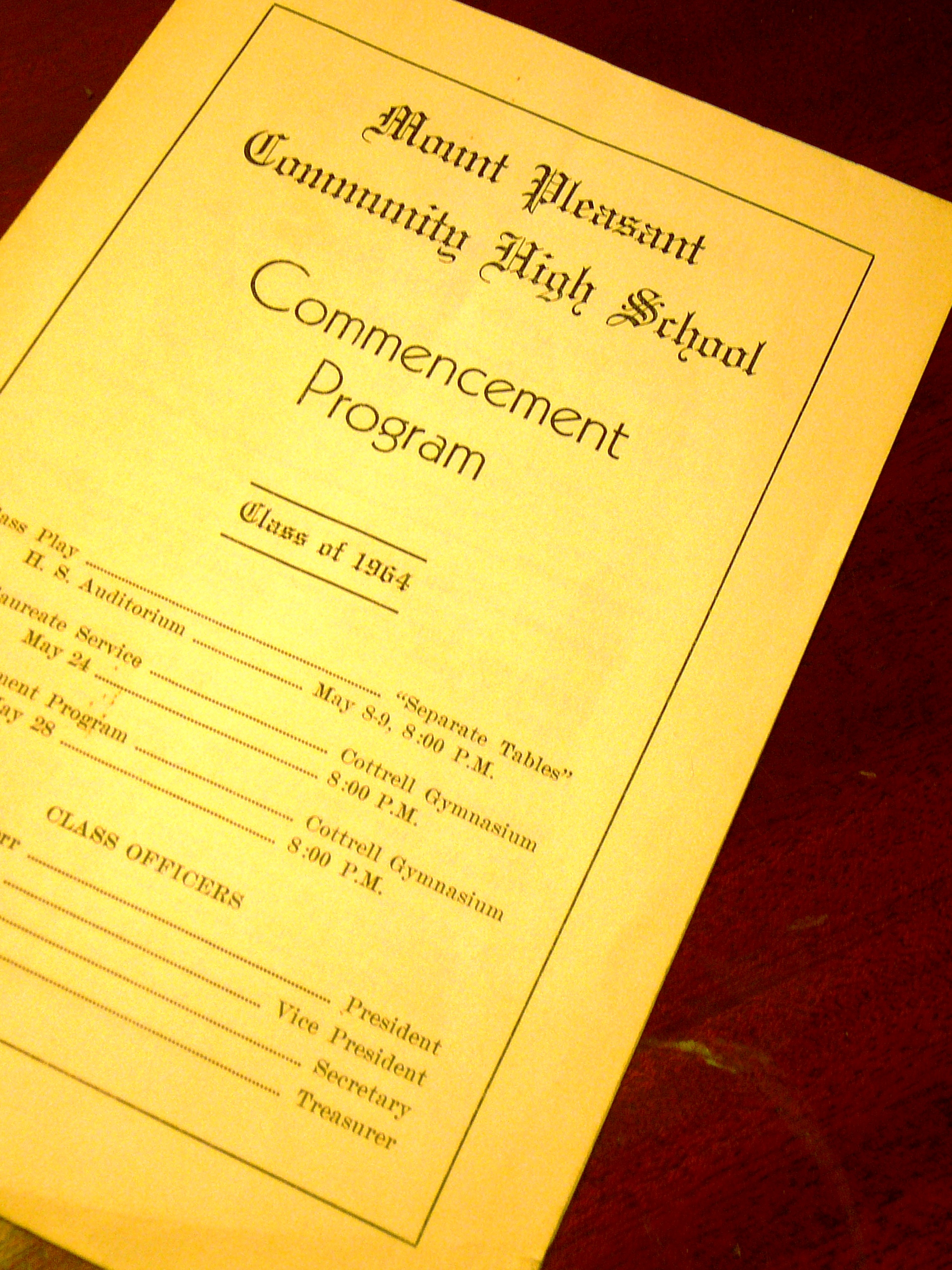
In one box mom saved programs from important events of family members. I found my high school commencement program. The top six scholars in my class spoke on the topic: 1960-1964 Years of Achievement and Turmoil, Events that Have and Will Affect Our Lives. Individual speeches covered Man’s Progress through Science; The American Image – Latin America; Tensions – Europe and Southeast Asia; The Passing of an Era – November 22, 1963 (the assassination of John F.Kennedy). One of the few African Americans in my class, Kathy Wells, spoke on Man’s Attempt to Overcome Bigotry. My title was Progress – Local and State.

No one can turn up his nose at the quality of the education at my alma mater.

I recently heard someone speak about “God’s plan” for us. The phrase sort of grated on me. “Plan” seems to me to be such a human notion with its linear quality, bound by time, space, and mortal reason. I do not think God has plans in the way we might think of them – a neat ending to a story, a way everything will make sense to us, or a satisfying tying up of all our loose ends.

Rather, I think of God as eternal unfurling with ever increasing nuance and connection until we see all lives as dancing flames rising and falling and rising again.

Meaning is something we tack on to Reality to comfort ourselves with a sense of having a handle on things. But Reality more likely slips through our fingers, whizzing past us, leaving trails of newspaper clippings, baby shoes, an old watch, and a tortoise shell comb worn by your great grandmother.

Today I think, rather than One who has plans, God is an endless returning, retracing,  weaving in and out, a grand do si do in waltz time, circling back and forward, all the while holding out his hand for us to join the dance, seeing the same place over and over, as if for the first time.

What we call the beginning is often the end.
And to make an end is to make a beginning.
The end is where we start from.
T.S. Eliot “Little Gidding”
I would love to know the wisdom you will be carrying with you in 2011. What is your verse, or piece of direction to see you through the coming year? Leave it here in the comments, or post it on our Facebook page.
A very blessed New Year to you!


The Sanctuary Foundation for Prayer
Read more about prayer www.fromholyground.org
Contact the author lross@fromholyground.org, www.fbook.me/sanctuary
Follow at http://twitter.com/lfross

Embarrassing Prayers

An Embarrassment

“Do you want to ask
the blessing?”

“No. If you do,
go ahead.”

He went ahead:
his prayer dressed up

in Sunday clothes
rose a few feet

and dropped with a soft
thump.

If a lonely soul
did ever cry out

in company its true
outcry to God,

it would be as though
at a sedate party

a man suddenly
removed his clothes

and took his wife
passionately into his arms.

~Wendell Berry – Leavings

Wendell Berry –  I love this Kentucky farmer and writer, with his deep affection for the land and generosity of spirit. I actually worry sometimes about his dying. He is getting older and I need him to keep going into his timber, where he observes Sabbath down by the creek. I need his passion for justice and goodness, which he keeps just under his worn jacket. I love it every time he tears off that jacket and strips down to show us the naked truth.

I used to say with the foolish assurance of someone newly in love with God, “If people knew how sexy God is, our churches would be filled.” Now I wonder if perhaps it is our churches themselves who don’t know how sexy God is, and that is why some are empty.

In the sedate worship circles I frequent, there are few passionate outbursts and everyone keeps his clothes on. If a God lover ever did rise up in some self-abandoned embarrassing expression of love, we would probably be appalled and call the police.

We have all heard those obligatory, studied prayers that rise a few feet and drop with a soft thump. I have prayed quite a few myself. I also confess I have been a perpetrator of prayers with an ax to grind: some pet notion or issue that wasn’t fully treated in the sermon or meeting, which the one praying attempts to correct. Perhaps, you have been assaulted with the prayer of someone, who is more concerned about setting you straight about some matter than entering into communion with the Lord of the Universe on your behalf. Then there are the quick and dirty nooners over lunch in a public restaurant, where you feel everyone is watching.

To the Holy One, I figure all our prayers are mostly childish babble, endearing scribbles in the sky.  I trust God loves them all, just as I still keep a box of my daughters’ childhood drawings and writing. Tell me, what are we, caged in our mortality, to do with this divine love, if not to slop it around like infants in a high chair eating our first plate of spaghetti? We are bound to be messy. More of us ought to be caught red handed in flagrante delicto with spaghetti sauce all over our faces.

Some Sundays I have an impulse to throw myself in an unseemly prostration before the altar on behalf of the people and the God I love so much that I can’t stand it.  I do not have the words to express the anguish, doubt, and fear I know some of the people carry. “Do something!” I want to scream at God. “Here take me, take my life, such as it is, ragged and tattered, and heal your people!”

Once, in a weak moment, overcome with love, I knelt in a Presbyterian church during worship. Presbyterians, as you may know, do not have kneelers in their churches or kneel as part of their worship. They express their passion by singing, something at which Roman Catholics, with their lovely genuflections and neat fold-down kneelers are generally less accomplished.

My embarrassment followed Holy Communion. After I received our Lord’s presence and love, I brazenly knelt right down in the First Presbyterian Church in Holton, Kansas. It was a little crowded between my seat and the back of my brother’s pew, but I just had to do it. Afterwards one of the elders of the church brought up my indiscretion at the session meeting, asking the pastor if what I did was “Presbyterian.” They haven ‘t kicked me out so far.

Saints, prophets, artists, and poets understand the passion of the human heart for the divine. These are persons, possessed and overcome with our Beloved, who often do and say things unseemly. Most people think they are a little kooky. Yet these same people, who hold mystics at arm’s length, regularly sing hymns with lyrics like:

Jesus, lover of my soul, let me
to thy bosom fly …

Come down, O love divine, seek thou this soul of mine,
and visit it with thine own ardor glowing…

Who do they think they are fooling? I know there are hearts aflame with God in more than one gentleman in the back row, not to mention the middle aged couple, or bored looking teenager pecking at his cell phone. Most us, including clergy, are well trained to keep our passion contained. Nobody wants to be embarrassed for heaven’s sake.

As Wendell Berry writes, there is public prayer, which can easily slide down the slippery slope into performance prayer. Then there is the Jesus-recommended private, shut up in your closet prayer. (Matthew 6:6) I suppose the closet prayers are the best kind for taking off your clothes. The only problem with hiding our passion is that people may get the idea that God is boring and that being a person of faith is only a matter of learning some doctrine and following a moral code of behavior.

Not for the faint hearted, a life of prayer is a perilous enterprise. One can pray a prayer so lame it is an embarrassment, or one can simply embarrass oneself. I believe God receives all our prayers, both the self-conscious thumpers, and the self-forgotten soarers. God, being beyond shame, is not embarrassed by either. Would we could all toss away our fig leaves and go walking in the garden with our Lover without a stitch.

I hope there is a place, where you can strip down to your naked, vulnerable, cellulite- encased, pocked-marked self and open your arms to your Beloved in a rush of desire and groping hunger for holiness, truth, justice, and mercy.

We won’t peek. Just go for it. Lame or passionate, pray an embarrassing prayer today.

Join the Community of Contemplatives on Facebook Page
Read more about prayer www.fromholyground.org, http://www.fromholyground.wordpress.org
Contact the author lross@fromholyground.org,  www.fbook.me/sanctuary
Follow at http://twitter.com/lfross

Yielding to Grace

Maybe you have taken on a very difficult and demanding task. Maybe you have been engaged in a burst of creative activity. Or perhaps, you have been involved in the long, slow, steady, outpouring of yourself for family, friends, or your job.

You may have noticed the signs: an anxious, sleepless night here or there; drinking too much caffeine or alcohol; not enough time to get to the grocery store; a sudden attraction to playing solitaire, and a rush of those Please-Lord-give-me-the-strength-to-do-this prayers.

In my case I was following my own devices again, rushing ahead of the Spirit, plowing my own path. Finally I was stopped by a sharp, shard of sorrow in my heart, a sense of restless unease, and the accompanying guilt and self-recrimination about my lack of motivation. I did not miss God’s irony that this should assail me over the Labor Day holiday.

After thirty years of devoting myself to prayer, I am amazed at how hard it still is to expose myself to the direct presence of Christ. I really think I would be the one in the back of the crowd, wanting desperately to push through to touch his robe, but fearful and cautious, and resigned to making the best of things on my own.

Many of us find it easy to read about faith and prayer. Books on these topics are best sellers. Countless people read the Bible. Most of us do not have much trouble telling God what we need. We may even write out a list of our needs and longings and hand it to the person in front of us, asking, “Would you pass this on up to Jesus, for me?”

What I hadn’t done was the simple, radical exposure of myself and my need to God. What I hadn’t done for several weeks was a sustained, still, silent offering of my being to the being of God. This is what I believe truly heals and redeems: contact with Holiness, that mysterious communion and co-mingling of my spirit with the Spirit, a dance of love beyond my understanding or control.

I know why I avoid it and why I, suppose, that I have to write about it. The reason is that this communion may hurt at first. The exposure of a raw, chaffed heart to the burning brightness of Grace can be excruciating. (Yes, that is the word for it: ex- crucifix, from the cross.) It may be the last thing we want to do. So we often just tell God about it, then get up and go on fretting, and look about for something to do, anything other than just sitting there in that fear and pain.

Now think for a moment. If you were sick, would you not pay attention to your symptoms, maybe check them out on the internet, and go to a physician and describe what you are feeling? And then, would you get up from your chair and go home, before the doctor had a chance to ask questions, to examine you, run tests, and prescribe your treatment?

Surely you would you wait for the examination. You would answer questions. You would you lie down on the table, bare your chest to the stethoscope, your arm to the blood pressure cuff, and take whatever tests the doctor advised. You would take your medicine and follow a treatment plan.

I had been making drive-by visits to God, where I would drop off my laundry or tell God what I need for today. I was sipping those devotions for busy people, spouting sound bite prayers on the run. I was not coming before God and disrobing. I was not holding still for God to search my heart and probe my mind.  I would not wait for his grace to move into me, to absorb the pain, to refresh and heal me. Further, it was all about me. I was all about me. I had nary a thought of what God might desire or need from me.

We fool ourselves if we think a quick shot of God, a pithy quote, or Bible verse alone will do it. God desires a relationship with us, not a power lunch, and depth relationships require leisure, attention, vulnerability, and mutuality.

Part of us really does desire this. However, another part of us is just not that interested. I hear about this internal conflict over and over in my practice of spiritual direction. People are sincere and have good intentions. Yet nearly everyone I know finds him or herself facing obstacles to a sustained presence to God.

Try it. Find a quiet place where you will not be interrupted. Set a timer. Twenty minutes is good. Ten minutes will do. Even five minutes can hold a miracle. Breathe a while. Just be there and allow yourself to be open to Christ, the patient physician, who has been waiting for you for an eternity. Now right off, you may notice all sorts of responses in yourself: a sudden urge to get up and tend to some task; some buried pain rising up, burning and stinging like really bad heart burn. You will take little sorties into the past and into future. You will write fiction, little novellas, about your life. You will discover some hurt or slight or worry to gnaw on.

Just stay there. Hold still. You are getting a CT scan. Don’t move. This time is for God’s examination of you. What you think and how you feel about this isn’t all that important. The physician is at work. Trust that. You may feel panic or anger or despair. You may feel deep peace and joy. Whatever you feel, just stay there opening yourself to the one who loves and cares for you beyond your wildest dreams.

When the timer rings, give thanks as honestly as you can. Then do the same thing the next day and the day after and the day after. Don’t look for “results,” just be obedient in allowing the doctor to heal you. Thomas Keating calls this form of centering prayer “divine therapy.” You, of course, may also read the Bible, pray in other ways that you are drawn to, do acts of love and service, and whatever else that seems right for you.

Sometimes this prayer is like detox, a weaning from some addiction, and we go through the painful withdrawal of whatever we may have been substituting for God in our lives. Other times this prayer is like the surrendered offering of Mary to the angel, Let it be to me according to thy word.

Always such yielded prayer is an act of faith in the mystery of God’s love and purposeful activity in the human heart and soul.


Hold your eyes on God and leave the doing to him.
That is all the doing you need to worry about.  St. Jeanne de Chantal

Have Thine Own Way – Organ Improvisation

We invite you to our Facebook Page: The Sanctuary Foundation for Prayer
Read more about prayer at www.fromholyground.org
Read Tracking Holiness – Newsletter
Contact the author at lross@fromholyground.org, www.fbook.me/sanctuary
Follow at http://twitter.com/lfross