Tag Archives: Jesus

A Torn Crust of What is So

  Silence and Awareness Retreat

The one journey that ultimately matters is the journey into the place of stillness deep within one’s self. To reach that place is to be at home; to fail to reach it is to be forever restless. At the place of ‘central silence,’ one’s own life and spirit are united with the life and Spirit of God. There the fire of God’s presence is experienced. The soul is immersed in love. The divine birth happens. We hear at last the living Word.   N. Gordon Cosby ( Foreword to Search for Silence by Elizabeth O’Connor)

“Our task here is to pay attention to what is,” our teacher said at the beginning of our eight days of silence.

Not what was, or should have been. Not what might be, or ought to be, or what we hope or wish will be – our task was to pay attention to what is so: the content, tone, and felt experience of this moment, now here, and then gone with each new breath.

One learns a lot from disciplined practice of the present moment. As I watch the fleeting shadows of the mind’s picture show, I encounter my restlessness and my estrangement from my deepest self, where holiness abides.

Day after day I watch my ego stride with a flourish to its pulpit to justify, defend, or convince imagined audiences of its own certainties. Persistent and untiring, it plants its elbows on the podium and tightly grips the sides in its effort to prevail against the horror of its disappearance, its diminishing and dying in the embrace of Love.

All the while, as we sit still as stones, Love stalks us, waiting just beyond the edges of the mind to pounce upon his prey and carry us between his teeth into the divine depths of each moment.

Southern novelist Flannery O’Connor writes that it is human nature to resist grace. So I do what comes naturally, as my mind turns to memory, constructs castles of the past, and walks back and forth among its dim corridors. I note, “remembering,” and then turn to planning lunch, my trip home after the retreat, a writing project, and the next five years. I write fiction and spin yarns. I grow paranoid, making up stories about the people who pray with me. They must think I am too noisy and move around too much. I get the giggles and think, if we were not all so dear and earnest, I imagine God would find what we are up to here hysterically funny.

My chin itches. I watch the irritating sensation and overwhelming desire to scratch it finally disappear. I hurt. My neck aches, my shoulders burn, my leg falls asleep and turns from pricking needles to dull heaviness. I breath and watch the fullness and release of pressure change and muscular contraction that draw in and expel the air.

Paying attention to what is feels like being trapped to most of us artists of the great escape. How dull, how boring, how wasteful of time, how tedious this mind I am burdened with.

Yet we kept at it and didn’t want it to end. For in between the spaces of the mind and the complaints of the body, we supped upon the sweet communion of I Am, the God who said his name was unembellished Being itself, Yahweh, what is. Beyond language and images, beneath the anxious ego, we became absorbed by the murmuring intimacies of the soul and God, an interpenetration and exchange beyond our knowing to which we simply consented.

One day in meditation my mind conjured up this poem, written nearly twenty years before. The poem is about the contemplative practice of prayer, an experience of God which never fails to deeply root me in reality and in the depths of God’s presence within me. It is a practice that changes, heals, soothes, and sets me free for joy and service. And for me it is all about Jesus.

This is my body
peeled back
broken open for you.

In my palm blazed suchness,
a torn fragrant crust of what is so.

O Common One, you are so plain,
so familiar, so simple
that we miss you
in our desire for some other novelty.

We seek you in mystery, ritual,
knowledge, and magic – all the things
we hope will take away our pain and imperfection.
We think that if we can just become enlightened,
then we will be one with you.

And here you are, hurrying toward us,
loving us so much, broken hearted,
risking everything
to be with us in our un-enlightenment.

Jesus, you are things as they are.
Here is where I meet you
in still splendor and completion.

Over and over, as I bump up against limitation and fear,
there you are
grinning,
sanctifying the moment
redeeming
in streaming satin
rivers
of grace
what is so.

Like ripe fruit
I pluck you
from the feast of each new moment.

Special gift for Praying Life readers: The latest issue of Holy Ground,a quarterly reflection on the contemplative life is available free for readers of this blog.
To get your free copy email your mailing address to info@fromholyground.org. We will mail it out to you right away.

Oh, Ick, a Christian


“I don’t like telling my friends that I am Christian,” she told me. “I always have so much explaining to do.”

Maybe you have felt patronized, judged, or violated by someone’s attempt to evangelize you. Others may know the discomfort of identifying yourself as Christian and watching people stiffen, bristle, and look for an easy exit from a conversation. I cringe when news media sum up Christianity with a one dimensional sound bite, which shrinks nuance, metaphor, and a 2000 year history of religious thought and lived expression to nail clipping snippets.


The image of Christianity in the United States has suffered a major setback in the past twenty years, and not without good cause. Dan Kinnaman and Gabe Lyons call this “a growing tide of hostility and resentment toward Christianity.” From the beginning Christians have disagreed about interpretation of faith. They have treated one another terribly in the process, as well as many non Christians, who have crossed their path over the centuries.

Yet outsiders in the twentieth century held a favorable view of the disparate followers of Jesus. In 1996 eighty five per cent of the people on the outside looking in at Christianity had widespread respect for Christianity. However today, only fifteen years later, younger people outside the faith, as well as some inside the faith, have lost much of their respect for Christianity.

Among the twenty four million outsiders (agnostics, atheists, and persons of other faiths) who are age sixteen to twenty nine, thirty eight per cent have a bad impression of present day Christianity. One-third say Christianity presents a negative image with which they do not want to be associated. Seventeen per cent maintain very bad perceptions of Christian faith. (David Kinnaman and Gabe Lyons, Un Christian – What a New Generation Really Thinks about Christianity  … and Why It Matters, Baker Books, 2008, pp 24-25.)

Clergy today are held with suspicion and even contempt by some people. Professional misconduct, the flagrant abuse of those entrusted to their care, scandals, and fraud have left a bad taste for all of us, and deeply scarred many.

I recently heard about a congregation which observed a day of repentance for the sins of Christians against others and against the earth. I like this idea so much that I think it ought to be incorporated in church calendars – a day of atonement for sins committed in the name of religion.

Once in a while I come up against hostility in thoughtful, intelligent, open minded people and am stunned to find a bigot.  At such moments I give thanks I am not in Rome when Paul was, or other places today where Christians are persecuted and killed. And in such moments I get a glimpse of what Muslim brothers and sisters must endure from those who perceive them as potential terrorists.

I also realize with a sigh that I have a lot of explaining to do, if I want to do the work of developing a more intimate and honest relationship with this person. This is not because I think the person needs to be saved, but because Christianity so deeply defines me, that for us to have an authentic relationship, we both need to be known as we are.


So why am I Christian? I will do a little explaining. My mother was a Quaker and my father, Mennonite, and faith was as common and sustaining as the air they breathed. When they got married, they joined the Presbyterian Church and there I was raised. Unassuming faith, which never had a conflict with science or a searching mind, was woven into our lives and led my parents to take stands to protect the environment and to respond to injustice.


In my early twenties I stepped back from the faith of my father and mother and did some exploring. Then in my early thirties I had a crisis of faith. It was not a crisis in my faith in God. No. It was a crisis in my faith in myself. I painfully discovered that I could not find wholeness and peace by how smart I was, how good I was, by how hard I worked, by what people thought of me.

In the giddy 1970s psychology and the human potential movement were going to save us. I remember clearly the day when I came up against the endless striving of my ego and saw the emptiness and futility of all my efforts to establish my well being on what I could do, or know, or possess.

I began to discover that peace and joy seemed to hinge more on my capacity to love and forgive others, my willingness to risk my personal well being for another’s well being, and to help those who suffered.

For as long as I can remember, Love has burned in my heart, as a nameless yearning, an aching desire for more, for expansion, and connection. Love has opened my heart to its breaking, driven me to the limits of my hope, my intellect, and my strength over and over. Love continues to draw me beyond myself, and my known world, toward what I can neither fully name, nor live without.

Because of this Love, which will not let me go, I want to live well, even nobly, while I am here on this earth. Faith helps me to do that. I suppose, given all the bad press and worse behavior of some Christians, if I could avoid it, I wouldn’t be a Christian, but it is the best way I know to be whole and free and full of joy.

My friend, Jeff Bean, recently posted this on his Facebook page:

Why do I love the Lord? To learn to love my wife better. Why do I love my wife? To learn to love the Lord better. Life is about perfecting our love.

Like Jeff, life is for me is about perfecting my ability to love, and boy do I need help. This is why I am a Christian.

The Christian faith helps, even makes it possible for me to strive toward that perfection and to love well. A relationship with Love, which remains ever beyond my possession and control, who will not become anyone’s brand or commodity, who stands always beyond in the mystery of Being itself, informs and shapes my relationship with the universe and everything that is in it.

Being a Christian invites me to forgive, which is the only way I know to bring lasting peace. It calls me to be more than I am, more caring, more compassionate, more honest and transparent. It exposes my brokenness and sin – my greed, selfishness, lust, envy, pride – and asks me to take responsibility for it.

Christianity  bows before a Power beyond my coercion to whom I am accountable for how I live my life. Christianity offers a community to support, teach, challenge, and love me into greater love.

Christianity gives me a story, a narrative of the journeys and wisdom of others who have struggled and learned to love. In their stories I mine my own story, like a vein of gold woven into the layers of the lives of other people, who have responded to and resisted Love’s call and demands. The multivalent resonance of the Bible, echoing, reflecting, and revealing truth and meaning, connects me with a purpose and a reality larger than my own tedious little drama.

The group of believers, the church, (and yes, sometimes they drive me crazy) asks me to trust in the wisdom of a community as the church keeps forming and reforming itself. Since its beginning the church has been falling down and getting up again, which gives me courage and hope, because I fall down all the time.

Christianity takes me to the extreme limits of my self identity, who I think I am, and draws me through the narrow channel of the cross of suffering to the death of parts of myself, which impede or block the flow of love.

Gina Beukelman, Topeka, KS The World Race Mission Volunteer

Christianity asks me to go places I want to avoid, to love people I don’t want to love, and to live with integrity and purity of heart in the midst of a world awash in deceit and greed.  My faith requires me to resist evil, in all its guises – empires, systems, and institutions – and to commit myself to work for justice and peace.

As a person of faith I discover my security not in what I own or who I know or how much power I possess, but rather in how many possessions and how much power and status I give away.

Finally, in the despised and rejected Palestinian Jewish peasant, who called himself the Son of Love, I am met by a most unlikely lover of my soul, who unfurls endlessly before me, the way, the truth, and the life.

I find in Jesus, who was the enemy, both of religion, and the oppressive empire, the grace to make us one. Here I find the generosity, compassion, and freedom to love even the icky ones – Christians, pagans, Muslims, atheists, Jews, rednecks, republicans, democrats, and my own icky self.

Stay in Touch:  lross@fromholyground.org

Like on Facebook


God and the Salad Luncheon

In the spring of the year in small towns in Kansas ladies often gather in church basements for their annual salad luncheon. This event summons forth the culinary creativity of the local community. Here you may find things done to beets and broccoli, which no respectable vegetable or fruit would ever dream of. Featured ingredients of these marvels include Jell-O, cool whip, Eagle brand condensed milk, and cherry pie filling.

The salads, spread out over several tables, accented with canning jars of lilacs, are something to behold, maybe, for some, even to kneel before. Chicken salad, cucumber salad, pasta salad, bean salad, and seven layered pea salad are served in big bowls and platters. Rainbow colored Jell-O salads hold bits of carrots, celery, fruit and nuts under layers of cream cheese and shredded cabbage.

After the meal, the women clear the tables, refill the glasses of ice tea, and settle back to listen to the guest speaker from out of town.

On one of these occasions over twenty five years ago I was that out of town guest speaker. This fact alone made me an expert on something which these women already knew plenty about: prayer.

So this is how I came to be finishing up my cranberry fluff salad, as my hostess was introducing me. I began to pray, as was my custom, “Lord, what do you want me to tell the people?” This was the prayer I often prayed as I prepared sermons and presentations. Though this prayer was part of my preparation long before my actual presentation, I would check in with God just before I began speaking in case there were any updates.

After I prayed, what I had always heard in the silence of my heart was, “Tell the people that I love them.” Okay, I would think. I can roll with this. Over the years, God was very consistent in the direction: “Here’s the word, sweetie, tell the little boogers I love em. They still need to hear it.”

So it was, that as my hostess was reading off my credentials to the ladies and I was wiping the crumbs from my mouth, I asked my question, what do you want me to tell the people?

And God said:

Tell the people that I miss them.

This post marks the one hundredth post of the Praying Life Blog. Over the past two years, I have been attempting to tell you this in various ways. This post gives it to you straight:

God misses you. God longs for you, pines for you, walks the floor at night for you. God throws himself down on the ground weeping for you. God slumps on the couch, drowning his sorrow, eating three cartons of Haagen-Dazs rocky road ice cream for you.

God misses you.

A whole lot.

This is what you must write to the angel of the church in Ephesus:

I am the one who holds the seven stars in my right hand, and I walk among the seven gold lamp stands. Listen to what I say.

I know everything you have done, including your hard work and how you have endured. I know you won’t put up with anyone who is evil. When some people pretended to be apostles, you tested them and found out that they were liars. You have endured and gone through hard times because of me, and you have not given up.

But I do have something against you!

And it is this:

You don’t have as much love as you used to.                                                Revelation 2: 1-4

Blood on My Hands – A Reflection on Love and Violence

If the Judeo-Christian ferment is not dead, it must be engaged in an obscure struggle against deeper and deeper layers of the essential complicity between violence and human culture.    Rene Girard

Only a few weeks ago on Easter Sunday we sang “The strife is o’er, the battle done; the victory of life is won; the song of triumph has begun: Alleluia!”

Something in me wants to say: Not!

Just what kind of strife is over, what sort of battle won? The constant drumbeat of war and strife seem to drown out any victory for life. Battles erupt and spread through the world like wild fire. Reading Shane Claiborne and Chris Haw’s  Jesus for President , I came across these statistics about defense spending:

The US arsenal is the largest stockpile of nuclear weaponry in the world, equivalent to over 150,000 Hiroshima bombs. US military budget is over 450 billion per year, and it would take the combined budgets of the next 15 countries to equal that of the US (Russia is the next biggest spender at around 70 billion, China at 50 billion, and the entire “Axis of Evil” is less than 10 billion. (p.178)

Then last week we learned of a decisive, courageous act of violence which seeks, if not to end the war on terror, to seriously debilitate it, while attempting to obtain justice for those so horribly wronged.

On the surface I felt a mixture of relief, satisfaction, and a sober resignation to the violence. As the days passed I kept asking, was not the state sponsored violent execution, to which the Son of God surrendered, supposed to end all this? Why are we still killing each other in the effort to preserve peace, when we have already killed the Prince of Peace who shook off death and rose to proclaim the forgiveness of sins?

Christians declare that in Christ’s death and resurrection a momentous, wrenching, earth shattering shift occurred in our relationship with God and with one another. So why is it business as usual? Sin, evil, resentment, lust, greed, war continue to thrive and spread.

With the Judeo-Christian ferment still strong in my heart, the killing of Osama Bin Laden has engaged me in that obscure struggle, which anthropologist Girard describes, against the deeper and deeper layers of the essential complicity between violence and human culture.

The very fact that I may live safely on a quiet street in Kansas, as I leisurely consider such questions, is a tip of my hat to countless individuals whose struggles, deaths, and acts of preemptive and retaliatory violence, have helped to preserve the peace I enjoy.

That peace was troubled six weeks ago, when I woke in the night terrified by a dream. I was staying in the home I grew up in, where I had been sorting through family treasures, photos, records, and sixty years of lives well lived. My father is deceased and mom now lives in a care center. My siblings and I are preparing the home for sale. I was in town that weekend to attend the auction of my father’s collection of Indian relics. The stone tools, arrow points, ax heads, and weapons had been his passion, a focus of a life-long study of the early people who lived in Southeast Iowa and whose history extends back thousands of years.

The dream was deeply disturbing. A demonic, ghostly presence is in the house moving about. A small white poodle lies under a table. Suddenly its fur turns bright red, like blood, as though a red light were shining upon it. I place my hands on the side of the dog where the light was shining. When I pull them away, my palms have real blood on them.

I want to show my hands to my brother. Then suddenly a terrifying presence is with me. I scream very loudly and in screaming, cough up a wad of phlegm, which flies out of my mouth into the air. I think to myself my brother will be here soon, and I wake myself up screaming.

Good grief, I thought, shaken, what was that about? As I lay fearful and pondering the blood on my hands, the blood seemed to change in my memory from wet blood to a small rust colored stain in the center of the palm of each hand.


I got up and walked through the house, past the stacks of old photographs and the large ornate memorial pictures commemorating the deaths of various family members. A blue willow plate that traveled in a covered wagon with my Great Aunt Ethel sat among old family dishes. A china chamber pot leaned next to a pile of scrap books containing local history.

The process of closing a home is disorienting, chaotic, and uprooting. Objects handled by generations are stirred up, turned over, lifted out of boxes, hauled down from attics, and exposed to the light. Once Dad took me to Indian mounds under excavation. I remember walking along a wooden platform that circled the mound and looking down at the tiers of the remains.

There are whispered stories of violence in my family history – suicide, murder, conflict, suffering, grief. Who am I to rail against war, when my hands have blood on them in ways both known and unknown to me? My civilized life is complicit with violence. In fact “civilization” stands on the shoulders of violence and layers upon layers of sacred bones.


The story does not end here, nor the gift of my dream. Though the roots of terror and violence run deep in the human heart, succumbing to violence to end violence is only a temporary solution.

Anthropologist Gil Bailie writes:

Violence is immensely compelling. Those who witness spectacles of violence can be seduced by its logic even when – perhaps especially when – they are morally scandalized by it. Violence is labyrinthine. It turns back on itself in serpentine ways. The paths that seem to exit from its madness so often lead deeper into its maze.
… We may no longer be able and willing to turn violence into religion [as in primitive approaches to violence, such as human sacrifice and scapegoating], but neither are we able to turn the other cheek, and the conventional way of resisting evil causes the contagion of evil to spread, perpetrated by those who are most determined to eradicate it. How to resist evil in ways that prevent its spread is now history’s most fundamental dilemma. Gil Bailie, Violence Unveiled – Humanity at the Crossroads, (p. 90)

How do we resist evil in ways that prevent its spread and prevent our own vulnerability to its contagion?  For the followers of Christ, the Way is in the manger and hanging from the cross. The Way is meeting us as we remember Christ’s suffering and resurrection. The Way is obedience to the greatest commandment: to love the Lord, your God, with all your heart, with all your soul, and with all your mind. (Matthew 22:37)

Perfect love is what casts out terror, not more terror.

There is no terror in love. But perfect love drives out terror, because terror has to do with punishment. The one who fears is not made perfect in love.
                                                                        I John 4: 18.

When our love is divided, when our love is parceled out and diffused among many desires, we are like a branch cut off from the vine. When we succumb to fear and anxiety, we wither, wilt, and die. When other desires stand between our hearts and that supreme Love, the power given to us in the cross of Christ is diluted, blocked, and becomes irrelevant to us.

Cain Leads Abel to Death

After I walked through the house, I went back to bed and a fervent prayer rose up in me. I prayed against that dark presence and for each family member, going back through the generations, all the way to Cain and Abel. I prayed for the ancient people, whose relics had been in my family’s respectful care for close to sixty years. The artifacts, now scattered, rested in unfamiliar hands. I prayed for all my relations, my brothers and sisters throughout time and space. I prayed for their protection, for forgiveness, healing, freedom, and peace. I prayed for their fullest joy in God. I prayed with the authority of my baptism for anything evil to depart and leave these ones alone. I prayed through the victory of Jesus won by his shed blood, once, for all.  I prayed like a house afire for everyone I could think of. Recalling my dream, I not only spit on the devil, I hocked a big loogie. Then I turned over and slept like a baby.

Gil Bailie illuminates the significance of the mysterious redemptive power of the crucifixion and the implications for our time with his anthropological perspective.

Humans in crisis easily succumb to social contagions that end in violence that is accompanied by a primitive form of religious intoxication.  In the final analysis, the only alternative to the simulated transcendence of social contagion and violence is another experience of religious transcendence, one at the center of which is a God who chooses to suffer violence rather than sponsor it. (Violence Unveiled – Humanity at the Crossroads, p 66)

“Put down your weapon!” Jesus told Peter, when Peter drew his sword to defend his master and severed the soldier’s ear.

The choice to suffer violence, rather than sponsoring it, is made possible by an extraordinary love for God, the Transcendent Power of the Universe. This is the greatest and first commandment. Only as this is followed may the second commandment of love for neighbor and self be fully embraced. For it is love for God, which gives one the strength for suffering the sins of others, the capacity to forgive, the faith to believe in the unseen possibility of new life, and the hope to endure. Love of God bestows the deeply sustaining and transforming inner communion with Love itself. Love of God releases the rushing river of redemption to flow through us into the world.

.

We are all complicit. We all have blood on our hands. The strife is o’er, the battle done; the victory of life is won for those who have suffered, along with Jesus, the crucifixion in themselves of all that is not love. These carry the stain of the blood of the Lamb in their palms.

Love wins.

For love is
as strong as death, passion fierce as the grave.
Its flashes are flashes of fire,
a raging flame.
Many waters cannot quench love,
neither can floods drown it.   Song of Songs 8: 6b-7

The Sanctuary Foundation for Prayer
More about Prayer 

Contact the author lross@fromholyground.orgwww.fbook.me/sanctuary
Follow at http://twitter.com/lfross

Resurrection’s Rude Affront

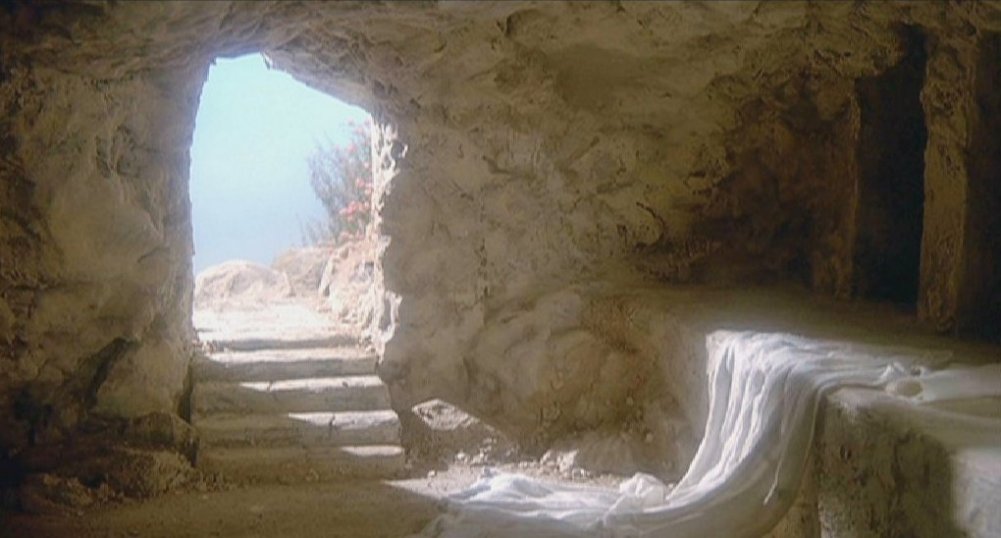
But he said to them, ‘Do not be alarmed; you are looking for Jesus of Nazareth, who was crucified. He has been raised; he is not here. Look, there is the place they laid him. But go, tell his disciples and Peter that he is going ahead of you to Galilee; there you will see him, just as he told you.’ So they went out and fled from the tomb, for terror and amazement had seized them; and they said nothing to anyone, for they were afraid.   Mark 16: 6-8

It is no wonder that they didn’t get it at first.

The distance from his line to theirs
is years of light –
from sorrow to joy,
despair to hope
death row to picnic in the park.

We still don’t get it.
We still haven’t made the perilous journey
beyond the edges of the known territories.
We want mostly to slouch around the tomb
spicing up death
dissecting sorrow.
Misery is kin.
Failure familiar.
But the man acquainted with grief
is intimate with gladness.

And when they arrived,

he was gone.

Of course,
just when you think you are going to put your hands
on divinity,
just when it seems to be holding still enough
to catch
just when swirling matter and energy
hesitates
pauses 

it’s gone to Galilee.

And we are left holding the spices.

Best make a pie
for death will not lie down
to wear grief’s flavor.
There is a joke here,
a cosmic practical joke.

If you go to the tomb
to tend to the dead
and talk to the angel,
you risk losing everything
that holds your life together.
But after you have already
lost most of it anyway
in the event that has brought
you to death’s house,
you really haven’t much to lose.

It is the suffering, the anguish
that has you scurrying at dawn
to touch for one last time
your love.
It is there you may see angels,
when all hope is lost,
all reality laid low.

Then the words of angels
will strike you,
crack you
open
and leave you spilling
down the sides of mercy.

Someone is laughing
and you still damp with tears
had hoped to spend the night
in sorrow’s arms.

A rude affront to ones
adjusted to the gloom,
this grinning angel,
garish almost in his gleam.


This post is excerpted from Quem Quaeritis?Whom Are You Seeking by Loretta F. Ross. This readers’ drama has been performed extensively, including a performance by the Metropolitan Memorial Methodist Church in Washington, DC.
The Sanctuary Foundation for Prayer
Read more about prayer www.fromholyground.org,
Contact the author lross@fromholyground.orgwww.fbook.me/sanctuary
Follow at http://twitter.com/lfross

A Spare, Bare Love

Spring is coming, maybe. A man, whom much of the world will declare is God, is making his way inexorably to death. He is going to do that ordinary thing people do everyday: he is going to suffer and die.

What makes this different is that it is God, who is doing it, and God overcomes the sting of it all by being God, by being One who attains victory, not by escaping evil or by beating it to a pulp, but by surrendering to it and going right through the heart of it, while remaining God.

As we watch Jesus walking toward the cross, we call out: “Don’t do it. Don’t go that way. And for heaven’s sake, don’t ask us to do it, too.” But he, who has set his face like flint, will not hide from the insult and spitting. No, the amazing claim is that this gray day, this aging body, this meager life, this broken world houses glory. And our reluctant following after Jesus is grounded in the slim hope that somehow, some way, this is true.

Spring doesn’t come from some far distant place like an eagerly awaited guest bringing exotic presents.  Spring recoils, bounces up from the heart of winter, and jiggles before us like a jack-in-the-box. The joke is on us.

We strain to turn the crank that sets free joy, and just when our guard is down and we think life is only a meaningless turning to an idiotic tune, out pops Jesus, winking his eye. “Now, die!” he says. We, who thought we were chasing joy and were hot on its trail, find ourselves swallowed up by Life and dwelling in the inner parts of the God who creates joy.  . . .

Amazingly, God wants to be with us and has gone to great lengths to get our attention, even condensing divinity to fit into a mortal being.  And that is almost more than we can bear. What do we know about being company for God? For thousands of years we have been trying to get it right.


 Someone hears a Word from the Lord and says: “Here do it like this. Here are the answers we are seeking.” We give names to Truth. We compose prayers, and rituals. We sew up little suits for Truth to wear. Over time Truth grows beyond the suits. Its legs stretch below the pant cuffs. Shirt sleeves ride up to the elbows. We try to stuff Truth back in its tearing clothes. We sew patches here and there. We get into fights about the right color of patches. We pay more attention to the clothes than to Truth.

Truth condescends to wear the forms we give it, only briefly. Jesus bursts the wineskin of the tomb we called death. The church shudders, draws in its breath and exhales, bursting its seams. Some panic. Some become weary and simply turn away.

When Truth as we have known and cherished it begins to grow beyond the forms which have mediated it for us; that is, language, institutions, and rituals – we may shrug our shoulders and walk away, feeling betrayed.

For a good part of the journey our relationship with the Holy is largely self serving. We seek God for our and others’ benefit. Then during this tedious lent we go seeking help and find a forlorn God carrying a cross.


Jesus asks, “How long have I been with you and you still do not understand? I want to be with you – not just to bring you peace, joy and good, but even more, because I need a place to lay my head.  Will you stay with me one hour?”

“We usually begin our acquaintance with God from the outside in. Jesus is external, beyond us.  I learn about God from the historical record, the witness of the church, scripture – through forms, rituals, disciplines, words, symbols. Could it not also be possible to know God from the inside out? To experience God from God’s interior reality, a reality which the forms seek to represent or express?  “Where are you staying?” John’s two disciples ask Jesus. “Come and see,” he says. And they went and saw where he lived and remained there with him that day. (John 1: 38-39)

How would it be for you to live in the place where Christ lives? To eat and sleep and move about in his home?

The shift from knowing Jesus from the outside in to the inside out may be perilous. The structures of meaning, categories for naming and holding one’s experience and truth, begin to disintegrate. They no longer work to contain one’s experience of self and Christ. We may feel confused. What was certain and absolute seems less so. We may feel abandoned by the God of our past experience. We may think we are losing our faith.

Spiritual growth may involve the pain of withdrawal we feel, as God is yanking our cherished means of knowing Divine Reality away from us. Our spiritual sense is still too unrefined and accustomed to spiritual glitz to appreciate the more subtle flavor of pure faith. Hence we may feel aridity and dullness. 


As God calls us away from familiar ways of knowing God what is left? Nothing but loss and a cross on hill with a dead man hanging from it? Stay there a bit longer. Wait. Be confused. Consent to not knowing or understanding.

Something you cannot even conceive of is preparing to spring up. Something so new, so radically different your mind cannot name is sending out roots in the silent darkness. Tiny tendrils are thrusting through the heavy earth, threading their way around stones to living water. Wait some more.


Oh, it’s hard to bear the ambiguity, the urge to plow up the soil and rip out the root, to hold it to the light, dissect it, name its parts and feel that secure sense of power and control where we can say this is this and that is that. Yet we can wait. We can trust until it stands before us in the morning sun. Then we reach in joy to touch once more our Beloved.

      “Don’t cling to me,” he says. (John 20:17)

Here is a spare, bare love. All that is left is a man walking alone carrying what will kill him, the merciless weight of mortality. Here is only a naked soul surrendered to God, slung from the pillar of its own predicament.

If God could enter into our humanity with humble love, can it be too much for us to do the same? There is no other way into the Kingdom.

Here this is what is so:  we all screw up. We all are limited and frail. And we can rejoice, because we do not have to lie about it anymore. 

Spring tenses in the roots of the pear tree. And all who were ever carried off in the teeth of jealousy or simply in the way of things, all innocence defiled, all vulnerability exploited sink with a sigh into a white dawn that stretches like a shroud wound round the world.

“Come follow me,” the Dawn whispers. And we are invited to take another step into that place beyond knowing, beyond feeling where everything really is all right.

Excerpted and adapted from Letters from the Holy Ground, by Loretta F. Ross (Ross-Gotta)
The Sanctuary Foundation for Prayer
Read more about prayer www.fromholyground.org,
Contact the author lross@fromholyground.orgwww.fbook.me/sanctuary
Follow at http://twitter.com/lfross

Homeless

Black grackles and speckled starlings,
with yellow beaks and rusty throated chatter
clatter up and down the branches
gleaning the leavings of winter’s suet cakes.

A pile of must-read books
litter my desk and the chair before the window
where I come to pray.

Wisdom and knowledge at my fingertips,
and the perfect YouTube video of a good life,
forwarded from friend to friend,
promises to change everything.
Click here now.

How long do you stand on the street corner,
listening to the preachers and barkers?

How long do you slurp up the news,
opinions, and seductions of others?

How long do you sit on the couch
of the world consuming secondhand notions,
lies, and rumors?

When will you sit down before mystery
and invite it to come rest in your lap,

your lap, I mean, your heart and singular, scintillating body?

When do you stop singing somebody else’s song
and chasing somebody else’s god
and coveting somebody else’s experience?

When, oh when,
dear, irreplaceable you,
will you lay
yourself down in your own true,
blue bonnet strewn field of a life?

And say to the starling –
Here come, with your little orange feet and strange black eye.
How precious you are in that freckled jacket.

And I ask you,
how many prayer breakfasts,
committee meetings, and strategy sessions,
how many well-intentioned,
and not so well-intentioned,
soldiers of truth
gathering to plot their version of a perfect world
must we salute?

Just how long will it take, do you think,
for us to be safe enough
and gentle enough
and humble enough

for the shy weary God to come and lay his head? 


Jesus replied, “Foxes have holes and birds of the air have nests,
but the Son of Man has no place to lay his head.” Matthew 8:  18-22 


A YouTube video on Matthew 8: 18-22

The Sanctuary Foundation for Prayer
Read more about prayer www.fromholyground.org, www.fromholyground.wordpress.org
Contact the author lross@fromholyground.org, www.fbook.me/sanctuary
Follow at http://twitter.com/lfross

Kyrie, Eleison

I have been pulling out thorns, stick tights and nursing cuts and scrapes. I spent the past couple of weeks in a briar patch. Tangled up in old resentments, anger, and feeling sorry for myself, I had worked myself  into a wadded mat of prickly brambles.

A briar patch with twisting vines, which cut or trip or cling at every turn, may be a good place to begin lent. In some respects, we, like Br’er Rabbit, are born and bred in the briar patch of human existence. I, however, did not find it as comfortable, as my cousin, Brother Rabbit. I felt trapped and wanted to break free of the barbed burden of myself.

My pride and arrogance coiled around one ankle. My entitlement and envy looped in a thorny noose around my throat. And soul smothering self pity sat on my chest like a heavy stone.

I could not seem to untangle myself. All my efforts only bound me more tightly. And, to tell the truth, I do not think I really wanted to get free. An insidious part of me seemed to enjoy how awful I was feeling. At the same time, another voice was asking, when I was willing to listen, “How happy do you want to be?” as if my happiness was somehow up to my simple consent and my willingness to receive what I desired.

Finally at my wits end and the end of my own strength, I prayed – not for God to fix the things that had me trapped, not for God to turn the briar patch into a luxury hotel, not for God to give me insights, knowledge, or explanations, but for mercy. I asked for God’s mercy – unmerited, undeserving, unearned mercy.

I, sick of myself, surrendered and stopped defending, justifying myself, and arguing with imagined foes. I came to my knees and asked for mercy.

And mercy was given

falling softly like a gentle rain.

Later that same day I discovered I had been set free from the briar patch. The heavy weight of myself was gone. I was no longer chaffing and pulling out splinters.

And the word, mercy,

sounded sweet in my ears,

like music,

like birdsong, unbidden and blest.


Perhaps there is no better prayer than to simply commend ourselves, others, and the whole world to the redeeming mercy of him who died and rose for us. According to Balthasar Fischer, this ancient prayer means more than “Help us!” It means:  “Take all of us with you on your journey through death to life.”


The quality of mercy is not strain’d,
It droppeth, as the gentle rain from heaven
Upon the place beneath: it is twice bless’d;
It blesseth him that gives, and him that takes:  . . .
Though justice be thy plea, consider this—
That in the course of justice, none of us
Should see salvation: we do pray for mercy;
And that same prayer, doth teach us all to render
The deeds of mercy.
Shakespeare’s Merchant of Venice
The Sanctuary Foundation for Prayer
Read more about prayer www.fromholyground.org, www.fromholyground.wordpress.org
Contact the author lross@fromholyground.org, www.fbook.me/sanctuary
Follow at http://twitter.com/lfross

Lent, Suffering, and Weary Pastors

“The reason why pastors are so tired around Easter is because they have to preach about something they don’t really believe and it just wears them out,” announced a colleague to the group of clergy.  Some clergy will tell you their fatigue is due to all the extra services, studies and observances that cluster around the season.  One wonders what it is that calls out the sudden burst of piety and round of religious soirees, if it is not the need to reinforce our sagging faith.


Evelyn Underhill describes spiritual growth as a “series of oscillations between states of pleasure and states of pain which fatigue the immature transcendental powers.” (E. Underhill, Mysticism, p. 381.)  Whatever the cause, the amazing truth of Good Friday and Easter is more than most of us can swallow, let alone integrate in such a way that we remain in possession of the power of the Risen Christ, while at the same time surrendered to that power.


Death is wearisome.  Suffering is wearisome.  Evil wears us down, grinds us down.  As the opposite of creativity, evil employs repetition as one of its weapons.  The slow steady accumulation of minor abuses and violations turn over time into an onslaught, which erodes our best intentions.  Sick and tired of it all, we finally succumb with a yawn and let death have its way with us.


Jesus says, “It is lent. Come on.  Take up your cross and follow me.” Jesus does not summon us to a quick easy death.  He says cross – that slow torment that keeps you hanging around, conscious, gasping, while the body strains and sags against the nails that pin us to our own circumstances and the slow agonizing drag of gravity does its job.


We sink slowly into the earth, the forces of the universe pulverizing us over eons into dust.  At such a prospect, heartily endorsed from pulpits far and wide, one’s transcendental powers, mature or immature, might well benefit from a swig of Geritol.


“Have a Happy Death,” my friend says.  And I go read about those eccentric saints who extol the joy of suffering and actually prayed to share in Christ’s pain.  What did they know I don’t know?


A while back I got a large envelope in the mail with the words SECRETS THAT CAN BANISH PAIN emblazoned across the front.  Inside a Mr. Mark Bricklin promised to send me secrets that would save my life and show me HUNDREDS OF WAYS TO GET FAST RELIEF.  I looked over his offer and decided to take a nap.


Our culture has little capacity to find anything redeeming in anyone who would deliberately seek to suffer. We have a difficult time distinguishing between the suffering of sacrificial love and suffering that is meaningless and self-defeating. It is hard for us to believe that suffering consciously chosen and accepted could be anything other than dysfunctional behavior.



This may be part of the reason why the season wears us out.  This Jesus hanging on a cross for our sakes appears hardly functional.  He makes none of the promises of Mr. Mark Bricklin who exhorts me not to deprive myself and my loved ones of the chance to truly banish pain.  (Mail the enclosed card today!) The effort of leaning up against that cross in a culture that seeks to banish pain, and the real spiritual work of extending ourselves past our exposed doubt deeper into God is more than a little fatiguing.


Spiritual growth may be seen as slowly deepening belief, or the steady erosion of our hypocrisy.  Layers of pretense and self deceit  peel away to expose our fear.  What is revealed is the limit of our belief, its edges.  A good deal of our suffering is that raw exposure of our doubt, our unbelief, to the light of the Risen Christ.  It stings, smarts.  We think we are dying, losing everything.


Perhaps the difference between tragic suffering and the redemptive suffering in which Christ invites us to participate lies not in the amount, kind or quality of the pain, nor in its cause.  What makes one kind of suffering sacred and healing, and another simply one more case of horror and abuse inflicted upon an innocent victim may lie in the extent of our personal freedom to choose how we respond to the pain we experience when others trespass against us.



And here we might look to Jesus, the pioneer and perfecter, “who for the joy that awaited him, endured the cross, despising the shame…” (Hebrews 12: 1-2)  We do not have to love our suffering; we just have to bear it.  We take up our crosses.  We consciously receive the pain that comes our way, not for the pain we must endure, but for the joy that awaits.  In this way we become martyrs, not in self abasing, whining, self-righteous martyrdom, but in the original sense of the word.  Martyr in Greek means witness, one who has seen God and is willing to testify by one’s life that God lives – even in the midst of death and evil and defeat.


Perhaps what those long-suffering saints know that I and Mr. Mark Bricklin haven’t yet grasped, is that what makes suffering redemptive is enduring the cross despising the shame, making light of its disgrace. The self which dies is the ego, the grasping, controlling, faithless part of ourselves which believes everything is up to us.  Unlike Jesus, we do not despise the shamefulness of our suffering.  We despise ourselves instead.  We are humiliated and contemptuous of ourselves in situations of disgrace, defeat and loss which expose our limits.


We want an explanation for our pain.  The ego anxiously searches for meaning in the mistaken notion that in understanding we may find relief.  Jesus does not seek to justify himself.  His focus is not on the cause of his suffering, but on obedience to the One he loves and from whom he came and to whom he is headed in joyful reunion. Jesus does not despise himself, instead he despises that which seeks to humiliate and destroy his identity as the holy Child of God, in other words, his innate goodness and sanctity.  Jesus does not stop loving himself or God in his suffering.
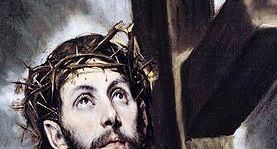

To be beaten, to be rejected, to be abandoned and despised without beating, rejecting, abandoning, and despising oneself is to know oneself as a child of the Holy One.  To suffer, despising the shame, is to remain grounded in one’s essential goodness, even when one has reached the limits of one’s ability to do good.


A blessed lent to you and to Mr. Bricklin too.  May we all enjoy a happy death, a good rest, and steadily maturing transcendental powers.


This post adapted from Letters from the Holy Ground, Sheed & Ward, 2000, written by Loretta F. Ross (Ross-Gotta).
The Sanctuary Foundation for Prayer

Read more about prayer www.fromholyground.org
Contact the author lross@fromholyground.org, www.fbook.me/sanctuary
Follow at http://twitter.com/lfross


Waiting: The Threats

Part Three of Four Parts

Maybe there will be a miscarriage. Maybe the child will be ill or damaged. Maybe nothing will happen, and I have made this all up. The demons slink in and taunt, harass, confuse, lie, and distort. Feeding on our fear, they float in our minds like bloated carcasses.

Impatience, fueled by fear and lack of faith, has resulted in many an aborted Christ child. Dreams, wrenched too soon from the womb of God’s providence, die torn and bleeding in the back rooms of our souls. Fearing that the Promised One cannot be trusted to save us from ourselves, we join the tribe of those who attempt to seize the kingdom by violence.

Yet the promise always comes in the context of threats, writes biblical scholar Walter Brueggemann.

The land of promise is never an eagerly waiting vacuum anticipating Israel. Nor is it an unambiguous arena for faith. It is always filled with Canaanites. That is how the promise comes… It is the very land of promise, the purpose of the whole journey of faith, which causes the failure of nerve. . . .

God’s people always want to settle for something short of promises, because promises fulfilled remind Israel how vulnerable it is, how exposed it is, and how precarious it all is. Promiseless existence is safer. The Bible knows from the beginning that promises are always kept in the midst of threats. Tables are always prepared  “in the presence of my enemies”and if one would eat at the table, one must eat in the presence of enemies. The land is precisely for those and only for those who sense their precariousness and act in their vulnerability. (The Land, Fortress Press, Philadelphia, 1977, p 67-69)

Threats, in whatever form they come, tend to scare the wits out of us. We feel like puny grasshoppers compared to these giants. Possibly the greatest threat, according to Jesus, is the failure to believe, or the lack of faith. There is that time before the pregnancy shows and no one can tell what is inside, and even after one has something visible to point to, like a vision, a possibility, the first faint glimmerings of a new idea, when the actual outcome is shrouded in mystery, and the course of the life of the new one to be born is unknown to us. So we must nourish the invisible, the inklings, the suggestions, and the voice of some ethereal visitor who whispered something wondrous and unbelievable.

Whom could you tell? What would they think? Maybe your lover will understand and give his support. Maybe God will intervene in a dream. Maybe a wise old friend, whose own promise leaps in recognition of your promise, maybe the old cousin will understand.

But there is a long time of hours, days, months, and even years –year upon year, when much is hidden and only you sing in your heart of what is to come, the gift you will offer. And what to do until then?

Fall back on praise and being. Notice the leaf in the redbud tree outside your window, curled and brown crisp in the sun. Stand at sundown as the earth grows still and silence creeps into your heart like a cat and curls up and purrs.

“Blessed is she who believed that the word of the Lord would be fulfilled,” announces the cousin. Blessed are those who believe in the glad and amazing truth that sings in their hearts, trusting with Mary and her Son that all will be well and that they are highly favored.

Watch for the last installment, Part Four, of this series on waiting, The Surrender, coming soon.

This post adapted from the author’s book, Letters from the Holy Ground – Seeing God Where You Are, Loretta (Ross-Gotta) F. Ross, Sheed & Ward, 2000.

The Sanctuary Foundation for Prayer
Read more about prayer www.fromholyground.org
Contact the author lross@fromholyground.org, www.fbook.me/sanctuary
Follow at http://twitter.com/lfross