Choosing Joy

Gabriel:
Since Adam, being free to choose,
Chose to imagine he was free
To choose his own necessity,
Lost in his freedom, Man pursues
The shadow of his images:
Today the Unknown seeks the known;
What I am willed to ask, your own
Will has to answer; child, it lies
Within your power of choosing to
Conceive the Child who chooses you.

      W.H. Auden, For the Time Being – A Christmas Oratorio 


Here it is: a choice – a nod, a hushed “yes,” a hearty “you betcha!” a desperate “Ok what else is there?” Our assent to what seems impossible sets in motion a radically different way of perceiving reality and living our lives.

Many say, “No, absolutely not, no way!” Others – “Well maybe, later, we’ll see.” Or, “I tried it. Nothing there for me.” One cannot fault them too much. We have all demurred, delayed, hemmed, hawed, and held out for what our senses and minds can deliver. One ought to hesitate, for a sword will pierce through your heart too. For this yes is not to a social security card, a 401k, or health insurance. This assent will require the suffering and sorrow that deep down, mature Love asks of us.

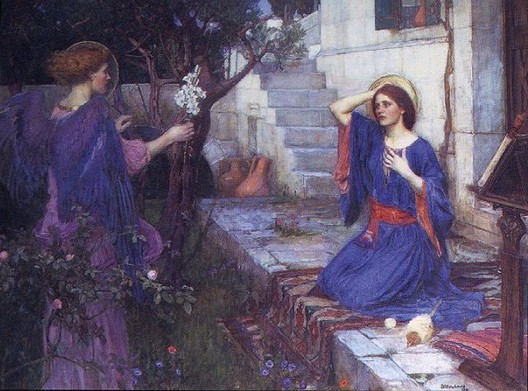
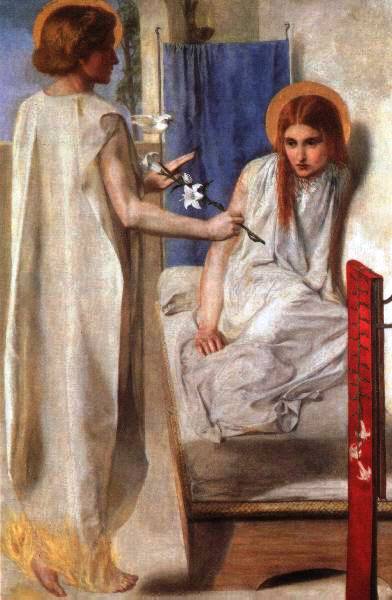
The angel, Gabriel, in W.H. Auden’s poem, holds out the choice and the promise that await Mary and us on the brink of a new year. This notion of choice has been a recurring theme in my prayer and study over the past year.

Moment by moment we get to choose. Perhaps it is obvious to you, but it just slays me.

An angel stands perpetually at the doorway of our hearts posing the question. “Will you conceive, apprehend, take hold of Christ?” What God has willed the angel to ask, our own will has to answer. A dozen times a day we may turn away and polish up our “no.” We embellish it with our needs, our way, our life, our opinions, our truth.

No matter what issue, conflict, trauma, joy, or disaster is unfolding before me I get to choose how I will respond and what sort of “meaning” I will give it. Will I conceive the promise of new life, possibility, and the presence and power of God in the mix of my life experience? Or will I play out some dead-end soap opera with those same sullen resentments and fears?

If I say yes, I assent to live in mystery, to let go of control and surrender to a power and wisdom greater than mine. I choose not to be an American idol, but rather a bit player in a story far more sweeping and magnificent than my own drama.

Come on now. Don’t quibble. Don’t make that angel stand out in the cold, you standing there clutching your worry and anxiety. Take a chance on Love. Go ahead in 2010 and choose the Child who is choosing you.

Get pregnant with Joy!


Read more about prayer at
www.fromholyground.org

Contact Loretta at
lross@fromholyground.org, www.fbook.me/sanctuary

 Follow at http://twitter.com/lfross

 Become a fan of the The Sanctuary Foundation for Prayer

The Shepherd’s Story


Once in the fields in a storm
hunched down in a cave
I saw a red tongue of fire
leap from the heavens
lick down a cedar,
and split it in two.

The cloven tree shuddered
and screeched
as it crashed to the ground,
like an animal in the jaw
of some great beast.

________

It wasn’t what you’d think –
lovely heavenly hosts
in neat rows and pretty song.

It was mostly wings and terror.

Cold night
stars like ice
fire down to coals
flock settled in the fold.

Some scattered for cover, crying
the world is ending
which it was,
but not the way you think.

Fear –
tomorrow’s frets
yesterday’s regrets –
that ember of anxiety
that never goes out
no matter how much religion
you throw at it –

fear rose up and choked me.

The great heaping clouds
of wings
and the Word that wrote itself
in the marrow of my bones
split me
into before and after
and left me puddled
on the ground
soaking into mystery.

Most don’t reckon the sheer terror
of God crashing into their lives.
I learned fear was not my enemy,
but a sign of His presence.

Ignorant and blind as a wood tick
on a lamb’s flank,
I’d been crawling
through a patch of fleece
and a bit of warm skin
without a clue
as to what is really going on.

I froze, stupefied.

The sovereign almighty God was asking
something of me,
God wanted me,
my will,
the way I held my world together in my
wood tick brain
my perceptions and understanding
my sense of competence,
my adequacy
seized and consumed by wings.

A master’s painting?
A Messiah chorus?
A quiet pastoral scene?

It was gasping for air,
trying to stay upright
with not a thing to hang onto.

What’s the Almighty to do –
all hobbled up with majesty
finally having to slip in the back
door
of the world
through a virgin’s womb?

It was Truth
taking aim
condensing its enormity –
its hosts and universes,
its fire and power and goodness –
and homing into me
like a dove returning to her nest
like a lamb turning to the breast.

It wasn’t what you’d think.
It was mostly wings and terror.

Then, something so plain
and ordinary,
a baby,
and a Love small enough
for me to carry.


For who can endure the day of his coming, and who can stand when he appears? Malachi 3:2
One Christmas I got a good dose of the awesome power of God. I wrote this poem in an attempt to describe that experience.  I love the way Annie Dillard puts it: “On the whole, I do not find Christians, outside of the catacombs, sufficiently sensible of conditions.”
May the Almighty God knock your socks off this Christmas!

When Hope Fails


Hope is what gets a lot of people through the Christmas season. And the failure of hope is what leaves some souls shipwrecked on the treacherous rocks of the sin and imperfection of this world.

What is it for you this year? Death of a loved one? Spouse in Afghanistan? Unemployed? House foreclosed? Cancer?

Hope is the presentiment that the imagination is more real, and reality less real, than we had thought. It is the sensation that the last word does not belong to the brutality of facts with their oppression and repression.  It is the suspicion that reality is far more complex than realism would have us believe, that the frontiers of the possible are not determined by the limits of the present, and that miraculously and surprisingly, life is readying the creative event that will open the way to freedom and resurrection.  Rubem Alves

She was fourteen. She sat next to me as we drove home after the Christmas Eve service. Lights sparkled from distant homes across the snow covered fields. Shattered with pain and trying not to show it, I tried to focus on driving. After a while she spoke out of the darkness, “Mom, things aren’t ever going to be the same, are they?”

That year, our family had been struck by a blow from which we would never fully recover. In spite of  brave efforts, prayer, and sacrifice we could not put back together what was broken and, perhaps, fatally flawed.

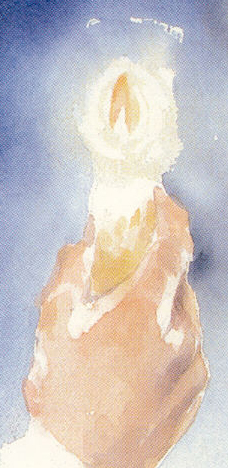
During that season of suffering, hope became nearly eclipsed by fear, anger, shame, and pain. Each evening I turned briefly from my grief in defiance of “the brutality of facts with their oppression and repression,” and lit a candle for hope. Even though I felt no hope, I let the candle hold my hope for hope.

In those days I clung to the verse of scripture the minister preached at our wedding. Remember thy word to thy servant in which thou hast made me hope. This is my comfort in my affliction, that thy word gives me life. Psalm 119: 49-50 What an odd text for a wedding, you may think. Yet as the years unfolded it became more and more meaningful. I prayed it, holding God accountable to the goodness promised to me in scripture and whispered to my soul. God’s promise of joy, peace, and love comforted me and gave me the ability to keep breathing in my affliction.

Carmelite writer Constance Fitzgerald writes about the movement in our spiritual journey from “naïve hope to theological hope.” Through experiences of loss and suffering, naïve hope in a Santa Claus god and other illusions nurtured by our egos give way to a different, richer kind of hope. We let go of placing our hope in our own efforts, our own goodness, our own “luck” or deservedness. We let go of our “right” to ourselves and our way. Or perhaps it is more accurate to say, we numbly watch our way wrenched from our grasp. We face our helplessness and the truth that we are not in control. Hope in oneself and one’s little plans and projects dies on the cross of our life experience.

It is there in that stillness of a drive back home on the worst Christmas Eve in one’s life, while a child’s heartbreaking question hangs in the air, that hope in God is born.

You may miss it at first, especially if the pain is choking you. But refuse to let the last word be the brutality of facts. Go ahead and light that tiny candle. Defy the darkness. And pay attention. A baby is on its way. Something fragile and new and unimaginably sweet is making its way into your consciousness. 

I tell my daughter, “Yes, honey, things will not be the same. But I believe somehow or other, things will be all right.”

And they were.

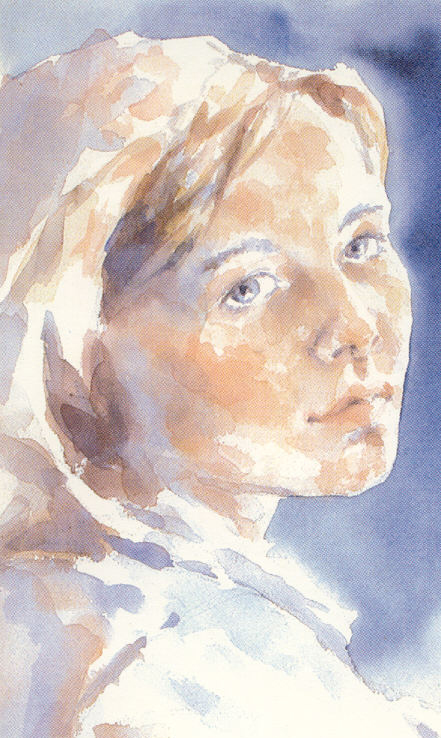
Special thanks to artist Anne Emmons for her permission to use “Hope” in this blog. You can reach Anne at anneemmons_8@msn.com or on Facebook. 

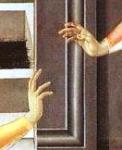
Here is Anne’s story about this painting:  I was trying to think of one moment in the Biblical narrative which captures the theme of hope.  Each year I have made a new image for Christmas since 1997, and in 2000, I was struck by the idea of hope as the source of light. The images in this series reflect the thought that Christ came, the Light of the world, into darkness. So I was thinking about one single moment in the story and I realized the moment Mary heard the announcement from the Archangel Gabriel must be the moment hope found a form, in her face. At the time, my daughter was almost 14, the estimated age of the Virgin Mary, and I suddenly connected with the story in a particular way. I kept her home from school that morning to have her sit for the painting. What struck me, and this has since been confirmed from other sources, most recently Anthony Bloom’s book, Beginning to Pray, was that the Incarnation was possible only through God’s will in union with the “yes” of the young Mary, who became the bearer of the Uncontainable God. Just after I painted this I saw the Pontormo Annuciation in a small side chapel in Florence, and Mary had the same sort of look of wonder I tried to catch.  Now my daughter Claire has a two year old son, Theodore. She is a single mother who said yes to the birth of this child, whose name she chose, not knowing it means “gift of God.”

Read more about prayer at www.fromholyground.org

Contact Loretta at
lross@fromholyground.org, www.fbook.me/sanctuary

 Follow at http://twitter.com/lfross

The Virgin Daughter of Jerusalem

A virgin is someone who is free of all false images and is detached
toward God’s dearest wish and ready to fulfill it unceasingly, as was Jesus.  Meister Eckhart


 My small daughter, playing with the holy family in the wooden stable sings her lullaby: Round yon urgent mother and child, holy infant so tender and wild.

 This mother, more urgent than virgin, smiles: Yes, Holy Infant tender and wild, you are so wild, so undomesticated, so radically other than anything known and familiar. No matter how hard we coax, you will not eat out of our hands, but remain out in the timber hidden in the brush. We set out bait, offerings on the snow. Cowboy theologians toss ropes into the forest and lasso decoys.  And roughrider ecclesiastics try to corral you in sedate doctrines.          

_______________

The virgin daughter of Jerusalem sings at the gate. In the dark we lay a trail of bread crumbs to our door. We wait, stilled, hushed. Come,  Lord Jesus.

But who can stand when you appear? The earth shudders, mountains topple, creatures shiver with fear. Shots ring out in the forest. Innocence awakens and moves toward us and the rough hand grasps for its lost treasure.

The virgin daughter of Jerusalem stands on the path and suddenly she is falling, falling into the blue sea into the wide sky, falling through pain and fear and despair, falling faster and faster, picking up speed, plummeting like a stone, falling through a tunnel formed at the intersection of the cross hairs in the telescopic sight aimed at redemption where opposites meet and all things come together.

She is whizzing down the tunnel like a child’s slide, sleek and silent, silver in the sun, falling free. And the kingdom does not suffer violence, and she is not taken by force and the two, who have been made for each other, delight to have found ground holy enough to hold each other’s purity, ground strong enough to bear each other’s pain. And in her joy she funnels greatness from the wideness of her hope down the narrow passage of her being into us.

So now I pray for passionate virgins who have died for love and dwell beyond the clutch and fever of desire. I pray for eccentric virgins who live on the outskirts of propriety and raise geese and talk to trees. I pray for violated virgins and their reconsecration. I pray for virgins who find the courage to reject the lie that eats away their souls and leads them down a winding path of mirages and fun house mirrors that mock Truth.

I pray for virgins who know they are only as holy as they are willing to see how horribly they have been profaned, and how horribly they profane.. . .I pray for revolutionary virgins who despise the shame and take up the suffering for the joy that awaits. I pray for virgins whose land, enclosed by strength, is untouched and guarded by a flaming sword. I pray for virgins, who with unveiled eyes gaze unflinchingly at evil and at God and live to tell the tale. I pray for virgin martyrs who are witnesses with the conviction to believe their own eyes. I pray for chaste, intrepid, impeccable virgins incapable of doubt.

I pray for virgins who apply themselves to prayer until their souls become clear focused lenses, through which we spy enlarged for us the intricate dazzling structures of divinity. And God, hidden in the forest, is magnified by them; and glory sprints across the clearing kicking up a cloud of blessing.

And I pray for a virgin with a heart which dilates. A bold virgin, who when she has grown as big as she can be, when she has come to the outer reaches of her being and all that she thinks and knows and hums to herself, will give up encompassing Plentitude. I pray for a virgin who becomes Emptiness, who will let go of her edges, the taut boundaries that separate this from that, and flinging herself like crumbs in a fragrant trail from what was once her heart to the forest will say: Let it be to me according to your word.

And the shy, tender God takes the bait. And she and holiness are won. And their child tumbles wet and wild into the wounded world to heal us with his stripes.


 _______________

Virgin comes from Latin and means literally slender branch, twig or shoot. The original sense of the word is a person who is one in him or herself. Such a person is free from possession and possessiveness and capable of the total giving of self, body as well as soul. The virgin aspect is that which is unpenetrated, unowned by humanity. It does not need to be validated or approved by anyone to know its own innate worth. Virgin carries much of the same intent as the word for holy, which means set apart, the temple. The parthenon (literally the virgin’s place) was the temple to Athena on the acropolis in Athens. In the New Testament virgin is used to depict the host of the redeemed in Revelation and to refer to the community as the bride of Christ. But by far the most frequent use of the word virgin is in the Bible’s figurative description of cities, nations, and communities. We often find virgin daughter as an expression for Jerusalem.

Excerpted from  Letters from the Holy Ground, Chapter 10, “Urgent Mother and Child – Holy Indifference and the Repose of the Virgin,” 39-43.

More about prayer at
www.fromholyground.org

Contact Loretta at
lross@fromholyground.org, www.fbook.me/sanctuary

 Follow at http://twitter.com/lfross

An Advent Story

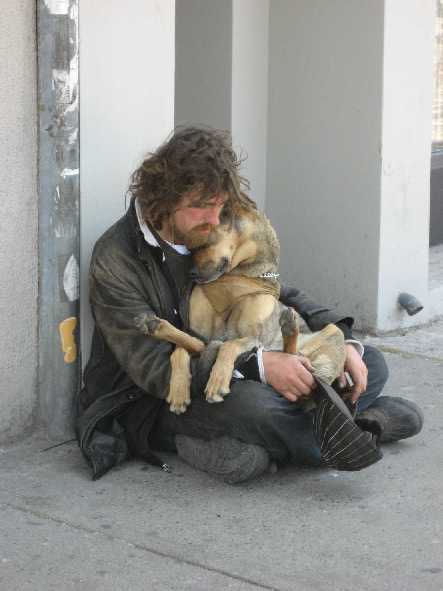
The people gathered in small clumps, on this Sunday early in Advent, chatting and laughing before entering the sanctuary.  Some sipped coffee while they caught up on the week’s events.  Outside in the bright sun the children were playing.  A man with a yellow dog who was walking by the church stopped and asked the children for directions to the rail yards.

The children invited the man into the church.  They tied his dog outside and brought it a bowl of water and someone gave it a cupcake.  They led the man to the preacher, telling him that the stranger needed directions and a little money for food.

The preacher, tall, well-groomed in his black robe and satin stole looked at the man and caught the smell of whiskey.  He invited the man to worship and said that afterwards we’d see about some food.

That Sunday amid the handsome suits and stylish dresses, the colorful wool sweaters, and the neatly styled hair and deodorized bodies, sat a man in a torn jacket, baggy pants and wearing shoes with cracked soles. 

They had gathered on this morning to keep their observance of Advent.  They spoke and sang of things to come, of waiting, of expectation, and of hope.  The minister admonished the people to be alert, on the look-out, for Christ might come at any moment.  Afterwards the people went downstairs for a pot-luck lunch and an afternoon of games and songs and making gifts for shut-ins.

The man in the torn coat did not join them, though he was invited.  He sat on a gray folding chair upstairs and talked about Jesus and wept.  He said he knew he had done bad, that he was just a bum.  He rode in empty boxcars across the country with his dog.  Then he said his father sold him when he was six for a case of beer.

The pastor was uneasy.  He needed to be downstairs to say the grace.  Was the man’s story true?  How many other churches had he been to that morning?  He handed him a sack of food and drove the man and his yellow dog to the rail yards.

The children who had found the man asked their teacher why he had no money and why he wouldn’t stay with them and how could your parents sell you and wasn’t his dog wonderful and would he come again?  “I don’t think so,” said the teacher.

Christ entered our midst, right on schedule with our liturgical calendar, wearing a torn jacket.  His only follower was a yellow dog.  There was whiskey on his breath.  He saw quickly how the inn was full. 

We told him politely as possible that we just didn’t have much room for folks who ride boxcars and have a problem with alcohol.

Once a young student asked a rabbi how it was that no one ever saw God any more.  The rabbi responded:  “Because nowadays no one is willing to stoop so low.”

Think of the person you have most despised, whom you have found utterly repulsive, revolting.  See that person in your mind.  Recall your disgust.  Now answer this question:  Who did you think it was that needed to be loved, anyway?

For God so loved the world . . .

http://www.flickr.com/photos/crowstoburnaby/170684833/
                                                 

This post is an excerpt from a Reader’s Drama I wrote many years ago, titled Adventually – Waiting for the Messiah. It is also a true story.


More about prayer:   www.fromholyground.org

Contact Loretta at
lross@fromholyground.org, www.fbook.me/sanctuary

 Follow at http://twitter.com/lfross

Thanksgiving Reverie

My ninety six year old mother dozes in her chair. Her toast remains half eaten on the tray. The dog sleeps at her side.

Frost last night. Now bright morning sun streams through the windows. The refrigerator hums. Outside the gnarly cedar with its silvered bark shelters the house. When did it get so tall?

Memories – laughter, faces of loved ones, snatches of conversation, four dogs romping in the back yard, good food – play in the mind.

Today is Black Friday, the make or break retail sales day of the U.S. economy. Only twenty eight days until Christmas.

There is no rush here. No need to shop.

All is calm
All is bright
Round yon mother and dog.

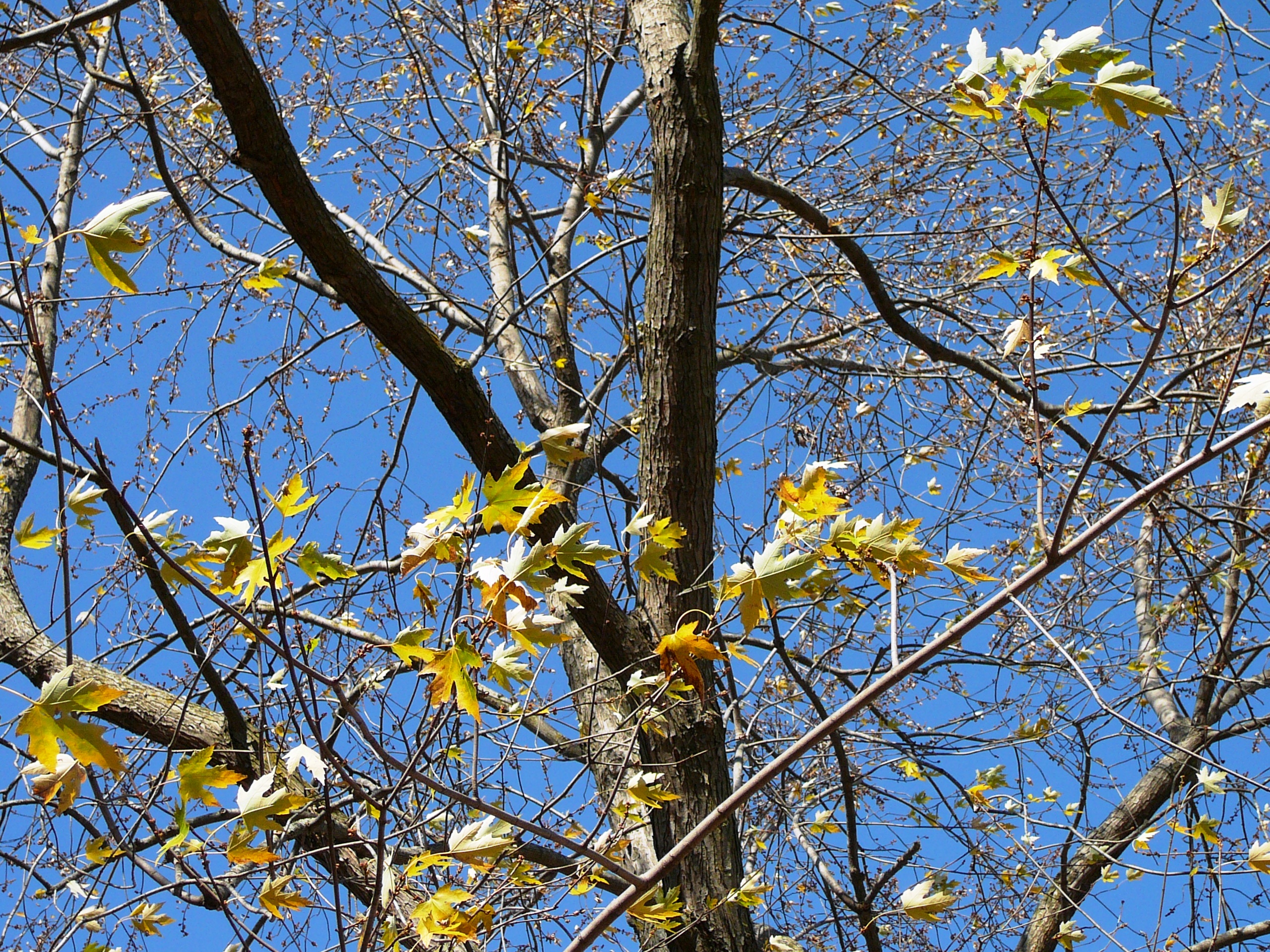
Here in this old house on Madison Street, whatever it was we thought we needed to do has given way to the art of being – of watching the leaf shadows play on the trunk of the cedar, and peering long into the deep blue sky.

The mother dozes. The dog stirs, turns on his side. His breath is slow and deep.

The air is tender and mild. Nothing to disturb the flow of grace.
Relax. Christmas already came here a long time ago.

Read more about prayer at
www.fromholyground.org
Contact Loretta at
lross@fromholyground.org, www.fbook.me/sanctuary

Follow at http://twitter.com/lfross

Prayer Boots – Part 2

This post is a continuation of last week’s, Prayer Boots – Part 1, a chapter from my book, Letters from the Holy Ground.

This summer a friend and I had a yard sale.  For a week I hauled boxes from attic and basement.  The children and I lugged baby clothes and infant swings to the dining room, where the kids promptly set up house.  “Remember this?  O Mom, look!  I remember this cute little dress.  I really looked so sweet in it, didn’t I?” they chirped sounding like they were eighty years old.  Cicelia spent two hours playing with the Johnson and Johnson baby blocks.  They had a tea party with the chipped china sitting at the little red table with their knees up to their chins.  Each box held wonder.  “Look mom, these beautiful curtains.  Can I have them in my room?”  Diana crowed, pulling out the tattered remains of the drapes that hung in our first apartment.

 Later that evening she came to me.  Holding a tiny blue sock to her lip and tucking her head under my arm, she said softly, eyes glowing with the rapt smile of one who has seen a vision of angels, “Oh Mommie, I remember me.”

Something forgotten, something precious, tender and pure that Diana called me had been recovered for her in that tiny sock.  When I asked what she meant, she said, “Well I just remember myself when I was a baby.”  That tiny sock I could never keep on her foot took her back to a pre-verbal time where she was held, rocked, nursed, sung to. It was a place where me dwelled, the essence of her being in the holy ground of the womb.  And she stilled her non-stop seven year old inquisitive mind to forget herself, to pay attention, and remember who she is: a child cradled in the loving bliss of One who is larger, kinder and more beautiful than she, and in whom she lives and moves and has her being.

She still crawls in bed with me in the mornings, her coltish long legs and arms poking, thrashing around, giggling, telling me jokes and that she loves me so much. She seeks herself in that safe place, before she bolts into her day of dolls and math and spelling and exuberant surprises. I wish we could all come to our prayer with her trust, playfulness and devotion.

I stared in shock whenever I passed the dining room with all those cartons brimming over with my past.  This is the room where we gather to pray, to recount our salvation history, to remember and receive the Eucharist.  Boxes lined the walls.  Infant seats and infant carriers and infant bottles and infant sleepers, undershirts and socks spilled all over the space where we sing songs of love to Mary’s baby.

My daughters poked about in their past, where we come to poke in our past, holding it to the light, turning it over in our palms, wondering what sort of price it would bring, praying God to be merciful.

The sale was one day only.  My friend and I sweated it out, swilling ice tea, tallying our profits and losses. During lulls in business, stricken with visions of having to haul all the stuff to the dump, we rushed about with markers slashing our prices.  “Everything must go,” we resolved, as we paused to fold one last time the sleeper we had laundered and folded so many occasions we had lost count.  We smoothed tiny collars and wrote $.10 on the stickers.

The Age of Aquarius macrame went, along with the tires, decrepit lounger, ice crusher, and malt maker.  We carted off my friend’s wedding gown, the fondue pot and five or six boxes of baby clothes to the thrift shop.

It was afterwards as I was picking up hangers and empty boxes from the floor of the room where we, breaking the bread and lifting the cup, do as he asked. Gathering up scraps of newspaper and tags, I saw the little nightie on the table.  It was then, forgetting myself in the mystery that rocks us all, and holding the soft worn flannel, sweet with baby scent to my cheek, that I remembered me.

One of the deepest mysteries of holy ground is the mystery of identity.  When God meets Moses at the burning bush, the two exchange their identities.  God calls, “Moses, Moses.”  The call is unique, distinct.  There can be no mistaking who is being summoned.

Moses’ response is the classic prophetic response to a call from God:  Henanni, or Here I Am.  After Moses receives his mission, he presses this burning Reality for its identity.  “Who shall I say sent me?” he asks.  And God responds, “Tell them that I Am.”

Holy ground is the place of exchange where I Am meets Here I Am, where What I Have Been will be transformed by Who I Am Becoming, where I forget what I thought I was and remember I am.

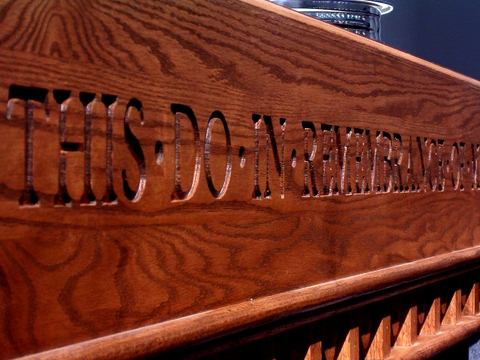
On just about every communion table I have ever seen are carved the words:  “Do this in remembrance.”  The little sacraments of our lives are those graced moments of holy communion when we do something prayerfully and in remembrance.  We release our grasping and coping. Then bread is transformed into the body of Christ, a blue sock into an angel’s wing, and a mortal being into a being in God.

God instructed Moses on Mt. Sinai to make holy garments for Aaron and his sons, including a plate of gold engraved with the words “Holy to the Lord,” which Aaron was to wear on his forehead, apparently to help everyone keep their parts straight.  My boots came with a tag that read: “Genuine Leather, Ozark Trail.”  They didn’t have any with gold plates.  I’ll try to remember my part anyway.

These days you can buy all kinds of prayer paraphernalia:  crystals, incense, podcasts of famous pray-ers, cds of words of power, icons, statues, pictures of Jesus in a startling array of poses, holy bells and whistles, oils and unguents.  My hunch is that it’s best to travel light, and you could do a lot worse than to get a good pair of boots.

Why not do it in remembrance?  Maybe we’ll meet on the trail.

Read more about prayer at
www.fromholyground.org

Contact Loretta at
lross@fromholyground.org, www.fbook.me/sanctuary

 Follow at http://twitter.com/lfross

Prayer Boots – Part 1

I am off to do some teaching and visiting with family. This week and next, I offer here in two parts a chapter from my book, Letters from the Holy Ground. Get some boots and go pray.

bootsI went to Holton Farm and Home Store last week and bought some praying gear, boots, warm socks and gloves.  I selected a pair of sturdy waterproof boots from the row of five buckle galoshes next to the watering troughs.  I think I am ready now.  I purchased the boots with money friends at the church I served gave me when I left. I kept the money, which came attached to the leaves of a prayer plant, for a whole year not knowing just how to spend it.  I considered books, office supplies and liturgical accouterments.  Now I see that proper prayer vestments include boots for walking over this land we call holy.

The more we pray, the more we discover prayer’s richness and power, and the more we hunger for it.  In its essence prayer is simply paying attention to God.  And that turning of the will to God, that choice to attend to God, is how we participate in making holy ground.

There is a temptation in the spiritual life to talk about praying, to read about it, to write about it, to attend workshops on it, to preach sermons about it, to feel guilty about not doing it, to build edifices where it is supposed to happen- anything but the scandalously simple, yet arduous task of doing it.  In contrast to our institutions of theological and religious education, the one thing the disciples asked Jesus to teach them was how to pray; and Jesus taught them by simply praying. “Here, do it like this,” he said.

So I am praying, turning my attention to God more intentionally and for longer periods of time with no particular result in mind beyond a simple open presence to the Holy One.  A good deal of this praying is happening on the land.  And when you stalk holiness in autumn in Kansas, you need a good pair of boots.

Crouched under the cedar in the rain, sloshing along the winding creek, following the deer trail up the gully, I try tocedar branch forget myself in prayer that I might remember who I really am.  I imagine hiking toward a place of being so self-forgotten in God that one needs nothing external to validate oneself.  Is it possible to follow the path to holy ground where the communion of prayer alone feeds and sustains us and the earth?

Perhaps our task is not so much making holy space in our lives, as becoming holy space ourselves. One way of becoming holy ground is to remember who we are.  And we are often quite convinced that we most certainly have been forgotten. That may be because we just can’t bear the wonder and joy of love.  Is that why Love stood before us that night before we killed Love and told us: “This bread is my body…this wine, a new promise sealed in my blood.  Don’t forget!”?

“Don’t forget,” Love said.  “I beg you not to forget.  For when you forget, you hang me back on the cross with your lies and self deception and fear and heedless stampede over my tender presence in all creation.”

communionStill we do forget.  Psychiatrist Gerald May writes that we often do not remember experiences of communion with God, because they are so threatening to our egos. The loss of self-definition characteristic of unitive experiences arouses unconscious fear. Wiping off the chalkboard of our spiritual experience, our officious ego scolds, “Let’s just forget this ever happened and go back to worshiping me as almighty in your life.”

 What might you need to remember?

 More next week…

 Gerald May in Will and Spirit (San Francisco: Harper & Row, 1987) Chapter 5.

Read more about prayer at
www.fromholyground.org

Contact Loretta at
lross@fromholyground.org, www.fbook.me/sanctuary

 Follow at http://twitter.com/lfross

Letting Go

leavesThe gold canopy outside my window has disappeared. For two weeks light, filtered and gilded by maple leaves, shed luster on the yellow carpet beneath. The luminous scene drew me into in a warm cocoon of whispering leaves. I listened to their stories of summer, their losses and gains, and their sweet good-byes.

Now stark branches make black scribbles on the wan blue sky. The dove perching with her head under her wing seems so exposed. The leaves on the ground curl like an old person’s hand, mottled and transparent. Only a few leaves remain on the branches, twisting in the wind, straining against their stems.

The season of letting go, of loosening one’s fastenings and sailing out into the unknown, comes round again. Too soon. A November nostalgia settles over me, that curious longing for lost opportunities and for what was, which, in retrospect, reveals those things, which were more important than you ever realized at the time. November – a time to disrobe, to remove what is no longer serviceable and send energy into the depths, the root of things.

Someone did something that really hurt my feelings. I have carried the wound for a week or two. It still smarts and brings tears when I take it out and look at it. I believe God is telling me to let it go, to have compassion for this person and her suffering. I don’t want to though. I wonder if there is something I need to listen to and learn from in the intensity of the pain. It is one of those situations where there is really little I can do, but move on with generosity and amnesia, until forgiveness moves in.

So, let’s turn back to the leaves. The word used to describe the process of a tree shedding its foliage is senescence – getting old. The eleventh month impresses upon us the reality of aging, of time running out, as the year winds down. As the days shorten, the green chlorophyll is destroyed and oranges and reds in the leaves are revealed. The tree is preparing for winter dormancy and draws all the nutrients in the leaves through the stems and down into the roots. The sugars and amino acids that are produced, instead of the chlorophyll dependent upon the sunlight, serve as a kind of antifreeze for the tree. leaves sky

At the place where a leaf stem fastens to a branch, there are two kinds of cells. The part of the stem attached to the branch contains waxy impermeable cells. These are called the bundle scar and contain the bud of next year’s leaf. The cells connected to the leaf itself are softer and snap easily in the wind and rain.

I watch a lone leaf near the top of my neighbor’s tree. It flutters, twists, turns in the wind, then releases itself and drops floating down through the huge dark limbs, finally settling lightly on the earth below like a sigh.

Oh to be drawn so gracefully by the tug of gravity into the arms of God’s providence. How glorious to ride the wind, to be tossed and blown. I think I should like to die in autumn or early winter, dropping like a late hanging leaf from a very tall tree. I am grateful to the leaves this year and their lesson to let go, to surrender, to fall, and come to rest at the foot of the tree of life. I am grateful, too, for bundle scars, that place that heals the wound of separation with the promise of new growth.

“Let go,” the leaves say as the wind sends them scuttling up the street under the moon. “Let go.”

Brown leaves

Read more about prayer at
www.fromholyground.org, www.theprayinglife.wordpress.com

Contact Loretta at
lross@fromholyground.org, www.fbook.me/sanctuary

 Follow at http://twitter.com/lfross

Small Things, Great Love

messy officeMy desk is a rat’s nest of notes, files, cards, books, pens and unfinished projects. A pile of bank statements and bills waits on the credenza. I am writing a blog, an essay, and a book, as well as meeting with clients, preparing for classes at church, responding to pastoral care needs, and planning for youth group. I have several presentations coming up and other projects on hold. My pantry ought to be roped off as a hazardous area. Then there are the meetings to attend, my 96 year old mom, my daughters, friends, pets, and oh, yes, God.

If this does not sound like the life of a hermit pray-er as I describe myself on the About Page of this blog, bear with me. I am still praying. I suspect things might be a little more organized and tidy if I were not, but overall things would be a bigger mess.

This week I received two quotes from friends in my email. One was from Mother Teresa: “We can do no great things, only small things with great love.” The other was from Charles Spurgeon: “Learn to say no. It will be of more use to you than to be able to read Latin.” Here’s where I went wrong. I took four years of Latin in high school.

Charles H. Spurgeon was a 19th century English Baptist who preached to crowds of ten thousand in London. As many of us, he had his hand in a lot of other things as well. I figure you know who Mother Teresa was. Both of these busy servants of God came into my life this week to offer their two cents on how to handle something which afflicts not only pastors, but just about everyone else I know.  Overwhelmed with tasks, stressed, and anxious many of us need to learn how to say no. Moreover, we need to learn to say no not only to other people, but also to ourselves. For I have found most of us are usually the most demanding, unreasonable, and, frequently, atheistic boss we have.

Recently someone described how she is simplifying her life. She asked herself why she was doing what she did, and was she really called to this. When I find myself on the treadmill of over doing, I notice an odd thing that happens to me. The more I am trying to do, the more I think I need to do, until I totally lose perspective and am worrying about accomplishing things, which in more sane moments I realize I do not need to do. This loss of perspective and over functioning which feeds on itself is a characteristic of addiction.

Mother Teresa says, “Don’t sweat the great stuff – getting big projects, big plans accomplished. Instead do small thingsBook on shelf with great love.” I like that. I can do that. Stay in the present. Put the file away carefully with reverence. Respond to this email thoughtfully with love. Gratefully gather up all the scattered pens and pencils. Put the books back on the shelf with thanksgiving. See the wonder of God’s provision in the goodness of this moment, as I think of you, yes, you, with love and gratitude. Just tend to the next small thing with all the love and generosity you can bring. Leave the outcomes, the great ends to God.

“The smallest thing, touched by love, is immediately transformed and becomes sublime,” wrote Thomas Merton. I still need to learn to say no, but I also want to learn how to work in such a way that what I touch becomes holy. I think it is all in the focus. Is God the center of my concern, or my Latin assignment? It makes all the difference.

Assignment: Practice doing small things with great love this week. Let me know how it goes.

More about prayer –
www.fromholyground.org

Contact Loretta –
lross@fromholyground.org, www.fbook.me/sanctuary

Follow on Twitter