It begins with a cry 
a muffled sob at midnight
a “Help me!” filling the dark alley with terror
a fist banging on the door
a numb, blank stare and a hand, clenching and unclenching a ball of tissue
a sudden lurch and collapse, facedown in the open field
This is how it begins, what we call Christmas.
Salvation is summoned by its negation.
The Savior is called forth by the raw expression
of the creation’s need,
the howl
that rises from the shattering
collision of what is with what should be.
Christmas begins when God hears
And God heard the voice of the boy… Gen 21:17
I have heard their cry on account of their taskmasters. Ex 3:7
Do not be afraid, Zechariah, for your prayer has been heard. Luke 1:13
Christmas begins when God sees
I have observed the misery of my people who are in Egypt. Ex 3:7
My tears will flow without ceasing, without respite until the Lord from heaven looks down and sees. Lamentations 3: 49-50
She answered God by name, praying to the God who spoke to her, “You’re the God who sees me!” “Yes, he saw me; then I saw him!” That’s how the desert spring got named God-Alive-Sees-Me Spring. Genesis 16: 13-14
Christmas begins when the earth turns, writhes, and lifts up its lamentation. When the protest of the human heart joins its sorrow with the heart of the One acquainted with grief,
then
you step out of the forest
and into the clearing
to place in our hands
a child
wet and wild.
Here is my answer, you say.
And the name of the child is
Love.

Posted in Advent, Christmas, Contemplation, prayer, The praying life
Tagged Advent, christ, Christmas, God hears, God sees, human need, Jesus, salvation, suffering

Not enough time, not enough energy, not enough hope, not enough money, not enough jobs, not enough room, not enough love, not enough peace …
not enuf nuthin !
So goes the lie.
As the holiday season of plenty, hope, and generosity opens its arms to us, some of us brace ourselves, suspicious of the season’s glittering wares. The family, who lost their home to foreclosure, the unemployed factory worker, and other despairing and heartsick souls may feel plenty is beyond their reach and scarcity their new normal.
The media depictions of holiday cheer play on our insecurity and sense of lack. They insinuate that no matter how much we have, we do not have the latest and greatest. Advertisers lure us with promises of more. We may find ourselves stumbling after ghostly phantoms in the desperate hope that this year we might find that illusive wholeness we are seeking.
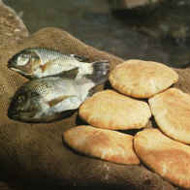
How does one feel whole and fulfilled, when one is more aware of scarcity in one’s life? Perhaps abundance in the midst of scarcity occurs for us as it did for Jesus, when he fed five thousand people with five barley loaves and two small fish.
We welcome what we have,
however meager.
We give thanks,
and watch it multiply.

Practice a Miracle: The Welcoming Prayer
Here is a simple, yet demanding, exercise to practice such a miracle in your own life. It is called The Welcoming Prayer. It was developed by Mary Mrozowski, one of Thomas Keating‘s closest associates and a prime mover in the development of centering prayer. She based the Welcoming Prayer on the 17th-century French spiritual classic Abandonment to Divine Providence by Jean-Pierre de Caussade as well as Fr. Keating’s teachings and her own lived experience of transformation with its underlying attitude of surrender. There are a number of variations on this prayer. Here is one.
FOCUS AND SINK IN:
-
Become aware of what is troubling you or occupying your mind. For example, your sadness, anger, or fear regarding scarcity of some kind in your life. Focus on your feelings, both cognitively and physically, noting how and where the feeling affects your body.
-
Instead of resisting, or feeling ashamed or denying, welcome the truth of what is troubling you. Welcome the feelings with curiosity and compassion.
LET GO: (Here is the hard part)
- Let go of your desire for power and control over the situation. Release your desire to be “right.”
- Let go of your desire for affection and esteem from others.
- Let go of your desire for survival and security.
- Let go of your desire to change the way things are.
REST :
-
Allow yourself to sink into the abundant flowing love of this moment.
The present is ever filled with infinite treasure; it contains more than you have capacity to hold. … The will of God is at each moment before us like an immense, inexhaustible ocean that no human heart can fathom; but none can receive from it more than he has capacity to contain, it is necessary to enlarge this capacity by faith, confidence, and love…French priest, Jeanne Pierre de Caussade
You may find the letting go section of the prayer difficult to do. One or two of the desires may be harder to release than others. Think of this as useful information about what things, other than God, are of primary importance in your life. Notice which desires might be getting in the way of your freedom in Christ. If you find you cannot release one of these, you might simply pray that God give you the desire to desire to let go.
The Welcoming Prayer invites us to trust in God’s presence and providence and to discover the infinite wealth of God available to us in each moment. “The divine will is a deep abyss of which the present moment is the entrance. If you plunge into this abyss you will find it infinitely more vast than your desires,” writes de Caussade.
I believe this is absolutely true. Over and over in the midst of distress, I have wrung my hands about there not being enough of one thing or another in my life. Yet as I have focused and welcomed the feelings and my present reality, let go of my ego’s desires, and rested in God, my need has been supplied with an abundant depth and power that swept away all my grasping and anxiety.

I heard the geese honking at dawn last week. My dog halted at the door and cocked his head and we listened together in wonder. I love the sound of them moving over head, giving themselves to the skies. Trusting in their ancient faith they make their way.
In spite of all appearances to the contrary, I believe there is enough.
The Wild Geese
Abandon, as in love or sleep,
Holds them to their way
clear in the ancient faith:
what we need is here.
And we pray not for new earth or heaven,
but to be quiet in heart
and in eye clear.
What we need is here. Wendell Berry
I trust in you, O Lord. You are my God.
My times are in your hands. Psalm 30:1

This post is a lightly edited version of a previous post. May this season fill your cup with overflowing goodness and a steady supply of all that you need!
Posted in Contemplation, prayer, Gratitude, Spiritual Practices, Thanksgiving, The praying life
Tagged abundance, detachment, Jean Pierre de Caussade, letting go, Scarcity, Thomas Keating, trust, Welcoming Prayer, Wendell Berry

“There’s a limit!” Mom yells up the stairs. My brother and I are throwing plastic race cars at each other. It is bedtime, and we have been arguing and annoying each other for half an hour. Mom yells again. “If you kids don’t settle down, I am coming up there with a stick with a bee on the end of it.”
That usually did it. The thought of the miraculous power of our mother, who could coax a bee, stinger and all, onto the end of a stick, and stride up the steps, wielding the buzzing weapon, aiming it at our bottoms,
sobered us right up.
Mom, ninety eight, now lives at Pleasant Manor Care Center and chuckles when I remind of her ability to settle us down.
Her words, there’s a limit, have been coming back to me lately. As I watch the news, listen to the pundits and politicians, and observe my own little world, I hear her saying in that no nonsense way, “There’s a limit!”
There is a limit – to what people can stand, when their boundaries are violated. There is a limit to what people can bear, when their basic needs are unmet, or they are unable to meet them themselves. There is a limit to the foolishness, whining, blaming, and fighting people can take. There is a limit to what the seas, rivers, forests, and the creatures that make their homes in them can survive. There is a limit to human ability to repair, mend, and change. There is a limit to how much suffering, how much trauma a person can endure before he loses hope, meaning, and his mind.
There is a limit. And limits are good.
There are places in creation which dare not be plundered, usurped, or penetrated. These virgin territories of purity and goodness, by definition need to remain separate, apart, and whole in themselves. There is a holiness, which dwells in the core of individuals, communities, and the creation itself. Respect for the singular distinctions of creation lies at the heart of reverence for life itself.

IN PRAISE OF BOUNDARIES
Glory be to God
for bounds and limits.
Thanks be for fences
and for barbed wire
pad locks, bolts
and abrupt unmoving
dead ends
for stop signs
ramparts
split rails
outlines
outskirts
contours
confines
borders
margin, hedge and rim
shore, bank and brow.
Blessed art Thou
for shalts
and for shalt nots
for oughts and shoulds
for prohibition
inhibition
and command.

I praise Thee
for enclosure
circumference, courtyard
croft, crib
corral and coop
pen, balustrade
and fold
for chamber
hutch and manger
paddock, cote and stall
for palisade and parapet
trellis, enclave, wall.
“To be properly bound
is to be properly free,”
said Luther of his God.

So blessed be Thee
for bindings, wraps
and swaddling cloths
for all quilts, covers,
comforter and counterpane
for lids, roofs, tents
hulls, shell, and pod
and all that partitions
holy from profane.

Thank you,
kind and gentle God
for edges, parameters,
and the delicate beauty
of borders thin
that separate this
from that
yes from no
the skin
from the juice
and Thou, sweet Trinity,
from me.
Oh Mighty Fortress,
glad hosannas raise to Thee
for the secret custody
of houses, stable,
shrine and temple
for garden locked
and fountain sealed
where Love tabernacles
under Thy bright wing
in shielded sanctuary.
Praise and laud
forever unto Thee.
Oh Thou art
a most exalted Canopy!
In thy strong shelter
sleeps the virgin
safe and free.

All creatures great and small,
be wary!
Posted in Christianity, Contemplation, prayer, spirituality, The praying life
Tagged boundaries, cloister, holiness, holy ground, limits, preserving the sacred, Trinity
I cannot for the life of me
figure out
how people who love God
good people
faithful people
are able to spend so much time
talking about God
reading about God
and running here and there
doing God’s work
and not have to stop.
And bow.
Awestruck.
Lost in love.
Every five minutes or so.
I know well the sweet seduction
of anxiety, power, and that little harlot,
ego.
I have fallen for their whispered lies,
and empty promises.
I have wakened from a night
in their arms,
unsatisfied, restless, and fretful.
But, I ask you,
do we not have a clue
that the Beloved is in the room
disrobing
right before our eyes?
How many epiphanies are omitted
from the minutes
of last month’s meeting?
How can we go on pretending
that Holiness is not breathing
shivers of ecstasy
down our necks?
Am I crazy?
Probably.
But I am also sick and weary of sitting on this Wonder.
Don’t be surprised then,
when I rise up and prostrate
myself
during Carl Mitchell’s report
on the cost of replacing the pews
with movable chairs.
I just couldn’t go on pretending any longer,
and this hungry Love has taken me
beyond propriety,
decency,
and order.
The kingdom of Heaven will come when men and women
allow themselves to be penetrated by bliss. M.C. Richards
Posted in Contemplation, prayer, Ephiphany, Sabbath, Spiritual Formation, Spiritual Practices, The praying life
Tagged adoration, church leadership, church meetings, love, sabbath, worship

Courage is being scared to death – but saddling up anyway. John Wayne
“Church people are too nice to each other. They need to grow spines,” a friend said to me the other day. My friend was commenting on the surface relationships, which exist in some faith communities, where we all want to get a long at almost any price and work really hard at being nice. A member’s problematic behavior is tolerated, at the expense of developing a healthy community. Neither the deep needs of the member, nor the needs of the community as a whole, are addressed, and both suffer.
Perhaps you have heard someone comment about a member who is overbearing, controlling, or in some other way hard to take, “Oh that’s the way he is. That’s just how he does things. He means well. Don’t take it personally.”
From my vantage point of thirty years of pastoral ministry and thousands of hours spent listening to church members and pastors in spiritual direction sessions, people do take it seriously, when they are run over, ignored, or otherwise misused. They take it very seriously. I have watched new people walk away and never return after a hurtful encounter. I have seen older members pull back and clergy stymied by power struggles. I have observed churches stuck in relational impasses for years.
Why does no one speak up? Why does a church system seem to harbor and implicitly support bad behavior in the body of Christ? Where did we get the notion that following Jesus meant that we were supposed to be nice? The word nice originates in a Latin word meaning ignorant, literally, not + knowing. In its original use in the thirteenth century nice meant foolish, stupid, or senseless. Today nice means agreeable, pleasant, or satisfactory.
Jane Austin captured the tired, feeble sense of the word in this passage from Northanger Abbey:
“I am sure,” cried Catherine, “I did not mean to say anything wrong; but it is a nice book, and why should I not call it so?” “Very true,” said Henry, “and this is a very nice day, and we are taking a very nice walk; and you are two very nice young ladies. Oh! It is a very nice word indeed! It does for everything.”
When Christianity is reduced to being nice people, it loses its spine and the energetic power of Christ among us.

Many factors may foster spineless Christians. Maybe I am related to the irritating individual or live with him. Perhaps the person has influential friends, or contributes a lot of money. We keep still, because we are afraid of offending others, or being attacked, or rocking the boat.
We also may be enmeshed as integral parts of a codependent church system in which we find ourselves manipulated by another. Codependency is a psychological condition, which develops when one’s behavior is controlled or determined by another, who is ill with an addiction to a substance or a behavior.
In such cases we walk on eggshells, work behind the scenes, have parking lot conversations, protect, and placate the person in question, while the system stays stuck. We help perpetuate the dysfunction and become sick ourselves.
Most people do not like confrontation. We shy away from speaking the truth as we see it, because it doesn’t seem safe. Instead we swallow our truth, question our own perceptions, try to make do, and from time to time acquiesce to bullies.
Of course, there are times, when we have good reason to be afraid. And, likewise, there may be occasions, when it is best to not confront someone, who contributes to problems in congregational life. There are times to step back, pray, and wait on the Holy Spirit to resolve impasses. There are times for us to grow in our understanding of ourselves and others. We always will see only part of what is going on, and our particular analysis may be incorrect.
Further, it is important to note that the so-called problem is not with the so-called problem person. The issue is not what we need to do about him or how we can control or manipulate her. The issue is ultimately with us, who are experiencing it. The issue rests with my particular and limited view, and my responsibility and willingness, not to change someone I do not like, but to share my perspective with humility and love in service to the greater community.

My responsibility is to be an expert witness to my reality and experience. Such witness might sound like this: when Susan does this or says that, I feel like this – angry, controlled, sad, hurt, left out, etc.
Such responsible truth-telling with love and humility may open doors of deeper understanding and freedom for everyone. Fear can grip an individual, a family, or a community in such a way that the fear becomes a lie, which obscures or distorts a larger truth. Such a lie may seriously compromise the mission of a church. Whenever fear and its expression in “being nice,” become a bigger motivator, than love and honesty, something is seriously amiss.
Jesus offered a different answer to a religious establishment and an empire, which used fear, threat of ostracism, and power to control its members. Instead of becoming terrorized, or becoming a terrorist, Jesus “set his face like flint,” as he turned to Jerusalem to look fear in the eye, calmly grounded in a sense of something larger, more loving, more powerful, and stronger than fear, which would sustain him and the whole world with him.
And then he said to those who watched, “Follow me.”

What would the world look like, if we were motivated by faith and love, instead of fear? The fear response, lodged in the brain stem, is primal and necessary to survival. Yet what does fear motivate us to do – circle the wagons, huddle together, adopt a world view of scarcity, and become rigid, defensive, offensive, and suspicious? Such postures hinder generosity and imagination. Faith, which requires trust in the unseen, is blocked by fear. Without faith, the flow of the Spirit through hearts in love with God is obstructed.
I am not sure that we know how to speak our truth and disagree without resorting to anger, blame, and attack. I am not sure we really believe there is a common ground beyond our dissent. Deeper truth is revealed as smaller truths are shared with courage and love. Discovering God’s will for our communities requires all parties to surrender to something greater than their individual points of view. We need, both to hear individual perspectives, and to bow to a larger more encompassing vision, which asks something heroic of each one of us; namely, to give up our way, even our lives, for the larger good of the whole.
I believe there are Christians with spines and with the courage to be Christian, who create spaces where the bullied and the bullies, the controlling and those who feel controlled, the powerful and those without power come together in mutual appreciation and surrender to the One beyond fear who offers abundance and sanctuary to all her children.
We all need to hear and be heard, to listen and to speak. The Holy Spirit with her bright wings dwells in the naked soul of each member of the body of Christ. We dare not silence any voice. It only takes a few divinely inspired souls to change the course of history or the climate of a local church.
May we all find the courage to set our faces like flint against the ghostly shroud of fear, which diminishes us and turns our spines to Jell-O. Then let’s saddle up and head out toward the Reign of God with possibility, love, freedom, and justice for all.

Posted in Christianity, sin, Spiritual Formation, Spiritual Practices, The praying life
Tagged Christianity, church, church leadership, Codependency, community, conflict, Difficult people, fear
You know the feeling: the noose slowly tightening around your neck, or that heavy ball and chain around your ankle, which you drag through the day.

Or, perhaps for you, it is the windowless room of your mind with that mean interrogator under the bare bulb, harping all day long and into the night: “You will never . . . You will always . . . You can’t … Who do you think you are?”
When I first heard the phrase, “areas of unfreedom,” I didn’t understand my teachers. (My spell checker doesn’t understand either.) I was just beginning to learn about the dynamics of spiritual growth, what in a simpler time we used to call discipleship or sanctification. “Huh? I’m free,” I thought. “This is the USA.” The Spirit had yet to show my inner prison.
My jailors were the assumptions, unexamined beliefs, and negative thoughts which operated below my awareness. This gang of ignorant, fear mongers, and liars had formed a portion of my self identity, that is, who I thought I was, and what I could, or could not do with my life.

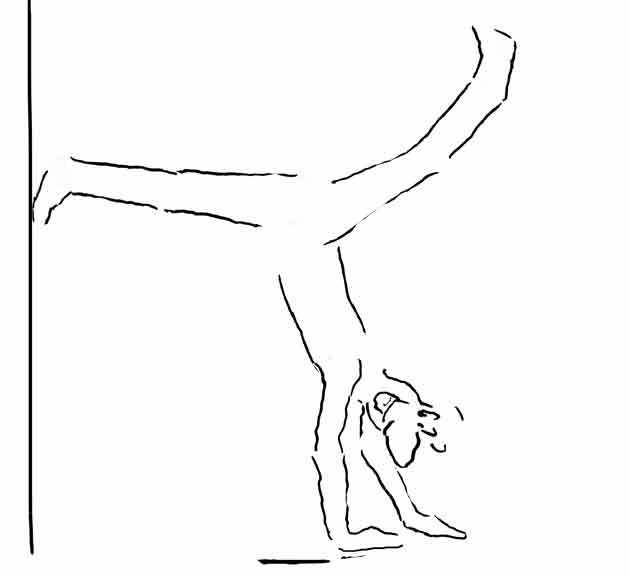
The other day one of these creepy little sadists gave me a swift kick in my solar plexus. Our teacher asked us to put our hands on the floor and kick our legs up into the air against a wall and balance on our arms. “Just try it,” she said, urging us on, “like when you were a kid. Your arms are strong enough to hold you.”
“Oh, yes. I can do this!” I thought. I have done many head stands and arm balances in my life. “Now just bend over, straighten your arms, and kick yourself up against the wall. No problem.”
As I took a few steps toward the wall, a dark, choking fear suddenly rose up in me and stopped me in my tracks. I was stunned. It had been over twenty years since my last hand stand, but I had stayed in shape and my arms were stronger now than ever. Where had this fear come from? I was safe here. There were people to catch me, if I fell or stumbled. I was dumbfounded. How did this happen in me?
“You’re too old,” my jailor sneered. “You can’t do things like this anymore. Pay attention to me or you will hurt yourself.”
Most of us have places of impasse in our interior world, where we feel stuck, fated, or chained to a particular understanding of ourselves, which limits our future unnecessarily. Sometimes these aspects of how we see ourselves are unconscious. Though not apparent to us, such beliefs may deeply affect our lives.

I have a little pile of quotations and scripture verses above my desk. The other day I pulled this one out and put it on top.
And the day came when the risk
to remain tight in a bud was more painful than to bloom.
This is a poem by Anais Nin, a woman whose life I do not entirely recommend, but certainly demonstrates that wisdom is not the property of only the straight-laced and conventional.
The path of spiritual growth calls us to break out of the constraints of our tight little buds. There is a point where the risk of opening to an unknown possibility is less than the pain of remaining bent over in the tight room of a constraining self conception.

Nin’s words remind me of Jesus’ urgency to break the boundaries of his ministry and his own chosen human mortality with his words:
I’ve come to start a fire on this earth—how I wish it were blazing right now! I’ve come to change everything, turn everything right side up—how I long for it to be finished! (Luke 12:50 Message)
Jesus expresses the urgency of his desire to burst beyond the expectations of his disciples and followers to fully express his purpose on the cross. There was so much more he had to offer than the healings, miracles, and teaching along those dusty roads and little villages.
The process of spiritual transformation confronts us over and over with those places of unfreedom in ourselves, which have us tied in knots, weighed down, or locked into a tiny cell. With a punch in the gut the Spirit may reveal how we are imposing limitations on ourselves, which have nothing to do with God’s will for us, but a lot to do with what others have told us, or assumptions we have picked up from the culture.
Paul reminds the Galatians, who were caging themselves with religious rules, “Christ has set us free to live a free life. So take your stand! Never again let anyone put a harness of slavery on you.” (Galatians 5:1 Message)

I am standing about six feet from the wall in my living room. My teacher thought I could do this. I know there are people older than I who do this. I have a choice. I can stay in the tight bud of my fear and be safe and be too old for this. Or I can keep trying until I do it.
Your goal might not be a handstand. For that matter, mine may not be a handstand either. I just whacked my foot on a piece of furniture, giving it another try.
However, more is at stake here than gymnastics. Spiritual growth requires flexibility, strength, and elasticity of soul. What might be keeping you in a constrained and incorrect conception of what you are capable of?
Simply recognizing the fear, or the faulty belief, allows it to dissipate. The sun is shining. Come on, sweetie, you know you can no longer resist its warming rays. You can do this.
I am yours, kicking up my heels, here in Kansas.

– Love and Gratitude in a Season of Sorrow

I had breakfast this morning with Billy Collins, American poet laureate. We met on the patio at dawn. I chewed my breakfast bar, while I watched him chew his thoughts – snatches of his days – savored, digested, and transformed in that warm oven of his imagination into tasty little scones.
And, the Lord is my witness, the man reached across the table under the tan umbrella and deftly placed the buttery sweetness into my mouth with his long, elegant fingers.
The trees were full of glad chatter, tweets, and whistles. Down the block a car started up. I slowly relished Mr. Collins’ scone, so rich and luxurious, beside my sensible protein bar. My dog, snoozing at my feet never noticed, when I fell in love with charming Billy. But that brown squirrel on the power line might have seen the cockeyed gratitude oozing out the corners of my mouth and running down my chin.

Here, help yourself to one of Billy’s scones:
As If to Demonstrate an Eclipse
I pick an orange from a wicker basket
and place it on the table
to represent the sun.
Then down at the other end
a blue and white marble
becomes the earth
and nearby I lay the little moon of an aspirin.
I get a glass from a cabinet,
open a bottle of wine,
then I sit back in a ladder-backed chair,
a benevolent god presiding
over a miniature creation myth,
and I began to sing
a homemade canticle of thanks
for this perfect little arrangement,
for not making the earth to hot or cold
not making it spin too fast or slow
so that the grove of orange trees
and the owl become possible,
not to mention the rolling wave,
the play of clouds, geese in flight,
and the Z of lightening on a dark lake.
Then I fill my glass again
and give thanks for the trout,
the oak, and the yellow feather,
singing the room full of shadows,
as sun and earth and moon
circle one another in their impeccable orbits
and I get more and more cockeyed with gratitude.
I know. Life is hard, even horrific. I wish I could give you answers and take away the pain. All I have is Billy. Take down a glass. Fill it to the brim with homemade gratitude. You know the kind, fermented with what is handy – the cat sleeping in the sun, the hot coffee in the brown cup, the yellow feather –
and sing a little cockeyed canticle of your own.


I am indebted to insufferable stinkers for a good deal of the understanding I possess. The people I dislike the most, usually have the most to teach me.
I enjoy nearly everyone I meet, but I have come across some corkers. I think this is because God has so much to teach me about myself and love. When I hit a learning plateau, the Almighty with a sly grin sends a new teacher into my life to help me over the hump.
I work in a profession where my job description is to love everyone, including my enemies. Such an expectation holds one’s nose to the grindstone, as the Holy Spirit sets out to polish and refine her servants in the friction of human relationships.
I am grateful that love is deepened in us in this way, because if I could have discounted the difficult, or avoided the boring I would be far more difficult and boring myself. So I give thanks for all the needy, self-centered, mean-spirited, self-pitying, abrasive, annoying, and crazy, scary people, whom Christ places before me to welcome and love.
Without these opportunities I never would have discovered how much I have in common with such lack luster, irritating souls. I would have felt no responsibility to change my impression of them or curiosity about the source of my aversion. I would have missed out on the wealth of gifts they bring to me in their outstretched arms and infuriating ways.

I think you know the sort of people I am talking about: the ones who enrage you, disgust you, upset you, or frighten you. Among these are people who are so easy to dislike, that you may take a perverse joy in dwelling on their shortcomings and talking with friends about just how awful they are.
Forbearance is a word seldom heard these days, except in its legal sense as an agreement to delay a mortgage foreclosure. As the word appears in the Greek scriptures, to forbear means to refrain from doing something and refers to patient endurance and self-control. Forbearance is the virtue of bearing with another’s sins and weaknesses. Forbearance is more than refraining from saying what is on the tip of your tongue, rolling your eyes, or wringing someone’s neck. Love enables us to bear with one another; and disciplined prayer and self-examination help us to love.
Sometimes my negative response to another may involve my unconscious projection of some unattractive attribute of myself, which I have not fully accepted. We tend to see our own flaws more clearly, when they show up in others. The offending party mirrors my own vexing habit. Or perhaps the negative feelings I carry for some other person in my life become attached to the person before me, who has some resemblance to my nemesis, and the unwitting soul must endure my unconscious dislike of him.
Or maybe – I just do not know the whole story.

He stopped me at the end of the meeting. He was the kind of person who, if you were in a hurry, you might duck down a hallway to avoid one of his tedious monologues. The man took forever to get to the point and gave you a whole lot of details that didn’t seem all that important and led to long, winding digressions.
As I listened, I felt the impatience and irritation rising up in me. Yet, because I was called to love and accept him, I took a breath, prayed and listened. I watched my internal irritation, wondering what it might have to tell me about the man and about myself.
I began to see that what I was feeling was instructive and likely how others felt listening to him. How hard that must be for him. What was going on here? Why was it so hard for him to be clear and concise?
I sensed in myself anxiety. Was he anxious too? Yes, I could see that now. He was anxious to be heard, fearful of being dismissed, of being devalued, or ignored. I recognized that needy feeling to be approved and valued in myself.
Who had made him feel this way? Where did it come from in me? That was when, in a flash, I glimpsed his suffering and all I wanted to do was give this man my total attention and acceptance. I realized that it didn’t really matter what he was saying as much as receiving someone’s caring attention. There might be a time later to explore the roots of his digressions. For now I wanted him to know how it felt to be heard without worrying the person you were talking to was eager to walk away.
Compassion rearranged my calendar, and I had all the time in the world to listen.

Rudy Rasmus is the pastor of Houston’s, St. John’s Downtown, a church with one of the most culturally diverse memberships in the country. Speaking to the United Methodist Kansas East Conference in 2010, Rudy said, “The kingdom is big enough for all the people you are afraid of, or think are wrong, or that you can’t love.”
Of the 9000 members at St. John’s 3000 are or were formerly homeless. Part of Rasmus’ success is due to his ability to help his members learn to move past judgment to compassion. In his address last year he asked his audience to practice compassion. His exercise went like this:
With attention on the person [you are judging] say to yourself:
Just like me this person has known sadness, loneliness, and despair in his or her life.
Just like me this person is trying to avoid suffering in his or her life.
Just like me this person is learning about life.
Then he shared what his Auntie used to tell him, “Rudy, people only do what they know to do.” The safer and more valued a person feels in my presence, the more they share of themselves and the more compassionate I become, as I grow in understanding and appreciation of the child of God before me.
The words of Oswald Chambers have helped me over and over to listen, to be curious, and open my heart to another, even when I don’t feel like it:
“Of every person there is always one more fact of which you know nothing.”
Put up with each other,
and forgive anyone who does you wrong, just as Christ has forgiven you. Colossians 3:13
Disclaimer: Any resemblance here to former or current church members, clients, friends, relatives, or dear readers of this blog is purely coincidental.
All the corkers I have known are now dead or live on Mars.
The way I see it, a mystic takes a peek at God and then does her best to show the rest of us what she saw. She’ll use image-language, not discourse. Giving an image is the giving of gold, the biggest thing she’s got… Hurling and wielding the best stuff she can imagine, insisting on an unmediated Way of Wakefulness,…she agrees to the quiet morning hour in front of God in exchange for a bit of revelation. She doesn’t ditch tradition as much as take it for its word and peer inside its cavernous shell. There must still be something worth saying. There must still be something worth pointing to.
-Jessie Harriman in God Laughs and Plays by David James Duncan

I greet you with my pockets turned inside out, holding out a few crumbs I picked from the seam.
Most every time I write this blog, I write from such a place of intellectual and spiritual poverty, that I feel like I am scraping gum off the sidewalk to offer you.
Oh, I have plenty of previously written material. Some of it you might like or find useful. I also seem to have an endless supply of ideas, opinions, and questions we could take up together here. However the longer I sit in that quiet morning hour waiting for a bit of revelation, the more stale and the less true all my previous thinking and posturing appear to be.
Something in me insists on peering into the Mystery anew each time I write. This is both an irresistible delight and a harrowing encounter with my own empty pockets.
I haul myself and the collected wear and tear of personal and world events before the throne of Great Stillness. There I reach out beyond my limits and press my palm in the face of Mystery and say, “Here. Here. Put it here.”
Then I wait.
In that waiting there is only the ache of love – nameless, infinite, ever beyond my control.
“Trust” was the word I found in my palm this week. Trust? That old thing? How many times does this word turn up in scripture and in the words we say to each other? How about something new, fresh, maybe a little edgier?
Thousands of children with stick legs and arms are dying in the horn of Africa. A young man just nineteen years old came home to the little town up the road, where he was buried with military honors. Global markets, drunk on anxiety, dip and sway, fall and crawl up again. Politicians argue. A self-styled prophet of God goes to prison for doing unspeakable things to little girls.
Holy One, the world is going to hell in a hand basket and all you can offer is trust?
Trust in the Lord with all your heart,
And lean not on your own understanding;
In all your ways acknowledge Him,
And He shall direct your paths.
Do not be wise in your own eyes;
Fear the Lord and depart from evil.
It will be health to your flesh,
And strength to your bones.
Proverbs 3:5-8, New King James Version
So – help yourself these crumbs:

Trust in what you cannot fully know or name or understand, or write about.
Trust in the enduring love in your heart that weeps with compassion and yearns for justice and struggles
to know what to do in these challenging times.
Trust in your conviction that God will not be defeated by the evil and sin of humans.
Trust that Someone is afoot, knitting together the broken bones of Christ’s body.
And most amazing of all:
Trust that our trust and faith are the salve,
which heals all wounds.
And he could do no miracle there except he laid hands on a few sick people and healed them.
And he wondered at their unbelief. Mark 6:5-6
Posted in Contemplation, prayer, Prayer, spirituality
Tagged christ, Christianity, David James Duncan, emptiness, God, Jesus, Mystery, Prayer, Religion & Spirituality, trust, writing

I have been dining at the glib café too frequently. I have been listening to too many bitter, angry, paper-hearted ones, locked in their own glare. I am turning from the table of TV dinners of MSNBC, CNN, and POX News – that alphabet soup of garish headlines, cynicism, blame, and eternally breaking bad news.
Instead, I am taking in the words of scripture. Poet and scholar, David Rosenberg exposes anew the dive of imposters, held captive in their own minds. His translation of Psalm 1 feeds me with the truth of the word of the infinite.

Psalm 1
Happy the one
stepping lightly over
the hearts of men
and out of the way
of mind-locked reality
the masks of sincerity
he steps from his place at the glib café
to find himself in the word
of the infinite
embracing it
in his mind
with his heart
parting his lips for it
lightly
day into night
transported like a tree
to a riverbank
sweet with fruit in time
his heart unselfish
whatever he does
ripens
while bitter men turn dry
blowing in the wind like yesterday’s paper
unable to stand in the gathering
light
they fall
faded masks
in love’s spotlight
burning hearts of paper
unhappily
locked in their own glare
but my Lord opens
his loving one
to breathe embracing air
David Rosenberg, A Poet’s Bible
Oh won’t you meet me there for dinner in that living word
and embracing air?
Shall we together part our lips lightly for this feast?

Posted in Christianity, Contemplation, prayer, Scripture, Spiritual Formation, Spiritual Practices
Tagged Bible, Breaking bad news, David Rosenberg, Lectio divina, news media, Psalm 1, Spiritual reading