I have been dining at the glib café too frequently. I have been listening to too many bitter, angry, paper-hearted ones, locked in their own glare. I am turning from the table of TV dinners of MSNBC, CNN, and POX News – that alphabet soup of garish headlines, cynicism, blame, and eternally breaking bad news.
Instead, I am taking in the words of scripture. Poet and scholar, David Rosenberg exposes anew the dive of imposters, held captive in their own minds. His translation of Psalm 1 feeds me with the truth of the word of the infinite.

Psalm 1
Happy the one
stepping lightly over
the hearts of men
and out of the way
of mind-locked reality
the masks of sincerity
he steps from his place at the glib café
to find himself in the word
of the infinite
embracing it
in his mind
with his heart
parting his lips for it
lightly
day into night
transported like a tree
to a riverbank
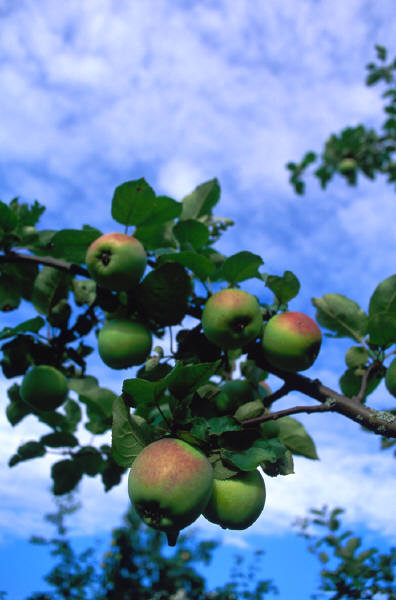
sweet with fruit in time
his heart unselfish
whatever he does
ripens
while bitter men turn dry
blowing in the wind like yesterday’s paper
unable to stand in the gathering
light
they fall
faded masks
in love’s spotlight
burning hearts of paper
unhappily
locked in their own glare
but my Lord opens
his loving one
to breathe embracing air
David Rosenberg, A Poet’s Bible
Oh won’t you meet me there for dinner in that living word
and embracing air?
Shall we together part our lips lightly for this feast?
Posted in Christianity, Contemplation, prayer, Scripture, Spiritual Formation, Spiritual Practices
Tagged Bible, Breaking bad news, David Rosenberg, Lectio divina, news media, Psalm 1, Spiritual reading
Silence and Awareness Retreat
The one journey that ultimately matters is the journey into the place of stillness deep within one’s self. To reach that place is to be at home; to fail to reach it is to be forever restless. At the place of ‘central silence,’ one’s own life and spirit are united with the life and Spirit of God. There the fire of God’s presence is experienced. The soul is immersed in love. The divine birth happens. We hear at last the living Word. N. Gordon Cosby ( Foreword to Search for Silence by Elizabeth O’Connor)

“Our task here is to pay attention to what is,” our teacher said at the beginning of our eight days of silence.
Not what was, or should have been. Not what might be, or ought to be, or what we hope or wish will be – our task was to pay attention to what is so: the content, tone, and felt experience of this moment, now here, and then gone with each new breath.
One learns a lot from disciplined practice of the present moment. As I watch the fleeting shadows of the mind’s picture show, I encounter my restlessness and my estrangement from my deepest self, where holiness abides.
Day after day I watch my ego stride with a flourish to its pulpit to justify, defend, or convince imagined audiences of its own certainties. Persistent and untiring, it plants its elbows on the podium and tightly grips the sides in its effort to prevail against the horror of its disappearance, its diminishing and dying in the embrace of Love.
All the while, as we sit still as stones, Love stalks us, waiting just beyond the edges of the mind to pounce upon his prey and carry us between his teeth into the divine depths of each moment.
Southern novelist Flannery O’Connor writes that it is human nature to resist grace. So I do what comes naturally, as my mind turns to memory, constructs castles of the past, and walks back and forth among its dim corridors. I note, “remembering,” and then turn to planning lunch, my trip home after the retreat, a writing project, and the next five years. I write fiction and spin yarns. I grow paranoid, making up stories about the people who pray with me. They must think I am too noisy and move around too much. I get the giggles and think, if we were not all so dear and earnest, I imagine God would find what we are up to here hysterically funny.
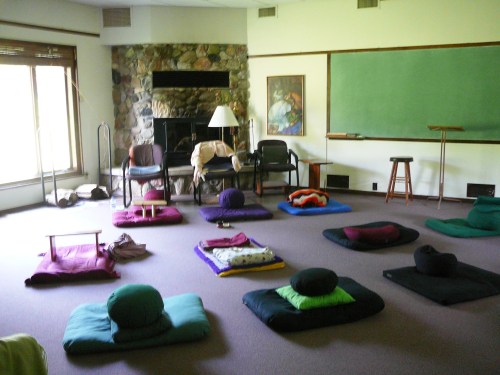
My chin itches. I watch the irritating sensation and overwhelming desire to scratch it finally disappear. I hurt. My neck aches, my shoulders burn, my leg falls asleep and turns from pricking needles to dull heaviness. I breath and watch the fullness and release of pressure change and muscular contraction that draw in and expel the air.
Paying attention to what is feels like being trapped to most of us artists of the great escape. How dull, how boring, how wasteful of time, how tedious this mind I am burdened with.
Yet we kept at it and didn’t want it to end. For in between the spaces of the mind and the complaints of the body, we supped upon the sweet communion of I Am, the God who said his name was unembellished Being itself, Yahweh, what is. Beyond language and images, beneath the anxious ego, we became absorbed by the murmuring intimacies of the soul and God, an interpenetration and exchange beyond our knowing to which we simply consented.
One day in meditation my mind conjured up this poem, written nearly twenty years before. The poem is about the contemplative practice of prayer, an experience of God which never fails to deeply root me in reality and in the depths of God’s presence within me. It is a practice that changes, heals, soothes, and sets me free for joy and service. And for me it is all about Jesus.

This is my body
peeled back
broken open for you.
In my palm blazed suchness,
a torn fragrant crust of what is so.
O Common One, you are so plain,
so familiar, so simple
that we miss you
in our desire for some other novelty.
We seek you in mystery, ritual,
knowledge, and magic – all the things
we hope will take away our pain and imperfection.
We think that if we can just become enlightened,
then we will be one with you.
And here you are, hurrying toward us,
loving us so much, broken hearted,
risking everything
to be with us in our un-enlightenment.
Jesus, you are things as they are.
Here is where I meet you
in still splendor and completion.
Over and over, as I bump up against limitation and fear,
there you are
grinning,
sanctifying the moment
redeeming
in streaming satin
rivers
of grace
what is so.
Like ripe fruit
I pluck you
from the feast of each new moment.

Special gift for Praying Life readers: The latest issue of Holy Ground,a quarterly reflection on the contemplative life is available free for readers of this blog.
To get your free copy email your mailing address to info@fromholyground.org. We will mail it out to you right away.
Posted in Contemplation, prayer, God, Spiritual Formation, Spiritual Practices, The praying life
Tagged divine birth, Flannery O'Connor, fleeting shadows, Jesus, Religion and Spirituality, spirit of god., Yahweh

I have been pulling out thorns, stick tights and nursing cuts and scrapes. I spent the past couple of weeks in a briar patch. Tangled up in old resentments, anger, and feeling sorry for myself, I had worked myself into a wadded mat of prickly brambles.
A briar patch with twisting vines, which cut or trip or cling at every turn, may be a good place to begin lent. In some respects, we, like Br’er Rabbit, are born and bred in the briar patch of human existence. I, however, did not find it as comfortable, as my cousin, Brother Rabbit. I felt trapped and wanted to break free of the barbed burden of myself.

My pride and arrogance coiled around one ankle. My entitlement and envy looped in a thorny noose around my throat. And soul smothering self pity sat on my chest like a heavy stone.
I could not seem to untangle myself. All my efforts only bound me more tightly. And, to tell the truth, I do not think I really wanted to get free. An insidious part of me seemed to enjoy how awful I was feeling. At the same time, another voice was asking, when I was willing to listen, “How happy do you want to be?” as if my happiness was somehow up to my simple consent and my willingness to receive what I desired.
Finally at my wits end and the end of my own strength, I prayed – not for God to fix the things that had me trapped, not for God to turn the briar patch into a luxury hotel, not for God to give me insights, knowledge, or explanations, but for mercy. I asked for God’s mercy – unmerited, undeserving, unearned mercy.
I, sick of myself, surrendered and stopped defending, justifying myself, and arguing with imagined foes. I came to my knees and asked for mercy.
And mercy was given
falling softly like a gentle rain.
Later that same day I discovered I had been set free from the briar patch. The heavy weight of myself was gone. I was no longer chaffing and pulling out splinters.
And the word, mercy,
sounded sweet in my ears,
like music,
like birdsong, unbidden and blest.

Perhaps there is no better prayer than to simply commend ourselves, others, and the whole world to the redeeming mercy of him who died and rose for us. According to Balthasar Fischer, this ancient prayer means more than “Help us!” It means: “Take all of us with you on your journey through death to life.”
The quality of mercy is not strain’d,
It droppeth, as the gentle rain from heaven
Upon the place beneath: it is twice bless’d;
It blesseth him that gives, and him that takes: . . .
Though justice be thy plea, consider this—
That in the course of justice, none of us
Should see salvation: we do pray for mercy;
And that same prayer, doth teach us all to render
The deeds of mercy.
Shakespeare’s Merchant of Venice
Posted in Contemplation, prayer, Lent, Spiritual Formation, spirituality
Tagged God, Jesus, Kyrie, Merchant of Venice, Prayer, Religion & Spirituality, repentance

This day
my cup is
empty,
my page
blank,
my mouth absent
of speech.
Here – receive the fullness of this emptiness:
the bottom of a pail
falling,
the obscurity of a veil
lifting.
Stillness,
carrying you rapidly
down an endless river to nowhere.
This is the best I will ever have to offer.
Take a drink.
Be filled.
This is what it means to seek God perfectly: to withdraw from illusion and pleasure, from worldly anxieties and desires, from the works that God does not want, from a glory that is only human display; to keep my mind free from confusion in order that my liberty may be always at the disposal of his will; to entertain silence in my heart and listen for the voice of God.
And then to wait in peace and emptiness and oblivion of all things.

- Love and the Wind (theprayinglife.wordpress.com)
- Christmas and the Recollected Soul (theprayinglife.wordpress.com)
- The Amaryllis and the Evangelist (theprayinglife.wordpress.com)
- Embarrassing Prayers (theprayinglife.wordpress.com)
Posted in apophatic spirituality, Christianity, contemplation, Prayer, Spiritual Formation, spirituality
Tagged emptiness, fullness, kenosis, letting go, seeking God perfectly, Thomas Merton
 For thus said the Lord God; the Holy One of Israel:
In re
turning
and
rest
you shall be
saved;
in quietness
and in
trust
shall be
your strength. Isaiah 30: 15
The verse was not what I expected or hoped for. I wanted a word from the Lord, which was snappier with more glory and fortune cookie flair. For example, “So the Lord restored Job’s fortunes and doubled all his possessions. … and all his brothers and sisters and former acquaintances and friends gave him a sheep and a gold ring.” Job 42: 10-11
Instead, Isaiah 30:15 dropped into my consciousness almost before I had finished my request: Holy One, give me a verse of scripture to guide me in the coming year. I need a point of true north to align myself with and measure my life against, a place of solid ground in the midst of chaos.
One of my Facebook friends took suggestions for her verse from friends, who offered rich verses for her to reflect on in 2011. She came up with her own: Paul’s lovely advice to the Philippians: “Finally, beloved, whatever is true…, honorable…, just, pure, pleasing, commendable, if there is anything worthy of praise, think about these things.” Philippians 4: 8. There is enough in these words to keep one’s head on straight for a whole year.
I got unbidden, rushing in even before I could think of something better or ask my friends, this humble little verse, from Isaiah. No Sweetie, no high drama, livestock, or gold rings for you. Turn back. Sit down. Be still. There you will find all you need.
I chaff with this because I have already carried (or been carried) by this verse for years. Haven’t I gnawed all the meat off it and sucked it dry of all its juices? Apparently not. So in obedience to the one I serve, in 2011 from time to time I will post about some aspect of this unpretentious verse.
Today, we start with the first two words – In returning. Around 734 BCE the prophet, Isaiah, spoke these words to the people of God as part of a scathing denunciation of the blindness and incompetence of their leaders. He was speaking to those who relied on their own resources rather than the power and wisdom of God. He pointed out their pride, idolatry, and greed. Rather than trusting in God, they trusted in deceit and oppression. The remedy to this path of destruction began with a returning to something once known, but tossed aside in a frenzy of anxiety and lack of faith.

Returning, turning, going back is what I have been doing a lot of the past year and will continue to do in the year ahead. Every month or so I go back to the small town in Iowa, where I grew up, and gather with my brother and sister to sort through over sixty years of accumulated household goods and memories in my parents’ home. I turn over the remnants of our lives together, lift them out of dusty boxes, and sweep cobwebs away. I pull down an aged, wooden Kraft Cheese box tucked under the eaves in the garage. I unfold yellowed, newspaper clippings and read letters I sent to mom and dad from Cedar Falls, Iowa; Ann Arbor and Kalamazoo, Michigan; and Louisville, Kentucky.
I gaze at a photo of myself I had not seen before. Who is that little girl sitting on the chair? I peer at a snapshot of mom and dad at some fancy dinner, both dressed to kill, vibrant and smiling. In one Father’s Day card we found, mom wrote, “You are a wonderful husband, lover, and father.” We whooped and giggled.

At week’s end I arrange the piles and boxes, run the sweeper, turn down the furnace, and lock the door. Elijah, my black lab, and I walk to the car. He jumps into the back seat, littered with rawhide chews and toys, and we return to Kansas, driving west across southern Iowa to catch I35 south down to Missouri, and then turning back west on I70 to Topeka.
I do not know how many more returns I will make before the auction is over, the papers signed, and the house keys turned over to a new owner. In such returning the prophet promises salvation, healing, some kind of cure for his nation’s disease. In such turning back and turning toward, life unwinds and furls us out, then draws us back again to lie curled round some center like the string of a yoyo.
Isaiah tells the people, flinging themselves toward their own devices, that it is the Lord they are to return to. The question is where in our turning do we find that hidden manger, that center, that core of unnameable, untameable truth? Is in the Tupperware, breeding plastic cartons on the floor of the pantry, or the stack of Styrofoam cups mom washed and saved? Is it in the notebooks, where dad recorded the dates when he replaced the faucet washers, changed the oil in the car, or put in a new furnace filter?
The other night, back here in Kansas in my bed, I heard my cat scratching outside my door, wanting to return to me and rest on my bed, where she likes to lay as close to my face as possible and tickle me softly with her whiskers. Somewhat allergic to cats, I rarely let her in. Having been alone, except for the boy who comes to feed and water her, she reached her paw under the door, pulling a throw rug and making an insistent ruckus.

In the morning I held her while I drank my coffee. She turned and turned on my lap, kneading my stomach, finally resting curled and purring, pressing her head against my chest.
Going back to recover old ground is an ancient dance. Any given life is so full of wonder, terror, and mystery that it deserves returning to over and over. There is always more to be seen and learned about the hands which wrote the note, “This wooden butter paddle belonged to my grandmother Van Doren.”
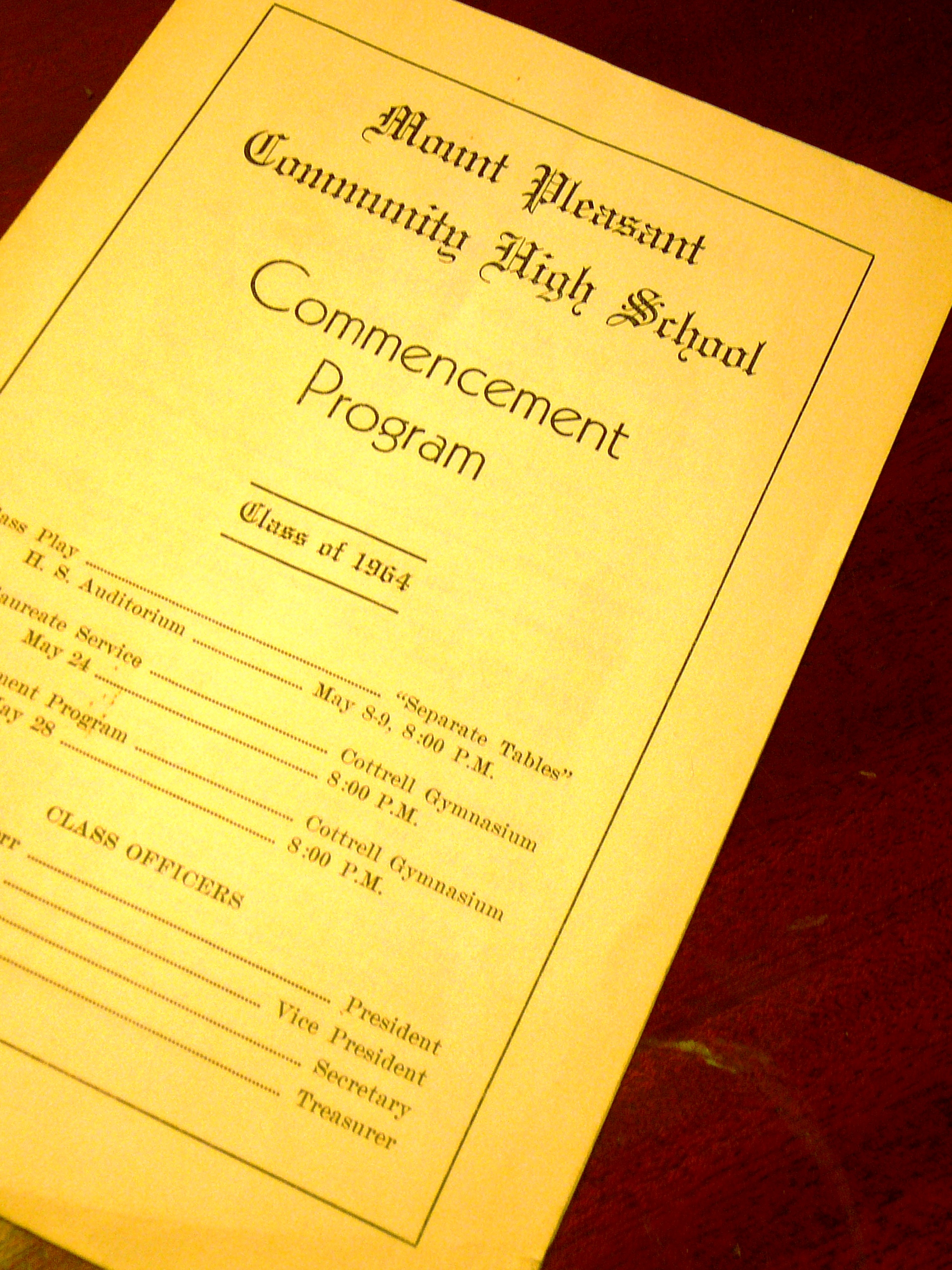
In one box mom saved programs from important events of family members. I found my high school commencement program. The top six scholars in my class spoke on the topic: 1960-1964 Years of Achievement and Turmoil, Events that Have and Will Affect Our Lives. Individual speeches covered Man’s Progress through Science; The American Image – Latin America; Tensions – Europe and Southeast Asia; The Passing of an Era – November 22, 1963 (the assassination of John F.Kennedy). One of the few African Americans in my class, Kathy Wells, spoke on Man’s Attempt to Overcome Bigotry. My title was Progress – Local and State.
No one can turn up his nose at the quality of the education at my alma mater.
I recently heard someone speak about “God’s plan” for us. The phrase sort of grated on me. “Plan” seems to me to be such a human notion with its linear quality, bound by time, space, and mortal reason. I do not think God has plans in the way we might think of them – a neat ending to a story, a way everything will make sense to us, or a satisfying tying up of all our loose ends.
Rather, I think of God as eternal unfurling with ever increasing nuance and connection until we see all lives as dancing flames rising and falling and rising again.
Meaning is something we tack on to Reality to comfort ourselves with a sense of having a handle on things. But Reality more likely slips through our fingers, whizzing past us, leaving trails of newspaper clippings, baby shoes, an old watch, and a tortoise shell comb worn by your great grandmother.
Today I think, rather than One who has plans, God is an endless returning, retracing, weaving in and out, a grand do si do in waltz time, circling back and forward, all the while holding out his hand for us to join the dance, seeing the same place over and over, as if for the first time.
What we call the beginning is often the end.
And to make an end is to make a beginning.
The end is where we start from.
T.S. Eliot “Little Gidding”
I would love to know the wisdom you will be carrying with you in 2011. What is your verse, or piece of direction to see you through the coming year? Leave it here in the comments, or post it on our Facebook page.
A very blessed New Year to you!
The Sanctuary Foundation for Prayer
Read more about prayer www.fromholyground.org
Contact the author lross@fromholyground.org, www.fbook.me/sanctuary
Follow at http://twitter.com/lfross
Part Four of Four Parts

The earth, muffled with snow, goes about its hidden preparation for spring. Silence spreads over the land. Our pace slows with the burden we are blessed to bear. The angel with his face of fire and his wings is now a dim memory. God has become a long, low hum, a slow pulsing throb. We, like the inside of a struck gong vibrating peace, wait.

The fox in the woods stops in its tracks and sits up listening – still. The hawk on the wing wheels in a broad circle, glides down a current, and settles on the post -still. The chickadee at the feeder lifts and tilts its head listening – still.

Then it comes. Wrenching pain pierces us like a sword in the belly. We collapse to our knees and crouch in the darkness. Impaled by the circumstances of our lives and God’s call to us we embrace the cross of Christ. Extended far beyond our feeble powers, such bearing is more than we can do. With each new contraction we lose our nerve and cower like Peter saying,”I don’t know nothin’ bout no man named Savior.
Now we may recall Jesus’ question, “Are you able to drink the cup that I drink, or be baptized with the baptism that I am baptized with?” And we had boasted like idiots, “We are able!” We had no idea what would be asked. Between contractions we pray, “If it be your will, remove this cup from me. But not my will, but yours.”

To entrust ourselves to the will of God at the very moment when we feel most alone and in the most pain requires us to have come to the absolute end of our own will and resources. What makes such a thing possible? How could Mary persevere? How did Paul in prison and facing death continue to preach the gospel?
Perhaps it was their surrender, their sense that something larger than themselves had taken hold of them. An ax had been laid at their roots. A furious whirlwind had shaken and blasted them. Now all in them that was chaff was burning in an unquenchable fire. Finally, exhausted from resisting they say, “Yes, yes. You are in charge. You are God. I love you. I trust you. I don’t like or understand this, but I give myself to you however you want me. My will and desires die to yours.”
A birth is not something one does as much as submits to. Processes set in motion long ago now come to fuller expression. One’s being is given over to a life and purpose beyond itself. The best thing to do is simply hold still, breathe with the pain and wait between contractions.

The Greek word used in the Bible for wait is hypomenein. It means “to stay behind, to stand still, and to hold out.” Hypomenein includes in its nuances to cleave to God in simple, quiet confident waiting as well as to endure, stand fast, persevere; and it includes courageous active resistance to hostile attack.
Wait in the New Testament refers to the endurance that is given for the realization of the kingdom. It is the basic attitude of the Christian as we face the attacks of a hostile and unbelieving world and as we find ourselves in the midst of temptations. The power to persevere is drawn from faith and hope.
Our wills, knowledge, or technology have no power to bring about salvation, wrote Simone Weil:
The role of humanity is to wait . . . The attitude that brings about salvation is not like any form of activity. . . . It is the waiting or attentive and faithful immobility that lasts indefinitely and cannot be shaken. The slave, who waits near the door so as to open immediately the master knocks, is the best image of it. He must be ready to die of hunger and exhaustion rather than change his attitude…We just have to wait for the solution. . . . Seeking leads us astray. This is the case with every form of what is truly good. [We] should do nothing but wait for the good and keep evil away. (Waiting for God, 195-6)

Might you be entrusted with a task to match the largeness of your soul? Could you, like Mary, tell your cousin, “My soul magnifies the Lord, and my spirit rejoices in God my savior, for he has looked with favor on the lowliness of his servant”? Is such heroism only for martyrs in foreign lands, prophets defying oppressive governments, and saints whose lives trace truth in their own blood? Of course, not.
“What good is it to me if Mary is full of grace, if I am not also full of grace? What good is it to me for the Creator to give birth to the Son if I do not also give birth to him in my time and my culture?” asks German theologian, Meister Eckhart. (1260-1329)
If you are summoned by an angel, if you find your heart stretched big with some unnameable love with a mind of its own, eat your broccoli. Remember my friend at the beginning of this series, who hoped to live long enough to see her thirteen year old son parent his own teenager? (Waiting: Broccoli and Perserverance.) Take your vitamins. Stay focused on your goal. Wait. Trust. It will be worth it just to be around on the day of the Lord, however long it takes.

The Sanctuary Foundation for Prayer
Read more about prayer www.fromholyground.org
Contact the author lross@fromholyground.org, www.fbook.me/sanctuary
Follow at http://twitter.com/lfross

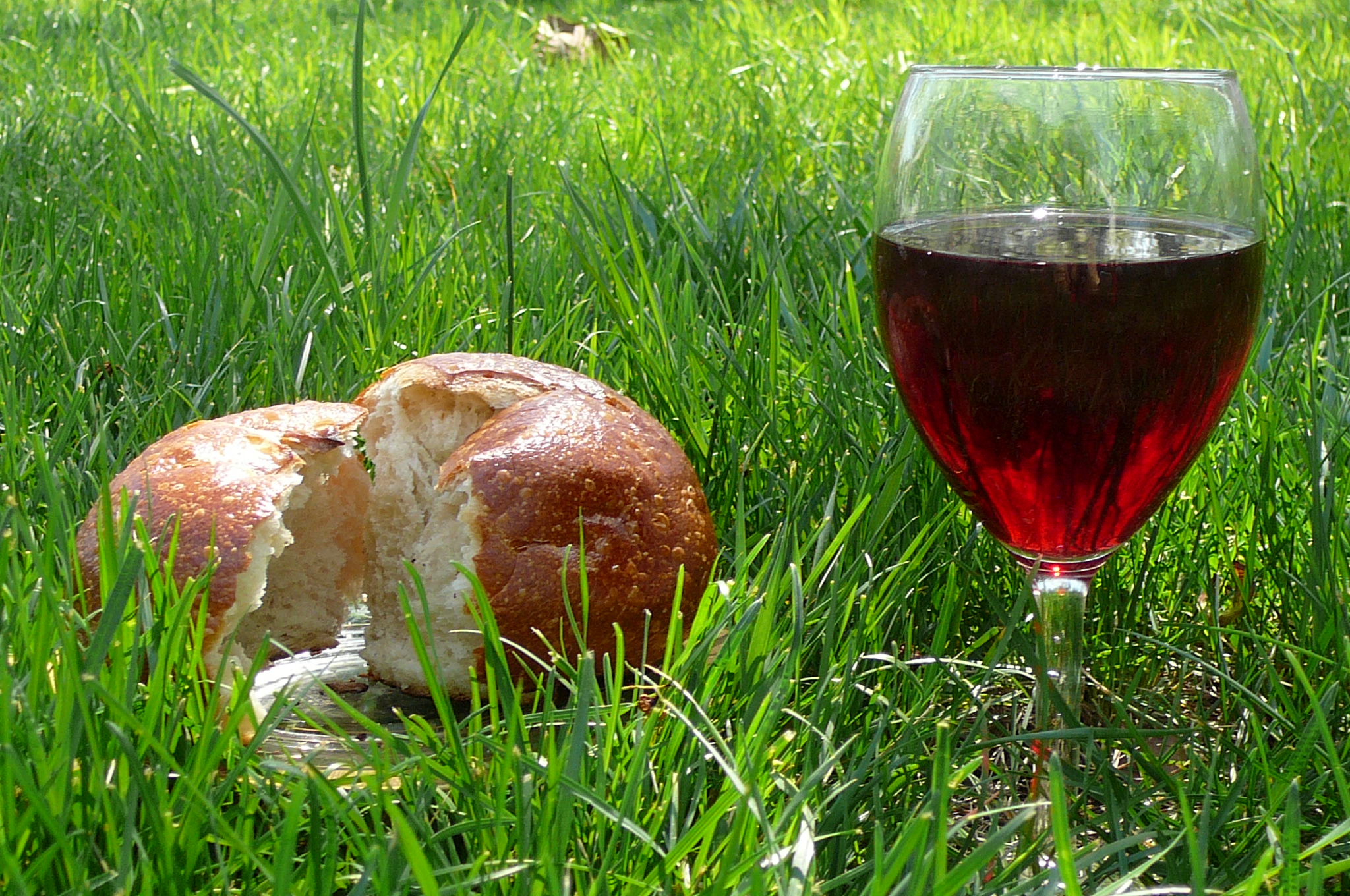
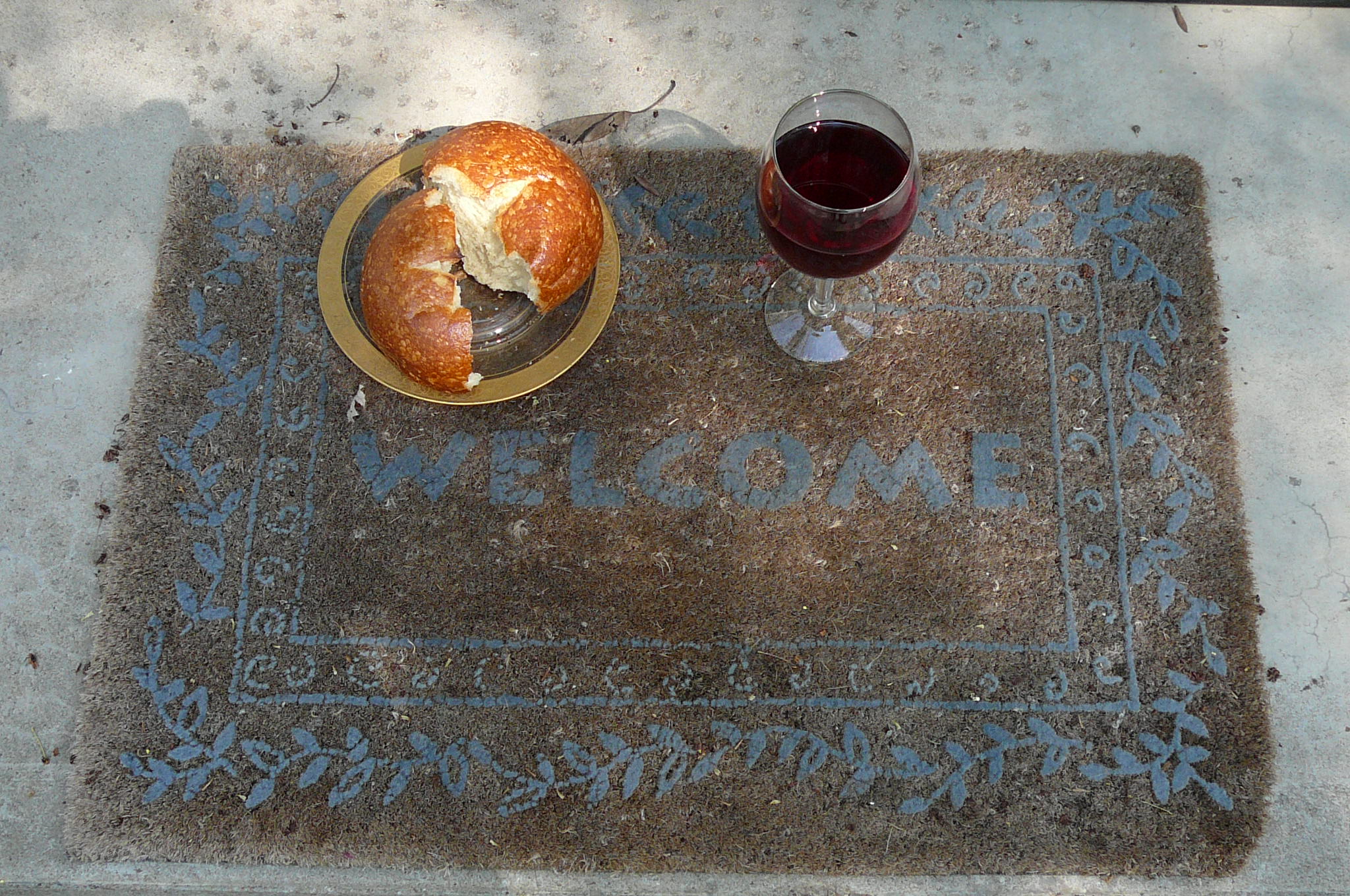
This is my body, peeled back, broken open for you.
In my palm blazed Suchness, a torn fragrant crust of What Is So.
Oh, Common One, you are so plain, so familiar, so simple that we miss you in our desire for some other novelty. We seek you in mystery, ritual, knowledge, magic – all the things we hope will take away our pain and imperfection. We think that if we can just become enlightened, then we will be one with you. But here you are, hurrying toward us, loving us so much, broken hearted, risking everything to be with us in our unenlightenment.
Jesus, you are things as they are. Here is where I meet you in such unassuming splendor and fullness. Over and over, as I bump up against imperfection, resistance, and fear I find you –
grinning at me, sanctifying the moment, redeeming in streaming satin rivers of Grace what is so.

When the dancer becomes the dance, the veil lifts. When the pray-er becomes the prayer, when nothing separates us from God – no self to comment, evaluate, compare – then the forms of prayer drop away and the heavenly hosts arrive packing picnic lunches and lawn chairs and settle in to watch the show.
Someone ought to open a School of True Belief where we could learn how to believe until there was nothing in us that was not a believer. Every June we could put on a recital. There we would solo in some show stopping number where we would cease watching what we are doing and just do it in the free spontaneous expression of the passion of our souls.
True believers are rare these days. There are many schools which teach us how to hone deceit and conceit to a fine art. To know nothing but Christ and him crucified, to be wholly available to God as God desires, one must be free of pretense. We cannot be pretending about what is real. Rather we must be full of faith in the context of the essential truths of our life.

Yet we learn by pretending. It may be a necessary step on the journey. Pretending may be evidence of both our unbelief, and our devotion. Through the gift of the ability to make believe we can try out and imagine what seems unimaginable. The foundation of spiritual growth and theological hope lies in the ability to risk into what doesn’t make sense or seem possible. A lot of the time we look like kids traipsing around in mom’s high heels and old prom dress. We smear on lipstick and crouch in the tree house being the squirrel sisters, famous ice skating stars and novelists. We giggle and sip Kool Aid from the stemmed goblets we stole from the kitchen. It is all a sham of course. Pretty soon Karen’s little brother will come around and throw tomatoes at us. But we are practicing the fine and awesome art of becoming our dearest dreams.
I remember the wild longing of age ten when I sat in the sun eating purple grapes, warm and sweet, spitting out the seeds at my brother. Summer was interminable and nothing ever happened except the daily routine of my hopelessly mundane family and Andy Griffith reruns. That longing took me to the cool dim corridors of the public library hunting ecstasy. I would haul home stacks of Nancy Drew mysteries and American Girl magazines and read about other times and places where Nancy motored about the countryside in her roadster and something more interesting than hanging out the wash and canning chili sauce was always happening.
Can we share in the wonder and deep need of the Great Pretenders? Can we cherish our vulnerability and say: “Go for it, pretend your hearts out! Go on. You be the Goddess of the Moon and I’ll be the Wise King. The back porch is our kingdom and the dogs can be our ladies-in-waiting. Here, you can walk on water and I’ll heal the sick.” Pretend and dress up and play until your dreams come true.
And this is how dreams come true. One day when you are playing, the ladies-in-waiting suddenly bolt, trailing their gowns made of old curtains across the lawn, to chase a squirrel. One day the Moon Goddess gets a mean streak and scribbles crayon all over your royal decrees. The castle you made of boxes gets rained on and the whole kingdom disintegrates. On a day like that, when all your pretending is exposed and you are just a little kid filled with an ache for bliss you cannot name, then someone like a Mother or a Father will come to you and pick you up and wipe your nose and tell you that you are beautiful just the way you are. And the wild hunger to be known and honored and loved for the Holy Child you are is at last met by the Holy Child of God.
And all the rules we made up when we were pretending will seem silly and useless. Like how you are supposed to eat your chips in your sack lunch first and save the gummy bears for last. How if you get home before your sister after school that means dad will take us out for a Dairy Queen after supper. How if you pray this way or believe that or wear this totem or light this candle things will turn out okay for you.
And then the very powerlessness and need of childhood that drove us to pretending in the first place, the very unacceptability of ordinary being, that tender vulnerability at the mercy of powers greater than us, and all that we did to impose sense and order – then that unfinished irredeemable self becomes the holy ground of redemption.
I do not know if our pretense amuses or offends God. I do know there is a time for us to stop pretending about what is not and bless what is. For when I stop acting out my fantasies and stay here to drink this cup poured out and eat the bread of this moment, then I meet Jesus, the one who came and keeps on coming into the world just the way it is, not to condemn it, but that it might be saved through him.

Contact the author by email: lross@fromholyground.org ; on Facebook: www.fbook.me/sanctuary
I have been on study leave the past month in order to work on a new book. The generosity of Crestview United Methodist Church, where I work part time, and several generous donors to the Sanctuary Fund have made this gift of time and space possible. I have prayed, listened, written, and rested in the stunning abundance and goodness of God. Did I make progress on the book? Oh yes. I also discovered how much more there is to do. My goal is to complete it by the end of this January. I tell you this so you will hold my feet to the fire. All of you are in my heart and thoughts. Thank you so much for your support and presence in this conversation about our lives together in God.
Here is a sneak preview of the work in progress:
God is voluptuous and delicious. Meister Eckhart
 O taste and see that the Lord is good, promises the psalmist. (Psalm 34:8) Yet many people find God hard to swallow, not to mention the side dishes served up with God: religion, piety, doctrine, rules, austerity, judgment, conflict, and war. According to contemporary research quite a few people are not swallowing Christianity.
Over one third of the people in this country looking at Christianity from the outside have a bad impression. Researcher David Kinnaman writes, “The growing hostility for Christians is very much a reflection of what outsiders feel they receive from believers. One outsider I met put it this way: ‘Most people I meet assume that Christian means very conservative, entrenched in their thinking, antigay, antichoice, angry, violent, illogical empire builders; they want to convert everyone and generally cannot live peacefully with anyone who doesn’t believe as they do.’
In a time when faith didn’t have such a bad image, Thomas Merton, teaching a group of monks about swallowing God, used this approach, recorded in a poem by Ron Seitz:
So, you see, it’s something like this, to use an image or a metaphor.
…In total inhalation, in the act of the Eucharist, you eat the Mystical Body,
the Cosmic Christ by accepting, by participating, by celebrating, in joy
the total charity of your Being in creation! …
And in total exhalation you offer up, give back, go home in redemption.
You do this by curing the inner spirit between you and God the Incarnate Creator,
what we oftentimes call in Mystical Theology, original sin.
That’s why you go to the monastery, the primary reason anyway.
It’s to do that, to heal the illusion of separation, the separation of you from your true person,
from the world in creation, and especially from God.
It’s all, we’re all one. So relax. Quit apologizing.
We really don’t have anything to be afraid of, now do we?
If Merton is too abstract for you, try this: Seeing the communion elements being passed down the row the little girl exclaims, “O look Grandma, we are getting snacks!”
Holiness seeks intimacy, asks to be consumed, taken in and digested by us in a fundamental, earthy way as food. Fruit of the vine, wheat from the fields grown in the soil, watered by rain, tempered by wind, kissed by the sun. Simple ordinary food becomes transformed by the presence of the one who said, “Here, this bread, this wine is my body. Drink it and it will become your body too.” We get snacks.
Merton continues,
See. Either we are one with the Holy Spirit or not, eh.
And if the incarnation, the Word make flesh is a living reality,
then the whole cosmos is sacramentalized, is sacred and holy.
Is really church,
see (laughing) and you cannot get out, eh, can’t escape that, even if you wanted to.
Not everyone understands God as Merton. A friend and long time church member once confided that one Sunday when the pastor tore off a chunk of bread and handed it to her with the words, This is the body of Christ, “Something happened. I almost gagged and suddenly this seemed like some primitive cannibalistic ritual of eating the body of some person to gain his prana. It seemed repulsive.” She hasn’t been back to a communion service since. Another friend, victimized by a satanic cult, has excruciating flash backs when she goes to receive the Eucharist. Add a few verses of the old hymn “Nothing But the Blood,” and one can imagine most any curious new comer beating a path out the door before the pastor gets out the benediction.
As one of my daughters would say when she was little with her hands on her hips, “Mom, you have a lot of splaining to do about this.”
For starters let’s take a larger, metaphorical view. God invites us to eat what is before us, the fundamental reality of our lives, no matter how unsatisfactory. As we taste and see, chew and digest our experience and truth, we are nourished and transformed by the sacred reality of this world. We grow into the likeness of God, holiness itself. In placing us in this life, God has asked us to swallow this world and one another with an inclusive unconditional love.
Many times I have preferred to spit it all out.

Read more about prayer at
Well, it’s over, thank
goodness.
The lilies droop.
The chocolate bunnies hunch
half eaten in the plastic grass.
Mrs. Mitchell runs the sweeper
in the sanctuary
sucking up the alleluias.
It’s over
and we made it.
We said it wouldn’t be easy.
We said we would be taking up the cross.
But the pain catches us
off guard
and we hunt
for other causes.
We said, “Yes, Lord, we will follow,”
and sauntered into lent
with the nonchalance of toddlers reeling
along some sheer drop off
all ignorant of our peril.
So when it comes.
The event, the person, the inner turmoil
which nudges us to embrace
the cross’s hideous face,
we forget
and call it irreconcilable differences
or stress or heartburn.
_____________
Once I went through a very painful period of deep suffering. When I talked with my spiritual director about it, he asked, “What have you been praying for?”
“To be conformed to God’s will.”
“Well, what did you expect?” he said.
We have an uncanny way of compartmentalizing our life in God. For some of us the things we say to God in church, the prayers, and songs, appear to have little connection to the life we lead outside church. How many times have we prayed “thy kingdom come, thy will be done on earth as it is in heaven” and then gone home and worried all week about the state of the economy, our nation, or our families?
Several people lately confided to me how afraid they are about the world. These are deeply faithful people, yet they are afraid. As for me, I, too, fretted most of last week – those useless “what should I do next” worries. The one we follow has explicitly told us not to fear. Yet we try to justify our fear by hunting around for the cause of our discomfort and call it whatever is fashionable – midlife crisis, the government, the economy.
In doing that we subvert the process of growth and maturity God has initiated within us, usually at our request. Think about it. What sort of things have you been asking of God lately?
 The sacred action of transformation within our souls as individuals and nations will create turmoil, uncertainty, painful loss, and suffering. This is the cross. At the same time it is purposeful, hopeful, and to those who remain grounded in faith will, absolutely, result in new life and greater freedom to love and serve one another.
For me the bottom line is this, where do I get my news? What is my foundation, the central fact and eternal truth of my life? CNN, FOX News, my wimpy ego, or the Risen One calling me to trust in the hidden life and power of God around every bend in the road?
Now – go eat the rest of that chocolate bunny and have a day full of wonders!
Blessed are the poor in spirit, for theirs is the kingdom of heaven.
Blessed are the pure in heart, for they will see God. Matthew 5: 3, 8
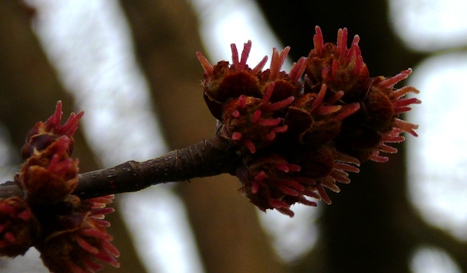
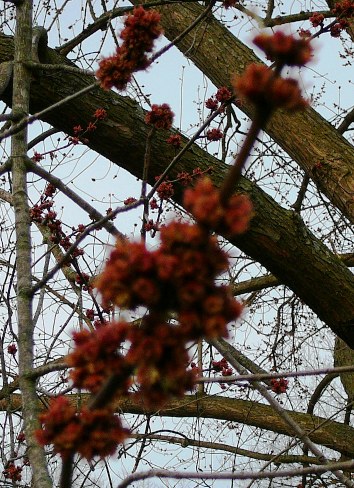
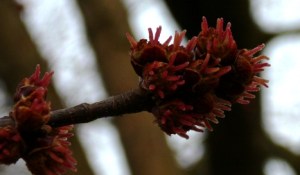 The slender branch of the maple tree outside my window extends itself in a graceful arc. Along its slim fingers it sports rust colored jewels, intricately cut opening buds, bursting with light. When did this happen? Last time I looked, barren twigs jutted stiffly into the cold air.
Here in Kansas, held captive for weeks under heavy overcast skies, we have plodded through our days with only basketball to get our blood pumping. Meanwhile, spring is quietly sneaking up on us.
Dare I say this? I am not ready. With only a few weeks of lent remaining, I have fallen off my wagon of simple living and over indulged in complexity, excess, and that ancient tempter, anxiety.
I need a little austerity, some ordered calm, and spaciousness, not a riotous burst of color luring me into getting anxious about gardening and yard work. I am looking for a paring down of tasks, and to tethering my heart to what is most important, not pecking mindlessly after every crumb I see.
 I need a spare, bare mind, swept clear of clutter and fuss, rather than the cramped, narrow, over stuffed rat’s nest I have created. These gray days are revealing to me more clearly the contours of my addiction to my agenda. How will I ever be ready for Easter splendor and the enchanting dance of spring with so much of me running the show, asserting itself and its way?
I am Peter, pulling Jesus’ coattails, saying, “No Lord, no cross! No death! We can win this on our own!” My spirit has not been poor, aware of its total dependence on the mercy of God. My heart has not been pure, willing only one thing, but rather, adulterated with conflicting desires.
My fetching maple beckons with her pretty fingers. “Come, you fool,” she whispers. “Let go. Dwell with me in the pure driven snow of grace.”
Prayer for Lent
Make me lean, Lord.
Teach me the quiet asceticism of winter trees
whose bare branches articulate space
in spare
thrusting
syllables
of praise.
Set me down before the bowl of emptiness
where you swirl, swell, steam,
brimming at the brink of nothing.
Feast me from the platter of want,
where need of anything but you is indigestible.
Cut away the obesity of pride,
the folds of selfishness.
Make me meager,
a mere thin thing flapping its limbs
composing snow angels
across the pristine sweep of your celestial substance,
an anonymous indentation pressed in desolation
telling your glory.
My sustenance: your Word.
And my life: glad graffiti splashed
across some time’s wall:
God goes here.
For a good time,
call.





















 The Praying Life