Category Archives: Contemplation, prayer

The Dancing God


Do you want to know what goes on in the core of the Trinity?
I will tell you.

In the core of the Trinity
the Father laughs
and gives birth to the Son.
The Son laughs back at the Father
and gives birth to the Spirit.
The whole Trinity laughs
and gives birth to us.       Meister Eckhart

Western Christianity used the Latin word circuminsessio to describe the activity of the Trinity. In contrast Eastern Christianity used the Greek word, perichoresis. Circuminsessio means broadly to sit around in a circle. Perichoresis means to dance in a circle.

 Needless to say, I prefer dancing.

BLEST COMMUNITY

 O Most Holy Trinity
Undivided Unity,
teach us the gentle deference
of your dance of surrendered love
how with infinite tenderness
and utmost esteem
you so gently
adoringly
are present
to one another.

Teach us your perichoresis,
your grand circle dance,
where you eternally birth joy
from the womb of reverence.

Teach us your unending,
enfolding regard
for the pure holiness
you hold and behold.

You,
sweet breath and the lungs of creation,
eternally giving,
empty
and eternally receiving
are filled.

You release and bind,
but never push nor pull.
You hold accountable,
but never blame.

You incline yourselves to one another
as a grove of green willows
bending in the breeze
bowing to each other’s grace
known and cherished
on the broad plain of mutuality.

Deepen our trust, O Blest Community,
that we may enter such intimacy.

                                                                Loretta F. Ross

Once a group of Western theologians traveled to the East to speak with a group of Buddhist monks, and asked, Will you tell us how you do theology?

 The monks thought for a while and then responded, I do not think we do theology.

 We dance.

Here is another post from The Praying Life on the Trinity: https://theprayinglife.com/2010/05/30/a-god-who-dances/

Ain’t Nothin to Worry About

She is sitting on a chair in her bedroom. I show her the new pants and blouse. “Try them on mom. I got them for you.”

“Oh, I don’t need any new clothes.”  She gestures to a pile of folded shirts on her dresser.

“Mom, you are holding up your pants with safety pins. That blouse is worn thin.”

She slowly pulls on the new pants, then stands and hitches them over her narrow hips. I help her button the blouse. We both like the results. “You look great mom.”

She smiles, then announces, “After ninety the worst is over.” We observe a thoughtful silence, and then burst into laughter. Eyes twinkling, she says, “Then they dress you. They fix your breakfast.”

The good news from Irma: if you are over ninety, relax. The worst is over. If you are not, take heart, the best is yet to come.

When I was a child the word used for senile dementia was “childish.” Uncle Lou was “getting childish.” Grandpa “was childish.” That meant that they were older and acted young somehow. Because of this, we were to understand and watch over them a little more. It was a gentle term, a matter of fact acceptance. When mother returned from visiting blind Aunt Ethel in the rest home, who, after she broke her hip, never got out of bed again, mom would say, “Aunt Ethel told me to go out back and get a chicken and dress it and make her some chicken and noodles. She doesn’t know where she is. She’s getting childish.” Mom would fix chicken and noodles with a store bought chicken and take them to her anyway.

__________

The house I grew up in is the kind of place where God shuffles around in his jammies and house slippers like part of the family – deeply loved and cherished, but not made a big fuss over.  Mother grew up Quaker and married my Mennonite father, whose family descended from the Swiss Anabaptists of the Reformation period. In some kind of compromise they became Presbyterian. When I told a seminary professor about my parents’ religious pedigree, he remarked, “Well it confirms what I have always felt.  Presbyterianism is many people’s second choice.”

Mother’s pastor brings her communion. She is grateful for the fellowship, but I wonder if the sacrament seems redundant to this old Quaker, already immersed in the Light. When she prays for me and my daughter before our Christmas dinner, she draws the words up from some deep place and forms them with a conviction that leaves me shaken.

My mother’s house has many rooms of treasures. If you come to visit, some of her childishness may rub off on you – her simplicity, transparency, and sense of humor. When two hip twenty-something graphic designers from a big city came for Thanksgiving, they were entranced by the carvings, my deceased father’s fifty year old book on design, the advertising in old magazines, and the relics of native Americans my father found.

The young men rooted around with my daughter in closets and basement, amazed and delighted. Because they had been raised well, they recognized “childishness” and listened to Mom’s stories with kindness and gentleness. Mother showed the same politely curious interest in the tattoos, which covered most of one of the visitor’s arms, as he did in her apple dolls.

Then the visitors all went out to play across the street on the swings and toys in the school yard, snapping photos on their iphones to send to their friends. They arrived early and stayed late. It was nearly midnight before Mom and I turned in on that magical day.

A poem by Thomas Merton has been coming to me lately:

Come my love
pass through my will
as through a window
shine on my life
as on a meadow
I, like the grass,
to be consumed
by the rays of the sun
on a late summer’s morning.

The poem is based on St. Johnof the Cross’s poem, The Dark Night of the Soul. In the poem John compares the soul to a window. He sees the spiritual journey as the process of cleansing and removal of anything in us that might impede or distort the Light of Christ as it passes through our lives. In this process we become more and more transparent and childlike.

My mother drinks her tea this morning as she watches a squirrel and a cardinal at the feeder. “I am remembering,” she says. “I am remembering how when I was a kid and would get upset or complain about something, Pop would say, ‘Oh that ain’t nothing to worry about.’”

“Gosh mom, that doesn’t sound very empathic.”

“Well that is what he would say. ‘Oh, that ain’t nothing to worry about.’” And she smiles out the window.

I want God to pass through me like a window, to shine on my life as on a meadow. I want to be consumed as the grass on a midsummer day.  I can ask for it, pray for it, but I think it ain’t nothing to worry about. In the end such childishness is given simply, quietly in the gracious surrender to growing old.

Mother puts down her tea cup and says, “After ninety three things get interesting. It is like reading a book backwards. I never understood before why people would look at the end of a book and read it first. It is smooth going. You can do what you want. People don’t expect much of you. They think you are childish. They try not to laugh, but you can see they are just dying.

I don’t let on I know.”

 

This post is adapted from Holy Ground, Vol. 19, No. 4  Winter  2009. Holy Ground is a quarterly reflection on the contemplative life, written by Loretta F. Ross, and published by The Sanctuary Foundation for Prayer.  

 Go here to read the entire issue online.  Download a FREE copy of Vol. 19, No. 4, Winter 2009. 

Exploring Solitude: Deadly Acedia, or Too Bored to Care

Sooner or later even the most devoted hermit or spiritual seeker will discover that this solitude and silence shtick does not seem to be all that it is cracked up to be.
Saintly souls and books far and wide, which recommend and extol solitude, may not include the whole truth of the experience. At some point the solitary pray-er is likely to ask this question:


What on earth do I think I am doing out here
in the middle 
of nowhere by myself!

Next the individual may pace back and forth in his holy abode, while the walls begin to close in. A suffocating boredom descends upon the person like a choking cloud. Her whole spiritual exploration takes on the character of a really bad afternoon spent as a child with an insufferably tedious old aunt. You sit fidgeting in the rocking chair with your feet wagging in the air looking at old Readers Digest magazines and listening to tiresome adults drone on and on about dead relatives.

Now your lovely hermitage grows dull and lifeless and smells faintly of mothballs and Vicks VapoRub. You are sure all your friends are going to wonderful places and having exciting experiences, while you are trapped at Great Aunt Hannah’s and doomed to a lackluster life of gradually increasing obscurity and dull mediocrity. Your back itches. Your tummy hurts. Your neck has a cramp in it. Your brother keeps sticking his tongue out at you. And you realize now that you actually hate him. Your mom ignores you, even when you fake a faint, slide off the rocker, and lie on the floor in a lump.

It can be like this, my friends, as some of you know. You pick up a Bible, read a verse, and it leaves a taste in your mouth like an open bottle of soda that has been in the fridge for a month. A kind of angsty horror rises up in your craw and an overpowering desire to get out of there floods your being.

If someone has not seriously questioned Love’s call, and has not encountered an all- encompassing indifference, even, perhaps at times, revulsion, toward the things of God, I would suggest they simply have not been at it very long. When we enter solitude, whether we find it in the bathroom or at the lovely cottage on the beach, we bring along our retreat provisions, books, journals, music, food, as well as our illusions, expectations, hopes and dreams of what this time will be like. Here we may be in for a rude confrontation of fantasy with Reality, or my will with the will of the One I am seeking.

When I hosted guests at The Sanctuary Foundation hermitage, I watched them haul bags of books and provisions up the slope to the cabin.

“I hope to plan my sermons for the next six months,” some would tell me brightly.

“I hope not.” I would say to myself.

We bring an agenda to our solitude: I want to deepen my awareness of God. I need help in discerning the next steps of my life. I am looking for peace and resolution of conflict.

We come hoping to accomplish some task, relieve pain, even to be entertained. Then lo and behold, we are met with dryness of spirit, dullness of mind and heart, a ho hum listlessness, and growing sense that nothing fun or good is going to happen to me here.

What we fail to see is that God comes to the hermitage as well us. And God has an agenda too. At some point God’s agenda may include a healthy dose of the demon of the noonday sun.

The name the early Christians gave for the dullness can settle over us is acedia.
The desert fathers and mothers called this oppressive state of spiritual apathy the demon of the noonday sun. Evagrius warned, AThis demon attacks the monk towards the fourth hour and besieges the soul until the eighth hour. He begins by giving the impression that the sun is hardly moving or not moving at all, and the day has at least forty hours. Ardor and passion for the things of God are replaced by indifference and boredom. The miserable soul is sick both of God and self.  

Acedia, engraving by Hieronymus Wierix, 16th c...


The purpose of this dry discontent is seen as part of the final purification of the will so that it may be merged without any reserve in God. Acedia abolishes spiritual gluttony as it strips us of our fascination with glamour, ease and sensory delights. Since God is spirit and must be worshiped in spirit, a soul’s worship of God grows over time to be less founded in the satisfaction and entertainment of the senses and more in the dark knowing called faith. Through the harsh succor of the demon of acedia the soul is weaned from its attachment to sensory gratifications to a more mature love.
From my book: Letters from the Holy Ground, Seeing God Where You Are (Chapter 24)

As unpleasant as it is, I believe that acedia helps to rid us of the three tendencies of our age, which militate against contemplation, according to Ronald Rolheiser. Rolheiser identifies these tendencies as our narcissism, pragmatism, and unbridled restlessness. The Shattered Lantern – Rediscovering a Felt Presence of God  (Chapter 2)

The excessive self preoccupation of narcissism makes everything we encounter about us and our needs. The cult of the individual deifies the personal and encourages focus on our private concerns and preferences.

“Pragmatism,” Rolheiser writes, “asserts that the truth of an idea lies in its practical efficacy. What that means is that what is true is what works.” We become obsessed with what Thomas Merton identified as the leading spiritual disease of our time: efficiency.

Our unbridled restlessness fuels our driven, compulsive, hyper lifestyles of multi-tasking and instant gratification.


So what’s a body to do? You have come all the way out here. Are you going to turn tale and sneak back home?

Try this: Sit there or go for a walk. Watch your discomfort. Settle into your body. Be curious about your indifference and learn from it. Breathe deeply, as the anxiety and pain of withdrawal from narcissism, pragmatism, and unbridled restlessness grip your soul and cramp your body.

Surrender your agenda. Stop demanding things to be different. Cease resisting what is so, what is real for you.

Gradually a shift will occur.

Perhaps you notice the splotch of light on the wall across from Great Aunt Hannah’s china hutch. Where did the light come from? The late afternoon sun is stretching its long arms across the carpet and up the china hutch, where it touches a crystal goblet which has sat there for thirty years, and just now catches fire as your eyes lay upon it, dazzling you with brightness. You lean back in the rocker, feeling your back sink into the cushion, and watch the dust motes moving lazily above the carpet. You notice the pictures woven into the carpet – a man on a white horse, a house with a red roof, people in olden clothes walking down a lane.

The light splotch on the wall moves and dances. Why? You look at the flaming goblet across from the wall and back to the wall. Then you see through the window in the wall tree branches swaying, sweeping back and forth covering and uncovering the path of the sun.

For a moment you and the dancing splotch and the fiery goblet and the man on the horse and the tree branches swaying, and your great aunt are all laced together with tiny tendrils of light and you yourself catch fire. And you say to yourself, oh this is the way the world is. Everything is all hooked up and intertwined together.

The grown ups are still talking. You feel safe. You see your brother reading his comic book. A sudden rush of love and gratitude for him pours over you. You decide to take a nap. As you doze off, you think, I really like that mothbally VapoRub smell.

Come to me all you who are weak and heavy burdened.
And I will give you rest.     Matthew 11:28


Solitude Practice:

  • Have you been afflicted by the demon of the noonday sun? How did it manifest in your life. How did you respond?

  • Does it help to learn that the negative experience of indifference might be a necessary part of your deepening love for God?

  • In the essay above what do you think happened as the child character moves from fidgeting to discovering peace. Do you see anything here that might help you in your acedia attacks?

  • How do narcisscism, pragmatism, and unbridled restlessness hinder your contemplation?

  • Want to learn more about acedia? Here is a good article: Acedia, Bane of Solitaries  See also Katheleen Norris’ book, Acedia & Me: A Marriage, Monks, and a Writer’s Life

Next post in this series: Exploring Solitude: Becoming Real

Exploring Solitude: Where the Wild Things Are

Come away by yourselves to a lonely place,” Jesus

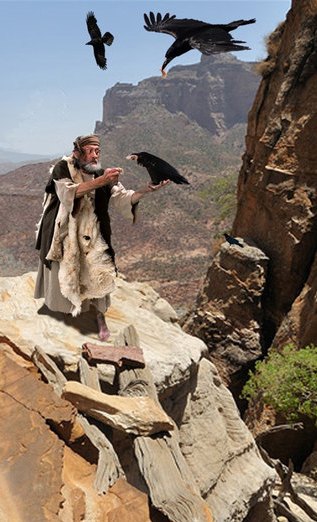
God then told Elijah, “Get out of here, and fast. Head east and hide out at the Kerith Ravine on the other side of the Jordan River. You can drink fresh water from the brook; I’ve ordered the ravens to feed you.”  Elijah obeyed God’s orders. He went and camped in the Kerith canyon on the other side of the Jordan. And sure enough, ravens brought him his meals, both breakfast and supper, and he drank from the brook. I Kings 17: 2-6 (Msg)

Nothing better expresses the urgent call of the wild for me than John Masefield’s Sea Fever.

I must  go down to the sea again, to the lonely sea and the sky,
And all I ask is a tall ship and a star to steer her by, . . .
I must go down to the sea again, for the call of the running tide
Is a wild call and a clear call that may not be denied; . . .
I must go down to the sea again, to the vagrant gypsy life,
To the gull’s way and the whale’s way where the wind’s like a whetted knife; . . .

Wild places and wild things invite us to themselves. If not the sea, perhaps, the mountains, the desert, the plains, or the forest draw you. The trout in the stream, the grizzly bear turning in his sleep, the mushroom popping up in the moist woods, the redwood tree dwarfing all else in its magnificence summon us to gaze in wonder and appreciation and share in the communion of all beings.

Shifting from Virtual Reality to Reality
In the wilderness we smell, and see, and touch, and hear, and taste – not a virtual reality, but reality. And here, we are likewise smelled, seen, touched, heard, and tasted. We not only change and act upon our surroundings, we are also changed and acted upon by those same surroundings. In the wilderness, we find again our place as a member of one of the species of beings on this planet. We leave our thermostatically, controlled environments and modern conveniences to feel the bracing chill of  the wind in our face, the tickling blurred vision through snow dusted eye lashes, the heavy ache in our calves after walking several miles.

In the process of wilderness dwelling, we shed the heavy brittle shells of our self importance and settle in with all our relations – brother sun, sister moon, and cousin fox. We discover the deer we are watching are also watching us.


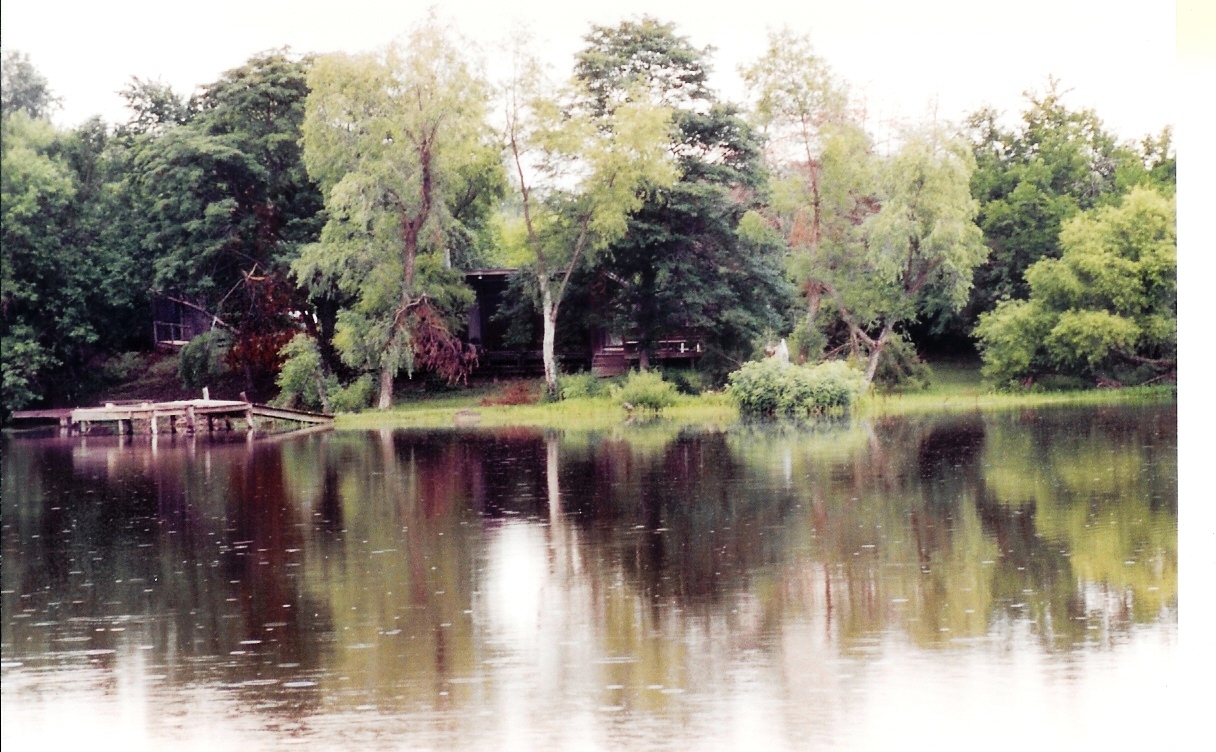
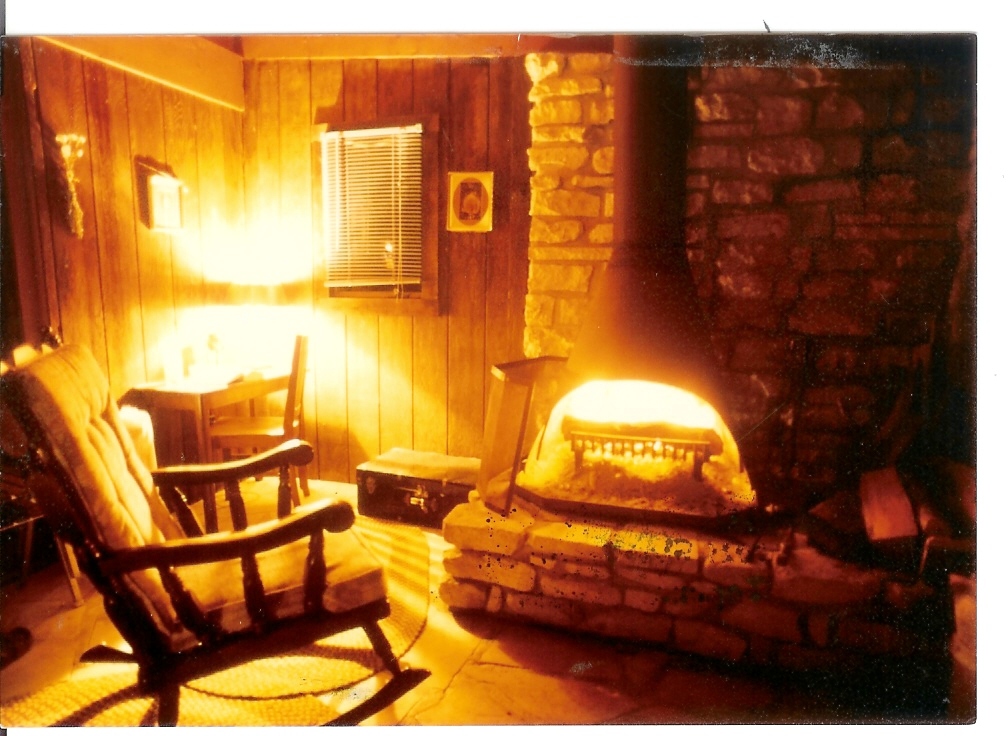
Solitude may occur, of course, away from wilderness in the midst of a noisy crowd, in a beehive high rise apartment, or on the back porch with city sirens screaming past. However, many of us find solitude most easily and fully in a place apart in some natural setting. For over twenty years I found my wilderness solitude in a one room cabin with a stone floor, built into the side of hill on a small lake in northeast Kansas.

The call to the wilderness runs deep in some people, and expresses itself as unappeasable longing, or a palpable need to be in wild places among wild things. These persons often feel compelled to seek out remote spots away from power grids, traffic, concrete, and housing developments. Some struggle to explain and justify their desire to family and friends.

Wilderness as Arena for Spiritual Growth
The Biblical Hebrew word for wilderness is often used interchangeably with desert and includes many varied kinds of terrain, arid and semi arid, pasture land, mountains, and the sea.

The wilderness, a place uninhabited by the human species, is a significant location for the spiritual journey, both in its literal and figurative senses. The Bible understands transformation and spiritual growth as a process, which involves the experience of both physical and psychic dis-location and re-location. The experiences of being lost and being found, of moving from a familiar land to a strange new country appear over and over in the Biblical narratives.

An important aspect, then to solitude and our development in faith, is that exposure to wilderness, both in the physical geographic sense, and in the internal experience of the self. I will set aside consideration of internal wilderness to another post, and focus here on the external physical places and settings in which we find solitude.

As a species and as varied races and ethnicities, we have been formed in part by the land in which we and our ancestors have made our living. The lay of the land itself, the richness or poverty of its soil, the vegetation, wild-life, presence or absence of water, winds, and temperature have shaped our economies, our languages, our diets, our health, what we value, and our religions.

David Abram in his masterful book, The Spell of the Senses – Perception and Language  in a More-than-Human World, writes about this relationship of humankind to the earth and its features and all that dwell upon, within, above, and in its waters.

our bodily rhythms, our moods, cycles of creativity and stillness, and even our thoughts are readily engaged and influenced by shifting patterns of the land. Yet our organic attunement to the local earth is thwarted by our ever-increasing intercourse with our own signs. Transfixed by our technologies, we short-circuit the sensorial reciprocity between our breathing bodies and the bodily terrain. Human awareness folds in upon itself, and the senses – once the crucial site of our engagement with the wild and animate earth – become mere adjuncts of an isolate and abstract mind bent on overcoming an organic reality that now seems disturbingly aloof and arbitrary. (p. 267)

Abram writes of our relationship with the whole of creation as an interpenetration and mutuality in which all parties are affected, changed, and interdependent. The creation is not something I act upon, seek to dominate, or control, but rather the creation is a whole gathering of life with which I may enter into a relationship of mutual benefit.

In the past seven years the consequences of our lack of communion with nature has received attention and comment as Nature Deficit Disorder. The lack of time spent out doors by children and adults is suggested as a factor influencing several illnesses, including obesity.

Starving for the Undomesticated God


Over many years I have observed person after person starving for such connection and communion. Some would trek across the country just to sit in a simple cabin without  running water in a Kansas pasture in order to touch in to such a relationship. With some notable exceptions, namely camp and conference ministries, the church has largely ignored this fundamental need. Though our faith was formed in our ancestors in deserts, tents, mountain tops, sea shores, ship wrecks, storms, and many solitary encounters with the Holy One, we insist that most of our faith be nurtured in buildings and classrooms under florescent lights. We further claim that knowledge of God may be gained by memorizing a set of propositions articulated by theologians, who gained most of their credentials in similar buildings and classrooms.

In contrast, we meet an undomesticated God in the wilderness, an unpredictable, wholly other God, who is neither tamed by sedate doctrines, nor penned up in church polity, nor leashed to political issues. The waves and meadowlark give testimony, the stones hold the stories of the ancient ones, the Spirit hovers over the waters, the prophet emerges from his cave, and hears the still small voice of the Lord.

Most pastors have heard from the person, who apologetically recounts the familiar reason for his Sunday morning absence. “I am closer to God on the golf course or in my boat out on the lake.”  

But can’t you do that on Saturday, wonders the pastor, whose district superintendent keeps count of his worship attendance. He needs to show an increase this year. “You need to worship with the community too, and we need to have you with us,” he tells the fisherman.

Both are right, of course. We need the solitude and nature and we need the gathered  community of believers. Yet, perhaps, rather than feeling defensive, our pastor could become genuinely curious about her parishioner’s life in God and what he is telling her. “Could we get together sometime? I’d like to hear about what these times mean to you and how you experience the Lord.”

A Cabin in the Woods
My brother and his wife recently moved and their first project was to build a small cabin in the woods behind their new home. The one room cabin perches part way down a steep ravine in the woods, above a pond and a river beyond. My brother spends hours down there and confesses, most of the time he just sits and looks out the window, watching the birds and critters, and resting his sore eyes on a vista absent of manipulation by his own species.

Formerly a hunter of deer, my brother is now living in more intimate and complementary relationship with his relatives. He rises early each day to put out food. Keeping track of them, he gives some of them names. He is respectful of the space they need and watches for signs of illness, or overcrowding of the herd. He worries about the invasive mustard grass, which chokes out the native plants.

Likewise the animals of this ravine are more intimate with my brother. They are eating well, unafraid, and willing to share more of themselves with this human. My brother is changing too. He has lost weight and strengthened his legs from making the steep climb down and back from the cabin to the house. He has become an evangelist for the gifts of that little structure. “Solitude is magnetic,” he tells me. Yes, indeed.

He shows me a little book he keeps for guests to write their impressions of time spent in his cabin. I open the cover and read the longing and gratitude in their comments.

The Force which Draws All Things Together
Solitude and the wilderness, where we find it, are magnetic. The wild things and places draw us to them by the force of our common relationship with each other as creatures on this earth. We are drawn by our desire to connect with and to enter into communion with Reality in a deeper, truer way than we find in the glib, sound bite assessments that surround us constantly. Such communion changes how we see ourselves and one another. Thomas Merton writes in his second chapter of Thoughts in Solitude that the wilderness invites us to stand back from our lives so we see things in a new perspective.

We cannot see things in perspective until we cease to hug them to our own bosom. When we let go of them, we begin to appreciate them as they really are. Only then can we begin to see God in them. Not until we find Him in them, can we start on the road to dark contemplation at whose end we shall be able to find them in Him.

 Get the Stink Blown Off
Do you postpone going down to your wild places until the time is right, until you have several days free, until you finish this or that project? I will tell you a secret. You don’t have to wait. Just go with whatever time you have. As Eugene Peterson, paraphrases I Kings 17: 2, “Get out of here and fast!” My mom’s version was, “You kids go on outside right now and get the stink blown off ya.” God receives what little time you can offer, a day, an afternoon, or ten minutes, and turns it into abundance with enough leftovers for you to eat on for the rest of week.

So go on. Get out. Go for a walk. Drive over to the lake or the beach. Take a blue highway home. Look around. Breathe. Smell.  Feel. Gaze into the eyes of a deer. Watch the eagle land and fold its wings on its perch above the river. Be seen by the squirrel, be blown by the wind. Be changed and shaped by the interplay and exchange of the animate world of which you are a beloved part.


Solitude Practice:

  • To what kind of wild places are you drawn? Have you been there recently? What keeps you from going?

  • What happens when you go? What changes or shifts do you notice in yourself?

  • Take some time to pray about your need for solitude and wilderness places. Listen for God’s response.

Next Post in this series on Exploring Solitude : The Wild Things Within


You can help support this series by donating to The Sanctuary Foundation for Prayer. Just five or ten dollars will make a difference and help pay some of our costs. Your gift is tax deductible. Donate Here. Thank you so much!

Exploring Solitude: Why Bother?

Come away by yourselves to a lonely place,” Jesus

 What is said here about solitude is not just a recipe for hermits.
It has a bearing on the whole future of humankind and the world:
and especially, of course, on the future of religion. Thomas Merton


Over the next several weeks I will be reflecting on selected passages from Thomas Merton’s little book, Thoughts in Solitude. First published in 1956 the book is a collection of Merton’s musings about time he spent alone in a hermitage at Gethsemane Abbey in Kentucky. Merton had been a monk for a while before he finally gained the Abbot’s permission to spend an extended time alone. An outgoing, gregarious fellow, he struggled throughout his life with finding a balance between his need for solitude and for community. His prolific, engaging writing brought seekers to the monastery and his ability to teach about the spiritual life attracted many followers.

If you have a copy of the book, you might want to get it out and follow along. You can easily find a used copy online, or check your local library for Thoughts in Solitude.

I confess that my relationship with this Trappist priest has been rocky. He has both deeply inspired and deeply disappointed me. There is much I admire in his life and writing and a few things I do not. Just as I decide I am finished with the man, I am drawn back. Like us all, Father Tom, as a friend calls him, has his sin and warts, yet God has used him mightily. We may all give thanks that falling short of the aim which God intends for us (the literal meaning of sin) has never been a road block to the power of God working through human lives.

I choose this book, not because I consider it among the best on the subject. We have over 2500 years of excellent material on the spiritual practice of solitude. I hope you will share your favorite resources in the comments section below, or on the Sanctuary Foundation Face Book Page, or email me. I will be happy to compile your suggestions with others and make them available to The Praying Life readers.

Thomas Merton
Thomas Merton (Photo credit: jimforest)

So let’s begin with the Preface. Here Merton lays out what he is up to in this book and makes his disclaimers. He tells us his “thoughts here are simply thoughts on the contemplative life, fundamental intuitions which seemed, at the time, to have a basic importance.” His writing comes from his “relationship with God in solitude and silence and that “interrelation of our personal solitudes with one another,” which are for Merton “essential to his own peculiar way of life.”

Then he launches into a broad societal justification for such peculiarity. A number of internal and external obstacles make it difficult for most of us to develop and nurture a practice of spiritual solitude. I have listened to many people who struggle to claim the “legitimacy” of the practice, to respond to this call of God, and to be consistent in the “coming away to a lonely place” with Jesus.

I feel guilty. Isn’t it selfish? Shouldn’t  I be doing something – working at the mission, helping out at church, serving on committees? My friends don’t understand. My pastor doesn’t get it. I can’t even explain why I do this or even what happens. Am I only fooling myself and being lazy and wasting time?

I hope this series will offer some support for your practice and a rationale which gives permission and value to a pursuit largely neglected in our culture and religious institutions, but sorely needed. In the end, though, you must come to your own rationale and your own “thoughts in solitude.” For each of us will experience solitude in different ways at different times, and God will speak within you the language of the unique nature of the intimacy you share. And each must make his or her own witness to the truth.

Merton begins his book by looking at the larger culture in which he found himself in 1956:

In an age when totalitarianism has striven, in every way, to devaluate and degrade the human person, we hope it is right to demand a hearing for any – and every sane reaction in favor of man’s [ok, from now on in this blog series I will make Merton’s gender nouns and pronouns neutral] inalienable solitude and interior freedom. The murderous din of our materialism cannot be allowed to silence the independent voices which will never cease to speak: whether they are the voices of Christian saints, Oriental sages like Lao-Tse or the Zen Masters, or the voices of persons like Thoreau, or Martin Buber, or Max Picard. It is all very well to insist that people are “social animals” – the fact is obvious enough. But that is no justification for making them into a mere cog in a totalitarian machine—or a religious one for that matter.”

Thomas Merton's hermitage at The Abbey of Our ...

Hermitage of Thomas Merton at Gethsemane Abbey

Society, for Merton, depends for its very existence on the inviolable solitude of its members. This is because, as he writes, “to be a person is to possess responsibility and freedom, and both of these imply a certain interior solitude, a sense of personal integrity, a sense of one’s own reality and of one’s own ability to give oneself to society – or to refuse that gift.”

He ends his preface with: “What is said here about solitude is not just a recipe for hermits. It has a bearing on the whole future of humankind and the world: and especially, of course, on the future of religion.”

One of my pet peeves about Merton, especially in his early writing, is his penchant for sweeping generalizations and pronouncements. I happen to agree with this one. How might such a claim be true?  Is there really a relationship between the time you take to create some space and time to be alone with God and our future as a race and the future of religion? I think so. And I am not alone.

When there is a crisis in the church, it is always a crisis of contemplation. The church wants to feel able to explain about her spouse even when she has lost sight of him; even when, although she has not been divorced, she no longer knows his embrace, because curiosity has gotten the better of her and she has gone searching for other people and other things.
Carlo Carretto


Might part of our struggle with keeping solitude be because we have our arms around the wrong lover?

Solitude Practice:

  • Ask the lover of your soul to show what you are hugging closer to yourself than the Holy One.

  • Identify competing lovers.

  • What might it take for you rediscover God’s embrace and forsake all others? It might be easier than you think.

As Paul Simon sang to us, there are fifty ways to leave your lover.

Next Post: The Wilderness of Solitude

You can help support this series by donating to The Sanctuary Foundation for Prayer. Just five or ten dollars will make a difference and help pay some of our costs. Your gift is tax deductible. Donate Here. Thank you so much!

Where Miracles Occur

Bristlecone Pines, California

The tension in my shoulders is melting. The tightness and ache in my jaw and throat are releasing. The constant, exhausting, mental jabber is growing silent.  The resolute soldiering on, pushing forward without awareness, without seeing anything, but a goal which constantly recedes over the horizon, is giving way to being    here      now.

The tunnel vision squint and laser focus are opening and broadening to a wide spacious plain that keeps revealing more and more. Reality unfolds like an undulating wave continuously turning up complexities, beauties, grace, and both harsh and comforting aspects of what is really going on.

I have been decelerating and decompressing over the past several weeks.  This process is not over, for it is the work of a lifetime. I need more time to shed the brain debris and external and internal clutter. I need to continue to tame the habit of acceleration, and restrain my inner harpy, that merciless harridan of self aggrandizement.

Though I have tried to practice and teach this for years, I feel like a rank beginner. And, as is the way of the Spirit, I am being shown how far I have to go. I am watching my many-faceted resistance, as I begin the slow, groaning, screeching grind to a halt. For ironically, in order to go further on this journey, I have to stop.

Sabbath means, literally, to stop. I am aiming for a Sabbath life, a life lived contemplatively, steeped in the awareness of the presence of the Holy, which initiates, and infuses my work and play. I like the broader definition of Sabbath, which Donna Schaper offers:

Sabbath sense is anything that makes spacious what is cramped. That makes large out of small, simple out of complex, choice out of obligation. Sabbath sense is anything that reconnects the necessities of drudgery to the marvelous uselessness of beauty. Sabbath sense is acknowledgment of the presence of Spirit in the petty and the profound.

In this time of beginning and transition, of halting and rest, I have discovered a different kind of urgency, than the urgency of schedule, production, and accomplishment. This is the urgency of a compass, a magnet, an urgency so primal it is like breath itself. This is the urgent love of the Maker of All honing into each particle of creation, boring into us and drawing us inexorably to itself.

"Tarfala Valley"

I have always been attracted to sparse, barren, open spaces – the high alpine tundra, and the edges of the tree line. There for over five thousand years the bent and twisted Bristlecone Pines dance their gnarled tango with the howling storms and eye the prize for the oldest continuous living residents on this planet. I look at maps for the wind-scoured boulder fields, the isolated islands, and the endless expanse of ice sheets at the poles. These places both fascinate, and frighten the wits out of me.

In a lovely blog, Being Poetry, I came across this quote from poet William Stafford:

Each poem is a miracle that has been invited to happen. I must be willingly fallible in order to deserve a place in the realm where miracles occur. 


Stafford, pacifist and formed in The Church of the Brethren, grew up in the semi arid high plains of western Kansas. He was also formed by those windswept plains, where you can see for miles. In these recent weeks I have been unwillingly confronted with my fallibility, my utter inability to live and be all that I desire. I hear Stafford advising, “Forget about overcoming anything. Embrace it all and live honestly from it.”

So I am heading out to the edges of my infallibility, that terrifying point where I and all I can think and do and figure out and hum to myself ends, and God begins.

Today I say that to live a life of prayer, I must go out to the edges of myself and my security. I must go beyond my ego to the outer banks, to my own fallibility, where the edges of the sea of God wash over my toes and beg me to fling myself into that deep Immensity.

I do not want to be safe. I do not want any part of a faith or a God or a religion that is safe. I want to stand in the barren field of the world, strewn with boulders, with only our wounds and fallibility, and without a prayer, a blog, a book, or a penny in my pocket, but the brooding mercy of God.

It is not a comfortable, quiet life of ease that God is calling me to, here in my retirement. It is to a life of surrendered love, where my meat and drink, and every breath are drawn from the grace of God. I am fearfully and gratefully being towed through fallibility to a place in the realm where miracles occur.

You come too.

English: Bristlecone Pines on a spur ridge bel...

Re-tired: Embracing the Call to Solitude

I need to be still for a while.

I need to savor and integrate a month of bounty, a year of gratitude.

I need to listen long

to the captivating resonance of relationships,

that singing bowl of community.

A Japanese rin marks the beginning of moments ...

I recently made a big change in my life and how I will spend my hours in the coming years. I retired. When I hear this word, retire, I see myself driving my car over to the repair shop and saying, “Hoist me up, Mike, and put on some Michelin Pilot Sport Pluses all around this dune buggy. I need something sturdy that will hold me to the road in all weather. Mike, my man, I got places to go and things to see.”


As the old year closed I said goodbye to a community I served for over twelve years and began my retirement from traditional parish ministry. The Sanctuary Foundation, which I founded over twenty years ago, will continue. In the coming year I will offer spiritual guidance, teach a little, and finish a new book.


Most importantly, I will practice what I have preached. I will allow the stillness to feed the hunger of my heart, and offer my life with greater integrity to what I feel most deeply called and what the church, regardless of all its good intentions, seems least able to support.


Mind you, I do not leave parish ministry burned out, beaten down, or resentful as some do. This may be because I worked part-time. I also did not carry the same responsibility, which a head of staff carries. And I continued my long established practice of taking a day a week for solitude and prayer through those twelve years. Besides, even though they work hard and balance multiple tasks and responsibilities, clergy continue to show statistically that they are among the happiest professionals. 


I continue to believe in the church, which is to say, that I believe in the wonder of people stepping out of their daily lives to come together to sing, and to lift their hearts and minds to something beyond their own manipulation and control. I believe in the miracle of people, who seek to love, forgive, and work together in spite of their differences. I believe in the Power that inspires their faith and surrender to One kinder and wiser than they. I believe in the Grace which meets us in vulnerability, admitting failures, and in opening our lives to the scrutiny of a loving God. I believe in the Compassion that leads people to acts of justice and mercy and the Love that empowers them to lay down their lives for each other.


In this sense church is a singular, unique mystery, which has grasped the human species. It startles the wits out of me every time I walk into or stumble upon such church in one of its many manifestations.


To leave parish ministry and my particular community of faith felt like parts of my heart were being pulled out by the roots. So deep was the love we shared and the goodness of God in our midst.


So why leave? Over the past thirty years of my service to the church I have found the traditional forms of ministry, as much as I have loved the work, have always seemed to require a compromise of what I hold most deeply – a life lived prayerfully, mindfully, steeped in the substance of the living God. Too often the church seemed to ask me to live more of the world, than in the world. The church, like each of us, is deeply influenced and captive to the values, practices, and gods of a secular culture. I find it very difficult to stand against that tide of endless production, pragmatism, and focus on self and survival.


Instead of becoming of the world, Paul calls the church to a transformation of its mind, its self understanding as it exists in the world.

Don’t become so well-adjusted to your culture that you fit into it without even thinking. Instead, fix your attention on God. You’ll be changed from the inside out. Readily recognize what he wants from you, and quickly respond to it. Unlike the culture around you, always dragging you down to its level of immaturity, God brings the best out of you, develops well-formed maturity in you. Romans 12: 2 The Message

I never fit in. My personal tension with the church is not because the church has failed. It is a because I am a monk, albeit a gregarious one. Monk, which means solitary is in direct conflict with church and its sense of gathering. And there’s the rub and the glory.  Service, whether in the hermitage or in the pulpit, on one’s knees or at the bedside of a suffering soul, listening to the pain of the poor or raising money for mission,  always requires a death, a sacrifice of some desire or another. I do not blame the church for this, but, rather, the church has educated and purified me through the very conflicts which tried and tempered my soul.


I, alone, am responsible for following the call of God in my life. I am grateful to my denomination, Presbyterian Church(USA), those intelligent, imaginative, decent and orderly ones, and the Presbytery of Northern Kansas  for making space for their solitary, monkish sister. Now at the end of her service and the beginning of her honorable retirement, she will embrace what called her out of darkness and back to the church thirty three years ago, in a way more congruent with her heart’s deepest desires.


So as you can see, I have some things to mull over. I need time to downshift and decelerate as I make for myself a life more congruent with the word of God as it sings in my heart and speaks to me in the ancient texts. Besides I have a big pile of thank you notes to write, and I need to get over to Mike’s and get those new tires.


I will take a couple weeks off from writing The Praying Life. And I will be back  before you know it. In the meantime I will post occasional thoughts and links here and on the 
Sanctuary Foundation Facebook page.

Holy God,
in your will is our peace.
In this moment is your will.
Here, now.

Let’s hit the road.


With deep love and gratitude to The Reverends Paul Waters, Ron Schultz and Rob Winger and the members and friends of Crestview UMC in Topeka, Kansas.

Dear Reader, I am interested in hearing from you. What do you need? How might this blog speak more directly to the hunger of your heart in the coming year? Email your ideas, questions, and suggestions here , or comment below.

I am looking forward to the journey ahead!

When Hope Fails – Redux

Hope is what gets a lot of people through the Christmas season. And the failure of hope is what leaves some souls shipwrecked on the treacherous rocks of the sin and imperfection of this world.

What is it for you this year? Death of a loved one? Spouse in Afghanistan? Unemployed? House foreclosed? Cancer?

Hope is the presentiment that the imagination is more real, and reality less real, than we had thought. It is the sensation that the last word does not belong to the brutality of facts with their oppression and repression.  It is the suspicion that reality is far more complex than realism would have us believe, that the frontiers of the possible are not determined by the limits of the present, and that miraculously and surprisingly, life is readying the creative event that will open the way to freedom and resurrection.           Rubem Alves
 

She was fourteen. She sat next to me as we drove home after the Christmas Eve service. Lights sparkled from distant homes across the snow-covered fields. Shattered with pain and trying not to show it, I tried to focus on driving. After a while she spoke out of the darkness, “Mom, things aren’t ever going to be the same, are they?”

That year, our family had been struck by a blow from which we would never fully recover. In spite of  brave efforts, prayer, and sacrifice we could not put back together what was broken and, perhaps, fatally flawed.

During that season of suffering, hope became nearly eclipsed by fear, anger, shame, and pain. Each evening I turned briefly from my grief in defiance of “the brutality of facts with their oppression and repression,” and lit a candle for hope. Even though I felt no hope, I let the candle hold my hope for hope.

In those days I clung to the verse of scripture the minister preached at our wedding. Remember thy word to thy servant in which thou hast made me hope. This is my comfort in my affliction, that thy word gives me life. Psalm 119: 49-50

What an odd text for a wedding, you may think. Yet as the years unfolded it became more and more meaningful. I prayed it, holding God accountable to the goodness promised to me in scripture and whispered to my soul. God’s promise of joy, peace, and love comforted me and gave me the ability to keep breathing in my affliction.

Carmelite writer Constance Fitzgerald writes about the movement in our spiritual journey from “naïve hope to theological hope.”

Through experiences of loss and suffering, naïve hope in a Santa Claus god and other illusions nurtured by our egos and culture give way to a different, richer kind of hope.

We let go of placing our hope in our own efforts, our own goodness, our own “luck” or worthiness. We let go of our “right” to ourselves and our way. Or perhaps it is more accurate to say, we numbly watch our way wrenched from our grasp. We face our helplessness and the truth that we are not in control. Hope in oneself and one’s little plans and projects dies on the cross of our life experience.

It is there in that stillness of a drive back home on the worst Christmas Eve in one’s life, while a child’s heartbreaking question hangs in the air, that hope in God is born.

You may miss it at first, especially if the pain is choking you.
But refuse to let the last word be the brutality of facts.
Go ahead and light that tiny candle.
Defy the darkness.
And pay attention.
A baby is on its way.
Something fragile and new and unimaginably sweet
is making its way into your consciousness.

I tell my daughter, “Yes, honey, things will not be the same. But I believe somehow or other, things will be all right.”

And they were.


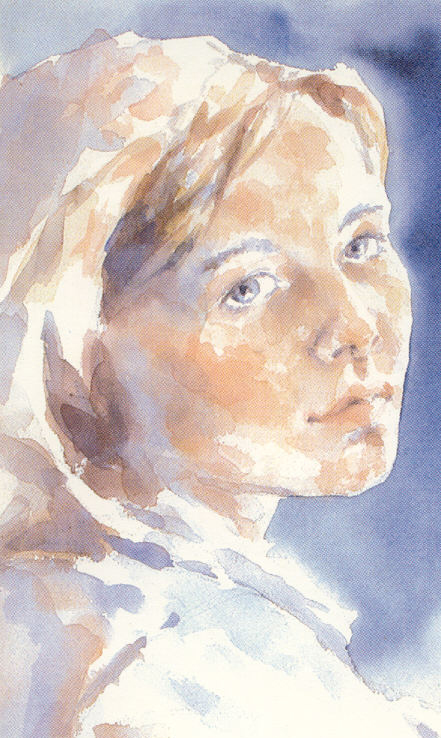
Special thanks to artist Anne Emmons for her permission to use “Hope” in this blog. You can reach Anne at anneemmons_8@msn.com or on Facebook.

Here is Anne’s story about this painting:  I was trying to think of one moment in the Biblical narrative which captures the theme of hope.  Each year I have made a new image for Christmas since 1997, and in 2000, I was struck by the idea of hope as the source of light. The images in this series reflect the thought that Christ came, the Light of the world, into darkness. So I was thinking about one single moment in the story and I realized the moment Mary heard the announcement from the Archangel Gabriel must be the moment hope found a form, in her face. At the time, my daughter was almost 14, the estimated age of the Virgin Mary, and I suddenly connected with the story in a particular way. I kept her home from school that morning to have her sit for the painting. What struck me, and this has since been confirmed from other sources, most recently Anthony Bloom’s book, Beginning to Pray, was that the Incarnation was possible only through God’s will in union with the “yes” of the young Mary, who became the bearer of the Uncontainable God. Just after I painted this I saw the Pontormo Annuciation in a small side chapel in Florence, and Mary had the same sort of look of wonder I tried to catch.  Now my daughter Claire has a two year old son, Theodore. She is a single mother who said yes to the birth of this child, whose name she chose, not knowing it means “gift of God.”

This is a previously published post (December 2009)  with some light editing.

It Begins with a Howl

 It begins with a cry            

      a muffled sob at midnight

      a “Help me!” filling the dark    alley with terror

      a fist banging on the door

      a numb, blank stare and a      hand, clenching and     unclenching a ball of tissue       

 a sudden lurch and collapse, facedown in the open field


This is how it begins, what we call Christmas.

Salvation is summoned by its negation.

The Savior is called forth by the raw expression
of the creation’s need,

the howl
that rises from the shattering
collision of what is with what should be.


Christmas begins when God hears

 And God heard the voice of the boy… Gen 21:17

I have heard their cry on account of their taskmasters. Ex 3:7

Do not be afraid, Zechariah, for your prayer has been heard. Luke 1:13

Christmas begins when God sees

I have observed the misery of my people who are in Egypt.  Ex 3:7

My tears will flow without ceasing, without respite until the Lord from heaven looks down and sees. Lamentations 3: 49-50

She answered God by name, praying to the God who spoke to her, “You’re the God who sees me!” “Yes, he saw me; then I saw him!” That’s how the desert spring got named God-Alive-Sees-Me Spring. Genesis 16: 13-14

Christmas begins when the earth turns, writhes, and lifts up its lamentation. When the protest of the human heart joins its sorrow with the heart of the One acquainted with grief,

then

you step out of the forest
and into the clearing
to place in our hands

a child
wet and wild.

Here is my answer, you say.
And the name of the child is

      Love.

Still Not Enough? ~ Redux

Not enough time, not enough energy, not enough hope, not enough money, not enough jobs, not enough room, not enough love, not enough peace …

not enuf nuthin !

So goes the lie.

As the holiday season of plenty, hope, and generosity opens its arms to us, some of us brace ourselves, suspicious of the season’s glittering wares. The family, who lost their home to foreclosure, the unemployed factory worker, and other despairing and heartsick souls may feel plenty is beyond their reach and scarcity their new normal.

The media depictions of holiday cheer play on our insecurity and sense of lack. They insinuate that no matter how much we have, we do not have the latest and greatest. Advertisers lure us with promises of more. We may find ourselves stumbling after ghostly phantoms in the desperate hope that this year we might find that illusive wholeness we are seeking.

How does one feel whole and fulfilled, when one is more aware of scarcity in one’s life? Perhaps abundance in the midst of scarcity occurs for us as it did for Jesus, when he fed five thousand people with five barley loaves and two small fish.

We welcome what we have,
however meager.
We give thanks,
and watch it multiply.

Practice a Miracle: The Welcoming Prayer

Here is a simple, yet demanding, exercise to practice such a miracle in your own life. It is called The Welcoming Prayer. It was developed by Mary Mrozowski, one of Thomas Keating‘s closest associates and a prime mover in the development of centering prayer. She based the Welcoming Prayer on the 17th-century French spiritual classic Abandonment to Divine Providence by Jean-Pierre de Caussade as well as Fr. Keating’s teachings and her own lived experience of transformation with its underlying attitude of surrender. There are a number of variations on this prayer. Here is one.

FOCUS AND SINK IN:

  • Become aware of what is troubling you or occupying your mind. For example, your sadness, anger, or fear regarding scarcity of some kind in your life. Focus on your feelings, both cognitively and physically, noting how and where the feeling affects your body.

  • Instead of resisting, or feeling ashamed or denying, welcome the truth of what is troubling you. Welcome the feelings with curiosity and compassion.

LET GO: (Here is the hard part)

  • Let go of your desire for power and control over the situation. Release your desire to be “right.”
  • Let go of your desire for affection and esteem from others.
  • Let go of your desire for survival and security.
  • Let go of your desire to change the way things are.

REST :

  • Allow yourself to sink into the abundant flowing love of this moment.

The present is ever filled with infinite treasure; it contains more than you have capacity to hold. … The will of God is at each moment before us like an immense, inexhaustible ocean that no human heart can fathom; but none can receive from it more than he has capacity to contain, it is necessary to enlarge this capacity by faith, confidence, and love…French priest, Jeanne Pierre de Caussade

You may find the letting go section of the prayer difficult to do. One or two of the desires may be harder to release than others. Think of this as useful information about what things, other than God, are of primary importance in your life. Notice which desires might be getting in the way of your freedom in Christ. If you find you cannot release one of these, you might simply pray that God give you the desire to desire to let go.

The Welcoming Prayer invites us to trust in God’s presence and providence and to discover the infinite wealth of God available to us in each moment. “The divine will is a deep abyss of which the present moment is the entrance. If you plunge into this abyss you will find it infinitely more vast than your desires,” writes de Caussade.

I believe this is absolutely true. Over and over in the midst of distress, I have wrung my hands about there not being enough of one thing or another in my life. Yet as I have focused and welcomed the feelings and my present reality, let go of my ego’s desires, and rested in God, my need has been supplied with an abundant depth and power that swept away all my grasping and anxiety.

I heard the geese honking at dawn last week. My dog halted at the door and cocked his head and we listened together in wonder. I love the sound of them moving over head, giving themselves to the skies. Trusting in their ancient faith they make their way.

In spite of all appearances to the contrary, I believe there is enough.

The Wild Geese

Abandon, as in love or sleep,
Holds them to their way
clear in the ancient faith:
what we need is here.
And we pray not for new earth or heaven,
but to be quiet in heart
and in eye clear.
What we need is here.       Wendell Berry

I trust in you, O Lord. You are my God.
My times are in your hands. Psalm 30:1


This post is a lightly edited version of a previous post. May this season fill your cup with overflowing goodness and a steady supply of all that you need!