Category Archives: Advent

The Amaryllis and the Evangelist


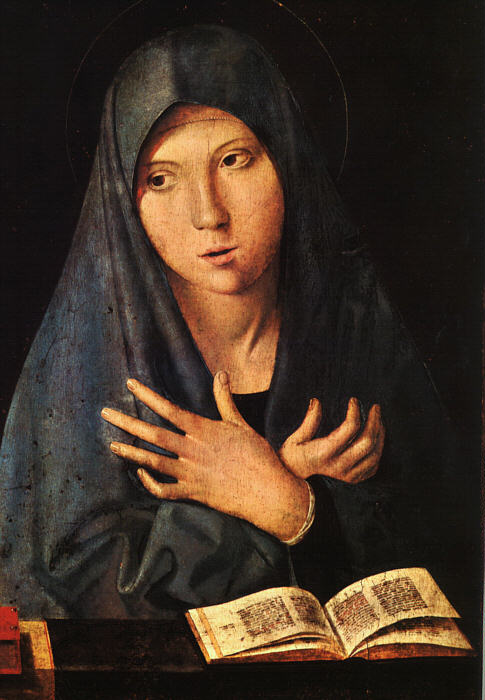
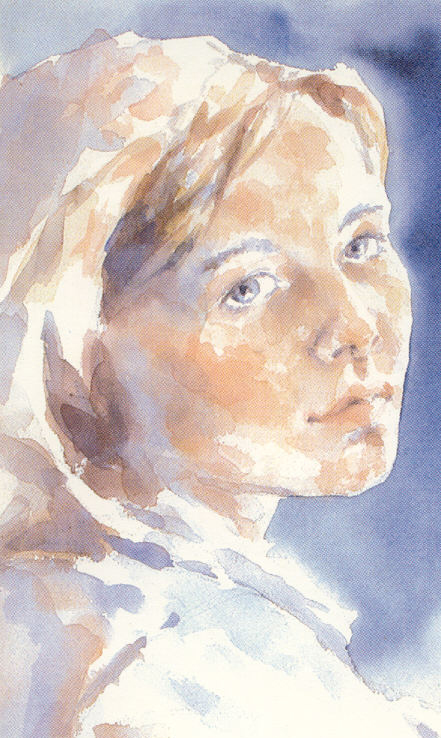
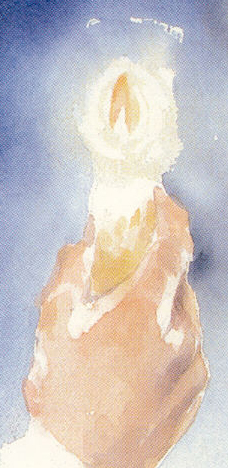
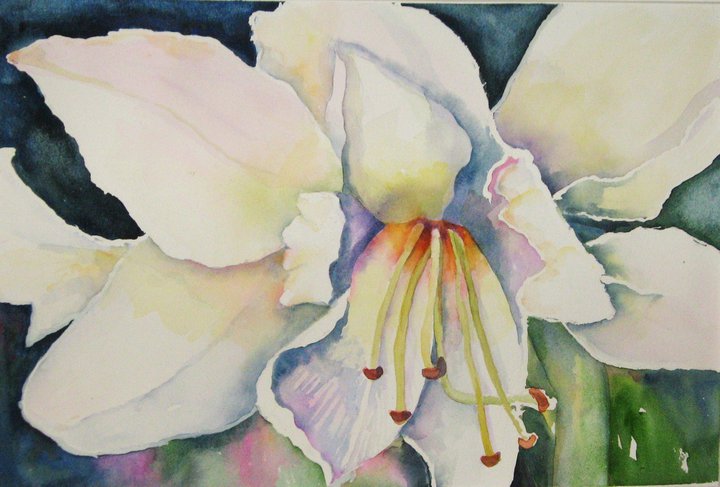
Painting by Dorothy Frager


To Look

 at

Any Thing

To look at any thing,
If you would know that thing,
You must look at it long:
To look at this green and say
‘I have seen spring in these
Woods,’ will not do – you must
Be the thing you see:
You must be the dark snakes of
Stems and ferny plumes of leaves,
You must enter in
To the small silences between
The leaves,
You must take your time
And touch the very peace
They issue from.   ~  John Moffit

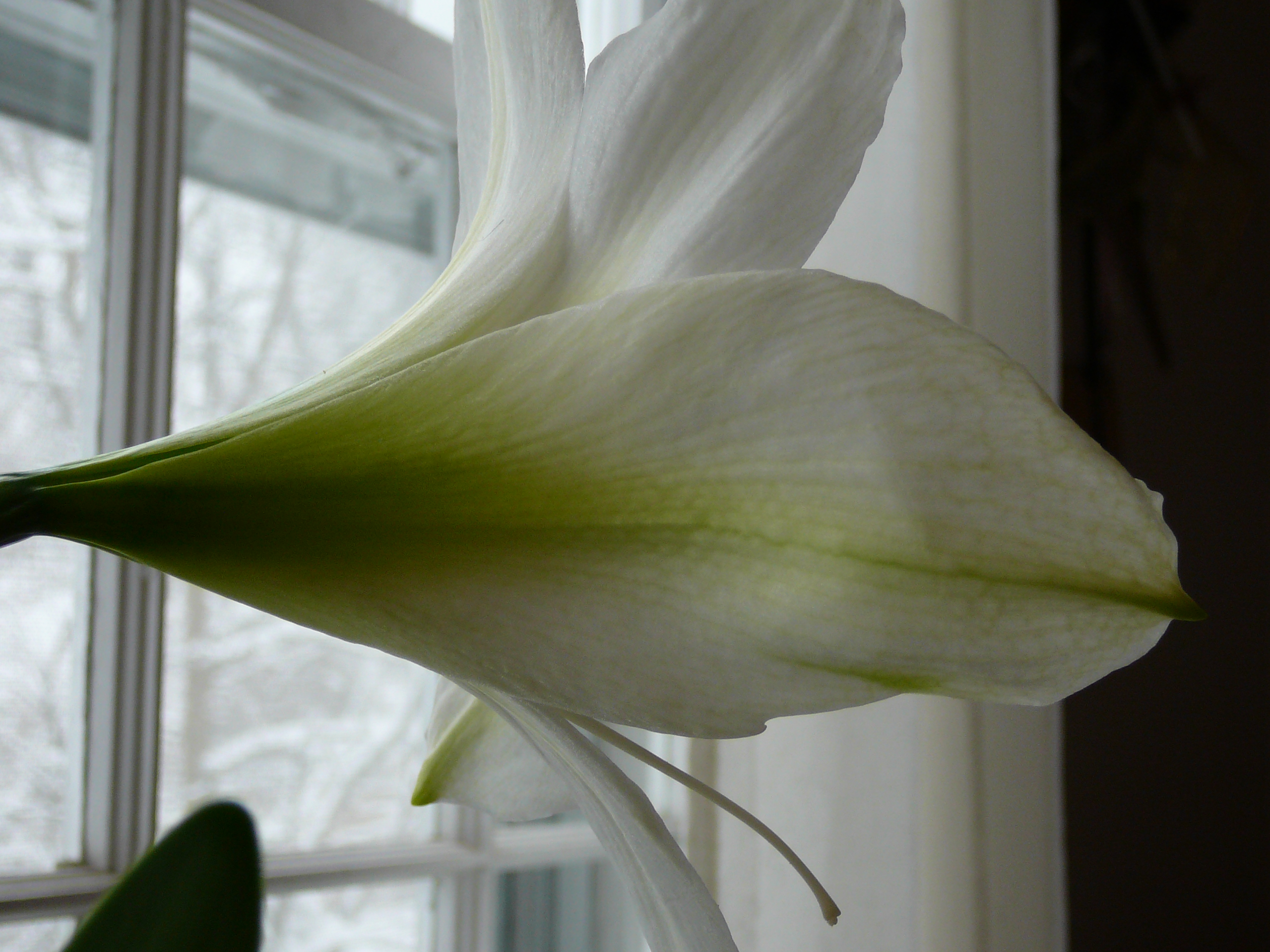
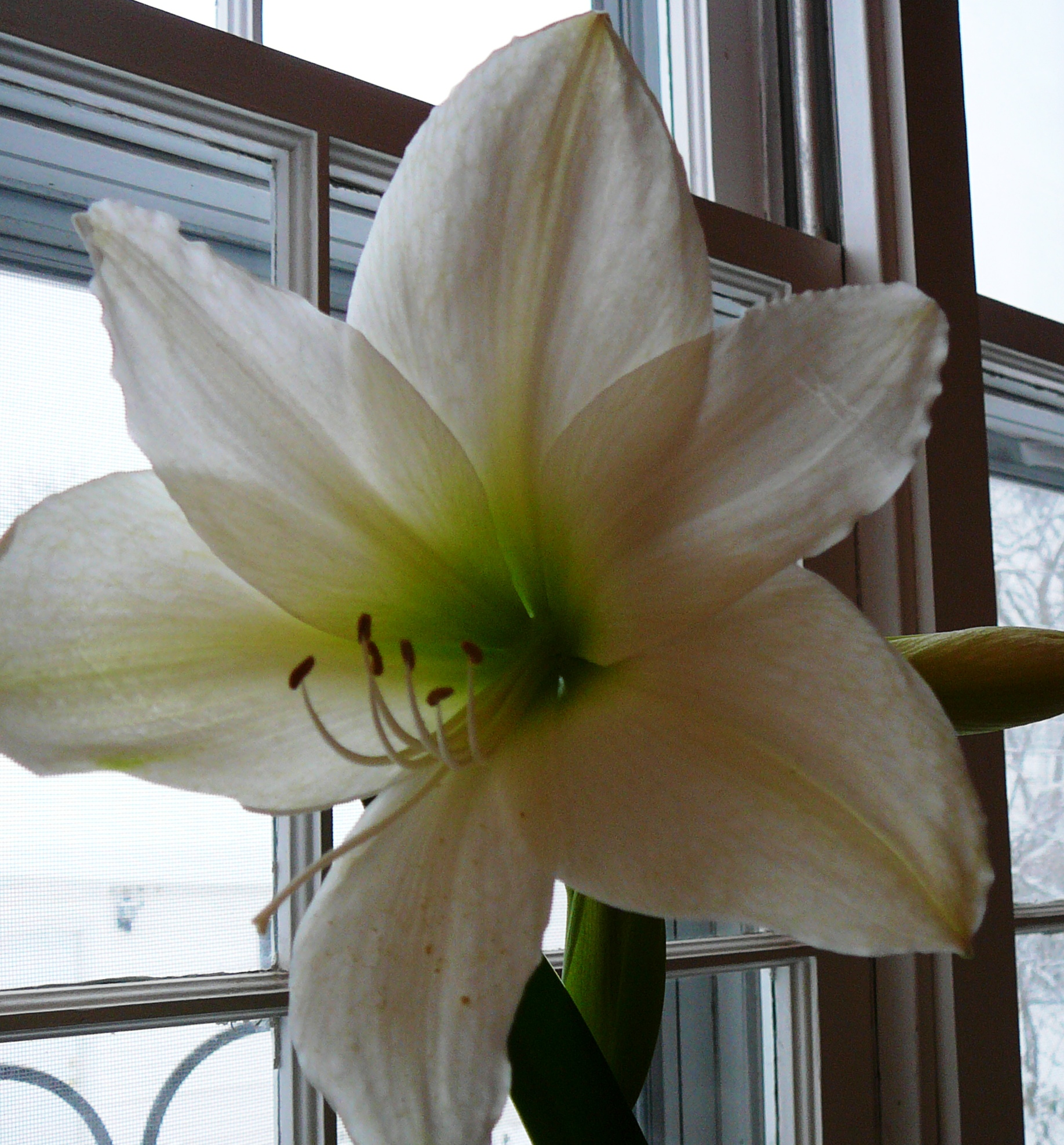
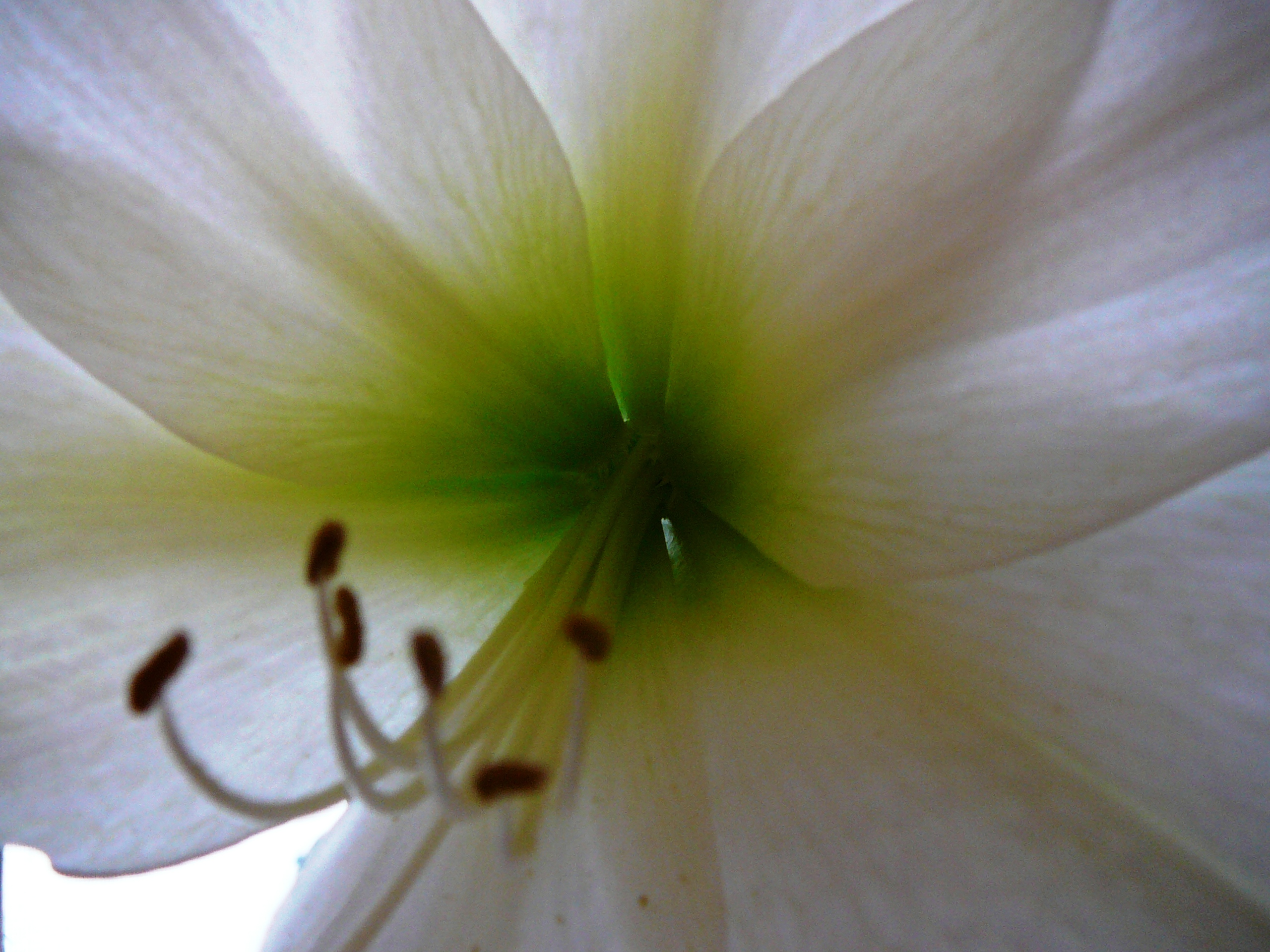
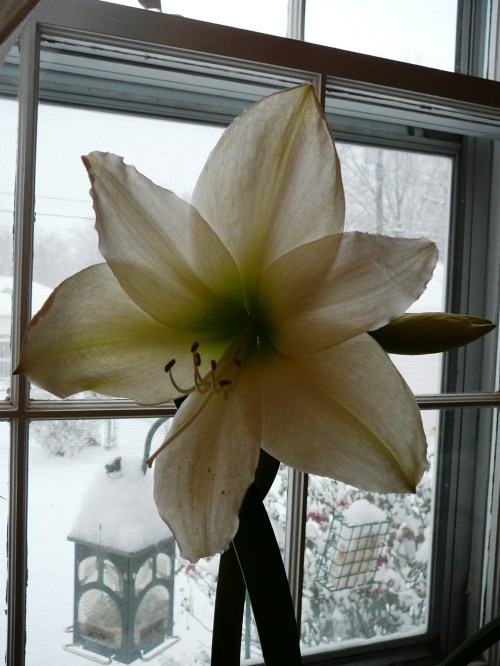
I am looking at the blossom of a white amaryllis, rising on a thick green stalk before my window. Outside it is snowing hard.

A woodpecker drills at the suet cake, swinging from the feeder. A brown squirrel plows down the power line, shoving clumps of snow to the ground. I am looking long at the amaryllis and that green seam shading into pale yellow tracing along the underside of a blossom.

I look and look – at the milky, translucent petals, the flared green heart of the blossom, the seven curved stamens with their golden haired anthers, the fluted, serrated fringe at the tip of the petals, and that tiny pale shoot rising up between the two large petals – the pistil and three legged stigma. I look at the split sheath covering of the three large blooms. The two pieces now hang limp, shriveling, spent from such sundering.


And I am

breathless

with the wonder

and beauty.


Last evening my home was filled with teenagers. Thirteen kids crowded into my tiny den to watch a video about faith called Beyond Our Differences. Earlier we took a pared down version of a survey conducted by the Pew Research Forum on Religion and Public Life. The survey, conducted last year, measured Americans’ knowledge of their own religions and their neighbors’ religions. On average Americans got only sixteen questions out of the thirty two correct.

The teens and I are learning about different religions this year in our desire to build understanding with our neighbors on this planet, discover points of common ground, and to become clearer and more articulate about our own beliefs.


On January 6 many Christians celebrated Epiphany, the visit of the wise men from a far away land with their gifts to the infant Jesus. Now we enter the stretch of Sundays after Epiphany that carry us all the way to Ash Wednesday and the beginning of lent.

Epiphany means a showing, a revealing and was applied early on in the Church to this event in Jesus’ life. The previously obscured and hidden God of the Jews unveils his divinity for all people in the Christ child, and folks from a long way out of town show up to see it.

The themes of the scripture readings which carry us through the next eight Sundays focus on the mission of the church as making disciples and reaching out into the world as evangelists. Some churches also use this season as an opportunity to foster fellowship, to repent of our sins of bigotry, hatred and prejudice, and work toward healing the divisions in church and society.

Soon after his birth Christ is introduced to his first cross cultural, interfaith experience in the form of the visitors from afar.  Next, fleeing Herod’s wrath, he and his parents become aliens, refugees,  in a foreign culture in their escape to Egypt.

History is full of stories of the church’s awkward, failed, and sometimes brutal and horrendous attempts to share what they have seen at the manger. History also is full of astounding stories of love, forgiveness, freedom and justice as the gospel has been shared.


At the beginning of Advent the youth group read Isaiah’s prophecy of the coming messiah:

He grew up before him like a tender shoot,
and like a root out of dry ground.
He had no beauty or majesty to attract us to him,
nothing in his appearance that we should desire him.                                                             Isaiah 53: 2

I held up a dry, flaky amaryllis bulb with a wad of pale spindly roots. This is where advent begins, I told the kids. This is where God begins to come into our world –through something ugly and apparently useless that you may think ought to be thrown out in the trash. God arrives as things appear hopeless, beyond repair, and we are realizing that there is no way we can figure this out and make things right on our own. When we realize we need help, we are ready to meet Jesus.

A few days later I planted the bulb in a green ceramic pot my daughter made. She would be embarrassed to see it in this pot. Not up to her standards, the pot has some flaws. I love it.

A month later, gazing at the blooming beauty heals my soul. I wonder what it would be to become those long smooth fleshy spears of leaves. I have been busy the past week with numerous contacts, encounters, preparations, and meetings. I have gazed into the pure white petals of many souls. Each person was stunningly beautiful and deserving of longer attention than I had time to give.

 Today I gaze long upon the white amaryllis. A prayer wells up for those thirteen young people and for their parents and grandparents. I love them all like the mother rabbit I saw in a video once. The rabbit was chasing a snake away from her nest. She followed and pounced and picked it up, thrashing in her mouth, until the snake escaped and slithered up a tree. I want no harm to disturb the growth of these souls. I tremble too, at the responsibility entrusted to those engaged in the care of the souls of others.

I am not absolutely sure what it means to be an evangelist.  I do think it has to do with telling the stories of what we have seen. We need to share with one another those epiphanies which bring us to our knees, call us to make long journeys, and inspire us to give away our precious treasures.

I also believe that being an evangelist has to do with offering the gold of our time,

with inviting the poor and needy into our lives,

and looking long and hard at each other

until we touch the very peace we issue from.


 Thank you to Dorothy Frager, who looks long and hard,  for permission to use her painting!

 The Sanctuary Foundation for Prayer
Contact the author: lross@fromholyground.org  www.fbook.me/sanctuary
Follow at http://twitter.com/lfross


Waiting: The Surrender

Part Four of Four Parts

The earth, muffled with snow, goes about its hidden preparation for spring. Silence spreads over the land. Our pace slows with the burden we are blessed to bear. The angel with his face of fire and his wings is now a dim memory. God has become a long, low hum, a slow pulsing throb. We, like the inside of a struck gong vibrating peace, wait.

The fox in the woods stops in its tracks and sits up listening – still. The hawk on the wing wheels in a broad circle, glides down a current, and settles on the post -still. The chickadee at the feeder lifts and tilts its head listening – still.

Then it comes. Wrenching pain pierces us like a sword in the belly. We collapse to our knees and crouch in the darkness. Impaled by the circumstances of our lives and God’s call to us we embrace the cross of Christ. Extended far beyond our feeble powers, such bearing is more than we can do. With each new contraction we lose our nerve and cower like Peter saying,”I don’t know nothin’ bout no man named Savior.

Now we may recall Jesus’ question, “Are you able to drink the cup that I drink, or be baptized with the baptism that I am baptized with?” And we had boasted like idiots, “We are able!” We had no idea what would be asked. Between contractions we pray, “If it be your will, remove this cup from me. But not my will, but yours.”

To entrust ourselves to the will of God at the very moment when we feel most alone and in the most pain requires us to have come to the absolute end of our own will and resources. What makes such a thing possible? How could Mary persevere? How did Paul in prison and facing death continue to preach the gospel?

Perhaps it was their surrender, their sense that something larger than themselves had taken hold of them. An ax had been laid at their roots. A furious whirlwind had shaken and blasted them. Now all in them that was chaff was burning in an unquenchable fire. Finally, exhausted from resisting they say, “Yes, yes. You are in charge. You are God. I love you. I trust you. I don’t like or understand this, but I give myself to you however you want me. My will and desires die to yours.”

A birth is not something one does as much as submits to. Processes set in motion long ago now come to fuller expression. One’s being is given over to a life and purpose beyond itself. The best thing to do is simply hold still, breathe with the pain and wait between contractions.

The Greek word used in the Bible for wait is hypomenein. It means “to stay behind, to stand still, and to hold out.” Hypomenein includes in its nuances to cleave to God in simple, quiet confident waiting as well as to endure, stand fast, persevere; and it includes courageous active resistance to hostile attack.

Wait in the New Testament refers to the endurance that is given for the realization of the kingdom. It is the basic attitude of the Christian as we face the attacks of a hostile and unbelieving world and as we find ourselves in the midst of temptations. The power to persevere is drawn from faith and hope.

Our wills, knowledge, or technology have no power to bring about salvation, wrote Simone Weil:

The role of humanity is to wait . . . The attitude that brings about salvation is not like any form of activity. . . . It is the waiting or attentive and faithful immobility that lasts indefinitely and cannot be shaken. The slave, who waits near the door so as to open immediately the master knocks, is the best image of it. He must be ready to die of hunger and exhaustion rather than change his attitude…We just have to wait for the solution. . . . Seeking leads us astray. This is the case with every form of what is truly good. [We] should do nothing but wait for the good and keep evil away. (Waiting for God, 195-6)

Might you be entrusted with a task to match the largeness of your soul? Could you, like Mary, tell your cousin, “My soul magnifies the Lord, and my spirit rejoices in God my savior, for he has looked with favor on the lowliness of his servant”? Is such heroism only for martyrs in foreign lands, prophets defying oppressive governments, and saints whose lives trace truth in their own blood? Of course, not.

“What good is it to me if Mary is full of grace, if I am not also full of grace? What good is it to me for the Creator to give birth to the Son if I do not also give birth to him in my time and my culture?” asks German theologian, Meister Eckhart. (1260-1329)

If you are summoned by an angel, if you find your heart stretched big with some unnameable love with a mind of its own, eat your broccoli. Remember my friend at the beginning of this series, who hoped to live long enough to see her thirteen year old son parent  his own teenager?  (Waiting: Broccoli and Perserverance.) Take your vitamins. Stay focused on your goal. Wait. Trust. It will be worth it just to be around on the day of the Lord, however long it takes.

This post adapted from the author’s book, Letters from the Holy Ground – Seeing God Where You Are, Loretta (Ross-Gotta) F. Ross, Sheed & Ward, 2000.
The Sanctuary Foundation for Prayer
Read more about prayer www.fromholyground.org
Contact the author lross@fromholyground.org, www.fbook.me/sanctuary
Follow at http://twitter.com/lfross

Waiting: The Threats

Part Three of Four Parts

Maybe there will be a miscarriage. Maybe the child will be ill or damaged. Maybe nothing will happen, and I have made this all up. The demons slink in and taunt, harass, confuse, lie, and distort. Feeding on our fear, they float in our minds like bloated carcasses.

Impatience, fueled by fear and lack of faith, has resulted in many an aborted Christ child. Dreams, wrenched too soon from the womb of God’s providence, die torn and bleeding in the back rooms of our souls. Fearing that the Promised One cannot be trusted to save us from ourselves, we join the tribe of those who attempt to seize the kingdom by violence.

Yet the promise always comes in the context of threats, writes biblical scholar Walter Brueggemann.

The land of promise is never an eagerly waiting vacuum anticipating Israel. Nor is it an unambiguous arena for faith. It is always filled with Canaanites. That is how the promise comes… It is the very land of promise, the purpose of the whole journey of faith, which causes the failure of nerve. . . .

God’s people always want to settle for something short of promises, because promises fulfilled remind Israel how vulnerable it is, how exposed it is, and how precarious it all is. Promiseless existence is safer. The Bible knows from the beginning that promises are always kept in the midst of threats. Tables are always prepared  “in the presence of my enemies”and if one would eat at the table, one must eat in the presence of enemies. The land is precisely for those and only for those who sense their precariousness and act in their vulnerability. (The Land, Fortress Press, Philadelphia, 1977, p 67-69)

Threats, in whatever form they come, tend to scare the wits out of us. We feel like puny grasshoppers compared to these giants. Possibly the greatest threat, according to Jesus, is the failure to believe, or the lack of faith. There is that time before the pregnancy shows and no one can tell what is inside, and even after one has something visible to point to, like a vision, a possibility, the first faint glimmerings of a new idea, when the actual outcome is shrouded in mystery, and the course of the life of the new one to be born is unknown to us. So we must nourish the invisible, the inklings, the suggestions, and the voice of some ethereal visitor who whispered something wondrous and unbelievable.

Whom could you tell? What would they think? Maybe your lover will understand and give his support. Maybe God will intervene in a dream. Maybe a wise old friend, whose own promise leaps in recognition of your promise, maybe the old cousin will understand.

But there is a long time of hours, days, months, and even years –year upon year, when much is hidden and only you sing in your heart of what is to come, the gift you will offer. And what to do until then?

Fall back on praise and being. Notice the leaf in the redbud tree outside your window, curled and brown crisp in the sun. Stand at sundown as the earth grows still and silence creeps into your heart like a cat and curls up and purrs.

“Blessed is she who believed that the word of the Lord would be fulfilled,” announces the cousin. Blessed are those who believe in the glad and amazing truth that sings in their hearts, trusting with Mary and her Son that all will be well and that they are highly favored.

Watch for the last installment, Part Four, of this series on waiting, The Surrender, coming soon.

This post adapted from the author’s book, Letters from the Holy Ground – Seeing God Where You Are, Loretta (Ross-Gotta) F. Ross, Sheed & Ward, 2000.

The Sanctuary Foundation for Prayer
Read more about prayer www.fromholyground.org
Contact the author lross@fromholyground.org, www.fbook.me/sanctuary
Follow at http://twitter.com/lfross
Waiting: The Promise

Part Two of Four Parts

How long can you carry the secret,
the gift of saving love,
before giving birth to it?

How long can you ponder things in your heart
and sit on the stone path in the sun?
After a while it becomes obvious
that there is something up your sleeve,
or under your tunic.

Someone’s delight is in you
and is growing bigger every day.

Some of us are called to bear children. All of us, male and female, are called to give birth to Christ. We carry God’s seed, a divine promise in us and for us. Each is called to conceive some aspect of the great promise of salvation. We are given the choice to surrender to it, to carry and nourish it, and give it birth on its terms in its time.

With such a call, we are at the service of powers greater than we are. We find ourselves as servants and handmaids, those who stand alert and ready at the door for the one they serve, who may come at any time. We belong to the promise and are given over to the promise. The child of the promise is the unique offering you, and only you, can give out of your love in the Bethlehem of your life.


What is it? Who is it? How is this done? We are each alone here. There were no witnesses when Gabriel came. One or two may understand, who are strong when we are weak, who have hope when we have despair, who have faith when we have none. For the most part we must face the rejection, fears, doubts, and devils alone. And then, suddenly in the dark comes the sharp all-encompassing pain of labor – so much more painful than we had ever imagined it could be.

It may not look like all that much, your child and your offering of yourself as a mother of redemption. It may seem a small thing compared to Mary’s child. The child you bear may be nothing more (or less) than the courage to get through a bad day, or a shred of hope you cling to like a broken raft in the midst of a churning sea.

Two signs may help you tell if this is your Christ child: first, a vision of the joy or beauty or love set free in the gift you offer; and second, your sacrificial suffering in the labor and delivery of that gift. Such suffering is not a consequence of abuse or injustice. This is the suffering of love, which is assailed by evil as it seeks to remain firm in its faith in the efficacy and power of God’ s suffering love on the cross.

Waiting

waiting

how did she keep the promise alive,
the hope,
the word which was spoken to her,
through all the days and nights
while she walked the rocky paths?

What good could come out of Nazareth?
How can this be?
I have no husband.
I have no money.
I have no strength.
I have no hope.
I have no skill . . .

But he said, Nothing is impossible with God.

A secret between her and the angel,
a child growing in a hostile environment
and stillness at dusk
when the light slides under the horizon
leaving a golden smear of hushed anticipation.

She was like a tiny flame
in a sea of darkness

.

Watch for Part Three of this series on waiting, The Threats, coming soon.
Adapted from the author’s book, Letters from the Holy Ground – Seeing God Where You Are, Loretta (Ross-Gotta) F. Ross, Sheed & Ward, 2000.
Website  The Sanctuary Foundation for Prayer
Read more about prayer www.fromholyground.org,
Contact the author lross@fromholyground.orgwww.fbook.me/sanctuary
Follow at http://twitter.com/lfross

Waiting: Broccoli and Perseverance

Part One of Four Parts

A friend recently asked me for the key to success in surviving a child’s thirteenth year. She told me she ate some truly nasty broccoli at dinner one night in a desperate attempt to do something good for herself. She swallowed the stuff in the hope that it would help her live long enough to see her son become the parent of a thirteen-year-old.

Longevity and sheer perseverance have a lot to do with justice and salvation. If you can live long enough, you may see the triumph of good with your own eyes. Being able to hang on, to wait through periods when all seems turned against you, to survive and prevail is a central activity of a Christian.

Some pastors struggle to get congregations to sing the more somber and penitential advent hymns before the favorite Christmas carols. I am not surprised. Our culture’s mindless celebration of Christmas distorts the basic truth of the season, namely, our need for redemption and what might be required of us to receive it. We gloss over our appalling sin and ruin, skip past the eager groan of creation’s need for healing. We drug ourselves against the suffering of dark nights. We grow numb and fall asleep before the TV instead of keeping alert and obedient watch for God’s saving action in our lives. We succumb to the temptation to consume more and more as we race to gratify desires.

In contrast, Christ tells us that here is where we are to linger, to stay awake, to wait and be ready,

here in the bleak and barren heart of our need.

Timing is everything. Should one push, move ahead and make something happen or lay low, wait, and watch for the hand of the Lord to act? Tolerating ambiguity, not knowing and uncertainty can be excruciating. In our anxiety and fear we may take things into our own hands.

As a general rule of discernment, when in doubt, wait. The stance of faith waits, trusts, praises, and gives thanks. Faith joined with love bears all things, believes all things, hopes all things, and endures all things.

Why is that hard for us? Perhaps we fear that we won’t be vindicated, that our longing will not be fulfilled, that our cause will not redeemed, that things will not be made right and goodness will not prevail.

My friend with the thirteen-year-old told me her family motto: “Learn to bear what must be borne.” This stern admonition carries for me a puritanical severity, a life of gritted teeth, pursed lips, and making the best of one trial after another. But when I shared the proverb with another friend, “What a great theme for advent,” she exclaimed, seeing a possibility I had missed. My understanding shifted from regarding what must be borne as some heavy load and having to slog along through life like a drudge to the exhilarating task of the labor and delivery of a baby.

“Love in real life is a harsh and dreadful thing compared to love in dreams,” observed Dostoevsky. The advent season invites us to the harsh and dreadful task of giving birth to a love that will ask more of us than we thought we could bear. Learning to bear the one who must be born, the Christ, into our lives, families, communities, and world requires us to wait, persevere, and overcome fear with faith.

As the promises of God are delivered through our lives, we can rejoice with St. Simeon, whom Orthodox Christians call “The God Receiver.” Old Simeon was waiting to see the Christ before he died. Led by the Spirit, Simeon showed up at the temple when Mary and Joseph brought their son to present him to the Lord, according to the law of Moses. Taking the infant into his arms with a heart full of love and eyes full of tears, the old man uttered these words:

Lord, now let Your servant depart in peace,
according to Your word,
for my eyes have seen Your salvation,
a Light to lighten the Gentiles,
the Glory of Your people Israel.
Luke 2:25-32

Watch for Part Two of this series on waiting, The Promise, coming soon.

Adapted from the author’s book, Letters from the Holy Ground – Seeing God Where You Are, Loretta (Ross-Gotta) F. Ross, Sheed & Ward, 2000.
The Sanctuary Foundation for Prayer
Read more about prayer www.fromholyground.org,www.fromholyground.wordpress.org
Contact the author lross@fromholyground.orgwww.fbook.me/sanctuary
Follow at http://twitter.com/lfross

Christmas and the Recollected Soul

The ferocious intensity and strain that many of us bring to Christmas must suggest to some onlookers that, on the whole, Christians do not seem to have gotten the point of it.

“Without me you can do nothing,” said Jesus.  Yet we act, for the most part, as though without us, God can do nothing. We think we have to make Christmas come, which is to imply that we think we have to bring about the redemption of the universe on our own. However, all that God needs is a willing womb, a place of safety, nourishment and love. “Oh, but nothing will get done,” you say. “If I don’t do it, Christmas won’t happen.”

God asks us to give everything of ourselves away. The gift of greatest power that we can offer God and creation is not our skills, talents, or possessions. The wise men had their gold, frankincense and myrrh.  Paul and Peter had their preaching. Poor Mary had only interior space, love, belief – her being.

What is it that delivers Christ into the world? Is it preaching, art, writing, scholarship, social justice, mission? These are gifts well worth sharing, but preachers lose their charisma, scholarship grows pedantic, and justice alone cannot save us. When all other human gifts have met their inevitable limitation, it is the recollected one, the bold virgin with a heart in love with God who makes a sanctuary of her life, who delivers Christ, who then delivers us.

Recollection is an old-fashioned word, rarely heard anymore. In the spiritual sense recollection means quiet tranquility of mind and self-possession. Recollection is the gentle art of prayerful gathering in in preparation for deeper prayer. One calls back the scattered, fragmented self, strewn about one’s world like trash on a windy day. I pick up the pieces, sweep out the psychic debris, reorder the clutter and bring back to the center – wholeness. All about me that is frantic and frayed, dispersed helter skelter, leaving me anxious, confused and overwhelmed is drawn back.  I am no longer like a cracked and broken bowl which leaks and spills its contents, but I am mended and suitable once again for holding my life, for containing safely and serviceably who I am.

Try it. Leave behind your briefcase and notes and proof texts. Leave behind your honed skills and knowledge. Leave the Christmas decorations up in the attic. Go to someone in need and say, “Here, all I have is Christ.” And find out that is enough.

Imagine a Christmas service where the worshipers come in their holiday finery to find a sanctuary empty of all the glittering decorations, silent of holiday carols. What if this year you canceled the church decoration committee and the worship committee and called off the extra choir rehearsals and the church school pageant?

What if on Christmas Eve people came and sat in the dim pews and someone stood up and said, “Something happened here while we were all out at the malls, while we were baking cookies and fretting about whether we bought our brother- in- law the right gift. Christ was born. God is here.”?

We wouldn’t need the glorious choruses, the harp, the bell choir, and the organ. We wouldn’t need the tree strung with lights. We wouldn’t have to deny that painful dissonance between the promise and hope of Christmas and a world wracked with sin and evil. There wouldn’t be that embarrassing conflict over the historical truth of the birth stories and whether Mary was really a virgin. And no one would have to preach sermons to work up our belief.

All that would seem gaudy and shallow in comparison to the sanctity of that still sanctuary. And we, hushed and awed by something greater and wiser and kinder than we, would kneel of one accord in the stillness. A peace would settle over the planet like a velvet coverlet drawn over a sleeping child. The world would recollect itself and discover itself held in the womb of the Mother of God. We would be filled with all the fullness of God.

You might try a small experiment this year. Deliberately do not do something you usually do at Christmas. Choose something that feels like a burden, or is no longer a source of fun or delight. Instead of doing something, be something. Be womb. Be dwelling for God.

Be recollected.

Adapted from Letters from the Holy Ground – Seeing God Where You Are, Loretta (Ross-Gotta) F. Ross, Sheed & Ward, 2000.
The Sanctuary Foundation for Prayer
Read more about prayer www.fromholyground.org
Contact the author lross@fromholyground.orgwww.fbook.me/sanctuary
Follow at http://twitter.com/lfross
The Shepherd’s Story


Once in the fields in a storm
hunched down in a cave
I saw a red tongue of fire
leap from the heavens
lick down a cedar,
and split it in two.

The cloven tree shuddered
and screeched
as it crashed to the ground,
like an animal in the jaw
of some great beast.

________

It wasn’t what you’d think –
lovely heavenly hosts
in neat rows and pretty song.

It was mostly wings and terror.

Cold night
stars like ice
fire down to coals
flock settled in the fold.

Some scattered for cover, crying
the world is ending
which it was,
but not the way you think.

Fear –
tomorrow’s frets
yesterday’s regrets –
that ember of anxiety
that never goes out
no matter how much religion
you throw at it –

fear rose up and choked me.

The great heaping clouds
of wings
and the Word that wrote itself
in the marrow of my bones
split me
into before and after
and left me puddled
on the ground
soaking into mystery.

Most don’t reckon the sheer terror
of God crashing into their lives.
I learned fear was not my enemy,
but a sign of His presence.

Ignorant and blind as a wood tick
on a lamb’s flank,
I’d been crawling
through a patch of fleece
and a bit of warm skin
without a clue
as to what is really going on.

I froze, stupefied.

The sovereign almighty God was asking
something of me,
God wanted me,
my will,
the way I held my world together in my
wood tick brain
my perceptions and understanding
my sense of competence,
my adequacy
seized and consumed by wings.

A master’s painting?
A Messiah chorus?
A quiet pastoral scene?

It was gasping for air,
trying to stay upright
with not a thing to hang onto.

What’s the Almighty to do –
all hobbled up with majesty
finally having to slip in the back
door
of the world
through a virgin’s womb?

It was Truth
taking aim
condensing its enormity –
its hosts and universes,
its fire and power and goodness –
and homing into me
like a dove returning to her nest
like a lamb turning to the breast.

It wasn’t what you’d think.
It was mostly wings and terror.

Then, something so plain
and ordinary,
a baby,
and a Love small enough
for me to carry.


For who can endure the day of his coming, and who can stand when he appears? Malachi 3:2
One Christmas I got a good dose of the awesome power of God. I wrote this poem in an attempt to describe that experience.  I love the way Annie Dillard puts it: “On the whole, I do not find Christians, outside of the catacombs, sufficiently sensible of conditions.”
May the Almighty God knock your socks off this Christmas!

When Hope Fails


Hope is what gets a lot of people through the Christmas season. And the failure of hope is what leaves some souls shipwrecked on the treacherous rocks of the sin and imperfection of this world.

What is it for you this year? Death of a loved one? Spouse in Afghanistan? Unemployed? House foreclosed? Cancer?

Hope is the presentiment that the imagination is more real, and reality less real, than we had thought. It is the sensation that the last word does not belong to the brutality of facts with their oppression and repression.  It is the suspicion that reality is far more complex than realism would have us believe, that the frontiers of the possible are not determined by the limits of the present, and that miraculously and surprisingly, life is readying the creative event that will open the way to freedom and resurrection.  Rubem Alves

She was fourteen. She sat next to me as we drove home after the Christmas Eve service. Lights sparkled from distant homes across the snow covered fields. Shattered with pain and trying not to show it, I tried to focus on driving. After a while she spoke out of the darkness, “Mom, things aren’t ever going to be the same, are they?”

That year, our family had been struck by a blow from which we would never fully recover. In spite of  brave efforts, prayer, and sacrifice we could not put back together what was broken and, perhaps, fatally flawed.

During that season of suffering, hope became nearly eclipsed by fear, anger, shame, and pain. Each evening I turned briefly from my grief in defiance of “the brutality of facts with their oppression and repression,” and lit a candle for hope. Even though I felt no hope, I let the candle hold my hope for hope.

In those days I clung to the verse of scripture the minister preached at our wedding. Remember thy word to thy servant in which thou hast made me hope. This is my comfort in my affliction, that thy word gives me life. Psalm 119: 49-50 What an odd text for a wedding, you may think. Yet as the years unfolded it became more and more meaningful. I prayed it, holding God accountable to the goodness promised to me in scripture and whispered to my soul. God’s promise of joy, peace, and love comforted me and gave me the ability to keep breathing in my affliction.

Carmelite writer Constance Fitzgerald writes about the movement in our spiritual journey from “naïve hope to theological hope.” Through experiences of loss and suffering, naïve hope in a Santa Claus god and other illusions nurtured by our egos give way to a different, richer kind of hope. We let go of placing our hope in our own efforts, our own goodness, our own “luck” or deservedness. We let go of our “right” to ourselves and our way. Or perhaps it is more accurate to say, we numbly watch our way wrenched from our grasp. We face our helplessness and the truth that we are not in control. Hope in oneself and one’s little plans and projects dies on the cross of our life experience.

It is there in that stillness of a drive back home on the worst Christmas Eve in one’s life, while a child’s heartbreaking question hangs in the air, that hope in God is born.

You may miss it at first, especially if the pain is choking you. But refuse to let the last word be the brutality of facts. Go ahead and light that tiny candle. Defy the darkness. And pay attention. A baby is on its way. Something fragile and new and unimaginably sweet is making its way into your consciousness. 

I tell my daughter, “Yes, honey, things will not be the same. But I believe somehow or other, things will be all right.”

And they were.

Special thanks to artist Anne Emmons for her permission to use “Hope” in this blog. You can reach Anne at anneemmons_8@msn.com or on Facebook. 

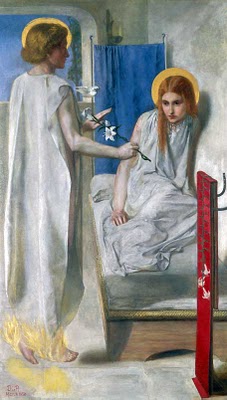
Here is Anne’s story about this painting:  I was trying to think of one moment in the Biblical narrative which captures the theme of hope.  Each year I have made a new image for Christmas since 1997, and in 2000, I was struck by the idea of hope as the source of light. The images in this series reflect the thought that Christ came, the Light of the world, into darkness. So I was thinking about one single moment in the story and I realized the moment Mary heard the announcement from the Archangel Gabriel must be the moment hope found a form, in her face. At the time, my daughter was almost 14, the estimated age of the Virgin Mary, and I suddenly connected with the story in a particular way. I kept her home from school that morning to have her sit for the painting. What struck me, and this has since been confirmed from other sources, most recently Anthony Bloom’s book, Beginning to Pray, was that the Incarnation was possible only through God’s will in union with the “yes” of the young Mary, who became the bearer of the Uncontainable God. Just after I painted this I saw the Pontormo Annuciation in a small side chapel in Florence, and Mary had the same sort of look of wonder I tried to catch.  Now my daughter Claire has a two year old son, Theodore. She is a single mother who said yes to the birth of this child, whose name she chose, not knowing it means “gift of God.”

Read more about prayer at www.fromholyground.org

Contact Loretta at
lross@fromholyground.org, www.fbook.me/sanctuary

 Follow at http://twitter.com/lfross

The Virgin Daughter of Jerusalem

A virgin is someone who is free of all false images and is detached
toward God’s dearest wish and ready to fulfill it unceasingly, as was Jesus.  Meister Eckhart


 My small daughter, playing with the holy family in the wooden stable sings her lullaby: Round yon urgent mother and child, holy infant so tender and wild.

 This mother, more urgent than virgin, smiles: Yes, Holy Infant tender and wild, you are so wild, so undomesticated, so radically other than anything known and familiar. No matter how hard we coax, you will not eat out of our hands, but remain out in the timber hidden in the brush. We set out bait, offerings on the snow. Cowboy theologians toss ropes into the forest and lasso decoys.  And roughrider ecclesiastics try to corral you in sedate doctrines.          

_______________

The virgin daughter of Jerusalem sings at the gate. In the dark we lay a trail of bread crumbs to our door. We wait, stilled, hushed. Come,  Lord Jesus.

But who can stand when you appear? The earth shudders, mountains topple, creatures shiver with fear. Shots ring out in the forest. Innocence awakens and moves toward us and the rough hand grasps for its lost treasure.

The virgin daughter of Jerusalem stands on the path and suddenly she is falling, falling into the blue sea into the wide sky, falling through pain and fear and despair, falling faster and faster, picking up speed, plummeting like a stone, falling through a tunnel formed at the intersection of the cross hairs in the telescopic sight aimed at redemption where opposites meet and all things come together.

She is whizzing down the tunnel like a child’s slide, sleek and silent, silver in the sun, falling free. And the kingdom does not suffer violence, and she is not taken by force and the two, who have been made for each other, delight to have found ground holy enough to hold each other’s purity, ground strong enough to bear each other’s pain. And in her joy she funnels greatness from the wideness of her hope down the narrow passage of her being into us.

So now I pray for passionate virgins who have died for love and dwell beyond the clutch and fever of desire. I pray for eccentric virgins who live on the outskirts of propriety and raise geese and talk to trees. I pray for violated virgins and their reconsecration. I pray for virgins who find the courage to reject the lie that eats away their souls and leads them down a winding path of mirages and fun house mirrors that mock Truth.

I pray for virgins who know they are only as holy as they are willing to see how horribly they have been profaned, and how horribly they profane.. . .I pray for revolutionary virgins who despise the shame and take up the suffering for the joy that awaits. I pray for virgins whose land, enclosed by strength, is untouched and guarded by a flaming sword. I pray for virgins, who with unveiled eyes gaze unflinchingly at evil and at God and live to tell the tale. I pray for virgin martyrs who are witnesses with the conviction to believe their own eyes. I pray for chaste, intrepid, impeccable virgins incapable of doubt.

I pray for virgins who apply themselves to prayer until their souls become clear focused lenses, through which we spy enlarged for us the intricate dazzling structures of divinity. And God, hidden in the forest, is magnified by them; and glory sprints across the clearing kicking up a cloud of blessing.

And I pray for a virgin with a heart which dilates. A bold virgin, who when she has grown as big as she can be, when she has come to the outer reaches of her being and all that she thinks and knows and hums to herself, will give up encompassing Plentitude. I pray for a virgin who becomes Emptiness, who will let go of her edges, the taut boundaries that separate this from that, and flinging herself like crumbs in a fragrant trail from what was once her heart to the forest will say: Let it be to me according to your word.

And the shy, tender God takes the bait. And she and holiness are won. And their child tumbles wet and wild into the wounded world to heal us with his stripes.


 _______________

Virgin comes from Latin and means literally slender branch, twig or shoot. The original sense of the word is a person who is one in him or herself. Such a person is free from possession and possessiveness and capable of the total giving of self, body as well as soul. The virgin aspect is that which is unpenetrated, unowned by humanity. It does not need to be validated or approved by anyone to know its own innate worth. Virgin carries much of the same intent as the word for holy, which means set apart, the temple. The parthenon (literally the virgin’s place) was the temple to Athena on the acropolis in Athens. In the New Testament virgin is used to depict the host of the redeemed in Revelation and to refer to the community as the bride of Christ. But by far the most frequent use of the word virgin is in the Bible’s figurative description of cities, nations, and communities. We often find virgin daughter as an expression for Jerusalem.

Excerpted from  Letters from the Holy Ground, Chapter 10, “Urgent Mother and Child – Holy Indifference and the Repose of the Virgin,” 39-43.

More about prayer at
www.fromholyground.org

Contact Loretta at
lross@fromholyground.org, www.fbook.me/sanctuary

 Follow at http://twitter.com/lfross

An Advent Story

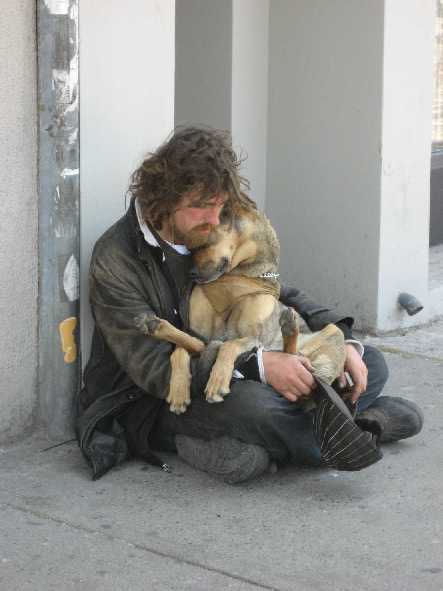
The people gathered in small clumps, on this Sunday early in Advent, chatting and laughing before entering the sanctuary.  Some sipped coffee while they caught up on the week’s events.  Outside in the bright sun the children were playing.  A man with a yellow dog who was walking by the church stopped and asked the children for directions to the rail yards.

The children invited the man into the church.  They tied his dog outside and brought it a bowl of water and someone gave it a cupcake.  They led the man to the preacher, telling him that the stranger needed directions and a little money for food.

The preacher, tall, well-groomed in his black robe and satin stole looked at the man and caught the smell of whiskey.  He invited the man to worship and said that afterwards we’d see about some food.

That Sunday amid the handsome suits and stylish dresses, the colorful wool sweaters, and the neatly styled hair and deodorized bodies, sat a man in a torn jacket, baggy pants and wearing shoes with cracked soles. 

They had gathered on this morning to keep their observance of Advent.  They spoke and sang of things to come, of waiting, of expectation, and of hope.  The minister admonished the people to be alert, on the look-out, for Christ might come at any moment.  Afterwards the people went downstairs for a pot-luck lunch and an afternoon of games and songs and making gifts for shut-ins.

The man in the torn coat did not join them, though he was invited.  He sat on a gray folding chair upstairs and talked about Jesus and wept.  He said he knew he had done bad, that he was just a bum.  He rode in empty boxcars across the country with his dog.  Then he said his father sold him when he was six for a case of beer.

The pastor was uneasy.  He needed to be downstairs to say the grace.  Was the man’s story true?  How many other churches had he been to that morning?  He handed him a sack of food and drove the man and his yellow dog to the rail yards.

The children who had found the man asked their teacher why he had no money and why he wouldn’t stay with them and how could your parents sell you and wasn’t his dog wonderful and would he come again?  “I don’t think so,” said the teacher.

Christ entered our midst, right on schedule with our liturgical calendar, wearing a torn jacket.  His only follower was a yellow dog.  There was whiskey on his breath.  He saw quickly how the inn was full. 

We told him politely as possible that we just didn’t have much room for folks who ride boxcars and have a problem with alcohol.

Once a young student asked a rabbi how it was that no one ever saw God any more.  The rabbi responded:  “Because nowadays no one is willing to stoop so low.”

Think of the person you have most despised, whom you have found utterly repulsive, revolting.  See that person in your mind.  Recall your disgust.  Now answer this question:  Who did you think it was that needed to be loved, anyway?

For God so loved the world . . .

http://www.flickr.com/photos/crowstoburnaby/170684833/
                                                 

This post is an excerpt from a Reader’s Drama I wrote many years ago, titled Adventually – Waiting for the Messiah. It is also a true story.


More about prayer:   www.fromholyground.org

Contact Loretta at
lross@fromholyground.org, www.fbook.me/sanctuary

 Follow at http://twitter.com/lfross