Tag Archives: Mary

When Hope Fails – Redux

Hope is what gets a lot of people through the Christmas season. And the failure of hope is what leaves some souls shipwrecked on the treacherous rocks of the sin and imperfection of this world.

What is it for you this year? Death of a loved one? Spouse in Afghanistan? Unemployed? House foreclosed? Cancer?

Hope is the presentiment that the imagination is more real, and reality less real, than we had thought. It is the sensation that the last word does not belong to the brutality of facts with their oppression and repression.  It is the suspicion that reality is far more complex than realism would have us believe, that the frontiers of the possible are not determined by the limits of the present, and that miraculously and surprisingly, life is readying the creative event that will open the way to freedom and resurrection.           Rubem Alves
 

She was fourteen. She sat next to me as we drove home after the Christmas Eve service. Lights sparkled from distant homes across the snow-covered fields. Shattered with pain and trying not to show it, I tried to focus on driving. After a while she spoke out of the darkness, “Mom, things aren’t ever going to be the same, are they?”

That year, our family had been struck by a blow from which we would never fully recover. In spite of  brave efforts, prayer, and sacrifice we could not put back together what was broken and, perhaps, fatally flawed.

During that season of suffering, hope became nearly eclipsed by fear, anger, shame, and pain. Each evening I turned briefly from my grief in defiance of “the brutality of facts with their oppression and repression,” and lit a candle for hope. Even though I felt no hope, I let the candle hold my hope for hope.

In those days I clung to the verse of scripture the minister preached at our wedding. Remember thy word to thy servant in which thou hast made me hope. This is my comfort in my affliction, that thy word gives me life. Psalm 119: 49-50

What an odd text for a wedding, you may think. Yet as the years unfolded it became more and more meaningful. I prayed it, holding God accountable to the goodness promised to me in scripture and whispered to my soul. God’s promise of joy, peace, and love comforted me and gave me the ability to keep breathing in my affliction.
Carmelite writer Constance Fitzgerald writes about the movement in our spiritual journey from “naïve hope to theological hope.”

Through experiences of loss and suffering, naïve hope in a Santa Claus god and other illusions nurtured by our egos and culture give way to a different, richer kind of hope.

We let go of placing our hope in our own efforts, our own goodness, our own “luck” or worthiness. We let go of our “right” to ourselves and our way. Or perhaps it is more accurate to say, we numbly watch our way wrenched from our grasp. We face our helplessness and the truth that we are not in control. Hope in oneself and one’s little plans and projects dies on the cross of our life experience.

It is there in that stillness of a drive back home on the worst Christmas Eve in one’s life, while a child’s heartbreaking question hangs in the air, that hope in God is born.

You may miss it at first, especially if the pain is choking you.
But refuse to let the last word be the brutality of facts.
Go ahead and light that tiny candle.
Defy the darkness.
And pay attention.
A baby is on its way.
Something fragile and new and unimaginably sweet
is making its way into your consciousness.

I tell my daughter, “Yes, honey, things will not be the same. But I believe somehow or other, things will be all right.”

And they were.


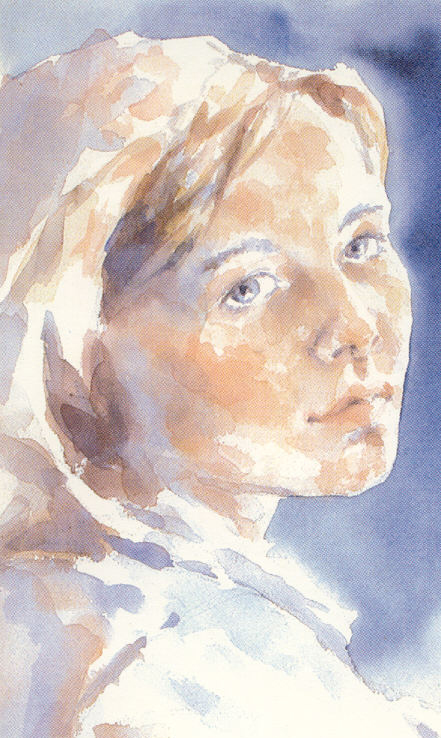
Special thanks to artist Anne Emmons for her permission to use “Hope” in this blog. You can reach Anne at anneemmons_8@msn.com or on Facebook.

Here is Anne’s story about this painting:  I was trying to think of one moment in the Biblical narrative which captures the theme of hope.  Each year I have made a new image for Christmas since 1997, and in 2000, I was struck by the idea of hope as the source of light. The images in this series reflect the thought that Christ came, the Light of the world, into darkness. So I was thinking about one single moment in the story and I realized the moment Mary heard the announcement from the Archangel Gabriel must be the moment hope found a form, in her face. At the time, my daughter was almost 14, the estimated age of the Virgin Mary, and I suddenly connected with the story in a particular way. I kept her home from school that morning to have her sit for the painting. What struck me, and this has since been confirmed from other sources, most recently Anthony Bloom’s book, Beginning to Pray, was that the Incarnation was possible only through God’s will in union with the “yes” of the young Mary, who became the bearer of the Uncontainable God. Just after I painted this I saw the Pontormo Annuciation in a small side chapel in Florence, and Mary had the same sort of look of wonder I tried to catch.  Now my daughter Claire has a two year old son, Theodore. She is a single mother who said yes to the birth of this child, whose name she chose, not knowing it means “gift of God.”

This is a previously published post (December 2009)  with some light editing.

The Virgin Daughter of Jerusalem

A virgin is someone who is free of all false images and is detached
toward God’s dearest wish and ready to fulfill it unceasingly, as was Jesus.  Meister Eckhart


 My small daughter, playing with the holy family in the wooden stable sings her lullaby: Round yon urgent mother and child, holy infant so tender and wild.

 This mother, more urgent than virgin, smiles: Yes, Holy Infant tender and wild, you are so wild, so undomesticated, so radically other than anything known and familiar. No matter how hard we coax, you will not eat out of our hands, but remain out in the timber hidden in the brush. We set out bait, offerings on the snow. Cowboy theologians toss ropes into the forest and lasso decoys.  And roughrider ecclesiastics try to corral you in sedate doctrines.          

_______________

The virgin daughter of Jerusalem sings at the gate. In the dark we lay a trail of bread crumbs to our door. We wait, stilled, hushed. Come,  Lord Jesus.

But who can stand when you appear? The earth shudders, mountains topple, creatures shiver with fear. Shots ring out in the forest. Innocence awakens and moves toward us and the rough hand grasps for its lost treasure.

The virgin daughter of Jerusalem stands on the path and suddenly she is falling, falling into the blue sea into the wide sky, falling through pain and fear and despair, falling faster and faster, picking up speed, plummeting like a stone, falling through a tunnel formed at the intersection of the cross hairs in the telescopic sight aimed at redemption where opposites meet and all things come together.

She is whizzing down the tunnel like a child’s slide, sleek and silent, silver in the sun, falling free. And the kingdom does not suffer violence, and she is not taken by force and the two, who have been made for each other, delight to have found ground holy enough to hold each other’s purity, ground strong enough to bear each other’s pain. And in her joy she funnels greatness from the wideness of her hope down the narrow passage of her being into us.

So now I pray for passionate virgins who have died for love and dwell beyond the clutch and fever of desire. I pray for eccentric virgins who live on the outskirts of propriety and raise geese and talk to trees. I pray for violated virgins and their reconsecration. I pray for virgins who find the courage to reject the lie that eats away their souls and leads them down a winding path of mirages and fun house mirrors that mock Truth.

I pray for virgins who know they are only as holy as they are willing to see how horribly they have been profaned, and how horribly they profane.. . .I pray for revolutionary virgins who despise the shame and take up the suffering for the joy that awaits. I pray for virgins whose land, enclosed by strength, is untouched and guarded by a flaming sword. I pray for virgins, who with unveiled eyes gaze unflinchingly at evil and at God and live to tell the tale. I pray for virgin martyrs who are witnesses with the conviction to believe their own eyes. I pray for chaste, intrepid, impeccable virgins incapable of doubt.

I pray for virgins who apply themselves to prayer until their souls become clear focused lenses, through which we spy enlarged for us the intricate dazzling structures of divinity. And God, hidden in the forest, is magnified by them; and glory sprints across the clearing kicking up a cloud of blessing.

And I pray for a virgin with a heart which dilates. A bold virgin, who when she has grown as big as she can be, when she has come to the outer reaches of her being and all that she thinks and knows and hums to herself, will give up encompassing Plentitude. I pray for a virgin who becomes Emptiness, who will let go of her edges, the taut boundaries that separate this from that, and flinging herself like crumbs in a fragrant trail from what was once her heart to the forest will say: Let it be to me according to your word.

And the shy, tender God takes the bait. And she and holiness are won. And their child tumbles wet and wild into the wounded world to heal us with his stripes.


 _______________

Virgin comes from Latin and means literally slender branch, twig or shoot. The original sense of the word is a person who is one in him or herself. Such a person is free from possession and possessiveness and capable of the total giving of self, body as well as soul. The virgin aspect is that which is unpenetrated, unowned by humanity. It does not need to be validated or approved by anyone to know its own innate worth. Virgin carries much of the same intent as the word for holy, which means set apart, the temple. The parthenon (literally the virgin’s place) was the temple to Athena on the acropolis in Athens. In the New Testament virgin is used to depict the host of the redeemed in Revelation and to refer to the community as the bride of Christ. But by far the most frequent use of the word virgin is in the Bible’s figurative description of cities, nations, and communities. We often find virgin daughter as an expression for Jerusalem.

Excerpted from  Letters from the Holy Ground, Chapter 10, “Urgent Mother and Child – Holy Indifference and the Repose of the Virgin,” 39-43.

More about prayer at
www.fromholyground.org

Contact Loretta at
lross@fromholyground.org, www.fbook.me/sanctuary

 Follow at http://twitter.com/lfross