Tag Archives: Jesus

The Virgin Daughter of Jerusalem

A virgin is someone who is free of all false images and is detached
toward God’s dearest wish and ready to fulfill it unceasingly, as was Jesus.  Meister Eckhart


 My small daughter, playing with the holy family in the wooden stable sings her lullaby: Round yon urgent mother and child, holy infant so tender and wild.

 This mother, more urgent than virgin, smiles: Yes, Holy Infant tender and wild, you are so wild, so undomesticated, so radically other than anything known and familiar. No matter how hard we coax, you will not eat out of our hands, but remain out in the timber hidden in the brush. We set out bait, offerings on the snow. Cowboy theologians toss ropes into the forest and lasso decoys.  And roughrider ecclesiastics try to corral you in sedate doctrines.          

_______________

The virgin daughter of Jerusalem sings at the gate. In the dark we lay a trail of bread crumbs to our door. We wait, stilled, hushed. Come,  Lord Jesus.

But who can stand when you appear? The earth shudders, mountains topple, creatures shiver with fear. Shots ring out in the forest. Innocence awakens and moves toward us and the rough hand grasps for its lost treasure.

The virgin daughter of Jerusalem stands on the path and suddenly she is falling, falling into the blue sea into the wide sky, falling through pain and fear and despair, falling faster and faster, picking up speed, plummeting like a stone, falling through a tunnel formed at the intersection of the cross hairs in the telescopic sight aimed at redemption where opposites meet and all things come together.

She is whizzing down the tunnel like a child’s slide, sleek and silent, silver in the sun, falling free. And the kingdom does not suffer violence, and she is not taken by force and the two, who have been made for each other, delight to have found ground holy enough to hold each other’s purity, ground strong enough to bear each other’s pain. And in her joy she funnels greatness from the wideness of her hope down the narrow passage of her being into us.

So now I pray for passionate virgins who have died for love and dwell beyond the clutch and fever of desire. I pray for eccentric virgins who live on the outskirts of propriety and raise geese and talk to trees. I pray for violated virgins and their reconsecration. I pray for virgins who find the courage to reject the lie that eats away their souls and leads them down a winding path of mirages and fun house mirrors that mock Truth.

I pray for virgins who know they are only as holy as they are willing to see how horribly they have been profaned, and how horribly they profane.. . .I pray for revolutionary virgins who despise the shame and take up the suffering for the joy that awaits. I pray for virgins whose land, enclosed by strength, is untouched and guarded by a flaming sword. I pray for virgins, who with unveiled eyes gaze unflinchingly at evil and at God and live to tell the tale. I pray for virgin martyrs who are witnesses with the conviction to believe their own eyes. I pray for chaste, intrepid, impeccable virgins incapable of doubt.

I pray for virgins who apply themselves to prayer until their souls become clear focused lenses, through which we spy enlarged for us the intricate dazzling structures of divinity. And God, hidden in the forest, is magnified by them; and glory sprints across the clearing kicking up a cloud of blessing.

And I pray for a virgin with a heart which dilates. A bold virgin, who when she has grown as big as she can be, when she has come to the outer reaches of her being and all that she thinks and knows and hums to herself, will give up encompassing Plentitude. I pray for a virgin who becomes Emptiness, who will let go of her edges, the taut boundaries that separate this from that, and flinging herself like crumbs in a fragrant trail from what was once her heart to the forest will say: Let it be to me according to your word.

And the shy, tender God takes the bait. And she and holiness are won. And their child tumbles wet and wild into the wounded world to heal us with his stripes.


 _______________
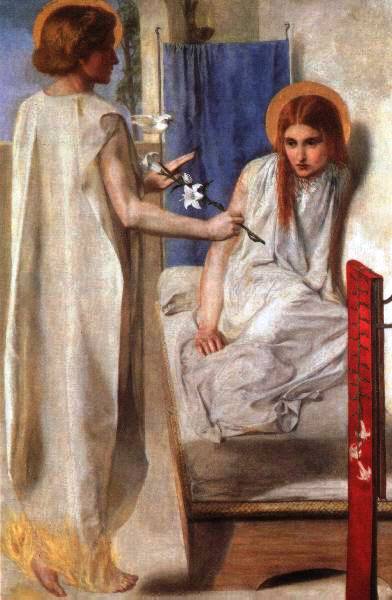
Virgin comes from Latin and means literally slender branch, twig or shoot. The original sense of the word is a person who is one in him or herself. Such a person is free from possession and possessiveness and capable of the total giving of self, body as well as soul. The virgin aspect is that which is unpenetrated, unowned by humanity. It does not need to be validated or approved by anyone to know its own innate worth. Virgin carries much of the same intent as the word for holy, which means set apart, the temple. The parthenon (literally the virgin’s place) was the temple to Athena on the acropolis in Athens. In the New Testament virgin is used to depict the host of the redeemed in Revelation and to refer to the community as the bride of Christ. But by far the most frequent use of the word virgin is in the Bible’s figurative description of cities, nations, and communities. We often find virgin daughter as an expression for Jerusalem.

Excerpted from  Letters from the Holy Ground, Chapter 10, “Urgent Mother and Child – Holy Indifference and the Repose of the Virgin,” 39-43.

More about prayer at
www.fromholyground.org

Contact Loretta at
lross@fromholyground.org, www.fbook.me/sanctuary

 Follow at http://twitter.com/lfross

An Advent Story

The people gathered in small clumps, on this Sunday early in Advent, chatting and laughing before entering the sanctuary.  Some sipped coffee while they caught up on the week’s events.  Outside in the bright sun the children were playing.  A man with a yellow dog who was walking by the church stopped and asked the children for directions to the rail yards.

The children invited the man into the church.  They tied his dog outside and brought it a bowl of water and someone gave it a cupcake.  They led the man to the preacher, telling him that the stranger needed directions and a little money for food.

The preacher, tall, well-groomed in his black robe and satin stole looked at the man and caught the smell of whiskey.  He invited the man to worship and said that afterwards we’d see about some food.

That Sunday amid the handsome suits and stylish dresses, the colorful wool sweaters, and the neatly styled hair and deodorized bodies, sat a man in a torn jacket, baggy pants and wearing shoes with cracked soles. 

They had gathered on this morning to keep their observance of Advent.  They spoke and sang of things to come, of waiting, of expectation, and of hope.  The minister admonished the people to be alert, on the look-out, for Christ might come at any moment.  Afterwards the people went downstairs for a pot-luck lunch and an afternoon of games and songs and making gifts for shut-ins.

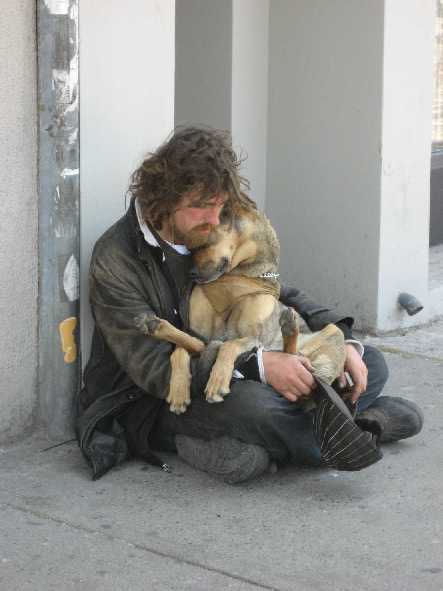
The man in the torn coat did not join them, though he was invited.  He sat on a gray folding chair upstairs and talked about Jesus and wept.  He said he knew he had done bad, that he was just a bum.  He rode in empty boxcars across the country with his dog.  Then he said his father sold him when he was six for a case of beer.

The pastor was uneasy.  He needed to be downstairs to say the grace.  Was the man’s story true?  How many other churches had he been to that morning?  He handed him a sack of food and drove the man and his yellow dog to the rail yards.

The children who had found the man asked their teacher why he had no money and why he wouldn’t stay with them and how could your parents sell you and wasn’t his dog wonderful and would he come again?  “I don’t think so,” said the teacher.

Christ entered our midst, right on schedule with our liturgical calendar, wearing a torn jacket.  His only follower was a yellow dog.  There was whiskey on his breath.  He saw quickly how the inn was full. 

We told him politely as possible that we just didn’t have much room for folks who ride boxcars and have a problem with alcohol.

Once a young student asked a rabbi how it was that no one ever saw God any more.  The rabbi responded:  “Because nowadays no one is willing to stoop so low.”

Think of the person you have most despised, whom you have found utterly repulsive, revolting.  See that person in your mind.  Recall your disgust.  Now answer this question:  Who did you think it was that needed to be loved, anyway?

For God so loved the world . . .

http://www.flickr.com/photos/crowstoburnaby/170684833/
                                                 

This post is an excerpt from a Reader’s Drama I wrote many years ago, titled Adventually – Waiting for the Messiah. It is also a true story.


More about prayer:   www.fromholyground.org

Contact Loretta at
lross@fromholyground.org, www.fbook.me/sanctuary

 Follow at http://twitter.com/lfross

Prayer Boots – Part 1

I am off to do some teaching and visiting with family. This week and next, I offer here in two parts a chapter from my book, Letters from the Holy Ground. Get some boots and go pray.

bootsI went to Holton Farm and Home Store last week and bought some praying gear, boots, warm socks and gloves.  I selected a pair of sturdy waterproof boots from the row of five buckle galoshes next to the watering troughs.  I think I am ready now.  I purchased the boots with money friends at the church I served gave me when I left. I kept the money, which came attached to the leaves of a prayer plant, for a whole year not knowing just how to spend it.  I considered books, office supplies and liturgical accouterments.  Now I see that proper prayer vestments include boots for walking over this land we call holy.

The more we pray, the more we discover prayer’s richness and power, and the more we hunger for it.  In its essence prayer is simply paying attention to God.  And that turning of the will to God, that choice to attend to God, is how we participate in making holy ground.

There is a temptation in the spiritual life to talk about praying, to read about it, to write about it, to attend workshops on it, to preach sermons about it, to feel guilty about not doing it, to build edifices where it is supposed to happen- anything but the scandalously simple, yet arduous task of doing it.  In contrast to our institutions of theological and religious education, the one thing the disciples asked Jesus to teach them was how to pray; and Jesus taught them by simply praying. “Here, do it like this,” he said.

So I am praying, turning my attention to God more intentionally and for longer periods of time with no particular result in mind beyond a simple open presence to the Holy One.  A good deal of this praying is happening on the land.  And when you stalk holiness in autumn in Kansas, you need a good pair of boots.

Crouched under the cedar in the rain, sloshing along the winding creek, following the deer trail up the gully, I try tocedar branch forget myself in prayer that I might remember who I really am.  I imagine hiking toward a place of being so self-forgotten in God that one needs nothing external to validate oneself.  Is it possible to follow the path to holy ground where the communion of prayer alone feeds and sustains us and the earth?

Perhaps our task is not so much making holy space in our lives, as becoming holy space ourselves. One way of becoming holy ground is to remember who we are.  And we are often quite convinced that we most certainly have been forgotten. That may be because we just can’t bear the wonder and joy of love.  Is that why Love stood before us that night before we killed Love and told us: “This bread is my body…this wine, a new promise sealed in my blood.  Don’t forget!”?

“Don’t forget,” Love said.  “I beg you not to forget.  For when you forget, you hang me back on the cross with your lies and self deception and fear and heedless stampede over my tender presence in all creation.”

communionStill we do forget.  Psychiatrist Gerald May writes that we often do not remember experiences of communion with God, because they are so threatening to our egos. The loss of self-definition characteristic of unitive experiences arouses unconscious fear. Wiping off the chalkboard of our spiritual experience, our officious ego scolds, “Let’s just forget this ever happened and go back to worshiping me as almighty in your life.”

 What might you need to remember?

 More next week…

 Gerald May in Will and Spirit (San Francisco: Harper & Row, 1987) Chapter 5.

Read more about prayer at
www.fromholyground.org

Contact Loretta at
lross@fromholyground.org, www.fbook.me/sanctuary

 Follow at http://twitter.com/lfross
Holy Spirit Contracting

 Demolition, Alterations, Renovations, Disaster Reconstruction

His delight is not in the strength of the horse,
nor his pleasure in the speed of a runner;
but the Lord takes pleasure in those who fear him,
in those who hope in his steadfast love.   Psalm 147: 10-11

j0432555I have been freaking out. Jesus is in my interior space and he is rearranging the furniture. He pushes a couch across the room. What! Are you going to put that over there? He opens a closet door and starts sorting through things I had hidden away. He is making piles of stuff to haul to the landfill and take to Good Will. Wait, Jesus! I might need that!  The place is a mess.  I hope nobody stops by unannounced.

Jesus doesn’t seem to mind the chaos he is making and pretty much ignores me. He pulls out something and holds it up. “Here take a look at this,” he says. Then I cringe, or weep, or shudder, or feel a tiny bit hopeful.

I asked for this. I prayed one of those reckless prayers which come upon us occasionally. Then I went and asked others to pray for me too. Really reckless. The prayer was to remove those things in me that blocked my receptivity to the Grace of God. What prompted the prayer was my need. You know – the frustration, weariness, sadness, loneliness, fear – it comes in many forms – that eats away at your peace and joy.

You start thinking, well if I could just get this thing changed, or add this or subtract that from Big Sale sign in red over white backgroundmy life – ah then I would feel so much better. As you know, this is the basic doctrine of The  Church of  Unholy Consumption, in which most of us are credit card carrying members. We get our daily devotions from TV commercials and the advertising that permeates every nook and cranny of our lives. We are reassured over and over that our problems may be solved by satisfying our desires. Figure out what you want and then go get it. You deserve it. Don’t know what you want? Well may we make a suggestion? We just got this new ratchet in today!

Of course we have desires and need to respect them and get them met appropriately. But desires may quickly become disordered and increasingly demanding. Ian Matthews (The Impact of God-Soundings from St. John of the Cross) writes, “When desire is out of order, it increasingly causes fatigue, anxiety, confusion, a sense of guilt, and finally an inability to do anything about it. It is a picture of addiction where the person’s dependence is killing him. … Disorder here, while it may bring gratification, ultimately kills joy.” (Page 41)

Jesus, no snake oil salesman of salvation, offers something radically different and – let’s be honest here – painful. John of the Cross writes about the process of deeper communion with Christ, “To come to what you know not, you must go by way of where you know not.”

To simply to be present to a need without having to blame someone, rush out and fill it, or feel ashamed is something people recovering from addictions understand very well. Iain Matthews continues: “Not filling the gap can feel like starving, but it allows the genuinely new to be disclosed. It allows one to live not as a consumer among objects, but as a person among persons fit for communion, for the love which can hold the other, and be held with open palms. That is the level of spirit: availability as a person for communion: the space for the gift of the Other. This is more than just a rearrangement of the pieces.” (pages 44-45)

Albert Einstein said, “No problem was ever solved by the same mind that created it.” Yet we think our problems will be resolved by a rearrangement of the pieces, that is, changing the organization of our lives, our relationships, our jobs, our life partners, our churches, our institutions. We think we can bring wholeness for ourselves by restructuring, redistribution, reimagining, and redesigning. We think strong horses and fast runners will solve our problems. Such thinking keeps us at the surface level and relying on ourselves – our intellect, creativity, and flexibility – for the answers. We refuse to tolerate the painful “gap” through which the genuinely new may be disclosed and Grace may emerge.

cyclone_hedgeshearwavyThere may come a time when you just get sick of it. You see the shallowness, the lack of freedom, the treadmill nature of operating our lives on the level of our senses. You are tired of watching the shadows of your ever shifting, ever insatiable surface desires. You may see a need for a deep down fundamental shift, a conversion of your heart. You may say, “Jesus, I want more than a rearrangement of the pieces. I want you.”

That’s Jesus’ cue. And he hops right to it. He sets to work, not on your external reality – the things you thought needed to be improved – but on reordering your desires themselves. He shifts your priorities, your values. He prunes runaway pride. He hacks out dead attitudes. He fires up a chainsaw and cuts away whole walls of rigid thinking. And friends, it is just as he told us. It feels terrible. It feels like you are dying, because you are.

Eugene Peterson paraphrases the verses from Psalm 147 above in this way: He’s not impressed with horsepower; the size of our muscles means little to him. Those who fear God, get God’s attention; they can depend on his strength. j0178928

Christ opens the gate on that pen of strong horses you had corralled and sets them free. He dismisses all the fast runners – the thinkers, the experts, the latest technologies. And you are left with your fear, your wonder, and your love for this God who cares enough about you to enter into you and create such a rumpus. There in the mess you untie your hope from your own efforts and strength and attach it to the strength of God. And little by little you begin to trust that something new and amazing is emerging, something which you could never think of or make happen in a thousand years.

Now tell me, who wouldn’t love a God like this?


More about prayer –
www.fromholyground.org

Contact Loretta –
lross@fromholyground.org, www.fbook.me/sanctuary

Follow on Twitter

What Is Truth?

 Butterscotch and Ahs Discuss Epistemology

In this time of crumbling institutions, conflict and rapid change, the question of what is truth emerges as we weigh in for and against various approaches to solving our problems. How do you express and live out truth as you know and experience it? How do you respond when your truth collides with someone else’s? What does Jesus mean when he says he is the truth?

Butterscotch, the golden rex rabbit, and Ahs, the collie, reclined in the shade under the pear tree. A gentle breeze lifted the hair on their necks. Butterscotch stretched her hind legs out behind her stubby tail. Ahs lay with his chin on the ground, nose close to her cage, eyes watchful. He heaved a long sigh.

Butterscotch 3“Stinky Dog, it is rude for you to drool like that when you look at me,” Butterscotch said. “Don’t think for a minute that I don’t notice how your jaw goes slack and you begin to salivate every time you see me. A prey species never has a moment’s rest. Which is why I say Jesus is getting a bad rap. Folks sniffing him up one side and down the other, running circles around him, chasing him into the brush, cornering him with their philosophies and theologies, poking him with their politics, trapping him in their minds – like he was some wild thing somebody wanted to make a hat or mittens out of.”

The dog sighed again. The rabbit pointedly rubbed her nose with her paw. Carnivores have terrible breath. “How do you know he doesn’t like it? Hasn’t even brought it all about?” asked the dog.

“Well, if you really knew him like I do, you’d see my point,” she sniffed.

The topic for the afternoon was epistemology – truth, and how you know what you know. Specifically, the two creatures were discussing the quest for the historical Jesus, the search by Biblical scholars to determine the historical reliability of the gospels. Their findings are seen by some as a frontal attack on Christianity.Ahs

Not that the rabbit put much store in two legged saviors. But she was able to recognize truth when she saw it. Ahs, on the other hand, slavishly worshiped two leggeds, followed them about, whined and begged to eat their food, and lie next to them. She knew for a fact that he let them pet him and never cleaned up afterward.

Since the pair could not read they hadn’t got as far as taking votes on whether Jesus really said and did the things that scripture claimed. Besides the sun was warm on their backs, the wind just right to waft the fragrance of honeysuckle their way, and neither believed the veracity of scriptural witness was the real issue.

068_le_christ_redempteur  14th CHow does one know what one knows? On what do we base our hope? On what authority does one make a claim? And just what does real mean anyway?  Butterscotch, like the blind man in John, rested her case on the indisputable facts of her experience. “Whether this man is a sinner or not, I do not know. One thing I know, that once I was blind, now I see!” Her reality was corroborated by the testimony of witnesses. Toad in the flower bed south of the house agreed that she was indeed a changed creature following some kind of encounter with this Jesus. Mourning Dove reported that the rabbit was more humble and compassionate.

Ahs, on the other hand, more faithful or more gullible, relied on the testimony of tradition and the dogma of the church. Yet each appreciated the limitations of his or her perspective. Neither the uncritical acceptance of systematic dogmatics, nor the subjective witness of the inner bunny could completely satisfy the inquiring mind. In the end the two were left with the disquieting notion that everything might be in the eye of the beholder, the universe a dream, and the two of them, snoozing under the pear tree, only the imagination of some mind greater than their own.

There is a bit of the scientist in every mystic, who sets out to test in his or her own life if Jesus Christ is really all he is cracked up to be. “Prove it,” he says to God. Here are all these promises: freedom, joy, abundance, peace, wholeness, justice, truth, and life eternal. “Show me,” says the mystic and sets out to experiment with divinity in the laboratory of her experience.

In the beginning God is the object of the search. At some point God may peremptorily rise out of the test tube and take over the experiment. I find myself being dissected. My soul is flayed open by truth.light and trees I am blinded by glaring light and toasted over a Bunsen burner, where my impurities are burned away and I am distilled into my essence. I am no longer in control of this process. The knower and the known have shifted places. And truth is not something I can find, but something that has me in its grasp.

Theologian Lesslie Newbigin observes, “Reason, even the most acutely critical reason cannot establish truth.” … [This is because] You cannot criticize a statement of what claims to be the truth except on the basis of some other truth-claim – which at the moment – you accept without criticism. But that truth-claim on which your critique is based must in turn be criticized. Any claim to know truth is, therefore, simply a concealed assertion of power.” 

The work of scientist Michael Polanyi reminds us that “all knowing involves the personal participation of the knower, that knowing always involves the risk of being wrong, and that the struggle to know calls for the fullest exercise of personal responsibility.”

Instead of seeking proofs of God from reason or experience, the contemplative finds fulfillment simply and humbly dwelling in love in God’s presence.  The contemplative gives God entry into the world, not through a claim of truth, but through a believing heart. Instead of an exercise of power through the assertion of my reality over yours via dazzling argument or feats of spiritual prowess, the contemplative takes the vulnerable route of allowing God to make God’s own appeal through the context of his or her surrendered life.

That’s how Jesus did it. He seems to me to be asking us to do the same.

Agony in the Garden

Excerpts from Letters from the Holy Ground – Seeing God Where You Are, Loretta Ross (-Gotta), Sheed & Ward, 2002, p 118-120.  Read more….

More about prayer –
www.fromholyground.org

Contact Loretta –
lross@fromholyground.org, www.fbook.me/sanctuary

Follow on Twitter

Day of Prayer

deer at dawn

I woke surrounded by warm pink light. Dawn filled the room like a rosy fog and drew me outside to look at the eastern sky. Banks of darker clouds, edged in gold, piled above the rose glow. Within minutes the sky darkened. Thunder rumbled. Rain fell gently throughout the morning and afternoon.

I spent the whole day chasing after that rosy suffusion which called me to awareness. But the light had flown to some other window, some other sleeper. I was left with a soft kiss, a sweet promise, and an ache in my heart that burned like a flame.  

This day my prayer was bare and to the point: I want you – not my way, my plans, my hopes, my dreams. Not peace on earth, healing for the suffering, hope for the broken hearted, or justice for the oppressed. I want YOU- giver of dawn and rain and this yearning in my heart for something unnamable, but ever compelling and true.

“The soul is not thought, nor is the will controlled by thought. It would be a great misfortune if it were. The soul’s profit then consists not in thinking much, but in loving much,” advised Teresa of Avila. I would rather think, connive, plan, strategize, manipulate, control – anything, but love this Author of our Being. But love is the way, says Teresa, as well as a whole company of others, including the Beatles.

Little renders us more vulnerable than love. A desire, a longing for someone, something beyond my grasp requires me to recognize my need and my limits. To love is to esteem the freedom of the Beloved and bear the pain of the essential separation of oneself from what is other than oneself. Love asks us to suffer the anguish of the reality that we may never fully possess what we love. Love asks us to be poor and naked in our need and our dependence upon the mercy of our Beloved.

No wonder we try to satisfy our longing for love by attachments to things which appear at first glance to deliver more and ask less of us than the uncompromising call of Christ. No wonder we attempt to extract from people, possessions, and work what only the Source of Love can give us. However, we soon find ourselves enslaved to and sucked dry by the insatiable demands of such false lovers.

Today I am sick, sin-sick, of my attachment to the world and my ego with its endless unappeasable needs.  I am weary and sore from the brutality and violence of a drive to succeed, ignoring my limits, and trying to do too much and be too much. Who can save me from myself, this body of death?

Only Love, Vulnerable Love entering into our misery as Christ Jesus, summoning us from our sleep, whispering, “Let go. Let go of it all. Follow me. I am all you will ever need.”  

So this day my prayer is a famished stumbling after Love. It is holding out my heart saying, “Here take it. I am yours.” It is Peter telling Jesus, with that desperate hope, “Lord, there is no one else that we can go to! Your words give eternal life. (John 6:68 CEV)  

Today my prayer is bearing the pain of this mystery, this rosy dawn which woos and embraces us all.  Amen.

 deer at dawn small

More about prayer –
www.fromholyground.org, www.theprayinglife.wordpress.com

Contact Loretta –
lross@fromholyground.org, www.fbook.me/sanctuary

Follow on Twitter

“Getting to Know You, Know All about You…”

42-16474021After their dinner date, Sandy was mildly disturbed. What was it? Something was eating at her. She really liked Greg. Everything seemed to go well – good conversation, a few laughs, great food, even some electricity in the air.

Oh, it came to her: that remark he made about her sister always being late. It stung. Why? Just what did he mean? Maybe she was over reacting…but his remark sounded catty…

Greg sat with his morning coffee and smiled to himself about the date. It went really well. Sandy actually listened to him. She was funny and pretty and he felt relaxed. He wondered if he should call and tell her how much he enjoyed the evening.

Sandy and Greg have unfinished business – the business of relationship building, the business of deepening intimacy and trust. A business which is the foundation of love.

We naturally review and reflect on conversations and our encounters with others. We sort out the positive and negatives. We go over what we wish we had said differently or left out. We discover questions we want to ask, more information we need.

We may even make a follow up call. “Hey Greg. It’s Sandy. I just want to tell you what a good time I had last night and thank you.” She took a breath, “Greg, I need to let you know something too. I am real loyal about my family and sensitive when people put down my sister. She’s gone through a lot dealing with her disabilities. I felt hurt when you made the joke about her always being late.”

OK. The ball is in Greg’s court now. His response will reveal more about himself, his needs, and experience. Greg and Sandy may build and deepen their relationship with greater trust and honesty in this process, or determine not to do that.

CB035813Let’s apply this idea to our practice of prayer. Sometimes we treat God as a combination landfill and filling station, rather than as a growing relationship of intimacy and trust.  Prayer becomes a place to dump our trash and get refilled with peace of mind. We drive up, open the trunk and haul out our anxieties, worries, sin, pain, sorrow, and confusion and toss them in the containers. We slurp up some high octane Living Water and drive off. “Well, that’s done,” we say. “Now, let’s get on to the important stuff I need to do today.”  In such a scenario of prayer God exists solely to meet my needs.

I suspect that the landfill/gas station approach characterizes quite a bit of our prayer. Yet God is mercifully patient with us about this. God knows that most us we will not come to God unless our trash is overflowing, filling our homes, spilling out the doors and down the street and we feel totally overwhelmed with the demands of our lives. We will wait until our tank is on empty, or we have run out of gas and are stranded on some lonely road late at night.

However, at some point we may notice a shift in us during our visits to the landfill. We may find a desire toj0314126 stay a little longer and linger at the filling station. We may feel a curiosity about the Landfill Owner and his generosity in taking in everyone’s trash and rotting garbage. Appreciation and questions may emerge. A conversation may begin with the Filling Station Fellow, an ebb and flow of mutual disclosure in coming to know each another. We may begin to notice changes in ourselves – an eagerness to get back to the Landfill, a greater sense of peace, a growing intimacy, and – Dare you say it? What will your friends think? – love for the Filling Station Guy.                                                                                                                                                                                              

Intimacy and love with one another and with God are built on a foundation of trust and honesty over time. As we are open with our individual truth, we are drawn into the larger more spacious truth of God. As we return to share more of ourselves, we learn more of God. We get to know and like and hope the other likes us too. The Filling Station Guy is, of course, already won over and hopelessly in love with you. I suspect Greg may be too.

 sanctuary-tree-tiny1

The Landfill will be open this Friday for Midday Prayer, 12:15 – 1:00 at The Sanctuary office at 1600 SW Campbell. Stop by, if you can, for a splash of  Living Water and get to know the Filling Station Guy. I think you will find he is a keeper.

More about prayer –
www.fromholyground.org

Contact lross@fromholyground.org, www.fbook.me/sanctuary

Follow on Twitter

The Miracle of Gratitude

woman praying 002Feeling discouraged? Despair breathing down your neck? Are you trapped in a painful situation with no way out?

Count your blessings. I know. It sounds lame. You need a whole life makeover. You need to win the lottery, find a new job, or discover the cure for cancer. Humor me. Do it anyway. Hold up your ten fingers, or however many you have. Count out loud one blessing for each finger.

Now that you are warmed up, take out a piece of paper and get to work filling it up with things you are grateful for. Just put down whatever pops in your head. Keep at it. Include the most specific details – water actually flowed from my faucet at the flick of my wrist when I was thirsty this morning; I can see the mourning dove pecking corn outside my window; my cup of coffee tastes delicious – dark, aromatic, and hot.

A sure way to find hope in a dark time is to count one’s blessings. This simple spiritual practice focuses our attention not on what has happened or what might happen, but on what we can discover to be thankful for in this moment. Gratitude awakens mindfulness, which calms and focuses us on simple pleasures and the miracle of life itself.

Gratitude unlocks the fullness of life. It turns what we have into enough, and more. It turns denial into acceptance, chaos into order, confusion into clarity…. It turns problems into gifts, failures into success, the unexpected into perfect timing, and mistakes into important events. Gratitude makes sense of our past, brings peace for today and creates a vision for tomorrow.  Melodie Beattie

I can recall some pretty anguished nights in my life. I flailed about rehearsing imagined scenarios, practicing speeches to give to various people, and writing scary science fiction. To what end? Nothing productive. I only became more and more entangled in my own hysterical drama. Some of us come to a point where we are being eaten up by worry and fear. This can be the key to a wonderful discovery. Right about when we say, I can’t live like this anymore, we discover we do not have to. Peace is a choice. We have the freedom through an act of our wills to choose peace of mind.

So much about the spiritual life and happiness in general depends upon where we put our focus. We get to choose what thoughts we entertain and which ones we sweep out the door. At the same time there is tremendous competition among multiple influences to occupy the center stage of our minds. Consider for a moment who or what influences are in charge of your mind? The mantras of our consumer culture? Some nasty critical, negative inner voice? A whiny, fearful, abandoned child? A tangled root of bitterness?

The psalmist puts it succinctly, “Do not fret – it only leads to evil.” Psalm 37: 8. Spiritual teachers of many traditions teach the practice of gratitude. Jesuit priest Jeanne Pierre de Caussade, who died in 1751, advises: The great principle of the interior life lies in peace of the heart: it must be preserved with such care that the moment it is in danger everything else should be abandoned for its re-establishment, just as when a house is on fire, one leaves everything to extinguish it.. . .  And the reason of this is that great peace and tranquility of spirit alone give the soul great strength to achieve all that God wills while trouble and disquiet turn the soul into a languishing invalid. 

De Caussade’s image of the languishing invalid cracks me up. That is exactly what I become as I succumb to fear and anxiety:  infected with negativity, unable to make clear decisions, confined to a bed of worry.

If the only prayer you ever pray is thank you, that would suffice, wrote Meister Eckhart. It seemed to work for Jesus. Remember that embarrassing moment when there were only two fish and five loaves and a huge hungry crowd to feed? The disciples quickly turned into languishing invalids. Jesus takes what he has, lifts his eyes to heaven, and gives thanks. After everyone had enough, they filled twelve baskets with leftovers.

That was Jesus’ miracle. Why don’t you go work a few of your own today?

 Praying hands


Learn more about prayer at
www.fromholyground.org

Contact Loretta at
lross@fromholyground.org, www.fbook.me/sanctuary

 Follow at http://twitter.com/lfross

Paying Attention and Taking Your Time

leaves in sunA thousand shades of green hold me enthralled.  The south wind teases up the glossy leaves, revealing their pale undersides. I find enough of God in a maple leaf to keep me occupied with wonder for a couple of centuries.

 Today the praying life consists of a continuous loving look at the universe. Prayer is a long wonder-filled gaze upon things as they unfold. The praying life is a front row ticket to the greatest show on earth. Okay. Sometimes I nap, complain, go out for popcorn, or dally in the restroom combing my hair. Sometimes I get self absorbed and miss whole acts, and then have to nudge my neighbor and whisper, “What did he say? When did she die? I didn’t know there was a war!”

In its simplest sense prayer is as an act of paying attention. The word the writers of the Greek scriptures used for prayer is proseuche, which means to turn toward God with a request. In order to get my need met, I shift my attention to God. Our word attention comes from the Latin ad tenderer (from which we also get tendon and tension) which adds the notion of stretching toward something beyond us.

Simone Weil wrote that prayer “is the orientation of all the attention of which the soul is capable toward God.” In prayer I bestow upon God the gift of my eyes, my mind, my awareness, my being at this moment. So Holiness gets our attention by creating in us desire and need? Interesting, huh?

To understand prayer as looking at or paying attention to God, means one must deal with the fact that we are all blind as bats and struggle to see what is really going on. We have cataracts, myopia, far sightedness. We squint through the dim filters of our prejudices, opinions, fears, and fantasies.

Jesus seemed to recognize this and a good deal of his message was about opening the eyes of the blind and teaching his followers to see with the eyes of faith. Such prayerful seeing is not easy. The poet John Moffit offers some instructions:

To look at any thing, Forest floor Montana
If you would know that thing,
You must look at it long:
To look at this green and say,
“I have seen spring in these Woods,”
will not do – you must
Be the thing you see:
You must be the dark snakes of
Stems and ferny plumes of leaves,
You must enter in
To the small silences between
The leaves,
You must take your time
And touch the very peace
They issue from.

 Must I become what I want to know, or see, or heal, or change? We protest. Oh please, no. That is too hard. I have my needs, you know. I have my point of view. I have these closely held beliefs.  Let’s make an argument for why this situation or person needs to change. Can’t we use persuasion, branding, marketing, scientific research, polls, and the press of public opinion? Can’t we ask God to just fix these things, these people? Now!

Nope. The poet says you must take your time. You must look at the poor long, the imprisoned long, our enemies long, our failures long. We must be the thing we see, enter into the dark realities of life in a refugee camp, and the chaotic tension and anxiety of our nation. We must be willing to love and  to become the thing we long to liberate –

             as God was willing to do for us.

 In my experience it takes strength and faith to enter into another’s reality and not be overcome by it, or to lose myself in it. We may become bitter, cynical, even abused by such experiences. We may become infected with the disease we are trying to relieve. We end up offering the other only a mirror version of his or her own dilemma. We become part of the problem we are trying to soothe.

Forest floor MontanaSimone Weil continues, “Not only does the love of God have attention for its substance; the love of neighbor, which we know to be the same love, is made of this same substance. Those who are unhappy have no need for anything in this world but people capable of giving them their attention. The capacity to give one’s attention to a sufferer is a very rare and difficult thing; it is almost a miracle; it is a miracle. . . .  The soul empties itself of all its own contents in order to receive into itself the being it is looking at, just as he is, in all his truth. Only he who is capable of attention can do this.”

When our attentiveness invites us “to enter into the small silences” and to “take our time and touch the Peace” from which all life issues, we find ourselves in union with that Peace. Our sacrificial gift of attention to another awakens the life of God in the other. That life may be dormant, deeply hidden, frightened, or wounded. Our prayerful attention extends a hand and bids the slumbering Peace in the other to rise up and walk.

God is paying attention to us in Jesus Christ. How could Jesus enter so deeply into our reality and suffering without being overcome by it? As I watch Jesus move through the Gospels it seems to me that he never loses his attentiveness to the Peace from which he issues, his Father in Heaven, and his identity as the beloved child. Perhaps for us to be agents of transformation in our prayer and relationships, we must possess a deep attentiveness to where we come from, and a sense of ourselves as deeply loved by God. This ongoing communion with our Source -our Father, our Mother in Heaven- gives us the freedom, the strength, and the safety to be channels of divine love and healing without harming ourselves or others. For to me little is more fierce or tender than the unfolding of the ferny plume of a mortal soul.

So I pray as I watch the maple leaves dance in the wind.
I take my time.
I aim for the Peace we issue from.
I meet you there.

 sanctuary-tree-tiny1

Simone Weil, Waiting for God, Harper Colophon, 1951,p 105, 114-115
John Moffitt,  Teaching With Fire, edited by S. M. Intrator and M. Scribner