Tag Archives: Christianity

Spineless Christians and the Courage to Be

Courage is being scared to death – but saddling up anyway.  John Wayne

“Church people are too nice to each other. They need to grow spines,” a friend said to me the other day. My friend was commenting on the surface relationships, which exist in some faith communities, where we all want to get a long at almost any price and work really hard at being nice. A member’s problematic behavior is tolerated, at the expense of developing a healthy community. Neither the deep needs of the member, nor the needs of the community as a whole, are addressed, and both suffer.

Perhaps you have heard someone comment about a member who is overbearing, controlling, or in some other way hard to take, “Oh that’s the way he is. That’s just how he does things. He means well. Don’t take it personally.”

From my vantage point of thirty years of pastoral ministry and thousands of hours spent listening to church members and pastors in spiritual direction sessions, people do take it seriously, when they are run over, ignored, or otherwise misused. They take it very seriously. I have watched new people walk away and never return after a hurtful encounter. I have seen older members pull back and clergy stymied by power struggles. I have observed churches stuck in relational impasses for years.

Why does no one speak up? Why does a church system seem to harbor and implicitly support bad behavior in the body of Christ? Where did we get the notion that following Jesus meant that we were supposed to be nice? The word nice originates in a Latin word meaning ignorant, literally, not + knowing. In its original use in the thirteenth century nice meant foolish, stupid, or senseless. Today nice means agreeable, pleasant, or satisfactory.

Jane Austin captured the tired, feeble sense of the word in this passage from Northanger Abbey:

“I am sure,” cried Catherine, “I did not mean to say anything wrong; but it is a nice book, and why should I not call it so?” “Very true,” said Henry, “and this is a very nice day, and we are taking a very nice walk; and you are two very nice young ladies. Oh! It is a very nice word indeed! It does for everything.”

When Christianity is reduced to being nice people, it loses its spine and the energetic power of Christ among us.

Many factors may foster spineless Christians. Maybe I am related to the irritating individual or live with him. Perhaps the person has influential friends, or contributes a lot of money. We keep still, because we are afraid of offending others, or being attacked, or rocking the boat.

 We also may be enmeshed as integral parts of a codependent church system in which we find ourselves manipulated by another. Codependency is a psychological condition, which develops when one’s behavior is controlled or determined by another, who is ill with an addiction to a substance or a behavior.

In such cases we walk on eggshells, work behind the scenes, have parking lot conversations, protect, and placate the person in question, while the system stays stuck. We help perpetuate the dysfunction and become sick ourselves.

Most people do not like confrontation. We shy away from speaking the truth as we see it, because it doesn’t seem safe. Instead we swallow our truth, question our own perceptions, try to make do, and from time to time acquiesce to bullies.

Of course, there are times, when we have good reason to be afraid. And, likewise, there may be occasions, when it is best to not confront someone, who contributes to problems in congregational life. There are times to step back, pray, and wait on the Holy Spirit to resolve impasses. There are times for us to grow in our understanding of ourselves and others. We always will see only part of what is going on, and our particular analysis may be incorrect.

Further, it is important to note that the so-called problem is not with the so-called problem person. The issue is not what we need to do about him or how we can control or manipulate her. The issue is ultimately with us, who are experiencing it. The issue rests with my particular and limited view, and my responsibility and willingness, not to change someone I do not like, but to share my perspective with humility and love in service to the greater community.

My responsibility is to be an expert witness to my reality and experience. Such witness might sound like this: when Susan does this or says that, I feel like this – angry, controlled, sad, hurt, left out, etc.

Such responsible truth-telling with love and humility may open doors of deeper understanding and freedom for everyone.  Fear can grip an individual, a family, or a community in such a way that the fear becomes a lie, which obscures or distorts a larger truth. Such a lie may seriously compromise the mission of a church. Whenever fear and its expression in “being nice,” become a bigger motivator, than love and honesty, something is seriously amiss.

Jesus offered a different answer to a religious establishment and an empire, which used fear, threat of ostracism, and power to control its members. Instead of becoming terrorized, or becoming a terrorist, Jesus “set his face like flint,” as he turned to Jerusalem to look fear in the eye, calmly grounded in a sense of something larger, more loving, more powerful, and stronger than fear, which would sustain him and the whole world with him.

And then he said to those who watched, “Follow me.”

What would the world look like, if we were motivated by faith and love, instead of fear?  The fear response, lodged in the brain stem, is primal and necessary to survival. Yet what does fear motivate us to do – circle the wagons, huddle together, adopt a world view of scarcity, and become rigid, defensive, offensive, and suspicious?  Such postures hinder generosity and imagination. Faith, which requires trust in the unseen, is blocked by fear. Without faith, the flow of the Spirit through hearts in love with God is obstructed.

I am not sure that we know how to speak our truth and disagree without resorting to anger, blame, and attack. I am not sure we really believe there is a common ground beyond our dissent. Deeper truth is revealed as smaller truths are shared with courage and love. Discovering God’s will for our communities requires all parties to surrender to something greater than their individual points of view. We need, both to hear individual perspectives, and to bow to a larger more encompassing vision, which asks something heroic of each one of us; namely, to give up our way, even our lives, for the larger good of the whole.

I believe there are Christians with spines and with the courage to be Christian, who create spaces where the bullied and the bullies, the controlling and those who feel controlled, the powerful and those without power come together in mutual appreciation and surrender to the One beyond fear who offers abundance and sanctuary to all her children.

We all need to hear and be heard, to listen and to speak. The Holy Spirit with her bright wings dwells in the naked soul of each member of the body of Christ. We dare not silence any voice. It only takes a few divinely inspired souls to change the course of history or the climate of a local church.

May we all find the courage to set our faces like flint against the ghostly shroud of fear, which diminishes us and turns our spines to Jell-O.  Then let’s saddle up and head out toward the Reign of God with possibility, love, freedom, and justice for all.

Empty Pockets and Trust in God

The way I see it, a mystic takes a peek at God and then does her best to show the rest of us what she saw.  She’ll use image-language, not discourse. Giving an image is the giving of gold, the biggest thing she’s got… Hurling and wielding the best stuff she can imagine, insisting on an unmediated Way of Wakefulness,…she agrees to the quiet morning hour in front of God in exchange for a bit of revelation.  She doesn’t ditch tradition as much as take it for its word and peer inside its cavernous shell.  There must still be something worth saying. There must still be something worth pointing to.
 -Jessie Harriman in God Laughs and Plays by David James Duncan

 I greet you with my pockets turned inside out, holding out a few crumbs I picked from the seam.

Most every time I write this blog, I write from such a place of intellectual and spiritual poverty, that I feel like I am scraping gum off the sidewalk to offer you.

Oh, I have plenty of previously written material. Some of it you might like or find useful. I also seem to have an endless supply of ideas, opinions, and questions we could take up together here. However the longer I sit in that quiet morning hour waiting for a bit of revelation, the more stale and the less true all my previous thinking and posturing appear to be.

Something in me insists on peering into the Mystery anew each time I write. This is both an irresistible delight and a harrowing encounter with my own empty pockets.

I haul myself and the collected wear and tear of personal and world events before the throne of Great Stillness. There I reach out beyond my limits and press my palm in the face of Mystery and say, “Here. Here. Put it here.”

Then I wait.

In that waiting there is only the ache of love – nameless, infinite, ever beyond my control.

“Trust” was the word I found in my palm this week. Trust? That old thing? How many times does this word turn up in scripture and in the words we say to each other? How about something new, fresh, maybe a little edgier? 

Thousands of children with stick legs and arms are dying in the horn of Africa. A young man just nineteen years old came home to the little town up the road, where he was buried with military honors. Global markets, drunk on anxiety, dip and sway, fall and crawl up again. Politicians argue. A self-styled prophet of God goes to prison for doing unspeakable things to little girls.

Holy One, the world is going to hell in a hand basket and all you can offer is trust?

Trust in the Lord with all your heart, 
And lean not on your own understanding; 
In all your ways acknowledge Him, 
And He shall direct   your paths.
Do not be wise in your own eyes; 
Fear the Lord and depart from evil.
It will be health to your flesh,
And strength to your bones.
         Proverbs 3:5-8, New King James Version

So – help yourself these crumbs:


Trust in what you cannot fully know or name or understand, or write about.

Trust in the enduring love in your heart that weeps with compassion and yearns for justice and struggles
to know what to do in these challenging times. 

Trust in your conviction that God will not be defeated by the evil and sin of humans.

Trust that Someone is afoot, knitting together the broken bones of Christ’s body.

And most amazing of all:

Trust that our trust and faith are the salve,

which heals all wounds.


And he could do no miracle there except he laid hands
on a few sick people and healed them.
And he wondered at their unbelief. Mark 6:5-6

Windbags, Blatherers, and Chatterboxes for God

Le Silence, painted plaster sculpture by Augus...

Image via Wikipedia

“The most beautiful thing a person could say about God would be to remain silent from the wisdom of an inner wealth. So, be silent and quit flapping your gums about God,” advises Meister Eckhart, the German theologian born in 1260.

My flapping gums are weary, my jaw aching, my tongue hangs out the corner of my mouth. I have spoken, written, and read far too many words about God. I am after that inner wealth, the wisdom of silence.

For the next two weeks I offer you silence, as I head to the lake and the woods and join a few other word-weary types, who will sit and pray and eat together without flapping our gums.


Will you join us? Will you listen for the crickets and feel the cool breeze off the lake? Will you lift your head one  morning and sniff the blooming silence of our prayer?

Will you choose to live from the peace from which you issue? Will you forsake the urgent illusion of your own ego and sink into your being and find your home there?

Of course you will. I’ll meet you in the silence.


Every creature, whether it knows it or not, seeks repose.
                                                                      – Meister Eckhart


Oh, Ick, a Christian


“I don’t like telling my friends that I am Christian,” she told me. “I always have so much explaining to do.”

Maybe you have felt patronized, judged, or violated by someone’s attempt to evangelize you. Others may know the discomfort of identifying yourself as Christian and watching people stiffen, bristle, and look for an easy exit from a conversation. I cringe when news media sum up Christianity with a one dimensional sound bite, which shrinks nuance, metaphor, and a 2000 year history of religious thought and lived expression to nail clipping snippets.


The image of Christianity in the United States has suffered a major setback in the past twenty years, and not without good cause. Dan Kinnaman and Gabe Lyons call this “a growing tide of hostility and resentment toward Christianity.” From the beginning Christians have disagreed about interpretation of faith. They have treated one another terribly in the process, as well as many non Christians, who have crossed their path over the centuries.

Yet outsiders in the twentieth century held a favorable view of the disparate followers of Jesus. In 1996 eighty five per cent of the people on the outside looking in at Christianity had widespread respect for Christianity. However today, only fifteen years later, younger people outside the faith, as well as some inside the faith, have lost much of their respect for Christianity.

Among the twenty four million outsiders (agnostics, atheists, and persons of other faiths) who are age sixteen to twenty nine, thirty eight per cent have a bad impression of present day Christianity. One-third say Christianity presents a negative image with which they do not want to be associated. Seventeen per cent maintain very bad perceptions of Christian faith. (David Kinnaman and Gabe Lyons, Un Christian – What a New Generation Really Thinks about Christianity  … and Why It Matters, Baker Books, 2008, pp 24-25.)

Clergy today are held with suspicion and even contempt by some people. Professional misconduct, the flagrant abuse of those entrusted to their care, scandals, and fraud have left a bad taste for all of us, and deeply scarred many.

I recently heard about a congregation which observed a day of repentance for the sins of Christians against others and against the earth. I like this idea so much that I think it ought to be incorporated in church calendars – a day of atonement for sins committed in the name of religion.

Once in a while I come up against hostility in thoughtful, intelligent, open minded people and am stunned to find a bigot.  At such moments I give thanks I am not in Rome when Paul was, or other places today where Christians are persecuted and killed. And in such moments I get a glimpse of what Muslim brothers and sisters must endure from those who perceive them as potential terrorists.

I also realize with a sigh that I have a lot of explaining to do, if I want to do the work of developing a more intimate and honest relationship with this person. This is not because I think the person needs to be saved, but because Christianity so deeply defines me, that for us to have an authentic relationship, we both need to be known as we are.


So why am I Christian? I will do a little explaining. My mother was a Quaker and my father, Mennonite, and faith was as common and sustaining as the air they breathed. When they got married, they joined the Presbyterian Church and there I was raised. Unassuming faith, which never had a conflict with science or a searching mind, was woven into our lives and led my parents to take stands to protect the environment and to respond to injustice.


In my early twenties I stepped back from the faith of my father and mother and did some exploring. Then in my early thirties I had a crisis of faith. It was not a crisis in my faith in God. No. It was a crisis in my faith in myself. I painfully discovered that I could not find wholeness and peace by how smart I was, how good I was, by how hard I worked, by what people thought of me.

In the giddy 1970s psychology and the human potential movement were going to save us. I remember clearly the day when I came up against the endless striving of my ego and saw the emptiness and futility of all my efforts to establish my well being on what I could do, or know, or possess.

I began to discover that peace and joy seemed to hinge more on my capacity to love and forgive others, my willingness to risk my personal well being for another’s well being, and to help those who suffered.

For as long as I can remember, Love has burned in my heart, as a nameless yearning, an aching desire for more, for expansion, and connection. Love has opened my heart to its breaking, driven me to the limits of my hope, my intellect, and my strength over and over. Love continues to draw me beyond myself, and my known world, toward what I can neither fully name, nor live without.

Because of this Love, which will not let me go, I want to live well, even nobly, while I am here on this earth. Faith helps me to do that. I suppose, given all the bad press and worse behavior of some Christians, if I could avoid it, I wouldn’t be a Christian, but it is the best way I know to be whole and free and full of joy.

My friend, Jeff Bean, recently posted this on his Facebook page:

Why do I love the Lord? To learn to love my wife better. Why do I love my wife? To learn to love the Lord better. Life is about perfecting our love.

Like Jeff, life is for me is about perfecting my ability to love, and boy do I need help. This is why I am a Christian.

The Christian faith helps, even makes it possible for me to strive toward that perfection and to love well. A relationship with Love, which remains ever beyond my possession and control, who will not become anyone’s brand or commodity, who stands always beyond in the mystery of Being itself, informs and shapes my relationship with the universe and everything that is in it.

Being a Christian invites me to forgive, which is the only way I know to bring lasting peace. It calls me to be more than I am, more caring, more compassionate, more honest and transparent. It exposes my brokenness and sin – my greed, selfishness, lust, envy, pride – and asks me to take responsibility for it.

Christianity  bows before a Power beyond my coercion to whom I am accountable for how I live my life. Christianity offers a community to support, teach, challenge, and love me into greater love.

Christianity gives me a story, a narrative of the journeys and wisdom of others who have struggled and learned to love. In their stories I mine my own story, like a vein of gold woven into the layers of the lives of other people, who have responded to and resisted Love’s call and demands. The multivalent resonance of the Bible, echoing, reflecting, and revealing truth and meaning, connects me with a purpose and a reality larger than my own tedious little drama.

The group of believers, the church, (and yes, sometimes they drive me crazy) asks me to trust in the wisdom of a community as the church keeps forming and reforming itself. Since its beginning the church has been falling down and getting up again, which gives me courage and hope, because I fall down all the time.

Christianity takes me to the extreme limits of my self identity, who I think I am, and draws me through the narrow channel of the cross of suffering to the death of parts of myself, which impede or block the flow of love.

Gina Beukelman, Topeka, KS The World Race Mission Volunteer

Christianity asks me to go places I want to avoid, to love people I don’t want to love, and to live with integrity and purity of heart in the midst of a world awash in deceit and greed.  My faith requires me to resist evil, in all its guises – empires, systems, and institutions – and to commit myself to work for justice and peace.

As a person of faith I discover my security not in what I own or who I know or how much power I possess, but rather in how many possessions and how much power and status I give away.

Finally, in the despised and rejected Palestinian Jewish peasant, who called himself the Son of Love, I am met by a most unlikely lover of my soul, who unfurls endlessly before me, the way, the truth, and the life.

I find in Jesus, who was the enemy, both of religion, and the oppressive empire, the grace to make us one. Here I find the generosity, compassion, and freedom to love even the icky ones – Christians, pagans, Muslims, atheists, Jews, rednecks, republicans, democrats, and my own icky self.

Stay in Touch:  lross@fromholyground.org

Like on Facebook


Lent, Suffering, and Weary Pastors

“The reason why pastors are so tired around Easter is because they have to preach about something they don’t really believe and it just wears them out,” announced a colleague to the group of clergy.  Some clergy will tell you their fatigue is due to all the extra services, studies and observances that cluster around the season.  One wonders what it is that calls out the sudden burst of piety and round of religious soirees, if it is not the need to reinforce our sagging faith.


Evelyn Underhill describes spiritual growth as a “series of oscillations between states of pleasure and states of pain which fatigue the immature transcendental powers.” (E. Underhill, Mysticism, p. 381.)  Whatever the cause, the amazing truth of Good Friday and Easter is more than most of us can swallow, let alone integrate in such a way that we remain in possession of the power of the Risen Christ, while at the same time surrendered to that power.


Death is wearisome.  Suffering is wearisome.  Evil wears us down, grinds us down.  As the opposite of creativity, evil employs repetition as one of its weapons.  The slow steady accumulation of minor abuses and violations turn over time into an onslaught, which erodes our best intentions.  Sick and tired of it all, we finally succumb with a yawn and let death have its way with us.


Jesus says, “It is lent. Come on.  Take up your cross and follow me.” Jesus does not summon us to a quick easy death.  He says cross – that slow torment that keeps you hanging around, conscious, gasping, while the body strains and sags against the nails that pin us to our own circumstances and the slow agonizing drag of gravity does its job.


We sink slowly into the earth, the forces of the universe pulverizing us over eons into dust.  At such a prospect, heartily endorsed from pulpits far and wide, one’s transcendental powers, mature or immature, might well benefit from a swig of Geritol.


“Have a Happy Death,” my friend says.  And I go read about those eccentric saints who extol the joy of suffering and actually prayed to share in Christ’s pain.  What did they know I don’t know?


A while back I got a large envelope in the mail with the words SECRETS THAT CAN BANISH PAIN emblazoned across the front.  Inside a Mr. Mark Bricklin promised to send me secrets that would save my life and show me HUNDREDS OF WAYS TO GET FAST RELIEF.  I looked over his offer and decided to take a nap.


Our culture has little capacity to find anything redeeming in anyone who would deliberately seek to suffer. We have a difficult time distinguishing between the suffering of sacrificial love and suffering that is meaningless and self-defeating. It is hard for us to believe that suffering consciously chosen and accepted could be anything other than dysfunctional behavior.


This may be part of the reason why the season wears us out.  This Jesus hanging on a cross for our sakes appears hardly functional.  He makes none of the promises of Mr. Mark Bricklin who exhorts me not to deprive myself and my loved ones of the chance to truly banish pain.  (Mail the enclosed card today!) The effort of leaning up against that cross in a culture that seeks to banish pain, and the real spiritual work of extending ourselves past our exposed doubt deeper into God is more than a little fatiguing.


Spiritual growth may be seen as slowly deepening belief, or the steady erosion of our hypocrisy.  Layers of pretense and self deceit  peel away to expose our fear.  What is revealed is the limit of our belief, its edges.  A good deal of our suffering is that raw exposure of our doubt, our unbelief, to the light of the Risen Christ.  It stings, smarts.  We think we are dying, losing everything.


Perhaps the difference between tragic suffering and the redemptive suffering in which Christ invites us to participate lies not in the amount, kind or quality of the pain, nor in its cause.  What makes one kind of suffering sacred and healing, and another simply one more case of horror and abuse inflicted upon an innocent victim may lie in the extent of our personal freedom to choose how we respond to the pain we experience when others trespass against us.


And here we might look to Jesus, the pioneer and perfecter, “who for the joy that awaited him, endured the cross, despising the shame…” (Hebrews 12: 1-2)  We do not have to love our suffering; we just have to bear it.  We take up our crosses.  We consciously receive the pain that comes our way, not for the pain we must endure, but for the joy that awaits.  In this way we become martyrs, not in self abasing, whining, self-righteous martyrdom, but in the original sense of the word.  Martyr in Greek means witness, one who has seen God and is willing to testify by one’s life that God lives – even in the midst of death and evil and defeat.


Perhaps what those long-suffering saints know that I and Mr. Mark Bricklin haven’t yet grasped, is that what makes suffering redemptive is enduring the cross despising the shame, making light of its disgrace. The self which dies is the ego, the grasping, controlling, faithless part of ourselves which believes everything is up to us.  Unlike Jesus, we do not despise the shamefulness of our suffering.  We despise ourselves instead.  We are humiliated and contemptuous of ourselves in situations of disgrace, defeat and loss which expose our limits.


We want an explanation for our pain.  The ego anxiously searches for meaning in the mistaken notion that in understanding we may find relief.  Jesus does not seek to justify himself.  His focus is not on the cause of his suffering, but on obedience to the One he loves and from whom he came and to whom he is headed in joyful reunion. Jesus does not despise himself, instead he despises that which seeks to humiliate and destroy his identity as the holy Child of God, in other words, his innate goodness and sanctity.  Jesus does not stop loving himself or God in his suffering.


To be beaten, to be rejected, to be abandoned and despised without beating, rejecting, abandoning, and despising oneself is to know oneself as a child of the Holy One.  To suffer, despising the shame, is to remain grounded in one’s essential goodness, even when one has reached the limits of one’s ability to do good.


A blessed lent to you and to Mr. Bricklin too.  May we all enjoy a happy death, a good rest, and steadily maturing transcendental powers.


This post adapted from Letters from the Holy Ground, Sheed & Ward, 2000, written by Loretta F. Ross (Ross-Gotta).
The Sanctuary Foundation for Prayer

Read more about prayer www.fromholyground.org
Contact the author lross@fromholyground.org, www.fbook.me/sanctuary
Follow at http://twitter.com/lfross


Christian Atheists

“If yas gonna pray – then yas don haft ta worry.
If yas gonna worry, then why bother to pray?”
Anne Lamott, Traveling Mercies


Though a majority of Americans claim they believe in God, most of us function in our lives as atheists. Little seems to cause us more trouble than the godless belief that the ultimate responsibility for everything rests with us. Parker Palmer calls this “functional atheism.”

This is the unconscious, unexamined conviction that if anything decent is going to happen here, we are the ones who make it happen – a conviction held even by people who talk a good game about God.

This shadow causes pathology on every level of our lives. It leads us to impose our will on others… stressing our relationships, sometimes to the point of breaking. It often eventuates in burnout, depression, and despair, as we learn the world will not bend to our will and we become embittered about that fact. Functional atheism is the shadow that drives collective frenzy as well. It explains why the average group can tolerate no more than fifteen seconds of silence: if we are not making noise, we believe, nothing good is happening and something must be dying.

~Parker J. Palmer, Let Your Life Speak

Functional atheism is not a new affliction for the believer’s soul. Remember the story of the father of the epileptic child who asked for Jesus’ help? Jesus said to the man, “If you are able! – All things can be done for the one who believes.” Immediately the father of the child cried out, “I believe, help my unbelief!” (Mark 9: 23-24)

The rough and tumble scramble of our daily lives reveals our hidden atheist. Our unbelief makes itself known in our worry and irritability. We see our betrayal of God in the way we clamp down on having things our way and in insisting that we are right. Such unbelief gives us heartburn, high blood pressure, sleepless nights, and anxious days. Try as we might, we will always fall short of being able to be God in our own lives. Such an enterprise only leads to misery.

So, let’s practice belief. Slowly, step by step, stumble by stumble, we can move more deeply into the conversion of our unbelief.

Here is a prayer exercise to try.

Find a quiet spot. Let yourself relax. Take five or six deep breaths in through your nose, and release each one slowly through your mouth.

Now, imagine yourself in a vast open spacious field: a mountain top, a plain, a meadow, and a lake or ocean shore. See the space on all sides stretching into the distance.

Next, put the things you are worrying about: finances, work, family, various tasks, or responsibilities — whatever has you tied in knots, into that spaciousness. Once you have spread out your concerns at some distance from yourself, simply be there, breathing.

Imagine the Holy Spirit is moving among and penetrating the many tasks, people, and issues with a vibrant, pulsating energy you cannot see, but may sense. As you remain in peace, centered in Christ, the work of God goes forth into all your concerns through your faith, your consent, and your belief that God is more powerful and effective in your life and the world, than you could ever be.

Watch. Wait. Trust. If you become anxious, ask God to help your unbelief.

After taking time to be present to God’s activity in your life concerns, ask if there are any specific responses or actions you are to take. Allow God’s response to rise up from your center of peace, rather than your anxiety or fear.

Here in the field of your life the One who knows you better than you know yourself is always healing, creating, mending, and summoning.

Relax. It is not all up to you. You are not alone. You are not even in charge.

You are just part of the field, a member of the family.

Amen.

Become a fan of the The Sanctuary Foundation for Prayer
Read more about prayer www.fromholyground.org,  Tracking Holiness – Newsletter
Contact the author lross@fromholyground.org, www.fbook.me/sanctuary
Follow at http://twitter.com/lfross

Yielding to Grace

Maybe you have taken on a very difficult and demanding task. Maybe you have been engaged in a burst of creative activity. Or perhaps, you have been involved in the long, slow, steady, outpouring of yourself for family, friends, or your job.

You may have noticed the signs: an anxious, sleepless night here or there; drinking too much caffeine or alcohol; not enough time to get to the grocery store; a sudden attraction to playing solitaire, and a rush of those Please-Lord-give-me-the-strength-to-do-this prayers.

In my case I was following my own devices again, rushing ahead of the Spirit, plowing my own path. Finally I was stopped by a sharp, shard of sorrow in my heart, a sense of restless unease, and the accompanying guilt and self-recrimination about my lack of motivation. I did not miss God’s irony that this should assail me over the Labor Day holiday.

After thirty years of devoting myself to prayer, I am amazed at how hard it still is to expose myself to the direct presence of Christ. I really think I would be the one in the back of the crowd, wanting desperately to push through to touch his robe, but fearful and cautious, and resigned to making the best of things on my own.

Many of us find it easy to read about faith and prayer. Books on these topics are best sellers. Countless people read the Bible. Most of us do not have much trouble telling God what we need. We may even write out a list of our needs and longings and hand it to the person in front of us, asking, “Would you pass this on up to Jesus, for me?”

What I hadn’t done was the simple, radical exposure of myself and my need to God. What I hadn’t done for several weeks was a sustained, still, silent offering of my being to the being of God. This is what I believe truly heals and redeems: contact with Holiness, that mysterious communion and co-mingling of my spirit with the Spirit, a dance of love beyond my understanding or control.

I know why I avoid it and why I, suppose, that I have to write about it. The reason is that this communion may hurt at first. The exposure of a raw, chaffed heart to the burning brightness of Grace can be excruciating. (Yes, that is the word for it: ex- crucifix, from the cross.) It may be the last thing we want to do. So we often just tell God about it, then get up and go on fretting, and look about for something to do, anything other than just sitting there in that fear and pain.

Now think for a moment. If you were sick, would you not pay attention to your symptoms, maybe check them out on the internet, and go to a physician and describe what you are feeling? And then, would you get up from your chair and go home, before the doctor had a chance to ask questions, to examine you, run tests, and prescribe your treatment?

Surely you would you wait for the examination. You would answer questions. You would you lie down on the table, bare your chest to the stethoscope, your arm to the blood pressure cuff, and take whatever tests the doctor advised. You would take your medicine and follow a treatment plan.

I had been making drive-by visits to God, where I would drop off my laundry or tell God what I need for today. I was sipping those devotions for busy people, spouting sound bite prayers on the run. I was not coming before God and disrobing. I was not holding still for God to search my heart and probe my mind.  I would not wait for his grace to move into me, to absorb the pain, to refresh and heal me. Further, it was all about me. I was all about me. I had nary a thought of what God might desire or need from me.

We fool ourselves if we think a quick shot of God, a pithy quote, or Bible verse alone will do it. God desires a relationship with us, not a power lunch, and depth relationships require leisure, attention, vulnerability, and mutuality.

Part of us really does desire this. However, another part of us is just not that interested. I hear about this internal conflict over and over in my practice of spiritual direction. People are sincere and have good intentions. Yet nearly everyone I know finds him or herself facing obstacles to a sustained presence to God.

Try it. Find a quiet place where you will not be interrupted. Set a timer. Twenty minutes is good. Ten minutes will do. Even five minutes can hold a miracle. Breathe a while. Just be there and allow yourself to be open to Christ, the patient physician, who has been waiting for you for an eternity. Now right off, you may notice all sorts of responses in yourself: a sudden urge to get up and tend to some task; some buried pain rising up, burning and stinging like really bad heart burn. You will take little sorties into the past and into future. You will write fiction, little novellas, about your life. You will discover some hurt or slight or worry to gnaw on.

Just stay there. Hold still. You are getting a CT scan. Don’t move. This time is for God’s examination of you. What you think and how you feel about this isn’t all that important. The physician is at work. Trust that. You may feel panic or anger or despair. You may feel deep peace and joy. Whatever you feel, just stay there opening yourself to the one who loves and cares for you beyond your wildest dreams.

When the timer rings, give thanks as honestly as you can. Then do the same thing the next day and the day after and the day after. Don’t look for “results,” just be obedient in allowing the doctor to heal you. Thomas Keating calls this form of centering prayer “divine therapy.” You, of course, may also read the Bible, pray in other ways that you are drawn to, do acts of love and service, and whatever else that seems right for you.

Sometimes this prayer is like detox, a weaning from some addiction, and we go through the painful withdrawal of whatever we may have been substituting for God in our lives. Other times this prayer is like the surrendered offering of Mary to the angel, Let it be to me according to thy word.

Always such yielded prayer is an act of faith in the mystery of God’s love and purposeful activity in the human heart and soul.


Hold your eyes on God and leave the doing to him.
That is all the doing you need to worry about.  St. Jeanne de Chantal

Have Thine Own Way – Organ Improvisation

We invite you to our Facebook Page: The Sanctuary Foundation for Prayer
Read more about prayer at www.fromholyground.org
Read Tracking Holiness – Newsletter
Contact the author at lross@fromholyground.org, www.fbook.me/sanctuary
Follow at http://twitter.com/lfross

Eating God

I have been on study leave the past month in order to work on a new book. The generosity of Crestview United Methodist Church, where I work part time, and several generous donors to the Sanctuary Fund have made this gift of time and space possible. I have prayed, listened, written, and rested in the stunning abundance and goodness of God. Did I make progress on the book? Oh yes. I also discovered how much more there is to do. My goal is to complete it by the end of  this January. I tell you this so you will hold my feet to the fire. All of you are in my heart and thoughts. Thank you so much for your support and presence in this conversation about our lives together in God.

Here is a sneak preview of the work in progress:

God is voluptuous and delicious. Meister Eckhart
O taste and see that the Lord is good, promises the psalmist. (Psalm 34:8) Yet many people find God hard to swallow, not to mention the side dishes served up with God: religion, piety, doctrine, rules, austerity, judgment, conflict, and war. According to contemporary research quite a few people are not swallowing Christianity.
Over one third of the people in this country looking at Christianity from the outside have a bad impression. Researcher David Kinnaman writes, “The growing hostility for Christians is very much a reflection of what outsiders feel they receive from believers. One outsider I met put it this way: ‘Most people I meet assume that Christian means very conservative, entrenched in their thinking, antigay, antichoice, angry, violent, illogical empire builders; they want to convert everyone and generally cannot live peacefully with anyone who doesn’t believe as they do.’
In a time when faith didn’t have such a bad image, Thomas Merton, teaching a group of monks about swallowing God, used this approach, recorded in a poem by Ron Seitz:
So, you see, it’s something like this, to use an image or a metaphor.
…In total inhalation, in the act of the Eucharist, you eat the Mystical Body,
the Cosmic Christ by accepting, by participating, by celebrating, in joy
the total charity of your Being in creation! …
And in total exhalation you offer up, give back, go home in redemption.
You do this by curing the inner spirit between you and God the Incarnate Creator,
what we oftentimes call in Mystical Theology, original sin.
That’s why you go to the monastery, the primary reason anyway.
It’s to do that, to heal the illusion of separation, the separation of you from your true person,
from the world in creation, and especially from God.
It’s all, we’re all one. So relax. Quit apologizing.
We really don’t have anything to be afraid of, now do we?
If Merton is too abstract for you, try this: Seeing the communion elements being passed down the row the little girl exclaims, “O look Grandma, we are getting snacks!”
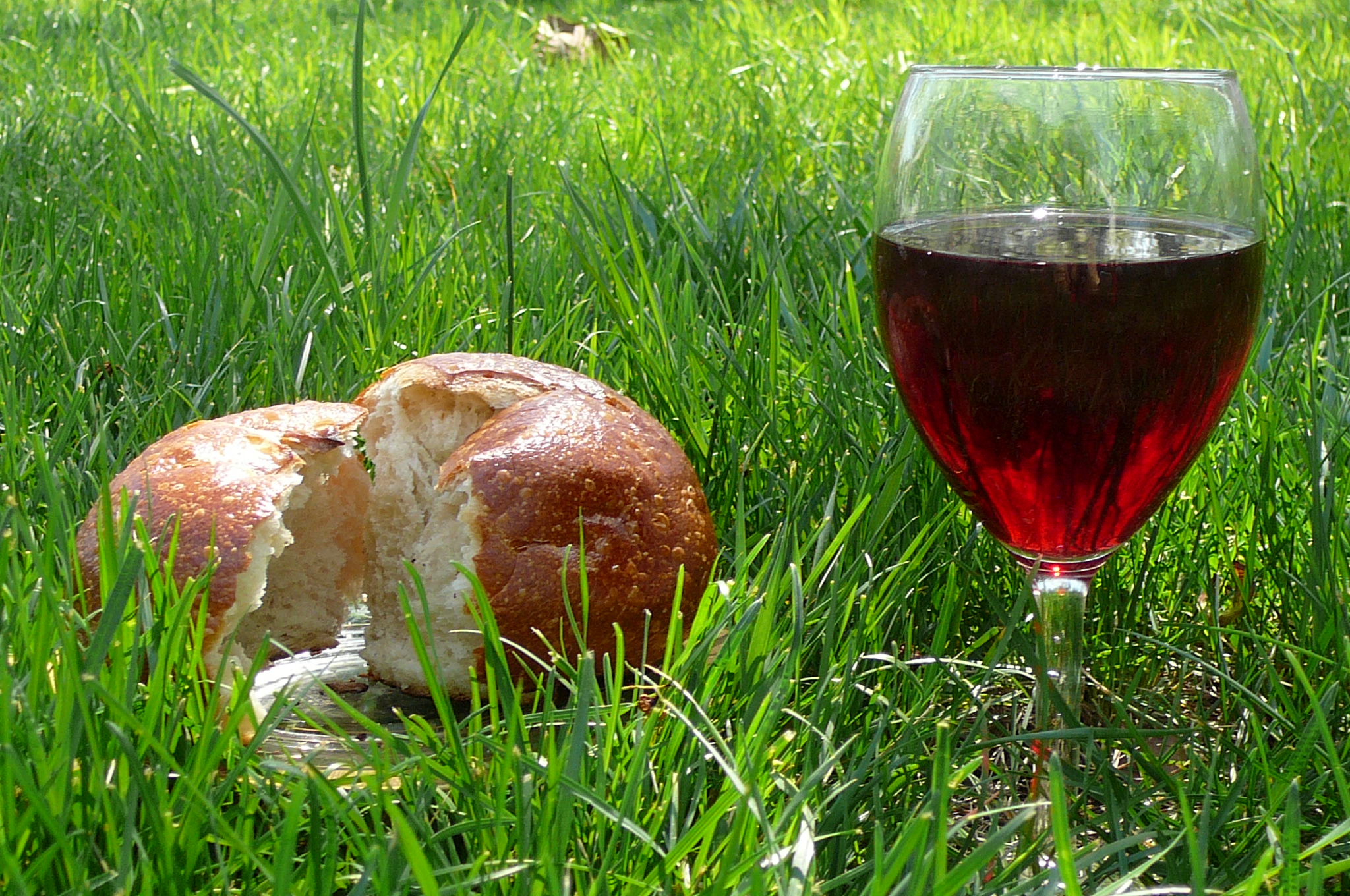
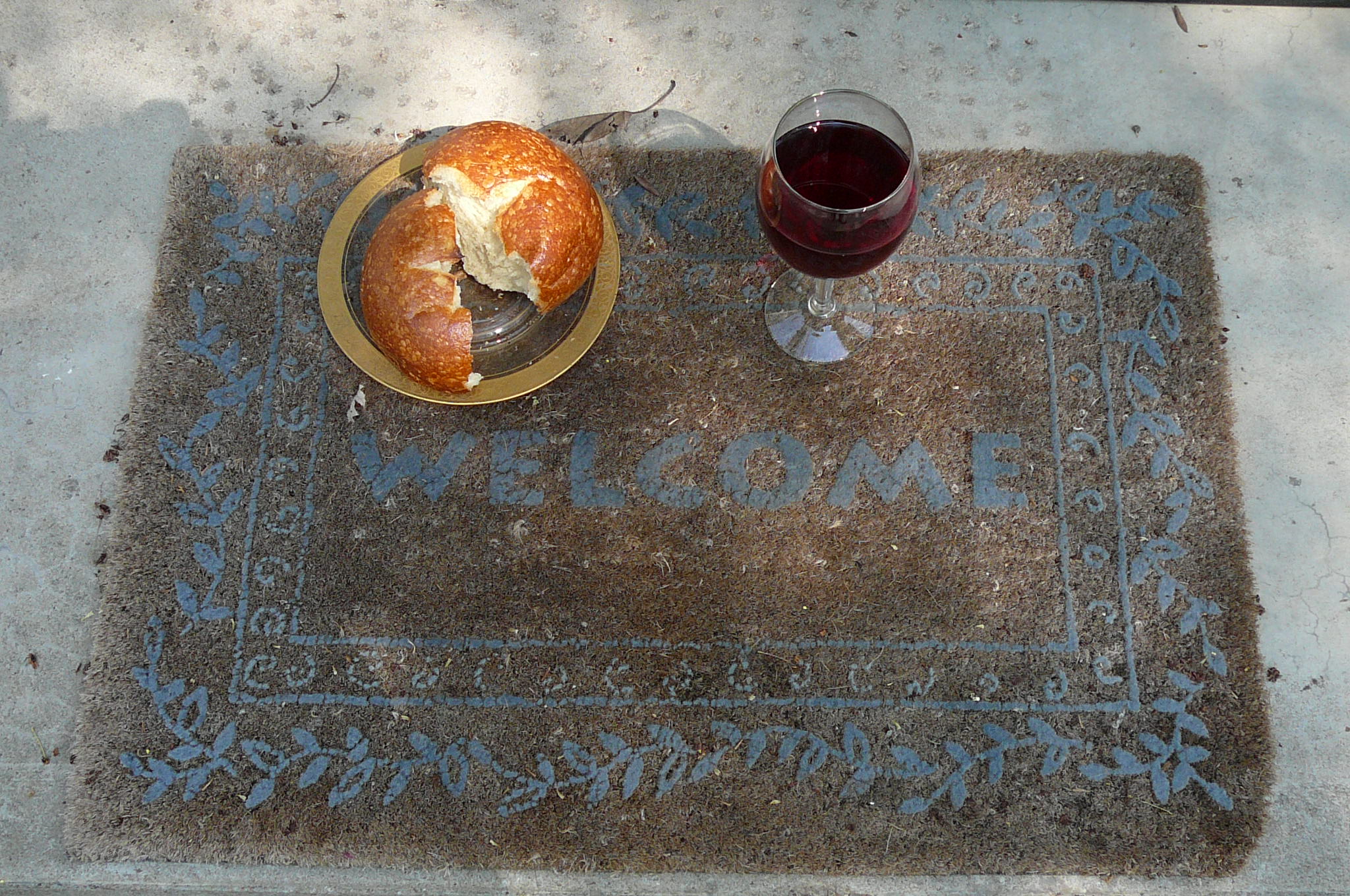
Holiness seeks intimacy, asks to be consumed, taken in and digested by us in a fundamental, earthy way as food. Fruit of the vine, wheat from the fields grown in the soil, watered by rain, tempered by wind, kissed by the sun. Simple ordinary food becomes transformed by the presence of the one who said, “Here, this bread, this wine is my body. Drink it and it will become your body too.” We get snacks.
Merton continues,
See. Either we are one with the Holy Spirit or not, eh.
And if the incarnation, the Word make flesh is a living reality,
then the whole cosmos is sacramentalized, is sacred and holy.
Is really church,
see (laughing) and you cannot get out, eh, can’t escape that, even if you wanted to.
Not everyone understands God as Merton. A friend and long time church member once confided that one Sunday when the pastor tore off a chunk of bread and handed it to her with the words, This is the body of Christ, “Something happened. I almost gagged and suddenly this seemed like some primitive cannibalistic ritual of eating the body of some person to gain his prana. It seemed repulsive.” She hasn’t been back to a communion service since. Another friend, victimized by a satanic cult, has excruciating flash backs when she goes to receive the Eucharist. Add a few verses of the old hymn “Nothing But the Blood,” and one can imagine most any curious new comer beating a path out the door before the pastor gets out the benediction.
As one of my daughters would say when she was little with her hands on her hips, “Mom, you have a lot of splaining to do about this.”
For starters let’s take a larger, metaphorical view. God invites us to eat what is before us, the fundamental reality of our lives, no matter how unsatisfactory. As we taste and see, chew and digest our experience and truth, we are nourished and transformed by the sacred reality of this world. We grow into the likeness of God, holiness itself. In placing us in this life, God has asked us to swallow this world and one another with an inclusive unconditional love.
Many times I have preferred to spit it all out.
Read more about prayer at
www.fromholyground.org,
T
racking Holiness – Newsletter
Contact the author at lross@fromholyground.org, www.fbook.me/sanctuary
Follow at http://twitter.com/lfross
Become a fan of the The Sanctuary Foundation for Prayer