
 Harold, awestruck and elated, told me that he had seen God. He said that God showed him hidden mysteries. No, he was not psychotic. He was simply full of Holiness bigger than his britches. Divinity burst through his immature psyche in sparks and streaks. He scared most people, impressed others, and annoyed his pastor.
He was angry and frustrated with church authorities who did not ordain him on the spot. He fussed and wore his experience like a badge of martyrdom. He was impatient about getting on with his life as a spiritual teacher or guru, and frustrated that no one seemed to recognize his superiority in this field.
A word for this fellow’s condition might be illumination, sometimes mistaken for the apex of the spiritual journey, but, rather, a roller coaster period characterized by swings of ego inflation and deflation which may last a number of years. I recognized this because I have been through such a painful period a time or two myself. I don’t know how people stood me.
According to some models for understanding the process of transformation in Christ, illumination is the middle period of spiritual development, occurring between purgation and union. In my experience these passages of spiritual growth do not proceed in an orderly linear fashion, but rather circle, repeating, and weaving in and out as the Spirit’s expression in the specific life of an individual. A person’s transformation is related to God’s purposes and the particular aspects of a personality and life situations that need cleansing, healing, reordering, and setting free.
The church and the Bible describe this passage of spiritual development in many ways – the vision of God, an opening of the heart, being born again, accepting Jesus as one’s Lord, a spiritual awakening. Though there are many ways of describing it, most would agree it is not the culmination of the journey. An individual receives a sudden infusion of the Holy Spirit – not once or twice, but over and over. Sometimes people receive more than they can “metabolize” and become intoxicated with God. When it happened to the gathered disciples on Pentecost, people thought they were drunk.
They are speaking our languages, describing God’s mighty works!” Their heads were spinning; they couldn’t make head or tail of any of it. They talked back and forth, confused: “What’s going on here?” Others joked, “They’re drunk on cheap wine.” Acts 2:12-13, The Message
Such experiences, as Evelyn Underhill puts it, “fatigue the immature transcendental powers.” We get more of God than our personalities and bodies can handle. We lose our balance and appear a little wacky for a while. This happened to Paul on the road to Damascus when the voice of Christ knocked him off his horse and left him blind and blubbering. He had to lay low for a while as he integrated this experience. And even years afterwards, he was still a little hard to take.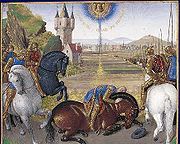 People have varying responses to large draughts of God. Not everyone becomes insufferable. In Harold’s case he felt that nobody really understood and knew God the way he did. To him all the other laborers in the vineyard, slogging away without a glimpse of the master, appeared as witless dullards. And I have to admit some of them probably were. Instead of focusing on what is wrong with those around them, some people respond to the Spirit infusion with a burst of creativity, an outpouring of service, the expression of their gifts, or art of some kind. Then there are the hidden souls who only want to withdraw to sit in silence and solitude, where they feel alternately forgotten and useless, and enraptured and blissfully happy.
However we respond to the bracing presence of the Holy Spirit blowing through our lives and being, there is likely more work to be done. This inglorious mundane work of dying to self and waiting irks us no end. We chaff and fuss as God slowly reshapes our motivations to conform to divine motivations. People do get drunk on the wine of God, but believe me the wine is not cheap.
Harold told me he had already died, done all that. I didn’t have the heart to disabuse him of his belief. First, because what did I know really? And second, what I would say would make no difference to him. I trusted God at work in him, more than anything I might prescribe. Some kind of growth and transformation was afoot which I didn’t want to mess up. I did have a sense there was some pruning ahead for him, and considerable surrender before sweet humility would blossom more fully in his being.
Even though Harold began to get on my nerves, I felt compassion for him as one ought for anyone in this condition. He was pretty miserable. Over time the man calmed down and found his way to service. He became able to hold his degree of glory in one hand and the reality of his sin and brokenness in the other without tipping over and wallowing in one or the other. Instead of bursting with pride or sinking into a pit of despair, anger, and suffering he grew into the largeness of the gift of God’s revelation to him. He attained the strength of soul and groundedness in the soil of humility to grasp this paradox of the human condition: our frailty and our glory. That sort of balance and strength in Reality is something to behold.
Watching the purposes of God unfold in someone’s life as a spiritual director is a front row seat to seeing God and hidden mysteries. The winsome way of God with an individual soul keeps me, entertained and delighted, on the edge of my seat. Now I must be honest. I made Harold up. Any resemblance to any person, living or dead, is not intended and purely coincidental. If, in an adaption of Carly Simon’s song, “you probably think this post is about you,” it is not. I really have no idea what God is up to in your soul, except to say without a doubt it is something wondrous, breathtakingly beautiful, and beyond your wildest dreams. For the record, I am still working on finding my balance.

 On the afternoon of the day my friend died in a hospital bed in Iowa City, my daughter and I made cookies. In the Kansas kitchen overlooking the finch feeder, while seventeen finch gobbled two pounds of thistle seed (95 cents a pound at Allen Farm and Feed), we measured flour and brown sugar, butter and ginger, and mixed them in the yellow bowl. Patting out the dough on the cookie sheet, we stopped to taste. “Umm, very good!” she said.
 A thousand shades of green hold me enthralled. The south wind teases up the glossy leaves, revealing their pale undersides. I find enough of God in a maple leaf to keep me occupied with wonder for a couple of centuries.
 Simone Weil continues, “Not only does the love of God have attention for its substance; the love of neighbor, which we know to be the same love, is made of this same substance. Those who are unhappy have no need for anything in this world but people capable of giving them their attention. The capacity to give one’s attention to a sufferer is a very rare and difficult thing; it is almost a miracle; it is a miracle. . . . The soul empties itself of all its own contents in order to receive into itself the being it is looking at, just as he is, in all his truth. Only he who is capable of attention can do this.”
 I held out the tray of tiny plastic cups filled with juice, freshly poured, bubbles still floating on top. He delicately placed finger and thumb around his choice, and went to draw it out, but it was stuck and would not budge. He tightened his grip, pulled, and the thin plastic cup shattered in his fingers. Juice flew onto the suit jacket of the fellow next to him, the carpet before the altar, and my white robe and scapular with the appliquéd wheat and golden sun. How can such a tiny cup hold so much? we wondered.
 ith her here, and, in her contact with God, find healing for her soul. Inside the hermitage my two daughters, ages four and six, are playing quietly. My guest and I sit still, leaning into the grace of the moment-listening to meadowlarks and watching willows bend in the breeze. After a while my children’s play grows noisier. Thumping, giggles, and something crashing to the floor intrude on the serenity. They are jumping on the bed. The more I try to focus on the silence and my guest, the louder the girls get. Finally I rise from my prayer stool and go inside. “Please be quiet,” I whisper. As I take Diana’s arm to lead her over to some books, she shouts in a screechy, ear-splitting whine, “Mom, stop! You are hurting my arm.”
 The Praying Life