Exploring Solitude: Becoming Real

Here is what I want you to do:
find a quiet secluded place so you won’t be tempted
to role play before God.

Just be there
as simply and honestly as you can manage.

The focus will shift from you
to God,
and you will begin to sense his grace.
                                                 Matthew 6:6 MSG

Nobody is watching. Go ahead. Be yourself. Relax. You walked off the stage of your life performance and the audience has all gone home. Feel the weight of that armor, the heavy guard you wear night and day about your shoulders and neck? You won’t need it now. Lay it down.

Oh. Wait a minute. It appears that not all of that audience has gone home. A few hitched a ride into the hermitage in your mind. Take that broom in the corner and chase them out. As long as you do not invite them to sit down, and then start feeding them milk and cookies they will leave. Their harping and commenting will begin to sound sillier and sillier to you in the context of your wilderness.
Go ahead. You can’t hurt the furniture here. Put your feet up and settle into that delicious and utterly joyful place of being yourself, your true self.

A wonderfully freeing aspect of solitude is that nobody cares what you look like. Nobody is there to comment upon, critique, approve, or disapprove of your actions, attitudes, words, mannerisms, personality preferences, and quirks. No one has expectations of you or needs they want you to meet. No one is going to call or drop by unannounced.

Go ahead. Remove that hot stuffy mask.

We have a public face we present to the world. In some cases it is brittle, artificial, and controlled. We put on the mask of a happy person, a competent person, a funny person. But a mask is a limited snap shot of the person we really are, which may include being happy, competent, and funny, but who we really are also has depth, texture, responsiveness, and spontaneity, which masks cannot communicate.

When the face we present to the world is the same nuanced face within us, people call us authentic and real. What we show on the outside has integrity with what is in the inside. The phoniness, pretension, and the effort of maintaining a façade are gone.

I loved taking people out to the hermitage. I would show them around the grounds and cabin, give them some orientation, and, leaving them alone for a few days, drive back to town. Then later, they arrived at my doorstep to drop off the trash, the empty water bottles, and return the key. When I opened door, I was amazed at the differences in the guests. The tension and stress were gone, and an ease and lightness filled their movements. And their faces, soft and smooth like a child’s, wore a refreshing, unguarded openness and simple presence to the moment.

After I spent a long period in solitude, a friend reported that I looked like the Velveteen Rabbit. “Worn and soft. Well loved, and real,” she said.
There is nothing like solitude for peeling off the layers of pretense and inviting a soul into deeper authenticity.

In the days of silence and company kept only with crows, meadowlarks, and the possum, who comes looking for food under the moon, one becomes aware of the vast amount of energy and time, which may be spent on building facades and presenting a particular face to the world. The hours of calculation and strategizing to strike the right note in a speech, the stress filled preparation and rehearsals to achieve a certain affect. We have all been encouraged to become marketers and publicists for our careers, our work places, and even our very lives.

Here relationships degenerate into a potential sale, or a possible connection to a step up the ladder. Social media invites us to fashion our lives on a global stage, where our preferences are watched and matched to product ads which pop up before us.

In contrast to the world of hype nothing is for sale in the wilderness. Further, in the wilderness your stuff and your “brand” start to become embarrassing — all that lipstick in your purse, the three jars of face cream, the books you lined up on the book shelf, those clothes you shopped for.

The wilderness around you takes on a depth, beauty, and fascination that cannot compare to that iPad you just had to have or that “outside the box, edgy high concept” project you have been working on. The world beyond your wilderness begins to  seem artificial, crass, and out of sync with a deeper more profound rhythm.

Oh course, it makes sense that the natural world would inspire you to drop off what is unnatural and false in yourself – those postures and attitudes you take; that pride that you use to hide your vulnerability and need.

Besides, you are not going to fool that turkey vulture soaring over the pasture. He may be pecking at your bones one day and won’t give a damn about what kind of car you drove. The lake, teeming with turtles, bullfrogs, fish, and dragonflies is unimpressed with your credentials.

Yet a few creatures may be curious about your presence. There is nothing you have they desire. All they can offer you is their own mysterious being.
The cows, snuffling at the window, wake you at dawn. A large black angus is peering into the cabin. Her face is framed by the window and the chintz curtains.
You go out barefoot in your pajamas to shoo the cows back into their pasture. There are several mamas with their young ones. You stand still gazing at each other. You watch their massive ribs expand as they breathe, their dark eyes, and pink tongues. They watch you, seeing how your feet are getting damp in the dew, considering your breath, your two legs, and your white silk pajamas.

Your being interpenetrates with their being. A conversation and exchange occurs beyond words. Atoms shift, energy moves, recedes, and gathers in the spreading light. Then they turn, their hooves sinking into the damp earth, swishing their tails, and go back through the broken fence.

Nobody in the wilderness cares what you did last week. Or what you didn’t do. One of the calves looks back at you, slowly chewing grass, hanging out both sides of his mouth.

You feel you need to get right down on your knees in your pajamas and repent of something you do not have the words for.

Oh my God, forgive me for not seeing,” you pray.

Solitude Practice

  • Do you find yourself caught up in playing a role or meeting others expectations and needs unnecessarily?
  • What is it you let go of, when you let down your guard?
  • How does being alone in nature help you be yourself?
  • In what way might the wilderness call you to repentance, or seeing in a new way?

Next post in this series: Exploring Solitude:
So What Do You Do Out There All Day Long?

Exploring Solitude: Deadly Acedia, or Too Bored to Care

Sooner or later even the most devoted hermit or spiritual seeker will discover that this solitude and silence shtick does not seem to be all that it is cracked up to be.
Saintly souls and books far and wide, which recommend and extol solitude, may not include the whole truth of the experience. At some point the solitary pray-er is likely to ask this question:


What on earth do I think I am doing out here
in the middle 
of nowhere by myself!

Next the individual may pace back and forth in his holy abode, while the walls begin to close in. A suffocating boredom descends upon the person like a choking cloud. Her whole spiritual exploration takes on the character of a really bad afternoon spent as a child with an insufferably tedious old aunt. You sit fidgeting in the rocking chair with your feet wagging in the air looking at old Readers Digest magazines and listening to tiresome adults drone on and on about dead relatives.

Now your lovely hermitage grows dull and lifeless and smells faintly of mothballs and Vicks VapoRub. You are sure all your friends are going to wonderful places and having exciting experiences, while you are trapped at Great Aunt Hannah’s and doomed to a lackluster life of gradually increasing obscurity and dull mediocrity. Your back itches. Your tummy hurts. Your neck has a cramp in it. Your brother keeps sticking his tongue out at you. And you realize now that you actually hate him. Your mom ignores you, even when you fake a faint, slide off the rocker, and lie on the floor in a lump.

It can be like this, my friends, as some of you know. You pick up a Bible, read a verse, and it leaves a taste in your mouth like an open bottle of soda that has been in the fridge for a month. A kind of angsty horror rises up in your craw and an overpowering desire to get out of there floods your being.

If someone has not seriously questioned Love’s call, and has not encountered an all- encompassing indifference, even, perhaps at times, revulsion, toward the things of God, I would suggest they simply have not been at it very long. When we enter solitude, whether we find it in the bathroom or at the lovely cottage on the beach, we bring along our retreat provisions, books, journals, music, food, as well as our illusions, expectations, hopes and dreams of what this time will be like. Here we may be in for a rude confrontation of fantasy with Reality, or my will with the will of the One I am seeking.

When I hosted guests at The Sanctuary Foundation hermitage, I watched them haul bags of books and provisions up the slope to the cabin.

“I hope to plan my sermons for the next six months,” some would tell me brightly.

“I hope not.” I would say to myself.

We bring an agenda to our solitude: I want to deepen my awareness of God. I need help in discerning the next steps of my life. I am looking for peace and resolution of conflict.

We come hoping to accomplish some task, relieve pain, even to be entertained. Then lo and behold, we are met with dryness of spirit, dullness of mind and heart, a ho hum listlessness, and growing sense that nothing fun or good is going to happen to me here.

What we fail to see is that God comes to the hermitage as well us. And God has an agenda too. At some point God’s agenda may include a healthy dose of the demon of the noonday sun.

The name the early Christians gave for the dullness can settle over us is acedia.
The desert fathers and mothers called this oppressive state of spiritual apathy the demon of the noonday sun. Evagrius warned, AThis demon attacks the monk towards the fourth hour and besieges the soul until the eighth hour. He begins by giving the impression that the sun is hardly moving or not moving at all, and the day has at least forty hours. Ardor and passion for the things of God are replaced by indifference and boredom. The miserable soul is sick both of God and self.  

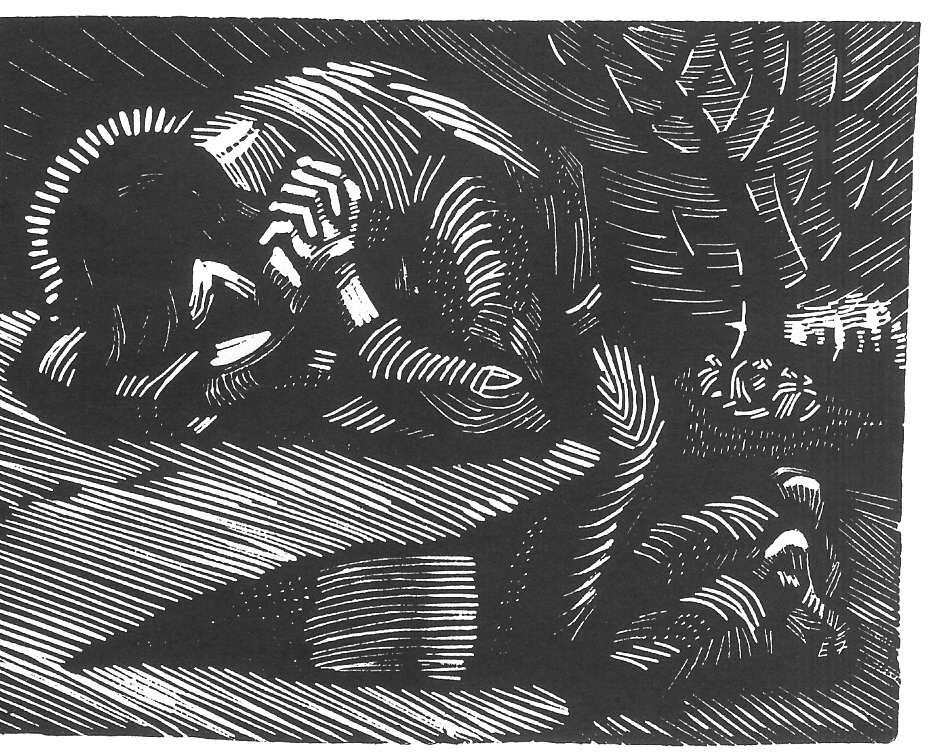
Acedia, engraving by Hieronymus Wierix, 16th c...


The purpose of this dry discontent is seen as part of the final purification of the will so that it may be merged without any reserve in God. Acedia abolishes spiritual gluttony as it strips us of our fascination with glamour, ease and sensory delights. Since God is spirit and must be worshiped in spirit, a soul’s worship of God grows over time to be less founded in the satisfaction and entertainment of the senses and more in the dark knowing called faith. Through the harsh succor of the demon of acedia the soul is weaned from its attachment to sensory gratifications to a more mature love.
From my book: Letters from the Holy Ground, Seeing God Where You Are (Chapter 24)

As unpleasant as it is, I believe that acedia helps to rid us of the three tendencies of our age, which militate against contemplation, according to Ronald Rolheiser. Rolheiser identifies these tendencies as our narcissism, pragmatism, and unbridled restlessness. The Shattered Lantern – Rediscovering a Felt Presence of God  (Chapter 2)

The excessive self preoccupation of narcissism makes everything we encounter about us and our needs. The cult of the individual deifies the personal and encourages focus on our private concerns and preferences.

“Pragmatism,” Rolheiser writes, “asserts that the truth of an idea lies in its practical efficacy. What that means is that what is true is what works.” We become obsessed with what Thomas Merton identified as the leading spiritual disease of our time: efficiency.

Our unbridled restlessness fuels our driven, compulsive, hyper lifestyles of multi-tasking and instant gratification.


So what’s a body to do? You have come all the way out here. Are you going to turn tale and sneak back home?

Try this: Sit there or go for a walk. Watch your discomfort. Settle into your body. Be curious about your indifference and learn from it. Breathe deeply, as the anxiety and pain of withdrawal from narcissism, pragmatism, and unbridled restlessness grip your soul and cramp your body.

Surrender your agenda. Stop demanding things to be different. Cease resisting what is so, what is real for you.

Gradually a shift will occur.

Perhaps you notice the splotch of light on the wall across from Great Aunt Hannah’s china hutch. Where did the light come from? The late afternoon sun is stretching its long arms across the carpet and up the china hutch, where it touches a crystal goblet which has sat there for thirty years, and just now catches fire as your eyes lay upon it, dazzling you with brightness. You lean back in the rocker, feeling your back sink into the cushion, and watch the dust motes moving lazily above the carpet. You notice the pictures woven into the carpet – a man on a white horse, a house with a red roof, people in olden clothes walking down a lane.

The light splotch on the wall moves and dances. Why? You look at the flaming goblet across from the wall and back to the wall. Then you see through the window in the wall tree branches swaying, sweeping back and forth covering and uncovering the path of the sun.

For a moment you and the dancing splotch and the fiery goblet and the man on the horse and the tree branches swaying, and your great aunt are all laced together with tiny tendrils of light and you yourself catch fire. And you say to yourself, oh this is the way the world is. Everything is all hooked up and intertwined together.

The grown ups are still talking. You feel safe. You see your brother reading his comic book. A sudden rush of love and gratitude for him pours over you. You decide to take a nap. As you doze off, you think, I really like that mothbally VapoRub smell.

Come to me all you who are weak and heavy burdened.
And I will give you rest.     Matthew 11:28


Solitude Practice:

  • Have you been afflicted by the demon of the noonday sun? How did it manifest in your life. How did you respond?

  • Does it help to learn that the negative experience of indifference might be a necessary part of your deepening love for God?

  • In the essay above what do you think happened as the child character moves from fidgeting to discovering peace. Do you see anything here that might help you in your acedia attacks?

  • How do narcisscism, pragmatism, and unbridled restlessness hinder your contemplation?

  • Want to learn more about acedia? Here is a good article: Acedia, Bane of Solitaries  See also Katheleen Norris’ book, Acedia & Me: A Marriage, Monks, and a Writer’s Life

Next post in this series: Exploring Solitude: Becoming Real

Exploring Solitude: The Wild Things Within

He said to the disciples, “Stay here while I go and pray over there.” When he took Peter and Zebedee’s two sons, he began to feel sad and anxious. Then he said to them, “I’m very sad. It’s as if I’m dying. Stay here and keep alert with me.” Then he went a short distance farther and fell on his face and prayed . .              Matthew 26: 36- 38 (CEV)


The season of lent invites us into wilderness solitude to encounter the wild things and places within us.  In a world of extraversion, solitude allows space for introspection and encounters with untamed and little known parts of ourselves.

On her way out of church one Sunday morning, a member told me a story about her granddaughter, who had come with her that day. My custom is to invite the congregation to a period of silent prayer before I offer the pastoral prayer. At the conclusion of my prayer, five year old Lindy whispered to her grandma, “Loretta took so long before she started praying, that I had to start praying for people I didn’t even like.”

Yes. Silence does that to us, doesn’t it? It brings us to the end of the list of our own needs and concerns and opens out our prayerful awareness of people and inner realities, which we do not even like. Many avoid solitude for this reason. When I stop doing, accomplishing, distracting, and numbing myself with various opiates, I am left with my wounds, enemies, and alienation. The wilderness of the self opens before us and we reach for the phone, turn on the television, or pour ourselves a glass of wine. 

He came back to the disciples and found them sleeping. He said to Peter, “Couldn’t you stay alert one hour with me? Stay alert and pray so that you won’t give in to temptation. The spirit is eager, but the flesh is weak.” Matthew 26: 40-41 (CEV)

The work of solitude includes the slow, patient task of befriending the darkness, of being present with compassion to my inner wildness, and of staying awake one hour with ourselves in our misery, as Jesus asked his disciples to do for him.

The followers of Jesus were unable to offer him such companionship. It is likewise very difficult for us to offer ourselves such gentle, present love. Yet if one can manage it, if only for a few minutes, that ache, that knife in the heart, the sick all encompassing grief  will begin to lessen just a bit, and a peace will slowly seep into the space of your silence.

This is where the deep work of contemplative transformation begins. The pleasant, consoling moments of contemplative prayer are important to our growth and infect us with the love of God. Sometimes they arrive unbidden, unexpected as sheer gifts. Other times we enter deeper communion with God through the ongoing practice of contemplation in some form: centering prayer, lectio divina, prayer of quiet, meditation.

Several years ago a friend confessed to me, “I am so over spiritual “disciplines.” She had reached a point beyond practicing prayer, because she wanted something from God, or because she ought to, or because it was interesting, or helpful to her daily life. Prayer for her was becoming much more demanding than a nice idea or exercise in personal improvement.

Thomas Merton wrote, “True prayer and love are learned in the hour when prayer becomes intolerable and the heart has turned to stone.” The deeper work begins when silence and solitude may be the last thing we want and the only thing we cannot live without. When just sitting still reveals to us a pervasive sadness, or the reality of a loss or truth we are denying or running from, silence is not some syrupy, cozy me-and-Jesus picnic. Silence is a summons to face into who I am and who God is becoming for me in a perilous confrontation with the truths of my life and who God will or will not be for me.

Again he came and found them sleeping.
Their eyes were heavy with sleep.
But he left them and again went
and prayed the same words for the third time.
Matthew 26: 43-44 (CEV)

Yet it is here – when facing fear, betrayal, or deep sorrow– that the encompassing and spreading love of God begins to open within us with its healing balm. Sometimes we need a companion to help us, as Jesus asked for from his friends in his hour of need. We may need to enter the silence in small doses at first. Tiny little sips of God may be all we can manage. Gradually that contact with God will begin to soothe our souls and bring a peace that will exceed our understanding.

It may not seem like much, this tiny bite of calm. You are still in your wilderness, up against a wall, facing an impasse, with little hope. Yet you keep going back for little sips of silence, as quiet fills you and you surrender to the moment.

My Forty Days in the Wilderness
One autumn over twenty years ago I spent forty days in the wilderness. I was sick and doctors were unable to diagnose or treat whatever was causing the unrelenting headaches and fatigue. Weary of the tests and drugs, I went off alone each day and several nights. I did not watch television, use the computer, talk on the phone, read mail or much of anything, except scripture. My only human interaction was with my immediate family.

Day after day and into the night I waited for that little sip of calm, that spark of life and hope. I learned to tend the spark, gather kindling, shavings, combustible scraps of living goodness: birdsong, the quail feeding along the lakeshore, the way a spider walked up the side of my tea cup. These and the stars over my head began to fuel the flame, which grew and illuminated the way for me.

Here is some of what happened as I tell it in my book, Letters from the Holy Ground:

I came to the wilderness in part because I heard Jesus crying and saying he was lonely for us.  I came out of a growing sense of God’s hunger and need for us and for one who would stay with him one hour.  I came to discover how it would be to delight in and enjoy God for God, and not for what God could do for me or the world.

And I found along with my brother, Simon Peter,  that the spirit is willing, but the flesh is weak.  And to pray with Christ is more difficult than praying to Christ.

Are there some among us who are willing to watch with Christ one hour? Are there some willing to turn in radical trust toward God and away from the forces within and without that seek to deny Christ?

Is there one willing to pay the cost of staying one hour, of tasting and knowing God’s suffering in her bones, of being bereft of all mortal assistance, of contending with a near constant onslaught of devils, of serving as a bridge between heaven and earth and thereby, bearing in his body, mind, and psyche on the one hand, the immaculate tenderness and the surging ferocity of Divine Love; and on the other hand, the immense ocean of mortal sorrow?

Like Peter, I couldn’t do it. For along with my good intentions I brought my weariness and poverty and dependence on God’s mercy.  And my eyes grew heavy and I slept.

But God slept too.  Christ rested too.  For Christ brought to the wilderness the same as I:  weariness and poverty and dependence on my mercy.  And so like two homeless children huddled in an alley, like two lovers entwined, we slept while the owl hooted and the bullfrogs boomed and the little grey mouse nibbled bread in the corner.

In the wilderness of solitude our suffering becomes bound up with, informed by, and transformed by the suffering of Jesus in his solitude.

By such fierce mercy and vulnerable love are we redeemed.


Solitude Practice:

  •  Have you had the experience of hurting too much to pray? Or have you avoided praying because you do not want to be still long enough to start feeling your pain?

  • What are some of the ways you distract yourself from entering silence and solitude?

  •  Have you found that place of peace in the midst of your chaos and suffering? How do you describe that experience? What would you tell someone who has never been there and is afraid to be alone in seeking it?

  •  Take some time today to be still and alone. Be with yourself with all the gentleness and love you can muster. Be with yourself as you would want to be with Jesus in his suffering. What do you notice or learn?

Next post in this series:
Exploring Solitude: Deadly Acedia, or Too Bored to Care 

I would love to hear about your experience of silence and facing the wild things within yourself, what you have learned, what helped ease your suffering and what did not. We offer our companionship to others as we tell our stories. You may comment below, on our Facebook Page, or email me at lross@fromholyground.org

Exploring Solitude: Where the Wild Things Are

Come away by yourselves to a lonely place,” Jesus

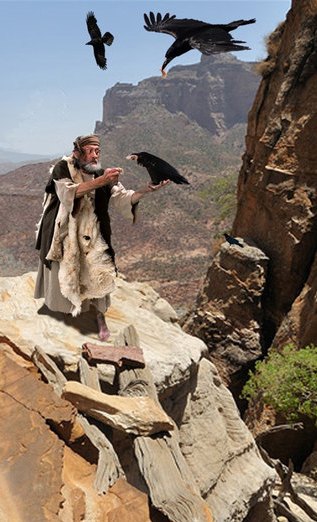
God then told Elijah, “Get out of here, and fast. Head east and hide out at the Kerith Ravine on the other side of the Jordan River. You can drink fresh water from the brook; I’ve ordered the ravens to feed you.”  Elijah obeyed God’s orders. He went and camped in the Kerith canyon on the other side of the Jordan. And sure enough, ravens brought him his meals, both breakfast and supper, and he drank from the brook. I Kings 17: 2-6 (Msg)

Nothing better expresses the urgent call of the wild for me than John Masefield’s Sea Fever.

I must  go down to the sea again, to the lonely sea and the sky,
And all I ask is a tall ship and a star to steer her by, . . .
I must go down to the sea again, for the call of the running tide
Is a wild call and a clear call that may not be denied; . . .
I must go down to the sea again, to the vagrant gypsy life,
To the gull’s way and the whale’s way where the wind’s like a whetted knife; . . .

Wild places and wild things invite us to themselves. If not the sea, perhaps, the mountains, the desert, the plains, or the forest draw you. The trout in the stream, the grizzly bear turning in his sleep, the mushroom popping up in the moist woods, the redwood tree dwarfing all else in its magnificence summon us to gaze in wonder and appreciation and share in the communion of all beings.

Shifting from Virtual Reality to Reality
In the wilderness we smell, and see, and touch, and hear, and taste – not a virtual reality, but reality. And here, we are likewise smelled, seen, touched, heard, and tasted. We not only change and act upon our surroundings, we are also changed and acted upon by those same surroundings. In the wilderness, we find again our place as a member of one of the species of beings on this planet. We leave our thermostatically, controlled environments and modern conveniences to feel the bracing chill of  the wind in our face, the tickling blurred vision through snow dusted eye lashes, the heavy ache in our calves after walking several miles.

In the process of wilderness dwelling, we shed the heavy brittle shells of our self importance and settle in with all our relations – brother sun, sister moon, and cousin fox. We discover the deer we are watching are also watching us.


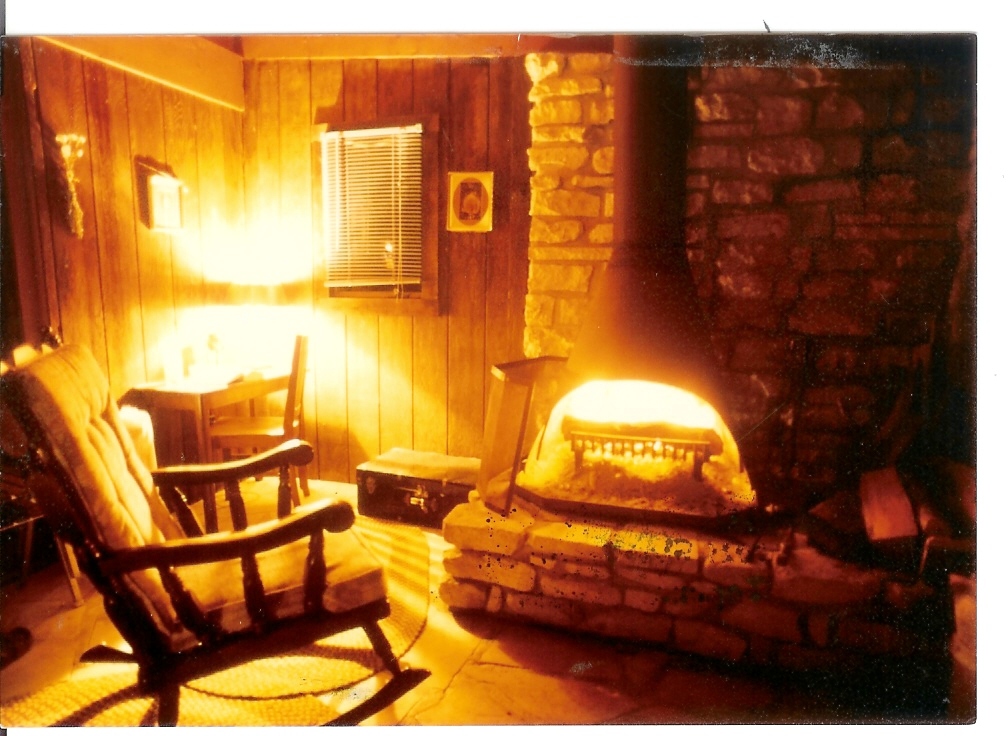
Solitude may occur, of course, away from wilderness in the midst of a noisy crowd, in a beehive high rise apartment, or on the back porch with city sirens screaming past. However, many of us find solitude most easily and fully in a place apart in some natural setting. For over twenty years I found my wilderness solitude in a one room cabin with a stone floor, built into the side of hill on a small lake in northeast Kansas.

The call to the wilderness runs deep in some people, and expresses itself as unappeasable longing, or a palpable need to be in wild places among wild things. These persons often feel compelled to seek out remote spots away from power grids, traffic, concrete, and housing developments. Some struggle to explain and justify their desire to family and friends.

Wilderness as Arena for Spiritual Growth
The Biblical Hebrew word for wilderness is often used interchangeably with desert and includes many varied kinds of terrain, arid and semi arid, pasture land, mountains, and the sea.

The wilderness, a place uninhabited by the human species, is a significant location for the spiritual journey, both in its literal and figurative senses. The Bible understands transformation and spiritual growth as a process, which involves the experience of both physical and psychic dis-location and re-location. The experiences of being lost and being found, of moving from a familiar land to a strange new country appear over and over in the Biblical narratives.

An important aspect, then to solitude and our development in faith, is that exposure to wilderness, both in the physical geographic sense, and in the internal experience of the self. I will set aside consideration of internal wilderness to another post, and focus here on the external physical places and settings in which we find solitude.

As a species and as varied races and ethnicities, we have been formed in part by the land in which we and our ancestors have made our living. The lay of the land itself, the richness or poverty of its soil, the vegetation, wild-life, presence or absence of water, winds, and temperature have shaped our economies, our languages, our diets, our health, what we value, and our religions.

David Abram in his masterful book, The Spell of the Senses – Perception and Language  in a More-than-Human World, writes about this relationship of humankind to the earth and its features and all that dwell upon, within, above, and in its waters.

our bodily rhythms, our moods, cycles of creativity and stillness, and even our thoughts are readily engaged and influenced by shifting patterns of the land. Yet our organic attunement to the local earth is thwarted by our ever-increasing intercourse with our own signs. Transfixed by our technologies, we short-circuit the sensorial reciprocity between our breathing bodies and the bodily terrain. Human awareness folds in upon itself, and the senses – once the crucial site of our engagement with the wild and animate earth – become mere adjuncts of an isolate and abstract mind bent on overcoming an organic reality that now seems disturbingly aloof and arbitrary. (p. 267)

Abram writes of our relationship with the whole of creation as an interpenetration and mutuality in which all parties are affected, changed, and interdependent. The creation is not something I act upon, seek to dominate, or control, but rather the creation is a whole gathering of life with which I may enter into a relationship of mutual benefit.

In the past seven years the consequences of our lack of communion with nature has received attention and comment as Nature Deficit Disorder. The lack of time spent out doors by children and adults is suggested as a factor influencing several illnesses, including obesity.

Starving for the Undomesticated God


Over many years I have observed person after person starving for such connection and communion. Some would trek across the country just to sit in a simple cabin without  running water in a Kansas pasture in order to touch in to such a relationship. With some notable exceptions, namely camp and conference ministries, the church has largely ignored this fundamental need. Though our faith was formed in our ancestors in deserts, tents, mountain tops, sea shores, ship wrecks, storms, and many solitary encounters with the Holy One, we insist that most of our faith be nurtured in buildings and classrooms under florescent lights. We further claim that knowledge of God may be gained by memorizing a set of propositions articulated by theologians, who gained most of their credentials in similar buildings and classrooms.

In contrast, we meet an undomesticated God in the wilderness, an unpredictable, wholly other God, who is neither tamed by sedate doctrines, nor penned up in church polity, nor leashed to political issues. The waves and meadowlark give testimony, the stones hold the stories of the ancient ones, the Spirit hovers over the waters, the prophet emerges from his cave, and hears the still small voice of the Lord.

Most pastors have heard from the person, who apologetically recounts the familiar reason for his Sunday morning absence. “I am closer to God on the golf course or in my boat out on the lake.”  

But can’t you do that on Saturday, wonders the pastor, whose district superintendent keeps count of his worship attendance. He needs to show an increase this year. “You need to worship with the community too, and we need to have you with us,” he tells the fisherman.

Both are right, of course. We need the solitude and nature and we need the gathered  community of believers. Yet, perhaps, rather than feeling defensive, our pastor could become genuinely curious about her parishioner’s life in God and what he is telling her. “Could we get together sometime? I’d like to hear about what these times mean to you and how you experience the Lord.”

A Cabin in the Woods
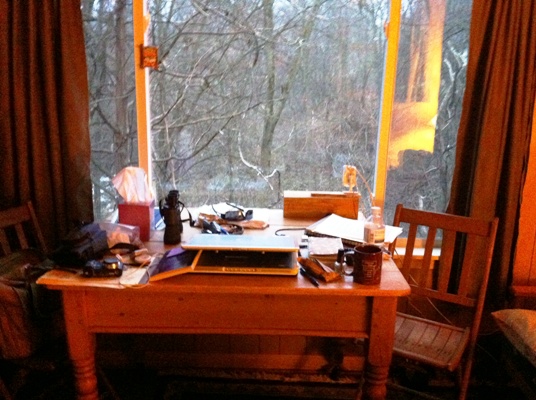
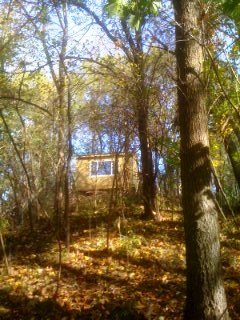
My brother and his wife recently moved and their first project was to build a small cabin in the woods behind their new home. The one room cabin perches part way down a steep ravine in the woods, above a pond and a river beyond. My brother spends hours down there and confesses, most of the time he just sits and looks out the window, watching the birds and critters, and resting his sore eyes on a vista absent of manipulation by his own species.

Formerly a hunter of deer, my brother is now living in more intimate and complementary relationship with his relatives. He rises early each day to put out food. Keeping track of them, he gives some of them names. He is respectful of the space they need and watches for signs of illness, or overcrowding of the herd. He worries about the invasive mustard grass, which chokes out the native plants.

Likewise the animals of this ravine are more intimate with my brother. They are eating well, unafraid, and willing to share more of themselves with this human. My brother is changing too. He has lost weight and strengthened his legs from making the steep climb down and back from the cabin to the house. He has become an evangelist for the gifts of that little structure. “Solitude is magnetic,” he tells me. Yes, indeed.

He shows me a little book he keeps for guests to write their impressions of time spent in his cabin. I open the cover and read the longing and gratitude in their comments.

The Force which Draws All Things Together
Solitude and the wilderness, where we find it, are magnetic. The wild things and places draw us to them by the force of our common relationship with each other as creatures on this earth. We are drawn by our desire to connect with and to enter into communion with Reality in a deeper, truer way than we find in the glib, sound bite assessments that surround us constantly. Such communion changes how we see ourselves and one another. Thomas Merton writes in his second chapter of Thoughts in Solitude that the wilderness invites us to stand back from our lives so we see things in a new perspective.

We cannot see things in perspective until we cease to hug them to our own bosom. When we let go of them, we begin to appreciate them as they really are. Only then can we begin to see God in them. Not until we find Him in them, can we start on the road to dark contemplation at whose end we shall be able to find them in Him.

 Get the Stink Blown Off
Do you postpone going down to your wild places until the time is right, until you have several days free, until you finish this or that project? I will tell you a secret. You don’t have to wait. Just go with whatever time you have. As Eugene Peterson, paraphrases I Kings 17: 2, “Get out of here and fast!” My mom’s version was, “You kids go on outside right now and get the stink blown off ya.” God receives what little time you can offer, a day, an afternoon, or ten minutes, and turns it into abundance with enough leftovers for you to eat on for the rest of week.

So go on. Get out. Go for a walk. Drive over to the lake or the beach. Take a blue highway home. Look around. Breathe. Smell.  Feel. Gaze into the eyes of a deer. Watch the eagle land and fold its wings on its perch above the river. Be seen by the squirrel, be blown by the wind. Be changed and shaped by the interplay and exchange of the animate world of which you are a beloved part.


Solitude Practice:

  • To what kind of wild places are you drawn? Have you been there recently? What keeps you from going?

  • What happens when you go? What changes or shifts do you notice in yourself?

  • Take some time to pray about your need for solitude and wilderness places. Listen for God’s response.

Next Post in this series on Exploring Solitude : The Wild Things Within


You can help support this series by donating to The Sanctuary Foundation for Prayer. Just five or ten dollars will make a difference and help pay some of our costs. Your gift is tax deductible. Donate Here. Thank you so much!

Exploring Solitude: Why Bother?

Come away by yourselves to a lonely place,” Jesus

 What is said here about solitude is not just a recipe for hermits.
It has a bearing on the whole future of humankind and the world:
and especially, of course, on the future of religion. Thomas Merton


Over the next several weeks I will be reflecting on selected passages from Thomas Merton’s little book, Thoughts in Solitude. First published in 1956 the book is a collection of Merton’s musings about time he spent alone in a hermitage at Gethsemane Abbey in Kentucky. Merton had been a monk for a while before he finally gained the Abbot’s permission to spend an extended time alone. An outgoing, gregarious fellow, he struggled throughout his life with finding a balance between his need for solitude and for community. His prolific, engaging writing brought seekers to the monastery and his ability to teach about the spiritual life attracted many followers.

If you have a copy of the book, you might want to get it out and follow along. You can easily find a used copy online, or check your local library for Thoughts in Solitude.

I confess that my relationship with this Trappist priest has been rocky. He has both deeply inspired and deeply disappointed me. There is much I admire in his life and writing and a few things I do not. Just as I decide I am finished with the man, I am drawn back. Like us all, Father Tom, as a friend calls him, has his sin and warts, yet God has used him mightily. We may all give thanks that falling short of the aim which God intends for us (the literal meaning of sin) has never been a road block to the power of God working through human lives.

I choose this book, not because I consider it among the best on the subject. We have over 2500 years of excellent material on the spiritual practice of solitude. I hope you will share your favorite resources in the comments section below, or on the Sanctuary Foundation Face Book Page, or email me. I will be happy to compile your suggestions with others and make them available to The Praying Life readers.

Thomas Merton
Thomas Merton (Photo credit: jimforest)

So let’s begin with the Preface. Here Merton lays out what he is up to in this book and makes his disclaimers. He tells us his “thoughts here are simply thoughts on the contemplative life, fundamental intuitions which seemed, at the time, to have a basic importance.” His writing comes from his “relationship with God in solitude and silence and that “interrelation of our personal solitudes with one another,” which are for Merton “essential to his own peculiar way of life.”

Then he launches into a broad societal justification for such peculiarity. A number of internal and external obstacles make it difficult for most of us to develop and nurture a practice of spiritual solitude. I have listened to many people who struggle to claim the “legitimacy” of the practice, to respond to this call of God, and to be consistent in the “coming away to a lonely place” with Jesus.

I feel guilty. Isn’t it selfish? Shouldn’t  I be doing something – working at the mission, helping out at church, serving on committees? My friends don’t understand. My pastor doesn’t get it. I can’t even explain why I do this or even what happens. Am I only fooling myself and being lazy and wasting time?

I hope this series will offer some support for your practice and a rationale which gives permission and value to a pursuit largely neglected in our culture and religious institutions, but sorely needed. In the end, though, you must come to your own rationale and your own “thoughts in solitude.” For each of us will experience solitude in different ways at different times, and God will speak within you the language of the unique nature of the intimacy you share. And each must make his or her own witness to the truth.

Merton begins his book by looking at the larger culture in which he found himself in 1956:

In an age when totalitarianism has striven, in every way, to devaluate and degrade the human person, we hope it is right to demand a hearing for any – and every sane reaction in favor of man’s [ok, from now on in this blog series I will make Merton’s gender nouns and pronouns neutral] inalienable solitude and interior freedom. The murderous din of our materialism cannot be allowed to silence the independent voices which will never cease to speak: whether they are the voices of Christian saints, Oriental sages like Lao-Tse or the Zen Masters, or the voices of persons like Thoreau, or Martin Buber, or Max Picard. It is all very well to insist that people are “social animals” – the fact is obvious enough. But that is no justification for making them into a mere cog in a totalitarian machine—or a religious one for that matter.”

Thomas Merton's hermitage at The Abbey of Our ...

Hermitage of Thomas Merton at Gethsemane Abbey

Society, for Merton, depends for its very existence on the inviolable solitude of its members. This is because, as he writes, “to be a person is to possess responsibility and freedom, and both of these imply a certain interior solitude, a sense of personal integrity, a sense of one’s own reality and of one’s own ability to give oneself to society – or to refuse that gift.”

He ends his preface with: “What is said here about solitude is not just a recipe for hermits. It has a bearing on the whole future of humankind and the world: and especially, of course, on the future of religion.”

One of my pet peeves about Merton, especially in his early writing, is his penchant for sweeping generalizations and pronouncements. I happen to agree with this one. How might such a claim be true?  Is there really a relationship between the time you take to create some space and time to be alone with God and our future as a race and the future of religion? I think so. And I am not alone.

When there is a crisis in the church, it is always a crisis of contemplation. The church wants to feel able to explain about her spouse even when she has lost sight of him; even when, although she has not been divorced, she no longer knows his embrace, because curiosity has gotten the better of her and she has gone searching for other people and other things.
Carlo Carretto


Might part of our struggle with keeping solitude be because we have our arms around the wrong lover?

Solitude Practice:

  • Ask the lover of your soul to show what you are hugging closer to yourself than the Holy One.

  • Identify competing lovers.

  • What might it take for you rediscover God’s embrace and forsake all others? It might be easier than you think.

As Paul Simon sang to us, there are fifty ways to leave your lover.

Next Post: The Wilderness of Solitude

You can help support this series by donating to The Sanctuary Foundation for Prayer. Just five or ten dollars will make a difference and help pay some of our costs. Your gift is tax deductible. Donate Here. Thank you so much!

Where Miracles Occur

Bristlecone Pines, California

The tension in my shoulders is melting. The tightness and ache in my jaw and throat are releasing. The constant, exhausting, mental jabber is growing silent.  The resolute soldiering on, pushing forward without awareness, without seeing anything, but a goal which constantly recedes over the horizon, is giving way to being    here      now.

The tunnel vision squint and laser focus are opening and broadening to a wide spacious plain that keeps revealing more and more. Reality unfolds like an undulating wave continuously turning up complexities, beauties, grace, and both harsh and comforting aspects of what is really going on.

I have been decelerating and decompressing over the past several weeks.  This process is not over, for it is the work of a lifetime. I need more time to shed the brain debris and external and internal clutter. I need to continue to tame the habit of acceleration, and restrain my inner harpy, that merciless harridan of self aggrandizement.

Though I have tried to practice and teach this for years, I feel like a rank beginner. And, as is the way of the Spirit, I am being shown how far I have to go. I am watching my many-faceted resistance, as I begin the slow, groaning, screeching grind to a halt. For ironically, in order to go further on this journey, I have to stop.

Sabbath means, literally, to stop. I am aiming for a Sabbath life, a life lived contemplatively, steeped in the awareness of the presence of the Holy, which initiates, and infuses my work and play. I like the broader definition of Sabbath, which Donna Schaper offers:

Sabbath sense is anything that makes spacious what is cramped. That makes large out of small, simple out of complex, choice out of obligation. Sabbath sense is anything that reconnects the necessities of drudgery to the marvelous uselessness of beauty. Sabbath sense is acknowledgment of the presence of Spirit in the petty and the profound.

In this time of beginning and transition, of halting and rest, I have discovered a different kind of urgency, than the urgency of schedule, production, and accomplishment. This is the urgency of a compass, a magnet, an urgency so primal it is like breath itself. This is the urgent love of the Maker of All honing into each particle of creation, boring into us and drawing us inexorably to itself.

"Tarfala Valley"

I have always been attracted to sparse, barren, open spaces – the high alpine tundra, and the edges of the tree line. There for over five thousand years the bent and twisted Bristlecone Pines dance their gnarled tango with the howling storms and eye the prize for the oldest continuous living residents on this planet. I look at maps for the wind-scoured boulder fields, the isolated islands, and the endless expanse of ice sheets at the poles. These places both fascinate, and frighten the wits out of me.

In a lovely blog, Being Poetry, I came across this quote from poet William Stafford:

Each poem is a miracle that has been invited to happen. I must be willingly fallible in order to deserve a place in the realm where miracles occur. 


Stafford, pacifist and formed in The Church of the Brethren, grew up in the semi arid high plains of western Kansas. He was also formed by those windswept plains, where you can see for miles. In these recent weeks I have been unwillingly confronted with my fallibility, my utter inability to live and be all that I desire. I hear Stafford advising, “Forget about overcoming anything. Embrace it all and live honestly from it.”

So I am heading out to the edges of my infallibility, that terrifying point where I and all I can think and do and figure out and hum to myself ends, and God begins.

Today I say that to live a life of prayer, I must go out to the edges of myself and my security. I must go beyond my ego to the outer banks, to my own fallibility, where the edges of the sea of God wash over my toes and beg me to fling myself into that deep Immensity.

I do not want to be safe. I do not want any part of a faith or a God or a religion that is safe. I want to stand in the barren field of the world, strewn with boulders, with only our wounds and fallibility, and without a prayer, a blog, a book, or a penny in my pocket, but the brooding mercy of God.

It is not a comfortable, quiet life of ease that God is calling me to, here in my retirement. It is to a life of surrendered love, where my meat and drink, and every breath are drawn from the grace of God. I am fearfully and gratefully being towed through fallibility to a place in the realm where miracles occur.

You come too.

English: Bristlecone Pines on a spur ridge bel...

Re-tired: Embracing the Call to Solitude

I need to be still for a while.

I need to savor and integrate a month of bounty, a year of gratitude.

I need to listen long

to the captivating resonance of relationships,

that singing bowl of community.

A Japanese rin marks the beginning of moments ...

I recently made a big change in my life and how I will spend my hours in the coming years. I retired. When I hear this word, retire, I see myself driving my car over to the repair shop and saying, “Hoist me up, Mike, and put on some Michelin Pilot Sport Pluses all around this dune buggy. I need something sturdy that will hold me to the road in all weather. Mike, my man, I got places to go and things to see.”


As the old year closed I said goodbye to a community I served for over twelve years and began my retirement from traditional parish ministry. The Sanctuary Foundation, which I founded over twenty years ago, will continue. In the coming year I will offer spiritual guidance, teach a little, and finish a new book.


Most importantly, I will practice what I have preached. I will allow the stillness to feed the hunger of my heart, and offer my life with greater integrity to what I feel most deeply called and what the church, regardless of all its good intentions, seems least able to support.


Mind you, I do not leave parish ministry burned out, beaten down, or resentful as some do. This may be because I worked part-time. I also did not carry the same responsibility, which a head of staff carries. And I continued my long established practice of taking a day a week for solitude and prayer through those twelve years. Besides, even though they work hard and balance multiple tasks and responsibilities, clergy continue to show statistically that they are among the happiest professionals. 


I continue to believe in the church, which is to say, that I believe in the wonder of people stepping out of their daily lives to come together to sing, and to lift their hearts and minds to something beyond their own manipulation and control. I believe in the miracle of people, who seek to love, forgive, and work together in spite of their differences. I believe in the Power that inspires their faith and surrender to One kinder and wiser than they. I believe in the Grace which meets us in vulnerability, admitting failures, and in opening our lives to the scrutiny of a loving God. I believe in the Compassion that leads people to acts of justice and mercy and the Love that empowers them to lay down their lives for each other.


In this sense church is a singular, unique mystery, which has grasped the human species. It startles the wits out of me every time I walk into or stumble upon such church in one of its many manifestations.


To leave parish ministry and my particular community of faith felt like parts of my heart were being pulled out by the roots. So deep was the love we shared and the goodness of God in our midst.


So why leave? Over the past thirty years of my service to the church I have found the traditional forms of ministry, as much as I have loved the work, have always seemed to require a compromise of what I hold most deeply – a life lived prayerfully, mindfully, steeped in the substance of the living God. Too often the church seemed to ask me to live more of the world, than in the world. The church, like each of us, is deeply influenced and captive to the values, practices, and gods of a secular culture. I find it very difficult to stand against that tide of endless production, pragmatism, and focus on self and survival.


Instead of becoming of the world, Paul calls the church to a transformation of its mind, its self understanding as it exists in the world.

Don’t become so well-adjusted to your culture that you fit into it without even thinking. Instead, fix your attention on God. You’ll be changed from the inside out. Readily recognize what he wants from you, and quickly respond to it. Unlike the culture around you, always dragging you down to its level of immaturity, God brings the best out of you, develops well-formed maturity in you. Romans 12: 2 The Message

I never fit in. My personal tension with the church is not because the church has failed. It is a because I am a monk, albeit a gregarious one. Monk, which means solitary is in direct conflict with church and its sense of gathering. And there’s the rub and the glory.  Service, whether in the hermitage or in the pulpit, on one’s knees or at the bedside of a suffering soul, listening to the pain of the poor or raising money for mission,  always requires a death, a sacrifice of some desire or another. I do not blame the church for this, but, rather, the church has educated and purified me through the very conflicts which tried and tempered my soul.


I, alone, am responsible for following the call of God in my life. I am grateful to my denomination, Presbyterian Church(USA), those intelligent, imaginative, decent and orderly ones, and the Presbytery of Northern Kansas  for making space for their solitary, monkish sister. Now at the end of her service and the beginning of her honorable retirement, she will embrace what called her out of darkness and back to the church thirty three years ago, in a way more congruent with her heart’s deepest desires.


So as you can see, I have some things to mull over. I need time to downshift and decelerate as I make for myself a life more congruent with the word of God as it sings in my heart and speaks to me in the ancient texts. Besides I have a big pile of thank you notes to write, and I need to get over to Mike’s and get those new tires.


I will take a couple weeks off from writing The Praying Life. And I will be back  before you know it. In the meantime I will post occasional thoughts and links here and on the 
Sanctuary Foundation Facebook page.

Holy God,
in your will is our peace.
In this moment is your will.
Here, now.

Let’s hit the road.


With deep love and gratitude to The Reverends Paul Waters, Ron Schultz and Rob Winger and the members and friends of Crestview UMC in Topeka, Kansas.

Dear Reader, I am interested in hearing from you. What do you need? How might this blog speak more directly to the hunger of your heart in the coming year? Email your ideas, questions, and suggestions here , or comment below.

I am looking forward to the journey ahead!

The Star Stopped – Part Two

Joy: Our Chief and Highest End

When they had heard the king, they set out;
and there, ahead of them went the star that they had seen at its rising in the east, until it stopped over the place where the child was.
When they saw that the star had stopped, they were overwhelmed with joy. Matthew 2:9-10

Once there was a man who played with Jesus a kind of peek-a-boo and hide and seek, asking to see him while he walked.  I go now where the man prayed and Jesus is everywhere, sitting in the trees, hanging upside down from the hawk’s nest, swinging his arms up ahead along the cow path, turning in wide circles in the heavens, glinting under the silver wings of geese.

“Jesus, get out of here,” I say.  “I have work to do, prayers to pray, fears to nurture, pain to bear, miles to go before I sleep.”

He just grins, riding down the back of the willow leaf. You bet,” he says, “who do you think is in charge here anyway? I came that you might have life abundant.”

“Yes, but there is so much suffering and sorrow in the world. I have survivor’s guilt.”

“Deal with it, sweetheart, joy is your burden to bear.”  Then quoting scripture, “‘Do not be like a horse or a mule without understanding, who must be curbed with bit and bridle, or else they will not stay near you.’  (Psalm 32:9)  Daughter, you are forgiven for being happier than some of the others.  In your joy is my joy made complete.”

____________

What is the chief and highest end of humankind?” asks the Larger Catechism.
Humankind’s chief and highest end is to glorify God and to fully enjoy God.

A friend of mine died after a long debilitating illness. Before he died he told me, “Life is funny. You know, I used to say life is messy. Now I say life is funny. God must be laughing his head off at us, saying, ‘Don’t they get it?’ I have no complaints. Life has been very good to me. I just try to enjoy.”

To enjoy:  to put into a state of or to be in joy – to indwell rejoicing. Joy is the emotion provoked by well-being, success, or possessing what one desires.

How strange that little teaching in the church has to do with helping us to be faithful to our highest end. We know how to read and interpret scripture. We understand the dynamics of church growth. We can conduct things decently and in order. We can do mission. We are even beginning to understand our spiritual life and prayer. But how many of us can state precisely how it is that we glorify and enjoy God as individuals and as a community of faith? When many of us start to enjoy we feel guilty. To claim that anything I might do actually glorifies God may sound arrogant. To seek enjoyment of God seems hedonistic and wrong.


It takes courage to risk joy. The older we get, the more we know of the ravages of life and sin, and the woeful limitations of the flesh. My dying friend, weak and suffering, says, “I just try to enjoy.” Perhaps that is when joy is born the truest, when we are firmly fixed in the limits of humanity, held by the teeth of our extremity with no illusions. Maybe you won’t get better. Maybe your friend will die. Maybe your heart will be broken. Maybe the divorce will be final. Maybe the worse that can happen will happen.

Now here, just when you thought it was all over

here

stop

where the star has stopped and let joy in.

It will take a mile if you give it an inch. Watch how it eases a hand and foot through the crack – pushing in a shoulder and hip, and flinging the door wide open on bliss.

What did you think would make the star stop, if not the sad song of mortal need?

A lot depends on the way the yellow willow leaf swims like a slim minnow downstream to rest in the musty shallows of earth.

Now it turns, spins in circles, now it dips and glides, now stops, still in the air, then drops like a sigh.

A lot depends on such surrender, but even more depends on someone noticing.

Jesus, help us to love you
more than the search for you.
Give us hearts of merriment and gratitude.
Teach us to tolerate goodness, to stable delight.

And Merciful Savior of loss and defeat,
bestow upon us the wit to trust
and to consent to contentment
that your joy and our joy be made complete.

Mirable Dictu (Wonderful to Behold) Harvey Bonner


Excerpted and adapted from Letters from the Holy Ground – Seeing God Where You Are, Loretta Ross (Gotta), Sheed & Ward, 2000, chapter 23.

Cover of "Letters from the Holy Ground: S...

Cover via Amazon

The Star Stopped – Part One

Joy: Our Chief and Highest End

The Magi Journeying

When they had heard the king, they set out;
and there, ahead of them went the star that they had seen at its rising in the east, until it stopped over the place where the child was.
When they saw that the star had stopped, they were overwhelmed with joy. Matthew 2:9-10

The star stopped.

Did they slam into one another like dominoes – camels, gifts, magi all in a scrambled pile before the manger?

They had been seeking joy for so long; and they knew more about traveling than arriving, more about need, than about fulfillment.

The star stopped.

The momentum of the journey, the habit of search, sent us lurching forward even as we beheld the prize. Like ones on a long auto trip riding over the flat stretch of prairie, we lie still at night in our beds feeling ourselves hurtling along phantom highways, our flesh imprinted to motion.

So we arrive at our destination, yet act as if we are still on the way. We shuffle on unsteady legs to the doorway where the light glows, the breath of cattle steams, and something makes a low choking coo. We are overwhelmed with joy, a sublime apprehension of the beauty and perfection of what lies before us under the stars and that we need travel no longer.

It doesn’t get any better than this:

the glad dog bounding gleefully after the yellow cat in the sun

the clutter in the child’s room – a still swirl of hair brushes, dirty socks, ribbons, Tootsie Rolls, and crayons

you and your friend laughing over lunch in the cozy diner

your own wrinkled hand and all it has grasped and caressed, pushed, smoothed and manipulated


You think you need to get busy. Accomplish something today. Wild-eyed John in his camel’s hair is out in the pasture yelling to get with it. “Bear fruit worthy of repentance, you brood of vipers,” he shouts. There is so much to do, so far to go. You think this or that thing has to be done. You think joy is up ahead, when you have reached some goal, satisfied that hunger.

We ought not to pray for things, as to pray to live as though we had the things we pray for. We ought to discover just what it is we think these things will give us, to consider carefully what is the sub text of our desire.

The star stopped.


Did they pile into each other like keystone cops? Was a screeching cosmic brake applied? Or was it so silent as was hardly noticed in the din of rising galaxies and earth teeming with the shrill frenzy of life and death? Perhaps it was a gentle slowing pressure in the heart, an impulse to do something unfamiliar, maybe a sudden press upon the shoulders to bend the knees and halt midway down the stairs absorbed in Joy.


The star stopped and cast its radiance like a neon arrow:

Exit now. Food. Gas. Lodging.

Here this is it. You need go no further.

The star stopped and they were overwhelmed with joy, writes Matthew.Well, how long did that last? How long before they began to fret, to glance anxiously at their watches and their bank balances, and worry about the future, recalling Herod and their disturbing dreams. There would be the trip back home by another road, and how they would explain the dishes still undone, the laundry piled upon the floor, the unpaid bills.How long before they would begin to doubt their own eyes – that they had seen what they had seen? “Perhaps I was mistaken, it all seems so unreal. It was long ago. I was ill, or grieving, young and foolish. We’d better keep on looking, just in case.”


O immaculate tenderness, O sweet hay in the wind, ground of our beseeching, joy of our desiring, we meet and greet you, kneel to adore and leave our gifts, then what? You are too much for us – you in your completeness, sufficiency. We, overwhelmed with joy, cannot bear the light and back out of the radiant stable to return to the familiar world of anxious fear and endless seeking.


The tension of incompletion fuels our lives and impels our action. Consummation is hard for us to take. People shouldn’t be so happy. “I’m sorry mom, but I just can’t keep my smiles down,” confides the eight year old apologetically on her eagerly awaited trip to the ice skating rink.


If we get too satisfied, won’t there be no striving, no invention, no creativity, no urge to improve, discover, move on? Won’t it be boring? Won’t it be dull?


Our capacity for satisfaction is much less than our capacity for hunger.

Who dares to take a vow of stability?
Who dares declare that this is it
this broken down stable of a life
this very life in shambles shelters Joy?

What most characterizes American culture, poet Richard Wilbur has said, “…is not unity, but rather a disjunction and incoherence aggravated by an intolerable rate of change.”

I gaze in bewildered nostalgia at old photographs of myself and loved ones. Motion is an essential property of things. Everything at one level of its being or another is in motion and change.

Is there anything in the universe that is absolutely still? The earth heaves, crumbles, splits, powders. The flesh pulses, sighs, and dies in the slow dance of decay. Electrons careen around nuclei. Five-flavored quarks flash in kinetic quick-step.

A lot depends on the way the willow leaf turns in the wind and curls to a dry crisp under the bird feeder, but even more depends on someone stopping to notice.


Our awareness gives birth to Christ. Seeing that the star has stopped and climbing down from the camel to kneel before the holy child dwelling in the heart of matter with innocence and salvation is what opens the door for God’s entry into our world.

The child yearns to be noticed. The child waits in the crib of creation for us to stop and pick it up and deliver it to the world by virtue of our own seeing.

Christ is born by our consent.
It all depends on someone saying, “Let it be to me according to thy word.”

Then a still small soul magnifies the holy one, and, like a mirrored prism, bends light into multicolored beams of joy.

~ to be continued in next post

Excerpted and adapted from Letters from the Holy Ground – Seeing God Where You Are, Loretta Ross (Gotta), Sheed & Ward, 2000, chapter 23.

When Hope Fails – Redux

Hope is what gets a lot of people through the Christmas season. And the failure of hope is what leaves some souls shipwrecked on the treacherous rocks of the sin and imperfection of this world.

What is it for you this year? Death of a loved one? Spouse in Afghanistan? Unemployed? House foreclosed? Cancer?

Hope is the presentiment that the imagination is more real, and reality less real, than we had thought. It is the sensation that the last word does not belong to the brutality of facts with their oppression and repression.  It is the suspicion that reality is far more complex than realism would have us believe, that the frontiers of the possible are not determined by the limits of the present, and that miraculously and surprisingly, life is readying the creative event that will open the way to freedom and resurrection.           Rubem Alves
 

She was fourteen. She sat next to me as we drove home after the Christmas Eve service. Lights sparkled from distant homes across the snow-covered fields. Shattered with pain and trying not to show it, I tried to focus on driving. After a while she spoke out of the darkness, “Mom, things aren’t ever going to be the same, are they?”

That year, our family had been struck by a blow from which we would never fully recover. In spite of  brave efforts, prayer, and sacrifice we could not put back together what was broken and, perhaps, fatally flawed.

During that season of suffering, hope became nearly eclipsed by fear, anger, shame, and pain. Each evening I turned briefly from my grief in defiance of “the brutality of facts with their oppression and repression,” and lit a candle for hope. Even though I felt no hope, I let the candle hold my hope for hope.

In those days I clung to the verse of scripture the minister preached at our wedding. Remember thy word to thy servant in which thou hast made me hope. This is my comfort in my affliction, that thy word gives me life. Psalm 119: 49-50

What an odd text for a wedding, you may think. Yet as the years unfolded it became more and more meaningful. I prayed it, holding God accountable to the goodness promised to me in scripture and whispered to my soul. God’s promise of joy, peace, and love comforted me and gave me the ability to keep breathing in my affliction.

Carmelite writer Constance Fitzgerald writes about the movement in our spiritual journey from “naïve hope to theological hope.”

Through experiences of loss and suffering, naïve hope in a Santa Claus god and other illusions nurtured by our egos and culture give way to a different, richer kind of hope.

We let go of placing our hope in our own efforts, our own goodness, our own “luck” or worthiness. We let go of our “right” to ourselves and our way. Or perhaps it is more accurate to say, we numbly watch our way wrenched from our grasp. We face our helplessness and the truth that we are not in control. Hope in oneself and one’s little plans and projects dies on the cross of our life experience.

It is there in that stillness of a drive back home on the worst Christmas Eve in one’s life, while a child’s heartbreaking question hangs in the air, that hope in God is born.

You may miss it at first, especially if the pain is choking you.
But refuse to let the last word be the brutality of facts.
Go ahead and light that tiny candle.
Defy the darkness.
And pay attention.
A baby is on its way.
Something fragile and new and unimaginably sweet
is making its way into your consciousness.

I tell my daughter, “Yes, honey, things will not be the same. But I believe somehow or other, things will be all right.”

And they were.


Special thanks to artist Anne Emmons for her permission to use “Hope” in this blog. You can reach Anne at anneemmons_8@msn.com or on Facebook.

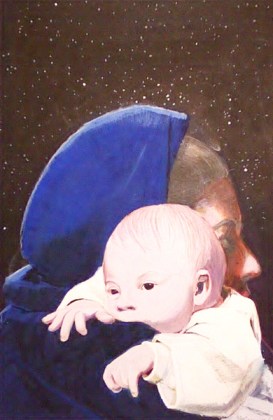
Here is Anne’s story about this painting:  I was trying to think of one moment in the Biblical narrative which captures the theme of hope.  Each year I have made a new image for Christmas since 1997, and in 2000, I was struck by the idea of hope as the source of light. The images in this series reflect the thought that Christ came, the Light of the world, into darkness. So I was thinking about one single moment in the story and I realized the moment Mary heard the announcement from the Archangel Gabriel must be the moment hope found a form, in her face. At the time, my daughter was almost 14, the estimated age of the Virgin Mary, and I suddenly connected with the story in a particular way. I kept her home from school that morning to have her sit for the painting. What struck me, and this has since been confirmed from other sources, most recently Anthony Bloom’s book, Beginning to Pray, was that the Incarnation was possible only through God’s will in union with the “yes” of the young Mary, who became the bearer of the Uncontainable God. Just after I painted this I saw the Pontormo Annuciation in a small side chapel in Florence, and Mary had the same sort of look of wonder I tried to catch.  Now my daughter Claire has a two year old son, Theodore. She is a single mother who said yes to the birth of this child, whose name she chose, not knowing it means “gift of God.”

This is a previously published post (December 2009)  with some light editing.