Category Archives: Spiritual Practices

Small Things, Great Love

messy officeMy desk is a rat’s nest of notes, files, cards, books, pens and unfinished projects. A pile of bank statements and bills waits on the credenza. I am writing a blog, an essay, and a book, as well as meeting with clients, preparing for classes at church, responding to pastoral care needs, and planning for youth group. I have several presentations coming up and other projects on hold. My pantry ought to be roped off as a hazardous area. Then there are the meetings to attend, my 96 year old mom, my daughters, friends, pets, and oh, yes, God.

If this does not sound like the life of a hermit pray-er as I describe myself on the About Page of this blog, bear with me. I am still praying. I suspect things might be a little more organized and tidy if I were not, but overall things would be a bigger mess.

This week I received two quotes from friends in my email. One was from Mother Teresa: “We can do no great things, only small things with great love.” The other was from Charles Spurgeon: “Learn to say no. It will be of more use to you than to be able to read Latin.” Here’s where I went wrong. I took four years of Latin in high school.

Charles H. Spurgeon was a 19th century English Baptist who preached to crowds of ten thousand in London. As many of us, he had his hand in a lot of other things as well. I figure you know who Mother Teresa was. Both of these busy servants of God came into my life this week to offer their two cents on how to handle something which afflicts not only pastors, but just about everyone else I know.  Overwhelmed with tasks, stressed, and anxious many of us need to learn how to say no. Moreover, we need to learn to say no not only to other people, but also to ourselves. For I have found most of us are usually the most demanding, unreasonable, and, frequently, atheistic boss we have.

Recently someone described how she is simplifying her life. She asked herself why she was doing what she did, and was she really called to this. When I find myself on the treadmill of over doing, I notice an odd thing that happens to me. The more I am trying to do, the more I think I need to do, until I totally lose perspective and am worrying about accomplishing things, which in more sane moments I realize I do not need to do. This loss of perspective and over functioning which feeds on itself is a characteristic of addiction.

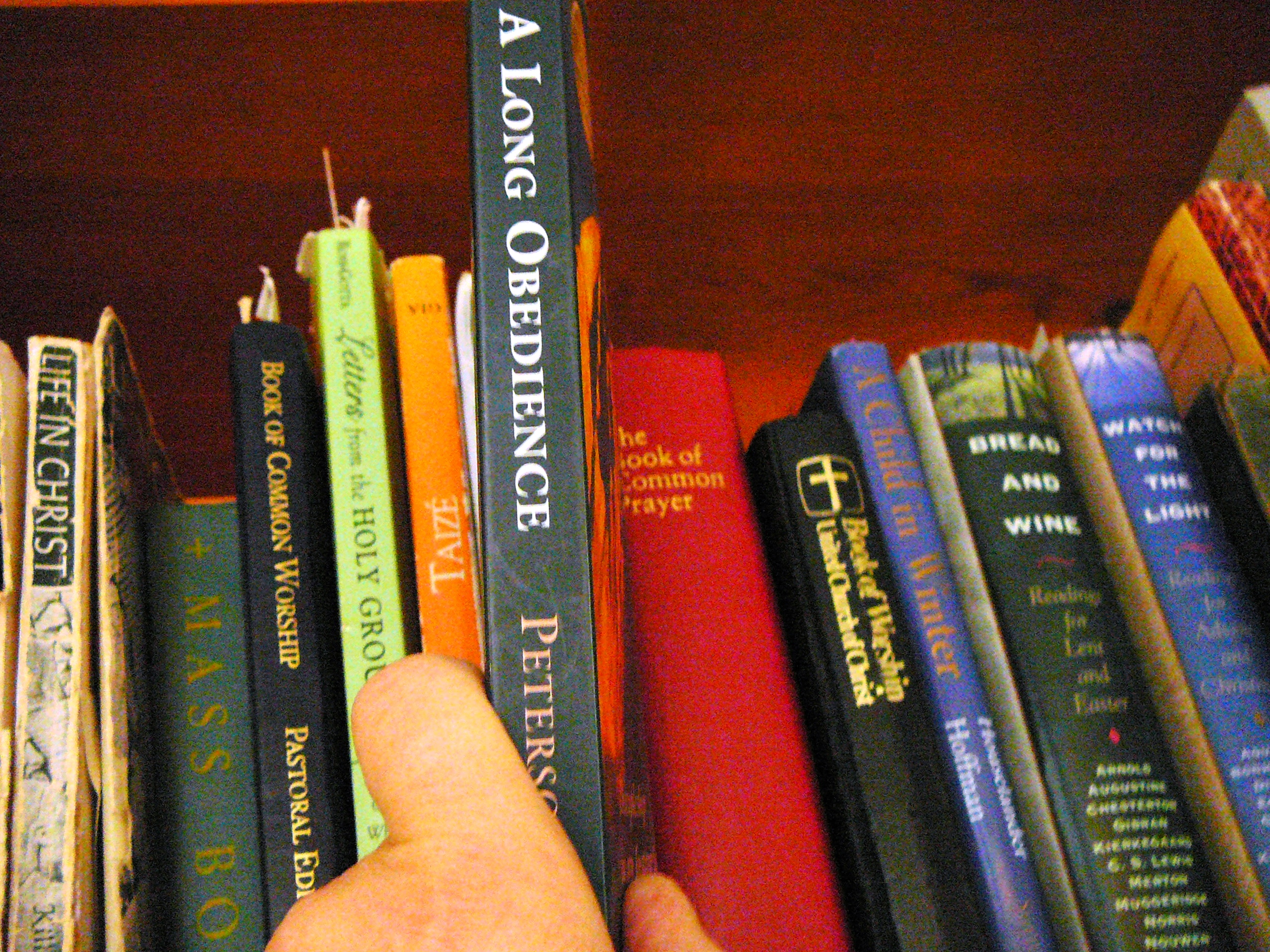
Mother Teresa says, “Don’t sweat the great stuff – getting big projects, big plans accomplished. Instead do small thingsBook on shelf with great love.” I like that. I can do that. Stay in the present. Put the file away carefully with reverence. Respond to this email thoughtfully with love. Gratefully gather up all the scattered pens and pencils. Put the books back on the shelf with thanksgiving. See the wonder of God’s provision in the goodness of this moment, as I think of you, yes, you, with love and gratitude. Just tend to the next small thing with all the love and generosity you can bring. Leave the outcomes, the great ends to God.
“The smallest thing, touched by love, is immediately transformed and becomes sublime,” wrote Thomas Merton. I still need to learn to say no, but I also want to learn how to work in such a way that what I touch becomes holy. I think it is all in the focus. Is God the center of my concern, or my Latin assignment? It makes all the difference.

Assignment: Practice doing small things with great love this week. Let me know how it goes.

More about prayer –
www.fromholyground.org

Contact Loretta –
lross@fromholyground.org, www.fbook.me/sanctuary

Follow on Twitter

Kids with Knives

Jesus pumpkin 3

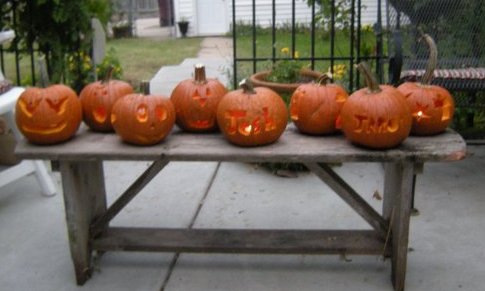
Nine kids: nine pumpkins. Grandpa and Grandma, with a pot of taco meat and fixings. After the dumb game where I make them interview each other and then introduce each other to the group, we get to work.

Knives: Five boys around a table covered with newspaper. Two girls in the kitchen. Two more on the patio. Seeds. Lots of seeds and stringy pumpkin innards. Laughter.  scooping

“I am making a bat.”
“I’m gonna have two faces on mine.”  
“Hey, where’s the knife?”

Then – that studied silence of creativity and focused concentration. Grandpa helping with the finer points of carving. Grandma taking photos, hunting up a toothpick to save a broken piece, helping set up the food.

Through it all – a barking puppy named Elijah, confined to his kennel in the kitchen, itching for a wild rumpus. We let him out and some of the kids take him for a walk.

Supper: tacos, chips, salsa, apple slices in caramel dip. Mrs. Miller’s yummy bundt cake with black and orange sprinkles. No leftovers.

Lesson:  We take off our shoes and gather in the prayer room. The sophisticated high school juniors sit down with the middle schoolers. One or two stretch out on the floor. Others wrap up in a prayer shawl. We turn out the lights. We settle down. Elijah does not. He is back in the kennel and very much wants to be in on this lesson. The little prophet, still early in his ministry, has not yet heard “the still small voice.” aleah

What does Jesus mean when he tells us to deny ourselves and to die? We watch a Nooma video about how death is the engine for life. We think about how parts of ourselves can get in the way of our ability to love or to be compassionate. Like the part of ourselves that always has to be right, to look good, or to impress others. The video is pretty sophisticated for this age group. I wonder if it is making any sense. The kids are quiet and listening intently.  

Elijah keeps barking. I bring him in and try to calm him. He only gets worse. I take him back. Grandma, who is not all that keen on dogs, goes out to the kitchen, kneels down before his kennel, and entertains Elijah with a paper towel.

I ask the kids what desire in them might need to die, what desire is getting in the way of God’s work for them and through them. One by one we bring an unlit candle forward to where there is a small statue of Jesus carrying a cross. We light the candle and place it near Jesus as a symbol of what we want to let go of. While we are praying, we listen to Dona Nobis Pacem sung by Beth Nielsen Chapman. Some of us sing along. We are silent for a little longer, gazing at all the candles around Jesus. We say amen. One sixth grader, wrapped in a shawl stretched out close to the candles, announces loudly, “I just love that chant!”

We go outside, light our pumpkins, and carry them home into the dark.Bill smith helping

I say I am too old for this. My youth group days are long over. I say I cannot devote the time and energy these kids deserve. I say we should be having lock-ins, going on mission trips, meeting more frequently. What I do seems so small. I teach them how to be still, silent, and prayerful. And I love them, wholly, and with a kind of wild desire for their highest good in God now and always.

I go to bed deeply grateful for grace in the midst of chaos. I think about the kids in Chicago where knives are wielded for a completely different purpose. At church this Sunday we had celebrated Children’s Sabbath. Some of these youth shared information with the congregation about the horrible neglect and suffering of many children in our country. The kids I work with are deeply loved and cared for by large extended families and a whole church pretty much totally gaga about their every move. My heart aches, thinking of kids for whom a knife is only a weapon, for whom school is a crime scene, and a walk down the street an invitation for murder. What needs to die in us for our children to stop dying?

As we were cleaning up Grandpa told me, “It is a miracle no one got cut!” Hmm, I think, no. Grandpa and Grandma, the miracle is that you are here. 

Jesus pumpkin 4

Special thanks to Bill and Sharon Smith, Eleanor Miller, Jean Schultz, Dave Strobel, “the pumpkin man,” everyone at Crestview UMC, and all of you who try to be present to children wherever they are.

More about prayer –
www.fromholyground.org 

Contact Loretta –
lross@fromholyground.org, www.fbook.me/sanctuary

Follow on Twitter

God’s Been Missing You


j0438446

The wilted remains of pea salad, oriental chicken salad, jello, macaroni salad, and drooping concoctions of cool whip, cherries and graham crackers weigh down the table in the church basement. We finished our salad luncheon and were listening, as I was being introduced as the guest speaker. Invited to address church women of Sabetha, Kansas at their annual spring gathering, I prayed silently, “Jesus, what do you want me to tell the people?” I had planned my remarks, but I often prayed this question before a presentation. Usually I heard, “Tell the people that I love them.” On this spring afternoon in 1991 what came was, “Tell the people that I miss them.”

Over the past eighteen years the message has remained the same: God misses you. Your presence and attention to the Divine matters, makes a difference, counts. God grieves when you are absent from communion with the Holiness filling this world.

 “We live in an age of unbelief,” writes Ronald Rolheiser. “What sets this apart from past generations is that, today, this is often as true within religious circles as outside them. The problem of faith today is especially that of unbelief among believers.” In his book, The Shattered Lantern – Rediscovering a Felt Presence of God, Rolheiser writes about our struggle with faith and agnosticism. “We still have some experience of God, though rarely is this a vital one wherein we actually drink, first-hand, from living waters.” (pages 17-18)

What does it mean for you to drink, first-hand, from living waters of God? What shift needs to occur in us in order to turn aside and reach for a felt presence of God? For me it begins with the recognition that fundamental peace and clarity do not come from my achievements, intellect, or effort, but rather from conscious contact with the Living Reality which sustains all life. To turn toward a God who misses me begins with a conviction that God is more active,  effective, and powerful in my life and world than I am.

In 1926 Evelyn Underhill addressed a class of young seminarians preparing to go into the ministry in the Anglican Church with these words:

We, the laity, know instantly the difference between the churches which are served with love and devotion and those which are not. And we know from this, what their ministers are like. And what you are like is going to depend on your secret life of prayer; on the steady orientation of your souls to the reality of God.                   

I love Underhill’s phrase, the steady orientation of your souls to the reality of God.compass   Such orientation is radically different from the business as usual orientation of the world.

 Remember those compasses people used to put on the dashboards of their vehicles before we had GPS? As a child I loved to watch the dial bounce around in the fluid as the driver turned the wheel and we changed directions.

How do you determine when your direction is steadily aligned with magnetic pull of God? For many of us there is no felt pull toward the holy, toward the compelling mystery of life and love. At the same time many people have a sense that something is missing – a dryness, loneliness, a searching for something of more substance and depth than celebrity worship, political posturing, or being defined as a consumer of commodities.

What is magnetic north in your life? What has the strongest pull on your attention and direction? Where is that direction leading you? Toward greater satisfaction, peace, and generosity?  Or toward something else? 

When we acknowledge that there is a God who misses us and that we are missing God, we set aside our agendas, the chaos, and allure of the world and enter into a larger, more generous, and wiser Reality. We are cleansed, rinsed by the refreshing, renewing Living Water, which soothes and realigns us with our deepest truth and purposes. Here is our heart’s true home, the soul’s magnetic north.auto compass

This Friday The Sanctuary Foundation for Prayer will resume Midday Prayer gatherings from 12:15 – 1:00.  Held weekly at The Sanctuary office at 1600 SW Campbell and open to the community, these periods of contemplative prayer focus on communal silence. Join us in body or spirit and orient yourself to Ultimate Reality. God may be missing you way more than you know.

  sanctuary-tree-tiny

More about prayer –
www.fromholyground.org, www.theprayinglife.wordpress.com

Contact Loretta –
lross@fromholyground.org, www.fbook.me/sanctuary

Follow on Twitter

Elijah and the Gentle Leader

I led them with cords of human kindness, with ties of love… Hosea 11:4 (NIV)

Elijah - foot at 11 weeksI got a new pup, a black lab with some golden retriever mixed in. His name is Elijah. We are in love. Thank God. Learning each other’s rhythms and limits in fits and starts, shouts and barks, foot stamping and puppy pouts, we are pulling at the restraints of the discipline, which all relationships require.  Without the love, we would never make it.

When people see Elijah they say, “Oh, how cute!” Then on taking a closer look, they shake their heads and add with pity, “He’s going to be a big dog.” I try not to shudder. The little prophet dog is mostly feet, knobbly knees, long legs, and a single minded purpose to chew. My last dog died at sixteen years. He had long given up gnawing at things and people.

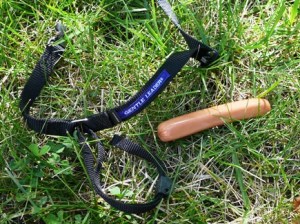
Elijah has all the approved chewing materials. We go to puppy training. At the advice of friends,  I got a training halter device which requires a degree in dog mechanics and six arms to put on your puppy. In spite of liberal use of hotdog bits, it didn’t go at all like the video showed. Obviously the demonstration dog had been drugged.

The device comes in a box resplendent with marketing genius, Immediate gentle control. “My pup was changed in a mere ten minutes.” The nose loop encircles your dog’s muzzle in the same way as a pack leader gently, but firmly grasps a subordinate’s muzzle in his mouth. This is a clear signal that You are his leader!  My dog is still working to pick up that clear signal.

Elijah detests this device with a passion. However, I confound him by offering the tastiest treats I can find, when I put it on and when I remove it. I rubbed hotdog juice all over the part that goes around his nose. When we walk, he turns summersaults over the grass trying to shake it off, or writhes on the ground like a snake. Then he will flop prone in the street with a huge sigh and pout. Despite the period of adjustment for us both, things are improving. Once he gets over his hissy fit, he trots along in fine fashion being the dog of my dreams. 

 Gentle Leader

Do not be like the horse or the mule, which have no understanding but must be controlled by bit and bridle or they will not come to you. (Psalm 32: 8-10 NIV)

The amusing name for this device is Gentle Leader Head Collar. This cracks me up. I got the giggles thinking about it in church this week. I had this picture of God struggling to put such a halter on us, while we flop about in our lives, straining to get loose from the constraints of our own realities. Our genetics, life experiences, choices, and environments wrap around our snouts and bind our movement. Such discipline may gentle us into surrender to the truth of who we are. We may come to accept the conditions placed upon us by our journey and the reality that we are not the leader of the pack, or we may toss ourselves in summersaults, whining, and wriggling against our limits.

“Now be ye not stiffnecked, as your fathers were, but yield yourself unto the Lord, and enter into his sanctuary (2 Chronicles 30:8),” I say to Elijah, who is trying to chew the darn thing off his head. The Hebrew scriptures frequently compare the people of Israel to oxen with stiff necks who will not submit to the yoke, or a horse who will not follow without bit and bridle. The notion of discipline and surrender to the Leader of the Pack appears also in Paul’s writings. In fact it is often the prophets, including Elijah’s namesake, who serve as God’s harnesses to restrain an unruly rebellious nation.Elijah 3 months 2

If Elijah could see the positive benefits of his Gentle Leader, he might not put us through such a struggle. His resistance only increases his discomfort. Being conformed to the harness requires repetition, discipline, love, and a good deal of faith in the Leader on both our parts. The way to Elijah’s abundance is a counter intuitive surrender to what feels at first as terribly confining. Not a bad prescription for the spiritual life.


More about prayer –
www.fromholyground.org

Contact Loretta –
lross@fromholyground.org, www.fbook.me/sanctuary

Follow on Twitter

I Want It and I Want It Now!

Speeding trafficFeeling overwhelmed by the speed of life? M. Rex Miller, (The Millennium Matrix – Reclaiming the Past, Reframing the Future of the Church) identifies seven qualities to describe the dynamics of our present world. He lists the qualities, which are inherent in digital age media, as interconnection, complexity, acceleration, intangibility, convergence, immediacy, and unpredictability. These seven qualities, largely absent from the Biblical world, are directly affecting the life of our churches and the life of our souls.

I want it. I want it now. And by gum, I’m gonna get it!
Let’s look at one of Miller’s qualities, immediacy.  “The time it takes us to absorb and adjust to digitally paced activities grows ever shorter. As the interval between question and answer, request and fulfillment, grows narrower, we are asked to respond to the world with an immediacy similar to that required by fighter pilots in combat… where high speeds require the F16 fighter to master a different set of rules for decision making.” Miller quotes Colonel John Boyd as he asks the question, “How do we function in an environment where reality leaves us little or no time for reflection but ‘changes ceaselessly, unfolding in an irregular, disorderly, unpredictable manner,’ despite our vain attempts to ensure the contrary?”

The disembodied voice at the drive-through chirps, “Which of our twenty four different topping combinations for your pizza would you like today? If you order in the next five seconds you may get your choice of a quart sized cooler, air freshener, or five dollars off your drink order. What would you like for dessert today? We have eight new shake flavors and are offering a special on our smoothies. If you buy two you get one free. Would you like to try our hot apple pie? Oh, sorry we know longer carry hamburgers.”

The quality of immediacy precludes a contemplative, thoughtful approach to our experience and our desires. The lapse between awareness of a desire and its fulfillment is potentially much briefer. Does twenty four hour access to the global market begin to render delayed gratification and patience obsolete? If I want or need something- a conversation, some information, a consumer good or service, a  relationship, something to eat – I want it fast. I want it now. And very often I can get it.

Digital immediacy leaves little or no breathing space between desire and fulfillment, event and response. We do not have time to absorb, savor and reflect upon our experience. To consider broader implications and what God might be saying to us will only hold up the line and irritate the person waiting behind us. We  find ourselves continually reacting to, being manipulated by, or attempting to protect and shelter ourselves from the immediacy of our environment.

Are we to mindlessly adjust to this reality, as a lobster in a slowly warming pot of water, and hence be transformed by it into somebody’s supper? Do we need to learn like the fighter pilot how to respond with greater precision and accuracy to ceaseless rapid change? Or do we have something to bring to the immediate digital age from the tradition of reflection, thoughtful consideration, and listening? Might people of faith draw on a different resource than a fighter pilot’s highly tuned nervous system and hyper responsive physical abilities?

An Antidote for Immediacy
An ancient spiritual practice can restore your balance and perspective. Wisdom from a deeper, truer source than the twenty four news cycle can shape our lives. The examen was developed and taught by St. Ignatius, the founder of the Jesuit order. In recent years the examen has found popularity among people of many faiths. In its simplest form it consists of a daily examination of your experience, asking the Holy Spirit to reveal God’s presence and activity in your day.  The examen is based on the assumption that God speaks to us through our deepest feelings and yearnings, or consolations and desolations. Consolations are things that satisfy and unite us with others, God, and creation in love, hope, and peace. Desolations are negative feelings – anxiety, fear, despair, anger, which tend to isolate us from ourselves, others, and God.

Here are some questions for your examen as presented in my favorite book on the subject, Sleeping with Bread – Holding What Gives You Life, by Dennis Linn, Sheila Fabricant Linn, Michael Linn.

For what moment today am I most grateful?CB022113
For what moment today am I least grateful?

There are many other ways to ask the same questions:
When did I give and receive the most love today?
When did I give and receive the least love today?

When did I feel most alive today?
When did I most feel life draining out of me?

When was I happiest today?
When was I saddest?

What was today’s high point?
What was today’s low point?

This exercise pulls us out of the sucking vortex of immediacy to notice and name our internal reality. What is giving me life and joy? What is diminishing my peace and serenity?  Instead of knee jerk reactions to the demands of immediacy, we stop to consider what is moving us closer to  the way of God, and what seems to be drawing us away from the qualities of holiness. We begin to see a thread, a direction for our lives, and a sense of God’s activity and call to us.

The Immediacy of God
The digital age did not invent immediacy. That rapid connection between thought and fulfillment, need and satisfaction is a quality of the divine. Scripture describes God as accessible, present, alive, and more immediate than the air we breathe. Wisdom 7:24 captures this immediacy of God with the words: Wisdom is quicker to move than any motion; she is so pure, she pervades and permeates all things.
Mulberry Tree
The examen, practiced over time, connects us with a Divine Immediacy more compelling, and satisfying than the life sucking immediacy of our digital age. It gives us direction for our life choices and gentles us into conforming with the will of God. In Divine Immediacy we discover the spacious and timeless grace of the present moment, in which we receive all we need. Right here. Right now.  


The Ignatian Daily Examen

More about prayer –
www.fromholyground.org

Contact Loretta –
lross@fromholyground.org, www.fbook.me/sanctuary

Follow on Twitter

A Calm and Quiet Soul

It is a simple psalm – the shortest in the Hebrew Scriptures, only three verses, easy to miss. It is a little announcement, a tweet, a facebook status post:

 O Lord, my heart is not lifted up,C, Co 1987 002
   my eyes are not raised too high;
I do not occupy myself with things
   too great and too marvelous for me.                             
But I have calmed and quieted my soul,
   like a weaned child with its mother;
   my soul is like the weaned child that is with me.
O Israel, hope in the Lord
   from this time on and for evermore. Psalm 131

The psalmist does not offer his knowledge, answers, opinions, strategies, outrage, or some new technological advance. He does not blast his enemies and ask for God’s vengeance. He does not recite a litany of his sorrows, nor does he plead for mercy. He does not even offer God praise or thanksgiving. He simply posts a calm and quiet soul and out of his serenity emerges a message to his friends, Israel: hope in God.

Here is no flashy super hero, no glamorous celebrity, no clever talking head striding up to the microphone to silence opponents with verbal repartee and inflammatory speech. Instead we find a balm for all wounds and a cool hand to smooth out the furrows in the forehead of a distracted, feverish world.

Peace is polite and unassuming. It does not force its way on others or announce itself with strobe lights and blaring headlines. With the irony, sarcasm, and impatience so endemic in our world, we may think, “Big deal. So the guy’s calmed himself down. Whatever.”

It is easy to miss the importance of this. I think some of you know how much work it takes to create and maintain inner peace. You have an idea of the courage and selflessness a calm and quiet heart requires. Such peace is won by the bloody confrontation with inner truth and the battle with all in oneself that resists or thwarts reconciliation.

D, Co 1987A calm heart is the heart of a weaned child, no longing gasping and grasping for nourishment from its mother. The psalmist has mastered his appetites and addictions. He has grown up and can return to the source of life free of the demanding temptations of ambition, restlessness, and narcissism.

The psalmist does a startling thing here. Notice that he is not blaming, or damning, or threatening to sue whatever has upset him or caused him to despair. We do not know what has set him about calming his heart. What we do know is that he has assumed responsibility for his inner peace and his outward response to the world. He does not hold others accountable for his difficulty. He is reconciled with his own experience. His soul is at rest and his desire for his friends is the hope he has found in God.

A calm and quiet soul is a great lake of strength and serenity, a pool of stillness reflecting reality where many come to drink. Yet the cacophony of the postmodern world has little appreciation for such souls. These are hidden folk with no desire for their five minutes of fame. They remain rooted and grounded in the soil of love, flexible, bending with the winds of change, and standing tall in tough times. I have known a few. I want to be someone like that more than anything. Don’t you?

For the past couple of weeks I’ve had the “eye twitch.” You know, that annoying  hysterical jerk of the eyelid? I’ve been so tired. I have not been respecting my limits. My sites have been set too high. I have been occupying myself with things too great for me.

It is a simple psalm. It is really a lullaby. Sing it to yourself this week.

 DC, Co 1987 1

If you alone find inner peace, thousands around you will be saved.
– St. Seraphim of Sarov

New issue of Holy Ground, a quarterly reflection on contemplative life, published by The Sanctuary Foundation for Prayer is out! This issue is about what happens when discernment appears to go wrong, resistance to love, and a puppy named Elijah. To request a free copy:  email info@fromholyground.org. Include your name and mailing address. We will send your copy right away.

Contact Loretta:
lross@fromholyground.org, www.fbook.me/sanctuary
Follow:  http://twitter.com/lfross

The Miracle of Gratitude

woman praying 002Feeling discouraged? Despair breathing down your neck? Are you trapped in a painful situation with no way out?

Count your blessings. I know. It sounds lame. You need a whole life makeover. You need to win the lottery, find a new job, or discover the cure for cancer. Humor me. Do it anyway. Hold up your ten fingers, or however many you have. Count out loud one blessing for each finger.

Now that you are warmed up, take out a piece of paper and get to work filling it up with things you are grateful for. Just put down whatever pops in your head. Keep at it. Include the most specific details – water actually flowed from my faucet at the flick of my wrist when I was thirsty this morning; I can see the mourning dove pecking corn outside my window; my cup of coffee tastes delicious – dark, aromatic, and hot.

A sure way to find hope in a dark time is to count one’s blessings. This simple spiritual practice focuses our attention not on what has happened or what might happen, but on what we can discover to be thankful for in this moment. Gratitude awakens mindfulness, which calms and focuses us on simple pleasures and the miracle of life itself.

Gratitude unlocks the fullness of life. It turns what we have into enough, and more. It turns denial into acceptance, chaos into order, confusion into clarity…. It turns problems into gifts, failures into success, the unexpected into perfect timing, and mistakes into important events. Gratitude makes sense of our past, brings peace for today and creates a vision for tomorrow.  Melodie Beattie

I can recall some pretty anguished nights in my life. I flailed about rehearsing imagined scenarios, practicing speeches to give to various people, and writing scary science fiction. To what end? Nothing productive. I only became more and more entangled in my own hysterical drama. Some of us come to a point where we are being eaten up by worry and fear. This can be the key to a wonderful discovery. Right about when we say, I can’t live like this anymore, we discover we do not have to. Peace is a choice. We have the freedom through an act of our wills to choose peace of mind.

So much about the spiritual life and happiness in general depends upon where we put our focus. We get to choose what thoughts we entertain and which ones we sweep out the door. At the same time there is tremendous competition among multiple influences to occupy the center stage of our minds. Consider for a moment who or what influences are in charge of your mind? The mantras of our consumer culture? Some nasty critical, negative inner voice? A whiny, fearful, abandoned child? A tangled root of bitterness?

The psalmist puts it succinctly, “Do not fret – it only leads to evil.” Psalm 37: 8. Spiritual teachers of many traditions teach the practice of gratitude. Jesuit priest Jeanne Pierre de Caussade, who died in 1751, advises: The great principle of the interior life lies in peace of the heart: it must be preserved with such care that the moment it is in danger everything else should be abandoned for its re-establishment, just as when a house is on fire, one leaves everything to extinguish it.. . .  And the reason of this is that great peace and tranquility of spirit alone give the soul great strength to achieve all that God wills while trouble and disquiet turn the soul into a languishing invalid. 

De Caussade’s image of the languishing invalid cracks me up. That is exactly what I become as I succumb to fear and anxiety:  infected with negativity, unable to make clear decisions, confined to a bed of worry.

If the only prayer you ever pray is thank you, that would suffice, wrote Meister Eckhart. It seemed to work for Jesus. Remember that embarrassing moment when there were only two fish and five loaves and a huge hungry crowd to feed? The disciples quickly turned into languishing invalids. Jesus takes what he has, lifts his eyes to heaven, and gives thanks. After everyone had enough, they filled twelve baskets with leftovers.

That was Jesus’ miracle. Why don’t you go work a few of your own today?

 Praying hands


Learn more about prayer at
www.fromholyground.org

Contact Loretta at
lross@fromholyground.org, www.fbook.me/sanctuary

 Follow at http://twitter.com/lfross