Category Archives: Prayer

Clueless

For I resolved to know nothing while I was with you except Jesus Christ and him crucified.  I Corinthians 2:2

He went out, not knowing where he was going,” says the writer of Hebrews.  Abraham,  the father of our faith, didn’t have a clue where he was headed, no map, five year plan, or GPS device. Just faith.

Most of us want a little more than simple obedience to the word of the Lord burning in our hearts. We want a backup plan, some insurance policy to guarantee that our wandering about in the dark and hard work will be justified. We do not want to look back in shame or sorrow at the choices we made.

Most of all, when someone asks what our plans are for this year, we want that calm sense of security that comes with being able to answer clearly: My goal for this year is to plant a garden, go to Greece, or graduate from the Neuroscience Institute. You need something with a nice ring, which wins a nod of approval, or even better envy. So we consult a bevy of advisors. How long do I have, Doc? Madame Sylvia looks in her crystal ball. We check our horoscope and give our broker a call.

In our sleepless nights we pray, “God… please… let me know things will be all right.”

Instead of a five year plan in the mail, we get the present moment.

This frayed and tattered now.

My old buddy, Oswald Chambers, writes in his January 2 entry in  “My Utmost for His Highest”:

One of the most difficult questions to answer in Christian work is, “What do you expect to do?” You do not know what you are going to do. The only thing you know is that God knows what he is doing….. Have you been asking God what He is going to do? He will never tell you. God does not tell you what he is going to do – He reveals to you who He is. … You must learn to “go out” through your own convictions, creeds, or experiences until you come to the point in your faith where there is nothing between yourself and God.

Wanting to know the future, and to possess absolute clarity about where one is going is the last stronghold of the ego and a defense against intimacy with God, where the way is revealed only as I have surrendered my desire to know anything, except, as St. Paul puts it, “Christ and him crucified.”
We are nearest to God when we have gone out from our egos – our own knowing, our worries, and desires – and are vulnerably present to Holiness. As we become present to the Presence, we discover a relationship so wholesome, nourishing, and tender in its embrace that our notion of direction and purpose is transformed. My life’s direction is not something I grasp by knowing, but rather is given to me as I allow myself to be known in the mutual exchange of love that is  our relationship with Christ.
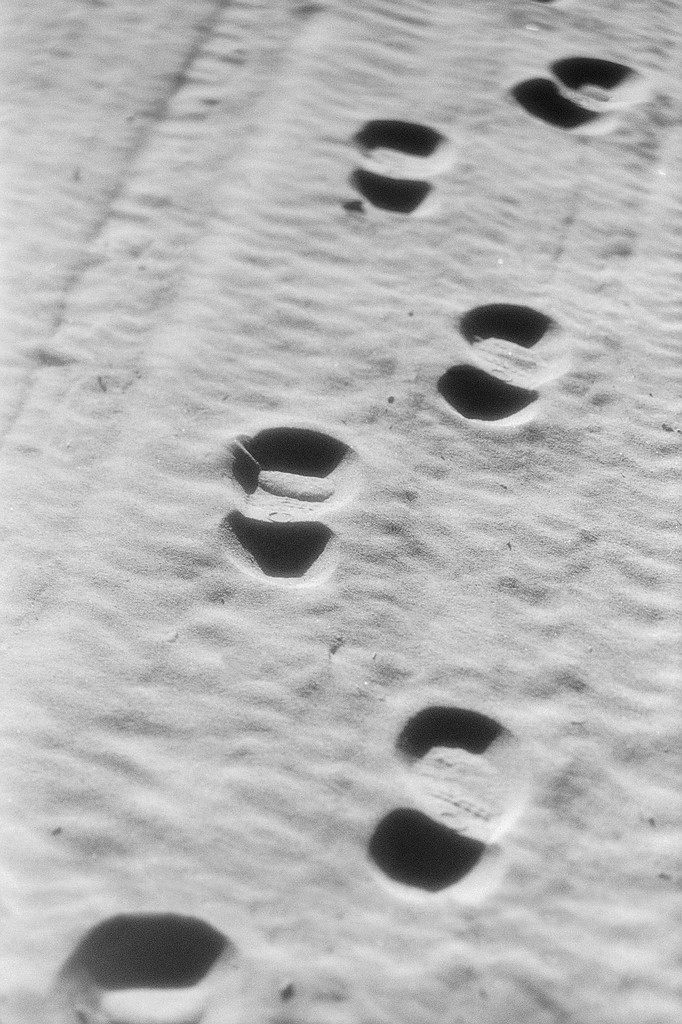
This seeking, palpable, grace filled Presence of Christ is what allows us to go out into the unknown, empty handed and clueless. Jesus told his followers: “Take nothing for the journey – no staff, no bag, no bread, no money, no extra tunic.”  Luke 9: 3

We learn to trust more in the ever present power of the One who sends us, than in our own preparations. And oh how much easier life becomes then!

How does one do this? Be aware. Allow space in your consciousness for God. Shovel away your lists and agendas, goals and objectives. Make a clear path through the snow drifts of your ego to the great I Am.

This is how I tried to do that today. All morning I prayed in the sunshine pouring through my window. I began with a list. A stream of words and worries that gradually slowed to a trickle.  Still in my pajamas and robe at 11:00, I am happy as a clam. Wrapped in love, I do not want to stop.

Often when I pray with others it is like this. Saying amen is a strain; lifting my head and opening my eyes, an effort. The magnetic pull of God captures me. To pull away is a sorrow, a sudden brutal severing from the heart’s true home. But the hour is up, the person who has come for prayer needs to go and is wondering if I am half crazy. So I return to “normal,” which seems ever more strange and artificial to me.

I know. I am weird. I also know many of you share this sense of God drawing you into Love.

I prayed for you this morning, for nothing in particular beyond peace, love, and joy. It is true I may not know you, yet I feel an oceanic rush of love and desire for your well being that hollows me out and leaves me breathless. I think it must be God’s love for you passing through my awareness. I hope it sweeps you off your feet today and tosses you hither and yon without a clue as to where you are going.

And on this cold day may you, beloved object of God’s devotion,

feel His warm breath upon your cheek.

Tell me about your prayer, the love song God is singing to you today.

Read more about prayer at www.fromholyground.org

Contact Loretta at lross@fromholyground.org, www.fbook.me/sanctuary

Follow at http://twitter.com/lfross

Become a Fan of the The Sanctuary Foundation for Prayer

Choosing Joy

Gabriel:
Since Adam, being free to choose,
Chose to imagine he was free
To choose his own necessity,
Lost in his freedom, Man pursues
The shadow of his images:
Today the Unknown seeks the known;
What I am willed to ask, your own
Will has to answer; child, it lies
Within your power of choosing to
Conceive the Child who chooses you.

      W.H. Auden, For the Time Being – A Christmas Oratorio 


Here it is: a choice – a nod, a hushed “yes,” a hearty “you betcha!” a desperate “Ok what else is there?” Our assent to what seems impossible sets in motion a radically different way of perceiving reality and living our lives.

Many say, “No, absolutely not, no way!” Others – “Well maybe, later, we’ll see.” Or, “I tried it. Nothing there for me.” One cannot fault them too much. We have all demurred, delayed, hemmed, hawed, and held out for what our senses and minds can deliver. One ought to hesitate, for a sword will pierce through your heart too. For this yes is not to a social security card, a 401k, or health insurance. This assent will require the suffering and sorrow that deep down, mature Love asks of us.

The angel, Gabriel, in W.H. Auden’s poem, holds out the choice and the promise that await Mary and us on the brink of a new year. This notion of choice has been a recurring theme in my prayer and study over the past year.

Moment by moment we get to choose. Perhaps it is obvious to you, but it just slays me.

An angel stands perpetually at the doorway of our hearts posing the question. “Will you conceive, apprehend, take hold of Christ?” What God has willed the angel to ask, our own will has to answer. A dozen times a day we may turn away and polish up our “no.” We embellish it with our needs, our way, our life, our opinions, our truth.

No matter what issue, conflict, trauma, joy, or disaster is unfolding before me I get to choose how I will respond and what sort of “meaning” I will give it. Will I conceive the promise of new life, possibility, and the presence and power of God in the mix of my life experience? Or will I play out some dead-end soap opera with those same sullen resentments and fears?

If I say yes, I assent to live in mystery, to let go of control and surrender to a power and wisdom greater than mine. I choose not to be an American idol, but rather a bit player in a story far more sweeping and magnificent than my own drama.

Come on now. Don’t quibble. Don’t make that angel stand out in the cold, you standing there clutching your worry and anxiety. Take a chance on Love. Go ahead in 2010 and choose the Child who is choosing you.

Get pregnant with Joy!


Read more about prayer at
www.fromholyground.org

Contact Loretta at
lross@fromholyground.org, www.fbook.me/sanctuary

 Follow at http://twitter.com/lfross

 Become a fan of the The Sanctuary Foundation for Prayer

Small Things, Great Love

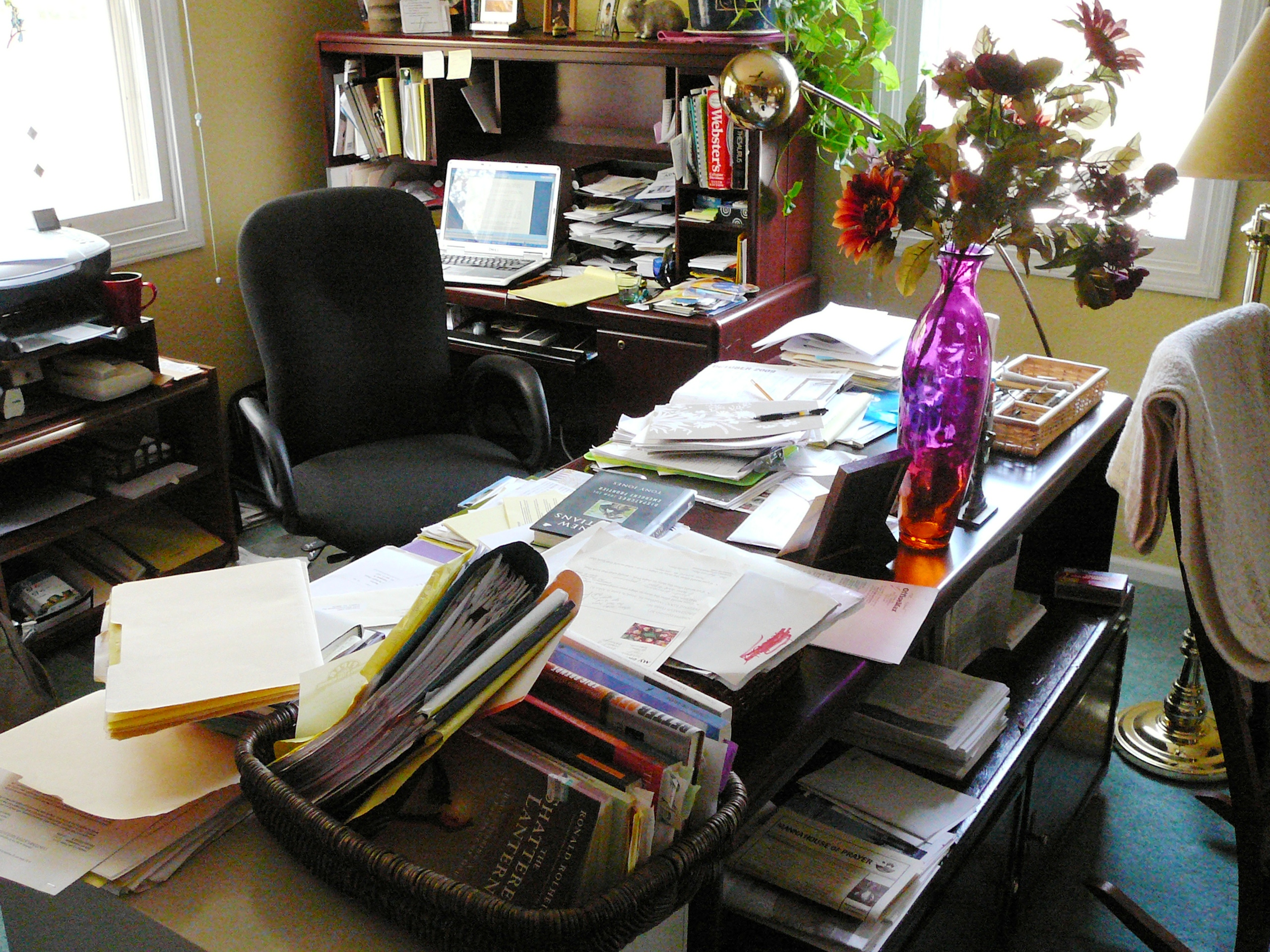
messy officeMy desk is a rat’s nest of notes, files, cards, books, pens and unfinished projects. A pile of bank statements and bills waits on the credenza. I am writing a blog, an essay, and a book, as well as meeting with clients, preparing for classes at church, responding to pastoral care needs, and planning for youth group. I have several presentations coming up and other projects on hold. My pantry ought to be roped off as a hazardous area. Then there are the meetings to attend, my 96 year old mom, my daughters, friends, pets, and oh, yes, God.

If this does not sound like the life of a hermit pray-er as I describe myself on the About Page of this blog, bear with me. I am still praying. I suspect things might be a little more organized and tidy if I were not, but overall things would be a bigger mess.

This week I received two quotes from friends in my email. One was from Mother Teresa: “We can do no great things, only small things with great love.” The other was from Charles Spurgeon: “Learn to say no. It will be of more use to you than to be able to read Latin.” Here’s where I went wrong. I took four years of Latin in high school.

Charles H. Spurgeon was a 19th century English Baptist who preached to crowds of ten thousand in London. As many of us, he had his hand in a lot of other things as well. I figure you know who Mother Teresa was. Both of these busy servants of God came into my life this week to offer their two cents on how to handle something which afflicts not only pastors, but just about everyone else I know.  Overwhelmed with tasks, stressed, and anxious many of us need to learn how to say no. Moreover, we need to learn to say no not only to other people, but also to ourselves. For I have found most of us are usually the most demanding, unreasonable, and, frequently, atheistic boss we have.

Recently someone described how she is simplifying her life. She asked herself why she was doing what she did, and was she really called to this. When I find myself on the treadmill of over doing, I notice an odd thing that happens to me. The more I am trying to do, the more I think I need to do, until I totally lose perspective and am worrying about accomplishing things, which in more sane moments I realize I do not need to do. This loss of perspective and over functioning which feeds on itself is a characteristic of addiction.

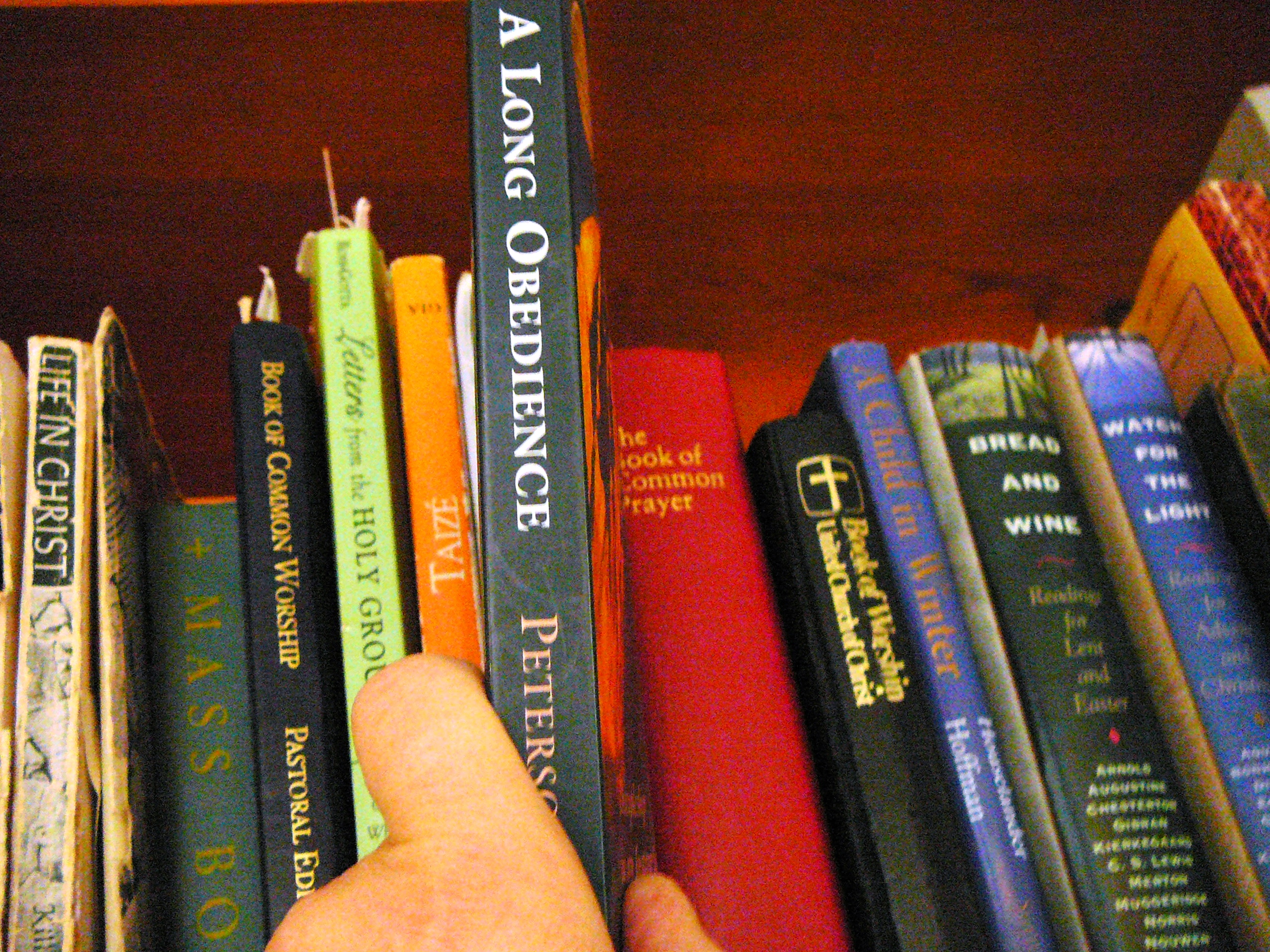
Mother Teresa says, “Don’t sweat the great stuff – getting big projects, big plans accomplished. Instead do small thingsBook on shelf with great love.” I like that. I can do that. Stay in the present. Put the file away carefully with reverence. Respond to this email thoughtfully with love. Gratefully gather up all the scattered pens and pencils. Put the books back on the shelf with thanksgiving. See the wonder of God’s provision in the goodness of this moment, as I think of you, yes, you, with love and gratitude. Just tend to the next small thing with all the love and generosity you can bring. Leave the outcomes, the great ends to God.

“The smallest thing, touched by love, is immediately transformed and becomes sublime,” wrote Thomas Merton. I still need to learn to say no, but I also want to learn how to work in such a way that what I touch becomes holy. I think it is all in the focus. Is God the center of my concern, or my Latin assignment? It makes all the difference.

Assignment: Practice doing small things with great love this week. Let me know how it goes.

More about prayer –
www.fromholyground.org

Contact Loretta –
lross@fromholyground.org, www.fbook.me/sanctuary

Follow on Twitter

Kids with Knives

Jesus pumpkin 3

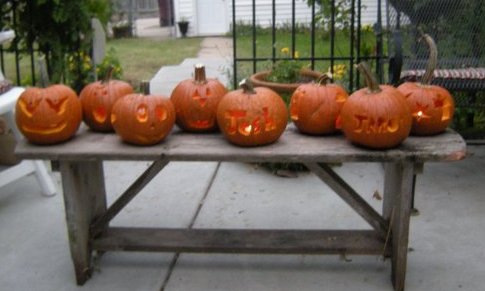
Nine kids: nine pumpkins. Grandpa and Grandma, with a pot of taco meat and fixings. After the dumb game where I make them interview each other and then introduce each other to the group, we get to work.

Knives: Five boys around a table covered with newspaper. Two girls in the kitchen. Two more on the patio. Seeds. Lots of seeds and stringy pumpkin innards. Laughter.  scooping

“I am making a bat.”
“I’m gonna have two faces on mine.”  
“Hey, where’s the knife?”

Then – that studied silence of creativity and focused concentration. Grandpa helping with the finer points of carving. Grandma taking photos, hunting up a toothpick to save a broken piece, helping set up the food.

Through it all – a barking puppy named Elijah, confined to his kennel in the kitchen, itching for a wild rumpus. We let him out and some of the kids take him for a walk.

Supper: tacos, chips, salsa, apple slices in caramel dip. Mrs. Miller’s yummy bundt cake with black and orange sprinkles. No leftovers.

Lesson:  We take off our shoes and gather in the prayer room. The sophisticated high school juniors sit down with the middle schoolers. One or two stretch out on the floor. Others wrap up in a prayer shawl. We turn out the lights. We settle down. Elijah does not. He is back in the kennel and very much wants to be in on this lesson. The little prophet, still early in his ministry, has not yet heard “the still small voice.” aleah

What does Jesus mean when he tells us to deny ourselves and to die? We watch a Nooma video about how death is the engine for life. We think about how parts of ourselves can get in the way of our ability to love or to be compassionate. Like the part of ourselves that always has to be right, to look good, or to impress others. The video is pretty sophisticated for this age group. I wonder if it is making any sense. The kids are quiet and listening intently.  

Elijah keeps barking. I bring him in and try to calm him. He only gets worse. I take him back. Grandma, who is not all that keen on dogs, goes out to the kitchen, kneels down before his kennel, and entertains Elijah with a paper towel.

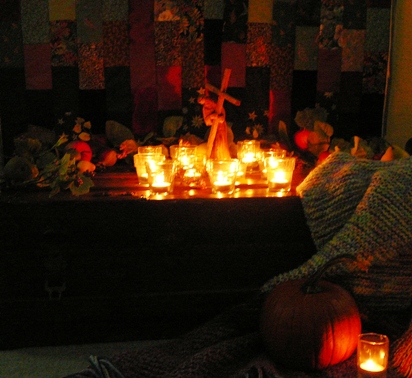
I ask the kids what desire in them might need to die, what desire is getting in the way of God’s work for them and through them. One by one we bring an unlit candle forward to where there is a small statue of Jesus carrying a cross. We light the candle and place it near Jesus as a symbol of what we want to let go of. While we are praying, we listen to Dona Nobis Pacem sung by Beth Nielsen Chapman. Some of us sing along. We are silent for a little longer, gazing at all the candles around Jesus. We say amen. One sixth grader, wrapped in a shawl stretched out close to the candles, announces loudly, “I just love that chant!”

We go outside, light our pumpkins, and carry them home into the dark.Bill smith helping

I say I am too old for this. My youth group days are long over. I say I cannot devote the time and energy these kids deserve. I say we should be having lock-ins, going on mission trips, meeting more frequently. What I do seems so small. I teach them how to be still, silent, and prayerful. And I love them, wholly, and with a kind of wild desire for their highest good in God now and always.

I go to bed deeply grateful for grace in the midst of chaos. I think about the kids in Chicago where knives are wielded for a completely different purpose. At church this Sunday we had celebrated Children’s Sabbath. Some of these youth shared information with the congregation about the horrible neglect and suffering of many children in our country. The kids I work with are deeply loved and cared for by large extended families and a whole church pretty much totally gaga about their every move. My heart aches, thinking of kids for whom a knife is only a weapon, for whom school is a crime scene, and a walk down the street an invitation for murder. What needs to die in us for our children to stop dying?

As we were cleaning up Grandpa told me, “It is a miracle no one got cut!” Hmm, I think, no. Grandpa and Grandma, the miracle is that you are here. 

Jesus pumpkin 4

Special thanks to Bill and Sharon Smith, Eleanor Miller, Jean Schultz, Dave Strobel, “the pumpkin man,” everyone at Crestview UMC, and all of you who try to be present to children wherever they are.

More about prayer –
www.fromholyground.org 

Contact Loretta –
lross@fromholyground.org, www.fbook.me/sanctuary

Follow on Twitter

“Getting to Know You, Know All about You…”

42-16474021After their dinner date, Sandy was mildly disturbed. What was it? Something was eating at her. She really liked Greg. Everything seemed to go well – good conversation, a few laughs, great food, even some electricity in the air.

Oh, it came to her: that remark he made about her sister always being late. It stung. Why? Just what did he mean? Maybe she was over reacting…but his remark sounded catty…

Greg sat with his morning coffee and smiled to himself about the date. It went really well. Sandy actually listened to him. She was funny and pretty and he felt relaxed. He wondered if he should call and tell her how much he enjoyed the evening.

Sandy and Greg have unfinished business – the business of relationship building, the business of deepening intimacy and trust. A business which is the foundation of love.

We naturally review and reflect on conversations and our encounters with others. We sort out the positive and negatives. We go over what we wish we had said differently or left out. We discover questions we want to ask, more information we need.

We may even make a follow up call. “Hey Greg. It’s Sandy. I just want to tell you what a good time I had last night and thank you.” She took a breath, “Greg, I need to let you know something too. I am real loyal about my family and sensitive when people put down my sister. She’s gone through a lot dealing with her disabilities. I felt hurt when you made the joke about her always being late.”

OK. The ball is in Greg’s court now. His response will reveal more about himself, his needs, and experience. Greg and Sandy may build and deepen their relationship with greater trust and honesty in this process, or determine not to do that.

CB035813Let’s apply this idea to our practice of prayer. Sometimes we treat God as a combination landfill and filling station, rather than as a growing relationship of intimacy and trust.  Prayer becomes a place to dump our trash and get refilled with peace of mind. We drive up, open the trunk and haul out our anxieties, worries, sin, pain, sorrow, and confusion and toss them in the containers. We slurp up some high octane Living Water and drive off. “Well, that’s done,” we say. “Now, let’s get on to the important stuff I need to do today.”  In such a scenario of prayer God exists solely to meet my needs.

I suspect that the landfill/gas station approach characterizes quite a bit of our prayer. Yet God is mercifully patient with us about this. God knows that most us we will not come to God unless our trash is overflowing, filling our homes, spilling out the doors and down the street and we feel totally overwhelmed with the demands of our lives. We will wait until our tank is on empty, or we have run out of gas and are stranded on some lonely road late at night.

However, at some point we may notice a shift in us during our visits to the landfill. We may find a desire toj0314126 stay a little longer and linger at the filling station. We may feel a curiosity about the Landfill Owner and his generosity in taking in everyone’s trash and rotting garbage. Appreciation and questions may emerge. A conversation may begin with the Filling Station Fellow, an ebb and flow of mutual disclosure in coming to know each another. We may begin to notice changes in ourselves – an eagerness to get back to the Landfill, a greater sense of peace, a growing intimacy, and – Dare you say it? What will your friends think? – love for the Filling Station Guy.                                                                                                                                                                                              

Intimacy and love with one another and with God are built on a foundation of trust and honesty over time. As we are open with our individual truth, we are drawn into the larger more spacious truth of God. As we return to share more of ourselves, we learn more of God. We get to know and like and hope the other likes us too. The Filling Station Guy is, of course, already won over and hopelessly in love with you. I suspect Greg may be too.

 sanctuary-tree-tiny1

The Landfill will be open this Friday for Midday Prayer, 12:15 – 1:00 at The Sanctuary office at 1600 SW Campbell. Stop by, if you can, for a splash of  Living Water and get to know the Filling Station Guy. I think you will find he is a keeper.

More about prayer –
www.fromholyground.org

Contact lross@fromholyground.org, www.fbook.me/sanctuary

Follow on Twitter

A Calm and Quiet Soul

It is a simple psalm – the shortest in the Hebrew Scriptures, only three verses, easy to miss. It is a little announcement, a tweet, a facebook status post:

 O Lord, my heart is not lifted up,C, Co 1987 002
   my eyes are not raised too high;
I do not occupy myself with things
   too great and too marvelous for me.                             
But I have calmed and quieted my soul,
   like a weaned child with its mother;
   my soul is like the weaned child that is with me.
O Israel, hope in the Lord
   from this time on and for evermore. Psalm 131

The psalmist does not offer his knowledge, answers, opinions, strategies, outrage, or some new technological advance. He does not blast his enemies and ask for God’s vengeance. He does not recite a litany of his sorrows, nor does he plead for mercy. He does not even offer God praise or thanksgiving. He simply posts a calm and quiet soul and out of his serenity emerges a message to his friends, Israel: hope in God.

Here is no flashy super hero, no glamorous celebrity, no clever talking head striding up to the microphone to silence opponents with verbal repartee and inflammatory speech. Instead we find a balm for all wounds and a cool hand to smooth out the furrows in the forehead of a distracted, feverish world.

Peace is polite and unassuming. It does not force its way on others or announce itself with strobe lights and blaring headlines. With the irony, sarcasm, and impatience so endemic in our world, we may think, “Big deal. So the guy’s calmed himself down. Whatever.”

It is easy to miss the importance of this. I think some of you know how much work it takes to create and maintain inner peace. You have an idea of the courage and selflessness a calm and quiet heart requires. Such peace is won by the bloody confrontation with inner truth and the battle with all in oneself that resists or thwarts reconciliation.

D, Co 1987A calm heart is the heart of a weaned child, no longing gasping and grasping for nourishment from its mother. The psalmist has mastered his appetites and addictions. He has grown up and can return to the source of life free of the demanding temptations of ambition, restlessness, and narcissism.

The psalmist does a startling thing here. Notice that he is not blaming, or damning, or threatening to sue whatever has upset him or caused him to despair. We do not know what has set him about calming his heart. What we do know is that he has assumed responsibility for his inner peace and his outward response to the world. He does not hold others accountable for his difficulty. He is reconciled with his own experience. His soul is at rest and his desire for his friends is the hope he has found in God.

A calm and quiet soul is a great lake of strength and serenity, a pool of stillness reflecting reality where many come to drink. Yet the cacophony of the postmodern world has little appreciation for such souls. These are hidden folk with no desire for their five minutes of fame. They remain rooted and grounded in the soil of love, flexible, bending with the winds of change, and standing tall in tough times. I have known a few. I want to be someone like that more than anything. Don’t you?

For the past couple of weeks I’ve had the “eye twitch.” You know, that annoying  hysterical jerk of the eyelid? I’ve been so tired. I have not been respecting my limits. My sites have been set too high. I have been occupying myself with things too great for me.

It is a simple psalm. It is really a lullaby. Sing it to yourself this week.

 DC, Co 1987 1

If you alone find inner peace, thousands around you will be saved.
– St. Seraphim of Sarov

New issue of Holy Ground, a quarterly reflection on contemplative life, published by The Sanctuary Foundation for Prayer is out! This issue is about what happens when discernment appears to go wrong, resistance to love, and a puppy named Elijah. To request a free copy:  email info@fromholyground.org. Include your name and mailing address. We will send your copy right away.

Contact Loretta:
lross@fromholyground.org, www.fbook.me/sanctuary
Follow:  http://twitter.com/lfross

What Is A Prayer?

CBR002349I don’t know exactly what a prayer is.
I do know how to pay attention, how to fall down
into the grass, how to kneel down in the grass,
how to be idle and blessed, how to stroll through the fields…
Mary Oliver (A Summer Day)

I have been at it for a lot of years now, and I still do not know exactly what a prayer is. It seems to have always been part of my life like the color of my eyes. As a preschooler I learned to fold my hands and bow my head. I prayed for my family, our dog, and my neighbor, Mrs.Wendel, who made good cookies. I had a set list I covered: Santa Claus, the Snowman, and Betty Crocker, whose picture was on the box which my mom’s iron came in.

CBR001191We always prayed before meals, usually led by my father. Every night he kneeled beside his bed to pray. I came upon him at prayer like that many times. He died in 2000. When I go back to Iowa to visit my mother, I like to sit in a corner by a bookcase, where dad read the Bible every day. His magnifying glass, pens, and letter opener are still there.

My father’s prayer was quiet and hidden, yet woven into the fabric of his life like his breath. I saw the fruit in his kindness and caring acts for others, in the vitality of his mind and interest in the world around him, and in his outrage at injustice. As he grew older, he would often say, “I am just so thankful.”

What exactly is a prayer? I fumble for the words. Traditional words about prayer feel like pebbles in my mouth, tasteless, hard and difficult to swallow. As much as I gnaw at them I find no nourishment.

“What language may we borrow to thank thee, dearest friend, for this thy dying sorrow, thy pity without end?” wrote the anonymous author of the lyrics to the hymn, O Sacred Head Now Wounded. Whatever language we use, it will always be “borrowed.” It will be loaned from some, other, lesser reality in an awkward, ill-fitting attempt to clothe The Reality beyond all language and human thought. Mere words fail to express the experience of our hearts in response to God’s love, gifts, and challenges in our lives.thinking businessman

Now I will foolishly do something I have just told you is impossible: tell you what I think a prayer is. For me prayer is fundamentally an attempt to communicate.  This desire to communicate is initiated in us by God and it is a way in which we participate in the likeness of God.

Take a look at that word, communicate. Its root carries the meaning of coming together, communing, communion. What is implied is that at least two separate parties are desirous of joining in some way, of reaching an understanding, of connecting with a commonly held perspective, need, desire, or purpose.

We could say prayer is the eternal conversation and exchange of love as experienced in the context of our lives in which all parties are affected and changed in some way. For me the life, what engages me, is not the abstract concepts of prayer, but in the lived experience of communication. By the way, this is why I believe God is on Facebook and is an old hand at Twitter.

Prayer rides on the wings of our hearts’ desires, anguish, hunger and joy – that bolt of white fire that connects heaven to earth and unites mortal with divine. I can’t say exactly what a prayer is. But I can sure tell when people have been doing it.

RFA073Who taught you to pray? Who are you teaching? What exactly is a prayer to you?

Learn more about prayer at
www.fromholyground.org, www.explorefaith.org

Contact Loretta at
lross@fromholyground.org, www.fbook.me/sanctuary

Follow at http://twitter.com/lfross

Gone Fishing

gcarpI couldn’t take my eyes off them. Thirteen years before I watched the eight grass carp slip out from the plastic bags from the fish farm and slide into the lake. Since than I had not seen them. I had heard their splashes growing louder over the years, and glimpsed an occasional fin. Some visitors spoke of the Lake Holy Ground Monster. A few saw one feeding close to shore.

 Now I stood on the shore enthralled. With no rain for weeks the lake was as clear as glass. From the shore west of the hermitage I could see through greenish yellow water to the bottom. An old lawn chair sat half submerged in the shallows. A few mossy sticks lay in the soft mud.

Then a movement caught my eye, something slowly waving. First one, then another and another – six huge grass carp swam lazily into my view. Some were over four feet in length. Moving slowly in a wide circle, their bodies shimmered with iridescent diamond scales, silver dappled in the sun.

Lifting the curve of their open pink mouths like soup ladles, they gulped the willow seeds and cottonwood fluff floatingcottonwood fluff 2 on the surface. Skimming off the white fuzz, the giants wove in and out in a dance of mesmerizing beauty. A large open mouth would break the surface and scoop the fluff. Then the mouth, water running from its corners like an overflowing pitcher, would close and sink into the lake. The fish scooped and sank, swimming silently, smooth and easy like the hawks riding the wind currents above us.

Later when I got home I cherished the memory of those fish swimming so self contained, whole in themselves, flowing through the water like cream in coffee before it is stirred. For days after I would close my eyes and see them swimming, a secret vision of grace. Here was beauty free for the seeing. And somehow the best gift was their creatureliness – that they knew nothing of me, or a world beyond the lake, that what I did or did not do mattered not to them.

I practiced floating that summer. I learned how my breath increases my buoyancy in the water and to relax the muscles in my neck and shoulders. I learned that water will hold my weight when I resist the least.

grass carpMarshall McLuhan said, “We do not know who discovered water, but we know it wasn’t the fish.” Could we overcome our ignorance of the very substance in which we live and move and find our being? Could we float in grace and swim in love, dipping our jaws and opening our throats to taste salvation?  I hope so.

A priest observed a peasant man coming daily to the church where he knelt and remained in prayer for some time. One day the priest approached the man and asked, “What do you say to our Lord on your daily visits?”

 “Oh, I don’t say anything,” the man replied. “I look at him and he looks at me.”

Such love does
the sky now pour,
that whenever I stand in a field,
I have to wring out the light
when I get home.   ~St. Francis

A lot about the spiritual life has to do with where you look, what it is you pay attention to and see. The prayer of the peasant man is sometimes called the prayer of the simple gaze or simple regard. In our time of incessant naming, describing, evaluating, where a daily deluge of words pours over us from radio, television, internet, mail and highway billboards, a prayer without words can be sweet refreshment to a word numbed soul. The wordless communion of the gaze is a potent and underrated form of prayer.

Go find something that fills you with wonder and look upon it with love for a while. Go swimming in beauty. It is your natural home, you know. Then wring out the light and pour it over the world.

sanctuary-tree-tiny1 

Poem by St. Francis from Love Poems from God by Daniel Ladinsky

Contact The Praying Life:
lross@fromholyground.org, www.fbook.me/sanctuary
Follow at:
http://twitter.com/lfross

The Conversion of Paul


BECAUSE  OF  THE  BRIGHTNESS  OF  THAT  LIGHT

 I fell to the ground and heard a voice saying to me,
“Saul, Saul, why are you persecuting me?”
. . .  Since I could not see because of the brightness of that light,
those who were with me took my hand and led me to Damascus. Acts 22: 7,11

Point of Light

Struck by a sickening blow to the gut,
slamming against the pitiless rock
I went down to the ground.
My body lay in the dust
My body folded upon itself in the dust.
My heart smeared with the dust.
And I lay still in the dust,
closed upon the dust,
like the wing of some great, dead bird.

I fell down
rolled down
splayed down
split, spread down
across the ground
like butter.

Like a serpent
I went down
crawling over the ground
on my belly.

I went down to the ground
where the salamanders and skinks
scurry over the cold stone walk.

I went down to the ground
where the sow bugs curl and the beetles hide.
I went down to the ground
and swam with turtle
out of the depths
up into the light
stretched my neck long
and turned my face
to the sun.

When I was lifted up from the ground,
day became night.
I staggered
my sin was always before me.

You wonder if it happened,
if I really saw what I say I saw,
heard what I tell I heard.
You wonder if I am mad
or fabricating.

See here,
see
the proof is in my groping blindness
my stunned, numbed, nauseous soul
stumbling in a foreign land.

There are ones who can testify
that I saw well enough before
that I did not wear this unveiled shocked look of the newly blind.
There are ones who can remember the zeal and pulse of desire in me.

My mind,
shattered into brittle splinters,
discrete thoughts
wholly
separate
with
no
known
connection
to
one
an
other
save my existence.

In darkness I paced that long night.

Near dawn some
thing like scales, like slivers,
husks,
a tough membrane-like scum
shucked from my eyes.
And I saw for the first time
the world
like a worn pouch turned inside out.

When sight returned
there remained as a translucent cataract

 Christ.

Betwixt me and creation exists that dear face
and upon it I gaze unceasingly
and therein find All.

“It hurts you to kick against the goads,” he said.

sanctuary-tree-tiny1

Paying Attention and Taking Your Time

leaves in sunA thousand shades of green hold me enthralled.  The south wind teases up the glossy leaves, revealing their pale undersides. I find enough of God in a maple leaf to keep me occupied with wonder for a couple of centuries.
 Today the praying life consists of a continuous loving look at the universe. Prayer is a long wonder-filled gaze upon things as they unfold. The praying life is a front row ticket to the greatest show on earth. Okay. Sometimes I nap, complain, go out for popcorn, or dally in the restroom combing my hair. Sometimes I get self absorbed and miss whole acts, and then have to nudge my neighbor and whisper, “What did he say? When did she die? I didn’t know there was a war!”

In its simplest sense prayer is as an act of paying attention. The word the writers of the Greek scriptures used for prayer is proseuche, which means to turn toward God with a request. In order to get my need met, I shift my attention to God. Our word attention comes from the Latin ad tenderer (from which we also get tendon and tension) which adds the notion of stretching toward something beyond us.

Simone Weil wrote that prayer “is the orientation of all the attention of which the soul is capable toward God.” In prayer I bestow upon God the gift of my eyes, my mind, my awareness, my being at this moment. So Holiness gets our attention by creating in us desire and need? Interesting, huh?

To understand prayer as looking at or paying attention to God, means one must deal with the fact that we are all blind as bats and struggle to see what is really going on. We have cataracts, myopia, far sightedness. We squint through the dim filters of our prejudices, opinions, fears, and fantasies.

Jesus seemed to recognize this and a good deal of his message was about opening the eyes of the blind and teaching his followers to see with the eyes of faith. Such prayerful seeing is not easy. The poet John Moffit offers some instructions:

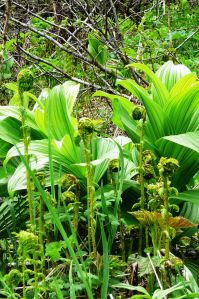
To look at any thing, Forest floor Montana
If you would know that thing,
You must look at it long:
To look at this green and say,
“I have seen spring in these Woods,”
will not do – you must
Be the thing you see:
You must be the dark snakes of
Stems and ferny plumes of leaves,
You must enter in
To the small silences between
The leaves,
You must take your time
And touch the very peace
They issue from.

 Must I become what I want to know, or see, or heal, or change? We protest. Oh please, no. That is too hard. I have my needs, you know. I have my point of view. I have these closely held beliefs.  Let’s make an argument for why this situation or person needs to change. Can’t we use persuasion, branding, marketing, scientific research, polls, and the press of public opinion? Can’t we ask God to just fix these things, these people? Now!

Nope. The poet says you must take your time. You must look at the poor long, the imprisoned long, our enemies long, our failures long. We must be the thing we see, enter into the dark realities of life in a refugee camp, and the chaotic tension and anxiety of our nation. We must be willing to love and  to become the thing we long to liberate –

             as God was willing to do for us.

 In my experience it takes strength and faith to enter into another’s reality and not be overcome by it, or to lose myself in it. We may become bitter, cynical, even abused by such experiences. We may become infected with the disease we are trying to relieve. We end up offering the other only a mirror version of his or her own dilemma. We become part of the problem we are trying to soothe.

Forest floor MontanaSimone Weil continues, “Not only does the love of God have attention for its substance; the love of neighbor, which we know to be the same love, is made of this same substance. Those who are unhappy have no need for anything in this world but people capable of giving them their attention. The capacity to give one’s attention to a sufferer is a very rare and difficult thing; it is almost a miracle; it is a miracle. . . .  The soul empties itself of all its own contents in order to receive into itself the being it is looking at, just as he is, in all his truth. Only he who is capable of attention can do this.”

When our attentiveness invites us “to enter into the small silences” and to “take our time and touch the Peace” from which all life issues, we find ourselves in union with that Peace. Our sacrificial gift of attention to another awakens the life of God in the other. That life may be dormant, deeply hidden, frightened, or wounded. Our prayerful attention extends a hand and bids the slumbering Peace in the other to rise up and walk.

God is paying attention to us in Jesus Christ. How could Jesus enter so deeply into our reality and suffering without being overcome by it? As I watch Jesus move through the Gospels it seems to me that he never loses his attentiveness to the Peace from which he issues, his Father in Heaven, and his identity as the beloved child. Perhaps for us to be agents of transformation in our prayer and relationships, we must possess a deep attentiveness to where we come from, and a sense of ourselves as deeply loved by God. This ongoing communion with our Source -our Father, our Mother in Heaven- gives us the freedom, the strength, and the safety to be channels of divine love and healing without harming ourselves or others. For to me little is more fierce or tender than the unfolding of the ferny plume of a mortal soul.

So I pray as I watch the maple leaves dance in the wind.
I take my time.
I aim for the Peace we issue from.
I meet you there.

 sanctuary-tree-tiny1

Simone Weil, Waiting for God, Harper Colophon, 1951,p 105, 114-115
John Moffitt,  Teaching With Fire, edited by S. M. Intrator and M. Scribner