Category Archives: contemplation

Prairie Lamentation

Driving west on Interstate 70 from Topeka, Kansas around ten in the morning, I plunged into that green swath of oceanic beauty called the Flint Hills. Named by explorer Zebulon Pike in 1806, the majestic sweep of bluestem prairie extends north to Nebraska and south all the way to Oklahoma.

Formed 250 million years ago when Kansas and Oklahoma were covered with shallow seas, the land is compared to the undulating roll of a great body of water. The shallow soil rests on seabed layers of flint, shale, and the fossilized remains of sea animals.

Reveling in the beauty, I was sailing down the road, when I came abruptly upon a sight that brought my heart to my throat and sent a chill down my spine. A huge shimmering whiteness moved off to the north along the road. Bigger than the side of a barn, it lifted and fell back to the ground. It seemed alive somehow, but no animal could be that large.

I slowed, curious and wary. The highway was deserted. Was this a UFO? Maybe I should look for an exit and turn back. I drove a bit further, then coasted onto the shoulder, and stopped about 100 yards away, watching that white thing waving.

It looked like huge wings. One wing spread up the side of a hill, the other lay nearer to the road in the valley. A few iridescent feathers lifted in the wind and reflected the blue sky like mirrors. The wings were rising and falling slightly in a convulsive shudder.

It’s hurt. It needs help. But it’s huge. Would I scare it? Would it attack me? And what is it?

I looked up and down the road. Still no traffic. I opened the car door and slid out. A sudden rush of wind whipped past and slammed the door shut. The air was cool and smelled of grass. The only sound was the soft swish of shuddering feathers. Standing by the side of the road between earth and heaven, I pressed my hands over my mouth and stepped forward. I had taken a few more steps when, suddenly, the thing, the bird hiccupped. It convulsed and heaved in a ragged sob.

I nearly jumped out of my skin, but I saw that it was crying. The beautiful bird had spread herself over the sea of grass to weep. Don’t ask me how, I just seemed to know the bird was a she.

I moved a little closer, wondering if I could be of comfort. May I help you? But before I could finish the thought, a river of grief and anguish engulfed me and I tumbled over and over, gasping for air, drowning in sorrow. A deafening roar of cries and sorrow filled my senses. Then a battering wind and hellish screams pulverized me into tiny pieces, flinging me into darkness. After that, nothing.

When I came back together as myself, I was there in the quiet August morning with the hills, the sky, the empty highway, and the still bird. She seemed calmer now. The shuddering had stopped.

Are you all right? I asked. Are you able to fly? And again, instantly, I was drawn out of myself in a sickening swoop over mountains. We dove into the depths of the sea, peered into the eye of a whale, and crawled with a crab on a shore. I saw the molecules of a heart valve, and plummeted into the shrunken belly of a child in Sudan. We whooshed through glittering palaces of power and stood on the floor of the New York Stock Exchange. She laid those wings over a pile of bodies in Pakistan and sat on the shoulder of a man holding an AK47 rifle. We splashed in a child’s swimming pool with a little girl in a pink and green striped bathing suit. She whispered to an artist bent over a painting, and coursed up the stem of a tomato vine in Fremont, Nebraska.

This time, reeling and breathless, I didn’t want to ask any more questions, or bear the answers. I gazed upon her wings spread over the prairie grass and the reflection of the blue sky, the puffy white clouds, and the tall grass waving. In the play of light and color I caught of glimpse of a woman peering back at me and realized with a start that the woman was myself.

Then she lifted one wing. She drew her head out from under it and turned her eyes on me. A bolt of love and compassion seared through me with the crackle and snap of flames rising from dry wood.

I sank down beside the bird. What do you want of me?

Tell them.
To stop.
Hurting me.

I cringed, shaking my head. I can’t. I am complicit. I have blood on my hands, too.

She waited for me. The wind ruffled her feathers. The puffy clouds moved across the sky. Somewhere a meadowlark called.

Okay. How?

Be brave.
Be brave, she told me.
Be brave.

_____________________________

Don’t grieve God. Don’t break his heart. His Holy Spirit, moving and breathing in you, is the most intimate part of your life, making you fit for himself. Don’t take such a gift for granted. Ephesians 4: 29 (The Message)
 
 
Let no unwholesome word proceed from your mouth, but only such a word as is good for edification according to the need of the moment, so that it will give grace to those who hear. Do not grieve the Holy Spirit of God, by whom you were sealed for the day of redemption. Let all bitterness and wrath and anger and clamor and slander be put away from you, along with all malice. Be kind to one another, tender-hearted, forgiving each other, just as God in Christ also has forgiven you. Ephesians 4: 29-32 (NASV)
Prairie Lamentation was first posted on August 31, 2010.


Exploring Solitude: Becoming Real

Here is what I want you to do:
find a quiet secluded place so you won’t be tempted
to role play before God.

Just be there
as simply and honestly as you can manage.

The focus will shift from you
to God,
and you will begin to sense his grace.
                                                 Matthew 6:6 MSG

Nobody is watching. Go ahead. Be yourself. Relax. You walked off the stage of your life performance and the audience has all gone home. Feel the weight of that armor, the heavy guard you wear night and day about your shoulders and neck? You won’t need it now. Lay it down.

Oh. Wait a minute. It appears that not all of that audience has gone home. A few hitched a ride into the hermitage in your mind. Take that broom in the corner and chase them out. As long as you do not invite them to sit down, and then start feeding them milk and cookies they will leave. Their harping and commenting will begin to sound sillier and sillier to you in the context of your wilderness.
Go ahead. You can’t hurt the furniture here. Put your feet up and settle into that delicious and utterly joyful place of being yourself, your true self.

A wonderfully freeing aspect of solitude is that nobody cares what you look like. Nobody is there to comment upon, critique, approve, or disapprove of your actions, attitudes, words, mannerisms, personality preferences, and quirks. No one has expectations of you or needs they want you to meet. No one is going to call or drop by unannounced.

Go ahead. Remove that hot stuffy mask.

We have a public face we present to the world. In some cases it is brittle, artificial, and controlled. We put on the mask of a happy person, a competent person, a funny person. But a mask is a limited snap shot of the person we really are, which may include being happy, competent, and funny, but who we really are also has depth, texture, responsiveness, and spontaneity, which masks cannot communicate.

When the face we present to the world is the same nuanced face within us, people call us authentic and real. What we show on the outside has integrity with what is in the inside. The phoniness, pretension, and the effort of maintaining a façade are gone.

I loved taking people out to the hermitage. I would show them around the grounds and cabin, give them some orientation, and, leaving them alone for a few days, drive back to town. Then later, they arrived at my doorstep to drop off the trash, the empty water bottles, and return the key. When I opened door, I was amazed at the differences in the guests. The tension and stress were gone, and an ease and lightness filled their movements. And their faces, soft and smooth like a child’s, wore a refreshing, unguarded openness and simple presence to the moment.

After I spent a long period in solitude, a friend reported that I looked like the Velveteen Rabbit. “Worn and soft. Well loved, and real,” she said.
There is nothing like solitude for peeling off the layers of pretense and inviting a soul into deeper authenticity.

In the days of silence and company kept only with crows, meadowlarks, and the possum, who comes looking for food under the moon, one becomes aware of the vast amount of energy and time, which may be spent on building facades and presenting a particular face to the world. The hours of calculation and strategizing to strike the right note in a speech, the stress filled preparation and rehearsals to achieve a certain affect. We have all been encouraged to become marketers and publicists for our careers, our work places, and even our very lives.

Here relationships degenerate into a potential sale, or a possible connection to a step up the ladder. Social media invites us to fashion our lives on a global stage, where our preferences are watched and matched to product ads which pop up before us.

In contrast to the world of hype nothing is for sale in the wilderness. Further, in the wilderness your stuff and your “brand” start to become embarrassing — all that lipstick in your purse, the three jars of face cream, the books you lined up on the book shelf, those clothes you shopped for.

The wilderness around you takes on a depth, beauty, and fascination that cannot compare to that iPad you just had to have or that “outside the box, edgy high concept” project you have been working on. The world beyond your wilderness begins to  seem artificial, crass, and out of sync with a deeper more profound rhythm.

Oh course, it makes sense that the natural world would inspire you to drop off what is unnatural and false in yourself – those postures and attitudes you take; that pride that you use to hide your vulnerability and need.

Besides, you are not going to fool that turkey vulture soaring over the pasture. He may be pecking at your bones one day and won’t give a damn about what kind of car you drove. The lake, teeming with turtles, bullfrogs, fish, and dragonflies is unimpressed with your credentials.

Yet a few creatures may be curious about your presence. There is nothing you have they desire. All they can offer you is their own mysterious being.
The cows, snuffling at the window, wake you at dawn. A large black angus is peering into the cabin. Her face is framed by the window and the chintz curtains.
You go out barefoot in your pajamas to shoo the cows back into their pasture. There are several mamas with their young ones. You stand still gazing at each other. You watch their massive ribs expand as they breathe, their dark eyes, and pink tongues. They watch you, seeing how your feet are getting damp in the dew, considering your breath, your two legs, and your white silk pajamas.

Your being interpenetrates with their being. A conversation and exchange occurs beyond words. Atoms shift, energy moves, recedes, and gathers in the spreading light. Then they turn, their hooves sinking into the damp earth, swishing their tails, and go back through the broken fence.

Nobody in the wilderness cares what you did last week. Or what you didn’t do. One of the calves looks back at you, slowly chewing grass, hanging out both sides of his mouth.

You feel you need to get right down on your knees in your pajamas and repent of something you do not have the words for.

Oh my God, forgive me for not seeing,” you pray.

Solitude Practice

  • Do you find yourself caught up in playing a role or meeting others expectations and needs unnecessarily?
  • What is it you let go of, when you let down your guard?
  • How does being alone in nature help you be yourself?
  • In what way might the wilderness call you to repentance, or seeing in a new way?

Next post in this series: Exploring Solitude:
So What Do You Do Out There All Day Long?

Exploring Solitude: The Wild Things Within

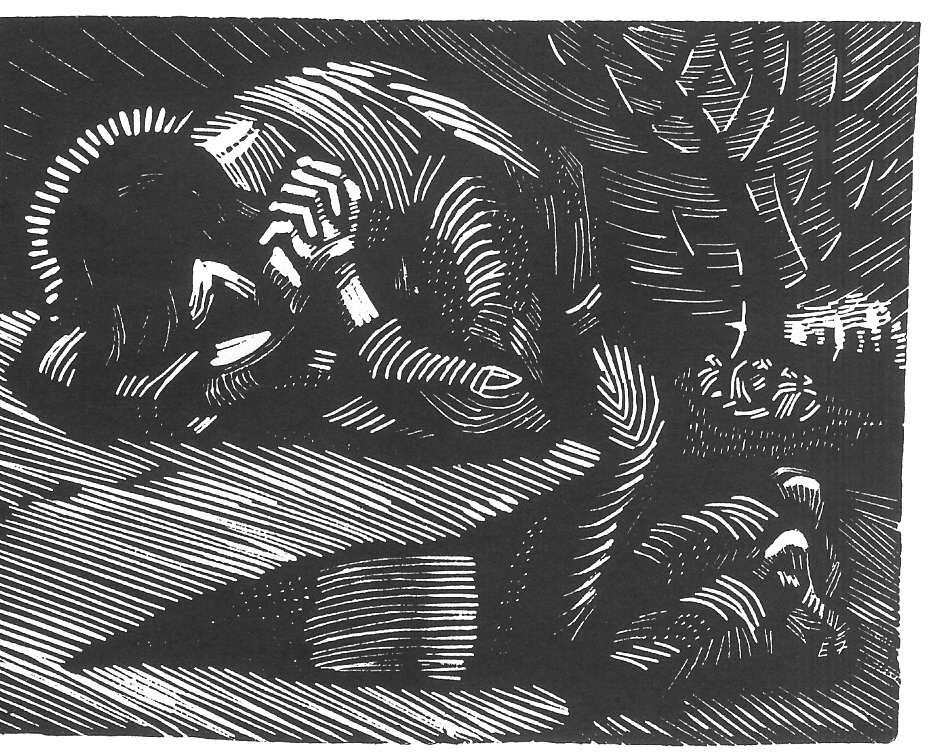
He said to the disciples, “Stay here while I go and pray over there.” When he took Peter and Zebedee’s two sons, he began to feel sad and anxious. Then he said to them, “I’m very sad. It’s as if I’m dying. Stay here and keep alert with me.” Then he went a short distance farther and fell on his face and prayed . .              Matthew 26: 36- 38 (CEV)


The season of lent invites us into wilderness solitude to encounter the wild things and places within us.  In a world of extraversion, solitude allows space for introspection and encounters with untamed and little known parts of ourselves.

On her way out of church one Sunday morning, a member told me a story about her granddaughter, who had come with her that day. My custom is to invite the congregation to a period of silent prayer before I offer the pastoral prayer. At the conclusion of my prayer, five year old Lindy whispered to her grandma, “Loretta took so long before she started praying, that I had to start praying for people I didn’t even like.”

Yes. Silence does that to us, doesn’t it? It brings us to the end of the list of our own needs and concerns and opens out our prayerful awareness of people and inner realities, which we do not even like. Many avoid solitude for this reason. When I stop doing, accomplishing, distracting, and numbing myself with various opiates, I am left with my wounds, enemies, and alienation. The wilderness of the self opens before us and we reach for the phone, turn on the television, or pour ourselves a glass of wine. 

He came back to the disciples and found them sleeping. He said to Peter, “Couldn’t you stay alert one hour with me? Stay alert and pray so that you won’t give in to temptation. The spirit is eager, but the flesh is weak.” Matthew 26: 40-41 (CEV)

The work of solitude includes the slow, patient task of befriending the darkness, of being present with compassion to my inner wildness, and of staying awake one hour with ourselves in our misery, as Jesus asked his disciples to do for him.

The followers of Jesus were unable to offer him such companionship. It is likewise very difficult for us to offer ourselves such gentle, present love. Yet if one can manage it, if only for a few minutes, that ache, that knife in the heart, the sick all encompassing grief  will begin to lessen just a bit, and a peace will slowly seep into the space of your silence.

This is where the deep work of contemplative transformation begins. The pleasant, consoling moments of contemplative prayer are important to our growth and infect us with the love of God. Sometimes they arrive unbidden, unexpected as sheer gifts. Other times we enter deeper communion with God through the ongoing practice of contemplation in some form: centering prayer, lectio divina, prayer of quiet, meditation.

Several years ago a friend confessed to me, “I am so over spiritual “disciplines.” She had reached a point beyond practicing prayer, because she wanted something from God, or because she ought to, or because it was interesting, or helpful to her daily life. Prayer for her was becoming much more demanding than a nice idea or exercise in personal improvement.

Thomas Merton wrote, “True prayer and love are learned in the hour when prayer becomes intolerable and the heart has turned to stone.” The deeper work begins when silence and solitude may be the last thing we want and the only thing we cannot live without. When just sitting still reveals to us a pervasive sadness, or the reality of a loss or truth we are denying or running from, silence is not some syrupy, cozy me-and-Jesus picnic. Silence is a summons to face into who I am and who God is becoming for me in a perilous confrontation with the truths of my life and who God will or will not be for me.

Again he came and found them sleeping.
Their eyes were heavy with sleep.
But he left them and again went
and prayed the same words for the third time.
Matthew 26: 43-44 (CEV)

Yet it is here – when facing fear, betrayal, or deep sorrow– that the encompassing and spreading love of God begins to open within us with its healing balm. Sometimes we need a companion to help us, as Jesus asked for from his friends in his hour of need. We may need to enter the silence in small doses at first. Tiny little sips of God may be all we can manage. Gradually that contact with God will begin to soothe our souls and bring a peace that will exceed our understanding.

It may not seem like much, this tiny bite of calm. You are still in your wilderness, up against a wall, facing an impasse, with little hope. Yet you keep going back for little sips of silence, as quiet fills you and you surrender to the moment.

My Forty Days in the Wilderness
One autumn over twenty years ago I spent forty days in the wilderness. I was sick and doctors were unable to diagnose or treat whatever was causing the unrelenting headaches and fatigue. Weary of the tests and drugs, I went off alone each day and several nights. I did not watch television, use the computer, talk on the phone, read mail or much of anything, except scripture. My only human interaction was with my immediate family.

Day after day and into the night I waited for that little sip of calm, that spark of life and hope. I learned to tend the spark, gather kindling, shavings, combustible scraps of living goodness: birdsong, the quail feeding along the lakeshore, the way a spider walked up the side of my tea cup. These and the stars over my head began to fuel the flame, which grew and illuminated the way for me.

Here is some of what happened as I tell it in my book, Letters from the Holy Ground:

I came to the wilderness in part because I heard Jesus crying and saying he was lonely for us.  I came out of a growing sense of God’s hunger and need for us and for one who would stay with him one hour.  I came to discover how it would be to delight in and enjoy God for God, and not for what God could do for me or the world.

And I found along with my brother, Simon Peter,  that the spirit is willing, but the flesh is weak.  And to pray with Christ is more difficult than praying to Christ.

Are there some among us who are willing to watch with Christ one hour? Are there some willing to turn in radical trust toward God and away from the forces within and without that seek to deny Christ?

Is there one willing to pay the cost of staying one hour, of tasting and knowing God’s suffering in her bones, of being bereft of all mortal assistance, of contending with a near constant onslaught of devils, of serving as a bridge between heaven and earth and thereby, bearing in his body, mind, and psyche on the one hand, the immaculate tenderness and the surging ferocity of Divine Love; and on the other hand, the immense ocean of mortal sorrow?

Like Peter, I couldn’t do it. For along with my good intentions I brought my weariness and poverty and dependence on God’s mercy.  And my eyes grew heavy and I slept.

But God slept too.  Christ rested too.  For Christ brought to the wilderness the same as I:  weariness and poverty and dependence on my mercy.  And so like two homeless children huddled in an alley, like two lovers entwined, we slept while the owl hooted and the bullfrogs boomed and the little grey mouse nibbled bread in the corner.

In the wilderness of solitude our suffering becomes bound up with, informed by, and transformed by the suffering of Jesus in his solitude.

By such fierce mercy and vulnerable love are we redeemed.


Solitude Practice:

  •  Have you had the experience of hurting too much to pray? Or have you avoided praying because you do not want to be still long enough to start feeling your pain?

  • What are some of the ways you distract yourself from entering silence and solitude?

  •  Have you found that place of peace in the midst of your chaos and suffering? How do you describe that experience? What would you tell someone who has never been there and is afraid to be alone in seeking it?

  •  Take some time today to be still and alone. Be with yourself with all the gentleness and love you can muster. Be with yourself as you would want to be with Jesus in his suffering. What do you notice or learn?

Next post in this series:
Exploring Solitude: Deadly Acedia, or Too Bored to Care 

I would love to hear about your experience of silence and facing the wild things within yourself, what you have learned, what helped ease your suffering and what did not. We offer our companionship to others as we tell our stories. You may comment below, on our Facebook Page, or email me at lross@fromholyground.org

Mr. Collins Serves Me a Scone


 –  Love and Gratitude in a Season of Sorrow


I had breakfast this morning with Billy Collins, American poet laureate. We met on the patio at dawn. I chewed my breakfast bar, while I watched him chew his thoughts –   snatches of his days – savored, digested, and transformed in that warm oven of his imagination into tasty little scones.

And, the Lord is my witness, the man reached across the table under the tan umbrella and deftly placed the buttery sweetness into my mouth with his long, elegant fingers.

The trees were full of glad chatter, tweets, and whistles. Down the block a car started up. I slowly relished Mr. Collins’ scone, so rich and luxurious, beside my sensible protein bar. My dog, snoozing at my feet never noticed, when I fell in love with charming Billy. But that brown squirrel on the power line might have seen the cockeyed gratitude oozing out the corners of my mouth and running down my chin.

Here, help yourself to one of Billy’s scones:


As If to Demonstrate an Eclipse

I pick an orange from a wicker basket

and place it on the table

to represent the sun.

Then down at the other end

a blue and white marble

becomes the earth

and nearby I lay the little moon of an aspirin.

 I get a glass from a cabinet,

open a bottle of wine,

then I sit back in a ladder-backed chair,

a benevolent god presiding

over a miniature creation myth,


and I began to sing

a homemade canticle of thanks

for this perfect little arrangement,

for not making the earth to hot or cold

not making it spin too fast or slow


so that the grove of orange trees

and the owl become possible,

not to mention the rolling wave,

the play of clouds, geese in flight,

and the Z of lightening on a dark lake.


Then I fill my glass again

and give thanks for the trout,

the oak, and the yellow feather,


singing the room full of shadows,

as sun and earth and moon

circle one another in their impeccable orbits

and I get more and more cockeyed with gratitude.

              Nine Horses – Billy Collins

I know. Life is hard, even horrific. I wish I could give you answers and take away the pain. All I have is Billy. Take down a glass. Fill it to the brim with homemade gratitude. You know the kind, fermented with what is handy – the cat sleeping in the sun, the hot coffee in the brown cup, the yellow feather –

and sing a little cockeyed canticle of your own.

Windbags, Blatherers, and Chatterboxes for God

Le Silence, painted plaster sculpture by Augus...

Image via Wikipedia

“The most beautiful thing a person could say about God would be to remain silent from the wisdom of an inner wealth. So, be silent and quit flapping your gums about God,” advises Meister Eckhart, the German theologian born in 1260.

My flapping gums are weary, my jaw aching, my tongue hangs out the corner of my mouth. I have spoken, written, and read far too many words about God. I am after that inner wealth, the wisdom of silence.

For the next two weeks I offer you silence, as I head to the lake and the woods and join a few other word-weary types, who will sit and pray and eat together without flapping our gums.


Will you join us? Will you listen for the crickets and feel the cool breeze off the lake? Will you lift your head one  morning and sniff the blooming silence of our prayer?

Will you choose to live from the peace from which you issue? Will you forsake the urgent illusion of your own ego and sink into your being and find your home there?

Of course you will. I’ll meet you in the silence.


Every creature, whether it knows it or not, seeks repose.
                                                                      – Meister Eckhart


The Fullness of Emptiness

This day

my cup is

empty,

my page

blank,

my mouth absent

of speech.

Here – receive the fullness of this emptiness:

the bottom of a pail

falling,

the obscurity of a veil

lifting.

Stillness,
carrying you rapidly

down an endless river to nowhere. 


This is the best I will ever have to offer. 


Take a drink.

Be filled.


This is what it means to seek God perfectly: to withdraw from illusion and pleasure, from worldly anxieties and desires, from the works that God does not want, from a glory that is only human display; to keep my mind free from confusion in order that my liberty may be always at the disposal of his will; to entertain silence in my heart and listen for the voice of God. 


And then to wait in peace and emptiness and oblivion of all things.

Thomas Merton


The Sanctuary Foundation for Prayer
Read more about prayer www.fromholyground.org,
Contact the author lross@fromholyground.org, www.fbook.me/sanctuary
Follow at http://twitter.com/lfross

Returning

For thus said the Lord God; the Holy One of Israel:

In re
turning
and
rest
you shall be
saved;
in quietness
and in
trust
shall be
your strength.  Isaiah 30: 15

The verse was not what I expected or hoped for. I wanted a word from the Lord, which was snappier with more glory and fortune cookie flair. For example, “So the Lord restored Job’s fortunes and doubled all his possessions. … and all his brothers and sisters and former acquaintances and friends gave him a sheep and a gold ring.” Job 42: 10-11

Instead, Isaiah 30:15 dropped into my consciousness almost before I had finished my request: Holy One, give me a verse of scripture to guide me in the coming year. I need a point of true north to align myself with and measure my life against, a place of solid ground in the midst of chaos.

One of my Facebook friends took suggestions for her verse from friends, who offered rich verses for her to reflect on in 2011. She came up with her own: Paul’s lovely advice to the Philippians: “Finally, beloved, whatever is true…, honorable…, just, pure, pleasing, commendable, if there is anything worthy of praise, think about these things.” Philippians 4: 8. There is enough in these words to keep one’s head on straight for a whole year.

I got unbidden, rushing in even before I could think of something better or ask my friends, this humble little verse, from Isaiah. No Sweetie, no high drama, livestock, or gold rings for you. Turn back. Sit down. Be still. There you will find all you need.

I chaff with this because I have already carried (or been carried) by this verse for years. Haven’t I gnawed all the meat off it and sucked it dry of all its juices? Apparently not. So in obedience to the one I serve, in 2011 from time to time I will post about some aspect of this unpretentious verse.

Today, we start with the first two words – In returning. Around 734 BCE the prophet, Isaiah, spoke these words to the people of God as part of a scathing denunciation of the blindness and incompetence of their leaders. He was speaking to those who relied on their own resources rather than the power and wisdom of God. He pointed out their pride, idolatry, and greed. Rather than trusting in God, they trusted in deceit and oppression. The remedy to this path of destruction began with a returning to something once known, but tossed aside in a frenzy of anxiety and lack of faith.

Returning, turning, going back is what I have been doing a lot of the past year and will continue to do in the year ahead. Every month or so I go back to the small town in Iowa, where I grew up, and gather with my brother and sister to sort through over sixty years of accumulated household goods and memories in my parents’ home. I turn over the remnants of our lives together, lift them out of dusty boxes, and sweep cobwebs away. I pull down an aged, wooden Kraft Cheese box tucked under the eaves in the garage. I  unfold yellowed, newspaper clippings and read letters I sent to mom and dad from Cedar Falls, Iowa; Ann Arbor and Kalamazoo, Michigan; and Louisville, Kentucky.

I gaze at a photo of myself I had not seen before. Who is that little girl sitting on the chair? I peer at a snapshot of mom and dad at some fancy dinner, both dressed to kill, vibrant and smiling. In one Father’s Day card we found, mom wrote, “You are a wonderful husband, lover, and father.” We whooped and giggled.

At week’s end I arrange the piles and boxes, run the sweeper, turn down the furnace, and lock the door. Elijah, my black lab, and I walk to the car. He jumps into the back seat, littered with rawhide chews and toys, and we return to Kansas, driving west across southern Iowa to catch I35 south down to Missouri, and then turning back west on I70 to Topeka.

I do not know how many more returns I will make before the auction is over, the papers signed, and the house keys turned over to a new owner. In such returning the prophet promises salvation, healing, some kind of cure for his nation’s disease. In such turning back and turning toward, life unwinds and furls us out, then draws us back again to lie curled round some center like the string of a yoyo.

Isaiah tells the people, flinging themselves toward their own devices, that it is the Lord they are to return to. The question is where in our turning do we find that hidden manger, that center, that core of unnameable, untameable truth? Is in the Tupperware, breeding plastic cartons on the floor of the pantry, or the stack of Styrofoam cups mom washed and saved? Is it in the notebooks, where dad recorded the dates when he replaced the faucet washers, changed the oil in the car, or put in a new furnace filter?

The other night, back here in Kansas in my bed, I heard my cat scratching outside my door, wanting to return to me and rest on my bed, where she likes to lay as close to my face as possible and tickle me softly with her whiskers. Somewhat allergic to cats, I rarely let her in. Having been alone, except for the boy who comes to feed and water her, she reached her paw under the door, pulling a throw rug and making an insistent ruckus.

In the morning I held her while I drank my coffee. She turned and turned on my lap, kneading my stomach, finally resting curled and purring, pressing her head against my chest.

Going back to recover old ground is an ancient dance. Any given life is so full of wonder, terror, and mystery that it deserves returning to over and over. There is always more to be seen and learned about the hands which wrote the note, “This wooden butter paddle belonged to my grandmother Van Doren.”

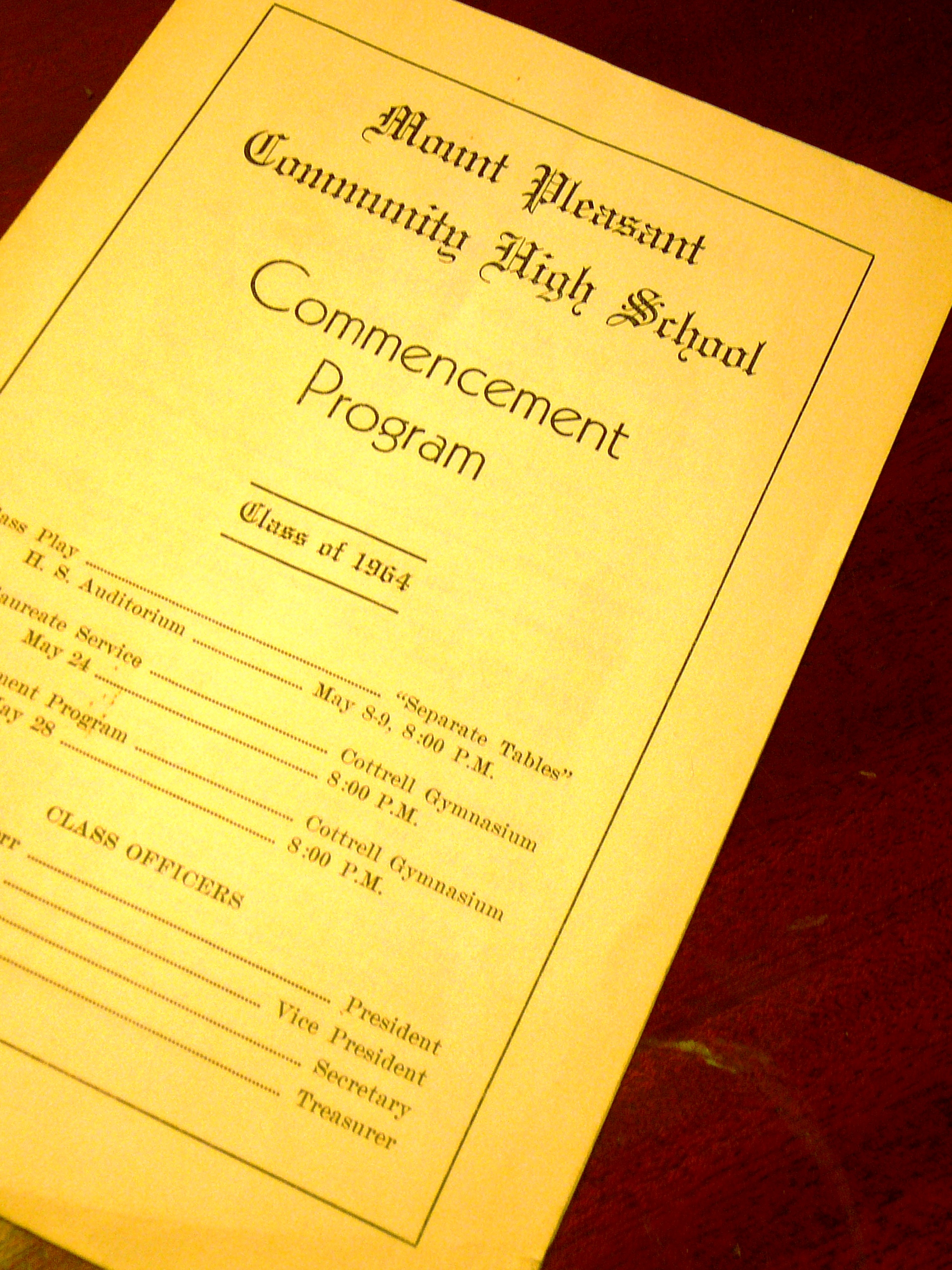
In one box mom saved programs from important events of family members. I found my high school commencement program. The top six scholars in my class spoke on the topic: 1960-1964 Years of Achievement and Turmoil, Events that Have and Will Affect Our Lives. Individual speeches covered Man’s Progress through Science; The American Image – Latin America; Tensions – Europe and Southeast Asia; The Passing of an Era – November 22, 1963 (the assassination of John F.Kennedy). One of the few African Americans in my class, Kathy Wells, spoke on Man’s Attempt to Overcome Bigotry. My title was Progress – Local and State.

No one can turn up his nose at the quality of the education at my alma mater.

I recently heard someone speak about “God’s plan” for us. The phrase sort of grated on me. “Plan” seems to me to be such a human notion with its linear quality, bound by time, space, and mortal reason. I do not think God has plans in the way we might think of them – a neat ending to a story, a way everything will make sense to us, or a satisfying tying up of all our loose ends.

Rather, I think of God as eternal unfurling with ever increasing nuance and connection until we see all lives as dancing flames rising and falling and rising again.

Meaning is something we tack on to Reality to comfort ourselves with a sense of having a handle on things. But Reality more likely slips through our fingers, whizzing past us, leaving trails of newspaper clippings, baby shoes, an old watch, and a tortoise shell comb worn by your great grandmother.

Today I think, rather than One who has plans, God is an endless returning, retracing,  weaving in and out, a grand do si do in waltz time, circling back and forward, all the while holding out his hand for us to join the dance, seeing the same place over and over, as if for the first time.

What we call the beginning is often the end.
And to make an end is to make a beginning.
The end is where we start from.
T.S. Eliot “Little Gidding”
I would love to know the wisdom you will be carrying with you in 2011. What is your verse, or piece of direction to see you through the coming year? Leave it here in the comments, or post it on our Facebook page.
A very blessed New Year to you!


The Sanctuary Foundation for Prayer
Read more about prayer www.fromholyground.org
Contact the author lross@fromholyground.org, www.fbook.me/sanctuary
Follow at http://twitter.com/lfross

Not Enough?

Not enough time, not enough energy, not enough hope, not enough money, not enough jobs, not enough room, not enough love, not enough peace …

not enuf nuthin !

So goes the lie.

As the holiday season of plenty, hope, and generosity opens its arms to us, some individuals are pained by and suspicious of the season’s glittering wares. The family, who have lost their home to foreclosure, the unemployed factory worker, and other despairing and heartsick souls may feel plenty is beyond their reach and scarcity their new normal.

The media depictions of holiday cheer play on our insecurity and sense of lack. They insinuate that no matter how much we have, we do not have the latest and greatest. Advertisers lure us with promises of more. We may find ourselves stumbling after ghostly phantoms in the desperate hope that this year we might find that illusive wholeness we are seeking.

How does one feel whole and fulfilled, when one is more aware of scarcity in one’s life? Perhaps abundance in the midst of scarcity occurs for us as it did for Jesus, when he fed five thousand people with five barley loaves and two small fish.

We welcome what we have, however meager. We give thanks, and watch it multiply.

Here is a simple, yet demanding, exercise to practice such a miracle in your own life. It is called The Welcoming Prayer. It was developed by Mary Mrozowski, one of Thomas Keating‘s closest associates and a prime mover in the development of centering prayer. She based the Welcoming Prayer on the 17th-century French spiritual classic Abandonment to Divine Providence by Jean-Pierre de Caussade as well as Fr. Keating’s teachings and her own lived experience of transformation with its underlying attitude of surrender. There are a number of variations on this prayer. Here is one.

WELCOMING  PRAYER

Focus and Sink In:

Become aware of what is troubling you or occupying your mind. For example, your sadness, anger, or fear regarding scarcity of some kind in your life. Focus on your feelings, both cognitively and physically, noting how and where the feeling affects your body.

Instead of resisting, or feeling ashamed or denying, welcome the truth of what is troubling you. Welcome the feelings with curiosity and compassion.

Let Go:

(Here is the hard part)

Let go of your desire for power and control over the situation. Release your desire to be “right.”

Let go of your desire for affection and esteem from others.

Let go of your desire for survival and security.

Let go of your desire to change the way things are.

Rest :

Allow yourself to sink into the abundant flowing love of this moment. French priest, Jeanne Pierre de Caussade, describes this love:

The present is ever filled with infinite treasure; it contains more than you have capacity to hold. … The will of God is at each moment before us like an immense, inexhaustible ocean that no human heart can fathom; but none can receive from it more than he has capacity to contain, it is necessary to enlarge this capacity by faith, confidence, and love…

You may find the letting go section of the prayer difficult to do. One or two of the desires may be harder to release than others. Think of this as useful information about what things, other than God, are of primary importance in your life. Notice which desires might be getting in the way of your freedom in Christ. If you find you cannot release one of these, you might simply pray that God give you the desire to desire to let go.

The Welcoming Prayer invites us to trust in God’s presence and providence and to discover the infinite wealth of God available to us in each moment. “The divine will is a deep abyss of which the present moment is the entrance. If you plunge into this abyss you will find it infinitely more vast than your desires,” writes de Caussade.

I believe this is absolutely true. Over and over in the midst of distress, I have wrung my hands about there not being enough of one thing or another in my life. Yet as I have focused and welcomed the feelings and my present reality, let go of my ego’s desires, and rested in God, my need has been supplied with an abundant depth and power that swept away all my grasping and anxiety.

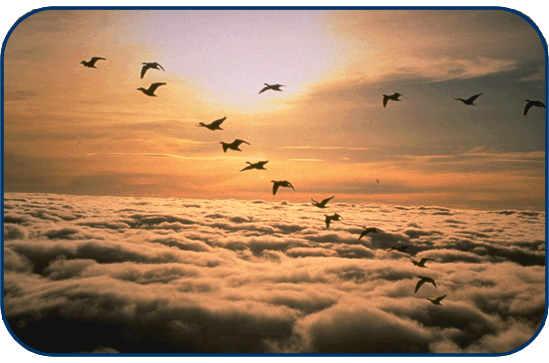
I heard the geese honking at dawn last week. My dog halted at the door and cocked his head and we listened together in wonder. I love the sound of them moving over head, giving themselves to the skies. Trusting in their ancient faith they make their way.

In spite of all appearances to the contrary, I believe there is enough.

The Wild Geese

Abandon, as in love or sleep,
Holds them to their way
clear in the ancient faith:
what we need is here.
And we pray not for new earth or heaven,
but to be quiet in heart
and in eye clear.
What we need is here.       Wendell Berry

I trust in you, O Lord. You are my God.
My times are in your hands. Psalm 30:1

What we need is here.

Become a fan of the The Sanctuary Foundation for Prayer
Read more about prayer www.fromholyground.org,www.fromholyground.wordpress.org
Contact the author lross@fromholyground.org, www.fbook.me/sanctuary
Follow at http://twitter.com/lfross

Embarrassing Prayers

An Embarrassment

“Do you want to ask
the blessing?”

“No. If you do,
go ahead.”

He went ahead:
his prayer dressed up

in Sunday clothes
rose a few feet

and dropped with a soft
thump.

If a lonely soul
did ever cry out

in company its true
outcry to God,

it would be as though
at a sedate party

a man suddenly
removed his clothes

and took his wife
passionately into his arms.

~Wendell Berry – Leavings

Wendell Berry –  I love this Kentucky farmer and writer, with his deep affection for the land and generosity of spirit. I actually worry sometimes about his dying. He is getting older and I need him to keep going into his timber, where he observes Sabbath down by the creek. I need his passion for justice and goodness, which he keeps just under his worn jacket. I love it every time he tears off that jacket and strips down to show us the naked truth.

I used to say with the foolish assurance of someone newly in love with God, “If people knew how sexy God is, our churches would be filled.” Now I wonder if perhaps it is our churches themselves who don’t know how sexy God is, and that is why some are empty.

In the sedate worship circles I frequent, there are few passionate outbursts and everyone keeps his clothes on. If a God lover ever did rise up in some self-abandoned embarrassing expression of love, we would probably be appalled and call the police.

We have all heard those obligatory, studied prayers that rise a few feet and drop with a soft thump. I have prayed quite a few myself. I also confess I have been a perpetrator of prayers with an ax to grind: some pet notion or issue that wasn’t fully treated in the sermon or meeting, which the one praying attempts to correct. Perhaps, you have been assaulted with the prayer of someone, who is more concerned about setting you straight about some matter than entering into communion with the Lord of the Universe on your behalf. Then there are the quick and dirty nooners over lunch in a public restaurant, where you feel everyone is watching.

To the Holy One, I figure all our prayers are mostly childish babble, endearing scribbles in the sky.  I trust God loves them all, just as I still keep a box of my daughters’ childhood drawings and writing. Tell me, what are we, caged in our mortality, to do with this divine love, if not to slop it around like infants in a high chair eating our first plate of spaghetti? We are bound to be messy. More of us ought to be caught red handed in flagrante delicto with spaghetti sauce all over our faces.

Some Sundays I have an impulse to throw myself in an unseemly prostration before the altar on behalf of the people and the God I love so much that I can’t stand it.  I do not have the words to express the anguish, doubt, and fear I know some of the people carry. “Do something!” I want to scream at God. “Here take me, take my life, such as it is, ragged and tattered, and heal your people!”

Once, in a weak moment, overcome with love, I knelt in a Presbyterian church during worship. Presbyterians, as you may know, do not have kneelers in their churches or kneel as part of their worship. They express their passion by singing, something at which Roman Catholics, with their lovely genuflections and neat fold-down kneelers are generally less accomplished.

My embarrassment followed Holy Communion. After I received our Lord’s presence and love, I brazenly knelt right down in the First Presbyterian Church in Holton, Kansas. It was a little crowded between my seat and the back of my brother’s pew, but I just had to do it. Afterwards one of the elders of the church brought up my indiscretion at the session meeting, asking the pastor if what I did was “Presbyterian.” They haven ‘t kicked me out so far.

Saints, prophets, artists, and poets understand the passion of the human heart for the divine. These are persons, possessed and overcome with our Beloved, who often do and say things unseemly. Most people think they are a little kooky. Yet these same people, who hold mystics at arm’s length, regularly sing hymns with lyrics like:

Jesus, lover of my soul, let me
to thy bosom fly …

Come down, O love divine, seek thou this soul of mine,
and visit it with thine own ardor glowing…

Who do they think they are fooling? I know there are hearts aflame with God in more than one gentleman in the back row, not to mention the middle aged couple, or bored looking teenager pecking at his cell phone. Most us, including clergy, are well trained to keep our passion contained. Nobody wants to be embarrassed for heaven’s sake.

As Wendell Berry writes, there is public prayer, which can easily slide down the slippery slope into performance prayer. Then there is the Jesus-recommended private, shut up in your closet prayer. (Matthew 6:6) I suppose the closet prayers are the best kind for taking off your clothes. The only problem with hiding our passion is that people may get the idea that God is boring and that being a person of faith is only a matter of learning some doctrine and following a moral code of behavior.

Not for the faint hearted, a life of prayer is a perilous enterprise. One can pray a prayer so lame it is an embarrassment, or one can simply embarrass oneself. I believe God receives all our prayers, both the self-conscious thumpers, and the self-forgotten soarers. God, being beyond shame, is not embarrassed by either. Would we could all toss away our fig leaves and go walking in the garden with our Lover without a stitch.

I hope there is a place, where you can strip down to your naked, vulnerable, cellulite- encased, pocked-marked self and open your arms to your Beloved in a rush of desire and groping hunger for holiness, truth, justice, and mercy.

We won’t peek. Just go for it. Lame or passionate, pray an embarrassing prayer today.

Join the Community of Contemplatives on Facebook Page
Read more about prayer www.fromholyground.org, http://www.fromholyground.wordpress.org
Contact the author lross@fromholyground.org,  www.fbook.me/sanctuary
Follow at http://twitter.com/lfross

Yielding to Grace

Maybe you have taken on a very difficult and demanding task. Maybe you have been engaged in a burst of creative activity. Or perhaps, you have been involved in the long, slow, steady, outpouring of yourself for family, friends, or your job.

You may have noticed the signs: an anxious, sleepless night here or there; drinking too much caffeine or alcohol; not enough time to get to the grocery store; a sudden attraction to playing solitaire, and a rush of those Please-Lord-give-me-the-strength-to-do-this prayers.

In my case I was following my own devices again, rushing ahead of the Spirit, plowing my own path. Finally I was stopped by a sharp, shard of sorrow in my heart, a sense of restless unease, and the accompanying guilt and self-recrimination about my lack of motivation. I did not miss God’s irony that this should assail me over the Labor Day holiday.

After thirty years of devoting myself to prayer, I am amazed at how hard it still is to expose myself to the direct presence of Christ. I really think I would be the one in the back of the crowd, wanting desperately to push through to touch his robe, but fearful and cautious, and resigned to making the best of things on my own.

Many of us find it easy to read about faith and prayer. Books on these topics are best sellers. Countless people read the Bible. Most of us do not have much trouble telling God what we need. We may even write out a list of our needs and longings and hand it to the person in front of us, asking, “Would you pass this on up to Jesus, for me?”

What I hadn’t done was the simple, radical exposure of myself and my need to God. What I hadn’t done for several weeks was a sustained, still, silent offering of my being to the being of God. This is what I believe truly heals and redeems: contact with Holiness, that mysterious communion and co-mingling of my spirit with the Spirit, a dance of love beyond my understanding or control.

I know why I avoid it and why I, suppose, that I have to write about it. The reason is that this communion may hurt at first. The exposure of a raw, chaffed heart to the burning brightness of Grace can be excruciating. (Yes, that is the word for it: ex- crucifix, from the cross.) It may be the last thing we want to do. So we often just tell God about it, then get up and go on fretting, and look about for something to do, anything other than just sitting there in that fear and pain.

Now think for a moment. If you were sick, would you not pay attention to your symptoms, maybe check them out on the internet, and go to a physician and describe what you are feeling? And then, would you get up from your chair and go home, before the doctor had a chance to ask questions, to examine you, run tests, and prescribe your treatment?

Surely you would you wait for the examination. You would answer questions. You would you lie down on the table, bare your chest to the stethoscope, your arm to the blood pressure cuff, and take whatever tests the doctor advised. You would take your medicine and follow a treatment plan.

I had been making drive-by visits to God, where I would drop off my laundry or tell God what I need for today. I was sipping those devotions for busy people, spouting sound bite prayers on the run. I was not coming before God and disrobing. I was not holding still for God to search my heart and probe my mind.  I would not wait for his grace to move into me, to absorb the pain, to refresh and heal me. Further, it was all about me. I was all about me. I had nary a thought of what God might desire or need from me.

We fool ourselves if we think a quick shot of God, a pithy quote, or Bible verse alone will do it. God desires a relationship with us, not a power lunch, and depth relationships require leisure, attention, vulnerability, and mutuality.

Part of us really does desire this. However, another part of us is just not that interested. I hear about this internal conflict over and over in my practice of spiritual direction. People are sincere and have good intentions. Yet nearly everyone I know finds him or herself facing obstacles to a sustained presence to God.

Try it. Find a quiet place where you will not be interrupted. Set a timer. Twenty minutes is good. Ten minutes will do. Even five minutes can hold a miracle. Breathe a while. Just be there and allow yourself to be open to Christ, the patient physician, who has been waiting for you for an eternity. Now right off, you may notice all sorts of responses in yourself: a sudden urge to get up and tend to some task; some buried pain rising up, burning and stinging like really bad heart burn. You will take little sorties into the past and into future. You will write fiction, little novellas, about your life. You will discover some hurt or slight or worry to gnaw on.

Just stay there. Hold still. You are getting a CT scan. Don’t move. This time is for God’s examination of you. What you think and how you feel about this isn’t all that important. The physician is at work. Trust that. You may feel panic or anger or despair. You may feel deep peace and joy. Whatever you feel, just stay there opening yourself to the one who loves and cares for you beyond your wildest dreams.

When the timer rings, give thanks as honestly as you can. Then do the same thing the next day and the day after and the day after. Don’t look for “results,” just be obedient in allowing the doctor to heal you. Thomas Keating calls this form of centering prayer “divine therapy.” You, of course, may also read the Bible, pray in other ways that you are drawn to, do acts of love and service, and whatever else that seems right for you.

Sometimes this prayer is like detox, a weaning from some addiction, and we go through the painful withdrawal of whatever we may have been substituting for God in our lives. Other times this prayer is like the surrendered offering of Mary to the angel, Let it be to me according to thy word.

Always such yielded prayer is an act of faith in the mystery of God’s love and purposeful activity in the human heart and soul.


Hold your eyes on God and leave the doing to him.
That is all the doing you need to worry about.  St. Jeanne de Chantal

Have Thine Own Way – Organ Improvisation

We invite you to our Facebook Page: The Sanctuary Foundation for Prayer
Read more about prayer at www.fromholyground.org
Read Tracking Holiness – Newsletter
Contact the author at lross@fromholyground.org, www.fbook.me/sanctuary
Follow at http://twitter.com/lfross