 A thousand shades of green hold me enthralled. The south wind teases up the glossy leaves, revealing their pale undersides. I find enough of God in a maple leaf to keep me occupied with wonder for a couple of centuries.
Today the praying life consists of a continuous loving look at the universe. Prayer is a long wonder-filled gaze upon things as they unfold. The praying life is a front row ticket to the greatest show on earth. Okay. Sometimes I nap, complain, go out for popcorn, or dally in the restroom combing my hair. Sometimes I get self absorbed and miss whole acts, and then have to nudge my neighbor and whisper, “What did he say? When did she die? I didn’t know there was a war!”
In its simplest sense prayer is as an act of paying attention. The word the writers of the Greek scriptures used for prayer is proseuche, which means to turn toward God with a request. In order to get my need met, I shift my attention to God. Our word attention comes from the Latin ad tenderer (from which we also get tendon and tension) which adds the notion of stretching toward something beyond us.
Simone Weil wrote that prayer “is the orientation of all the attention of which the soul is capable toward God.” In prayer I bestow upon God the gift of my eyes, my mind, my awareness, my being at this moment. So Holiness gets our attention by creating in us desire and need? Interesting, huh?
To understand prayer as looking at or paying attention to God, means one must deal with the fact that we are all blind as bats and struggle to see what is really going on. We have cataracts, myopia, far sightedness. We squint through the dim filters of our prejudices, opinions, fears, and fantasies.
Jesus seemed to recognize this and a good deal of his message was about opening the eyes of the blind and teaching his followers to see with the eyes of faith. Such prayerful seeing is not easy. The poet John Moffit offers some instructions:
To look at any thing, 
If you would know that thing,
You must look at it long:
To look at this green and say,
“I have seen spring in these Woods,”
will not do – you must
Be the thing you see:
You must be the dark snakes of
Stems and ferny plumes of leaves,
You must enter in
To the small silences between
The leaves,
You must take your time
And touch the very peace
They issue from.
Must I become what I want to know, or see, or heal, or change? We protest. Oh please, no. That is too hard. I have my needs, you know. I have my point of view. I have these closely held beliefs. Let’s make an argument for why this situation or person needs to change. Can’t we use persuasion, branding, marketing, scientific research, polls, and the press of public opinion? Can’t we ask God to just fix these things, these people? Now!
Nope. The poet says you must take your time. You must look at the poor long, the imprisoned long, our enemies long, our failures long. We must be the thing we see, enter into the dark realities of life in a refugee camp, and the chaotic tension and anxiety of our nation. We must be willing to love and to become the thing we long to liberate –
as God was willing to do for us.
In my experience it takes strength and faith to enter into another’s reality and not be overcome by it, or to lose myself in it. We may become bitter, cynical, even abused by such experiences. We may become infected with the disease we are trying to relieve. We end up offering the other only a mirror version of his or her own dilemma. We become part of the problem we are trying to soothe.
 Simone Weil continues, “Not only does the love of God have attention for its substance; the love of neighbor, which we know to be the same love, is made of this same substance. Those who are unhappy have no need for anything in this world but people capable of giving them their attention. The capacity to give one’s attention to a sufferer is a very rare and difficult thing; it is almost a miracle; it is a miracle. . . . The soul empties itself of all its own contents in order to receive into itself the being it is looking at, just as he is, in all his truth. Only he who is capable of attention can do this.”
When our attentiveness invites us “to enter into the small silences” and to “take our time and touch the Peace” from which all life issues, we find ourselves in union with that Peace. Our sacrificial gift of attention to another awakens the life of God in the other. That life may be dormant, deeply hidden, frightened, or wounded. Our prayerful attention extends a hand and bids the slumbering Peace in the other to rise up and walk.
God is paying attention to us in Jesus Christ. How could Jesus enter so deeply into our reality and suffering without being overcome by it? As I watch Jesus move through the Gospels it seems to me that he never loses his attentiveness to the Peace from which he issues, his Father in Heaven, and his identity as the beloved child. Perhaps for us to be agents of transformation in our prayer and relationships, we must possess a deep attentiveness to where we come from, and a sense of ourselves as deeply loved by God. This ongoing communion with our Source -our Father, our Mother in Heaven- gives us the freedom, the strength, and the safety to be channels of divine love and healing without harming ourselves or others. For to me little is more fierce or tender than the unfolding of the ferny plume of a mortal soul.
So I pray as I watch the maple leaves dance in the wind.
I take my time.
I aim for the Peace we issue from.
I meet you there.

Simone Weil, Waiting for God, Harper Colophon, 1951,p 105, 114-115
John Moffitt, Teaching With Fire, edited by S. M. Intrator and M. Scribner



 Harold, awestruck and elated, told me that he had seen God. He said that God showed him hidden mysteries. No, he was not psychotic. He was simply full of Holiness bigger than his britches. Divinity burst through his immature psyche in sparks and streaks. He scared most people, impressed others, and annoyed his pastor.
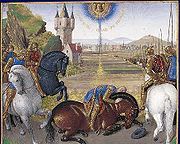 People have varying responses to large draughts of God. Not everyone becomes insufferable. In Harold’s case he felt that nobody really understood and knew God the way he did. To him all the other laborers in the vineyard, slogging away without a glimpse of the master, appeared as witless dullards. And I have to admit some of them probably were. Instead of focusing on what is wrong with those around them, some people respond to the Spirit infusion with a burst of creativity, an outpouring of service, the expression of their gifts, or art of some kind. Then there are the hidden souls who only want to withdraw to sit in silence and solitude, where they feel alternately forgotten and useless, and enraptured and blissfully happy.
  On the afternoon of the day my friend died in a hospital bed in Iowa City, my daughter and I made cookies. In the Kansas kitchen overlooking the finch feeder, while seventeen finch gobbled two pounds of thistle seed (95 cents a pound at Allen Farm and Feed), we measured flour and brown sugar, butter and ginger, and mixed them in the yellow bowl. Patting out the dough on the cookie sheet, we stopped to taste. “Umm, very good!” she said.
 I held out the tray of tiny plastic cups filled with juice, freshly poured, bubbles still floating on top. He delicately placed finger and thumb around his choice, and went to draw it out, but it was stuck and would not budge. He tightened his grip, pulled, and the thin plastic cup shattered in his fingers. Juice flew onto the suit jacket of the fellow next to him, the carpet before the altar, and my white robe and scapular with the appliquéd wheat and golden sun. How can such a tiny cup hold so much? we wondered.
 ith her here, and, in her contact with God, find healing for her soul. Inside the hermitage my two daughters, ages four and six, are playing quietly. My guest and I sit still, leaning into the grace of the moment-listening to meadowlarks and watching willows bend in the breeze. After a while my children’s play grows noisier. Thumping, giggles, and something crashing to the floor intrude on the serenity. They are jumping on the bed. The more I try to focus on the silence and my guest, the louder the girls get. Finally I rise from my prayer stool and go inside. “Please be quiet,” I whisper. As I take Diana’s arm to lead her over to some books, she shouts in a screechy, ear-splitting whine, “Mom, stop! You are hurting my arm.”
 The Praying Life