Monthly Archives: March 2012

Exploring Solitude: Learning to Be

So What Do You Do Out There All Day Alone?

 “You must love the Lord your God with all your heart, with all your being,
with all your strength, and with all your mind . . .” Luke 10: 27(CEV)

“Why not? I thought this is what it is all about. I have this list. I told some of the people I would. You are not making any sense!”

I was on my second circuit around the lake arguing with God. This was the first day of an extended period of solitude at the hermitage and things had started off with a big fight.

I had made arrangements for my family, shared my plans with friends and clients, packed my provisions, gathered up my good intentions, and stepped into solitude with considerable self importance.

God went right to work on me. On the first day I ran into a wall. That was why I had thrown my journal on the floor and stomped off to the pasture. That was why I was walking around the lake pleading and arguing with the Holy One.

The word of the Lord that had come unto me was this:

Thou shalt not pray for other people or projects or events while here. Thou shalt not worry and fret about them or their futures. Thou shalt not dwell on the past.


Thou shalt pray on my terms.  Any intercession will be at my invitation,  not your over-functioning,  good intended, works righteous,  anxiety ridden,  guilty, controlling ego.


Thou shalt partner with me in bringing in my kingdom not by being available to the world, but by being available to me. Thou shalt get the first commandment well established in thy heart before thou shalt be ready for the second.

So it had come to this. My will versus God’s will.
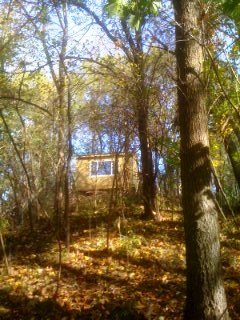
I had planned to pray for others and for the needs of the world, while I was at the hermitage. God’s word to me shook my very foundations. Huh? What am I going to do out here then? This is a question people often ask me when I tell them I take a day a week for solitude.

It has taken me years to untangle myself from relationships and assuming too much responsibility for others’ well being. The notion that just being with God without doing anything in particular is foreign to many. It may take us a while to learn how to simply be present to God and enjoy our relationship with the Source of All Being.

We learn to detach ourselves from the things of creation in order to more fully attach ourselves to the Creator, in whom we rediscover the creation. In this new context my relationship to the world is transformed. Where my attachment to the creation was enmeshed, codependent, grasping, urgent, and possessive, it becomes freer, less sticky, as I allow others to be as they are. No longer do I demand things of people or of the world. No longer do I attempt to control or manipulate them, because my deepest needs are being met my God.

So what does one “do out there all day long?” All kinds of things: read, listen, watch, pray, walk, rest, create. . . .as one slowly is weaned from “doing” itself. One gives up the addiction to producing, efficiency, and ego enhancing, controlling behaviors in favor of the freedom of being, to joining with the One who gave the divine name to Moses as the holiest of names: I am. One discovers the gratitude and joy in sheer being. In this shift of perspective the things of creation are no longer “objects” for me to manipulate, persuade, desire, or possess, but holy beings themselves, each shimmering in their own goodness and beauty.

How this transformation occurs, I believe, is a process over a life time. It is different for each person, according to the work of the Holy Spirit. You may be called to suffer, to face hidden truths about yourself, to encounter evil, to repent, to grieve, and to experience ecstasy and bliss. You may also have periods of very ordinary, grounded experience with little drama or fireworks.

The common thread through the variety and intensity of experience and activity that may occur in solitude is surrender of the self, a kind of dying and letting go of whatever you may be hanging onto in place of God, who wants no less than all of you.

Whether you argue or whine, pout or throw your journal across the room, the task, over and over, is to forsake all other lovers and lay down your life before the One Shining, Sweet, and Unfathomable Power without whom you are nothing.

God has no need of our works.

God has need of our love.  

Therese of Liseaux


Solitude Practice:

  • How does the need to produce and “do” express itself in you? Through overworking, anxiety, fear, trying to control others?
  • Recall a time when you were able to just be with God. Where were you, what enabled that kind of awareness and presence? How did such a time affect your subsequent presence to your work and other people?
  • When they were little, my children used to tell me at times: “Mom, you need to go out to the cabin.” What helps you become aware of your need for solitude?

Next post in this series: Exploring Solitude: Meeting the Crucified One

Exploring Solitude: Becoming Real

Here is what I want you to do:
find a quiet secluded place so you won’t be tempted
to role play before God.

Just be there
as simply and honestly as you can manage.

The focus will shift from you
to God,
and you will begin to sense his grace.
                                                 Matthew 6:6 MSG

Nobody is watching. Go ahead. Be yourself. Relax. You walked off the stage of your life performance and the audience has all gone home. Feel the weight of that armor, the heavy guard you wear night and day about your shoulders and neck? You won’t need it now. Lay it down.

Oh. Wait a minute. It appears that not all of that audience has gone home. A few hitched a ride into the hermitage in your mind. Take that broom in the corner and chase them out. As long as you do not invite them to sit down, and then start feeding them milk and cookies they will leave. Their harping and commenting will begin to sound sillier and sillier to you in the context of your wilderness.
Go ahead. You can’t hurt the furniture here. Put your feet up and settle into that delicious and utterly joyful place of being yourself, your true self.

A wonderfully freeing aspect of solitude is that nobody cares what you look like. Nobody is there to comment upon, critique, approve, or disapprove of your actions, attitudes, words, mannerisms, personality preferences, and quirks. No one has expectations of you or needs they want you to meet. No one is going to call or drop by unannounced.

Go ahead. Remove that hot stuffy mask.

We have a public face we present to the world. In some cases it is brittle, artificial, and controlled. We put on the mask of a happy person, a competent person, a funny person. But a mask is a limited snap shot of the person we really are, which may include being happy, competent, and funny, but who we really are also has depth, texture, responsiveness, and spontaneity, which masks cannot communicate.

When the face we present to the world is the same nuanced face within us, people call us authentic and real. What we show on the outside has integrity with what is in the inside. The phoniness, pretension, and the effort of maintaining a façade are gone.

I loved taking people out to the hermitage. I would show them around the grounds and cabin, give them some orientation, and, leaving them alone for a few days, drive back to town. Then later, they arrived at my doorstep to drop off the trash, the empty water bottles, and return the key. When I opened door, I was amazed at the differences in the guests. The tension and stress were gone, and an ease and lightness filled their movements. And their faces, soft and smooth like a child’s, wore a refreshing, unguarded openness and simple presence to the moment.

After I spent a long period in solitude, a friend reported that I looked like the Velveteen Rabbit. “Worn and soft. Well loved, and real,” she said.
There is nothing like solitude for peeling off the layers of pretense and inviting a soul into deeper authenticity.

In the days of silence and company kept only with crows, meadowlarks, and the possum, who comes looking for food under the moon, one becomes aware of the vast amount of energy and time, which may be spent on building facades and presenting a particular face to the world. The hours of calculation and strategizing to strike the right note in a speech, the stress filled preparation and rehearsals to achieve a certain affect. We have all been encouraged to become marketers and publicists for our careers, our work places, and even our very lives.

Here relationships degenerate into a potential sale, or a possible connection to a step up the ladder. Social media invites us to fashion our lives on a global stage, where our preferences are watched and matched to product ads which pop up before us.

In contrast to the world of hype nothing is for sale in the wilderness. Further, in the wilderness your stuff and your “brand” start to become embarrassing — all that lipstick in your purse, the three jars of face cream, the books you lined up on the book shelf, those clothes you shopped for.

The wilderness around you takes on a depth, beauty, and fascination that cannot compare to that iPad you just had to have or that “outside the box, edgy high concept” project you have been working on. The world beyond your wilderness begins to  seem artificial, crass, and out of sync with a deeper more profound rhythm.

Oh course, it makes sense that the natural world would inspire you to drop off what is unnatural and false in yourself – those postures and attitudes you take; that pride that you use to hide your vulnerability and need.

Besides, you are not going to fool that turkey vulture soaring over the pasture. He may be pecking at your bones one day and won’t give a damn about what kind of car you drove. The lake, teeming with turtles, bullfrogs, fish, and dragonflies is unimpressed with your credentials.

Yet a few creatures may be curious about your presence. There is nothing you have they desire. All they can offer you is their own mysterious being.
The cows, snuffling at the window, wake you at dawn. A large black angus is peering into the cabin. Her face is framed by the window and the chintz curtains.
You go out barefoot in your pajamas to shoo the cows back into their pasture. There are several mamas with their young ones. You stand still gazing at each other. You watch their massive ribs expand as they breathe, their dark eyes, and pink tongues. They watch you, seeing how your feet are getting damp in the dew, considering your breath, your two legs, and your white silk pajamas.

Your being interpenetrates with their being. A conversation and exchange occurs beyond words. Atoms shift, energy moves, recedes, and gathers in the spreading light. Then they turn, their hooves sinking into the damp earth, swishing their tails, and go back through the broken fence.

Nobody in the wilderness cares what you did last week. Or what you didn’t do. One of the calves looks back at you, slowly chewing grass, hanging out both sides of his mouth.

You feel you need to get right down on your knees in your pajamas and repent of something you do not have the words for.

Oh my God, forgive me for not seeing,” you pray.

Solitude Practice

  • Do you find yourself caught up in playing a role or meeting others expectations and needs unnecessarily?
  • What is it you let go of, when you let down your guard?
  • How does being alone in nature help you be yourself?
  • In what way might the wilderness call you to repentance, or seeing in a new way?

Next post in this series: Exploring Solitude:
So What Do You Do Out There All Day Long?

Exploring Solitude: Deadly Acedia, or Too Bored to Care

Sooner or later even the most devoted hermit or spiritual seeker will discover that this solitude and silence shtick does not seem to be all that it is cracked up to be.
Saintly souls and books far and wide, which recommend and extol solitude, may not include the whole truth of the experience. At some point the solitary pray-er is likely to ask this question:


What on earth do I think I am doing out here
in the middle 
of nowhere by myself!

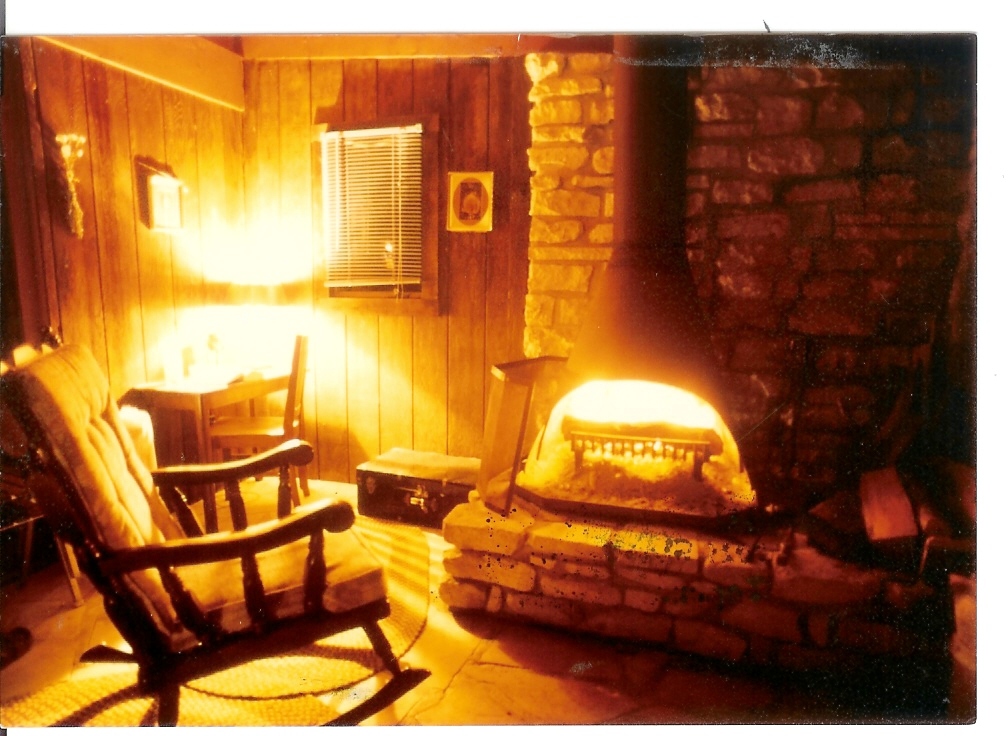
Next the individual may pace back and forth in his holy abode, while the walls begin to close in. A suffocating boredom descends upon the person like a choking cloud. Her whole spiritual exploration takes on the character of a really bad afternoon spent as a child with an insufferably tedious old aunt. You sit fidgeting in the rocking chair with your feet wagging in the air looking at old Readers Digest magazines and listening to tiresome adults drone on and on about dead relatives.

Now your lovely hermitage grows dull and lifeless and smells faintly of mothballs and Vicks VapoRub. You are sure all your friends are going to wonderful places and having exciting experiences, while you are trapped at Great Aunt Hannah’s and doomed to a lackluster life of gradually increasing obscurity and dull mediocrity. Your back itches. Your tummy hurts. Your neck has a cramp in it. Your brother keeps sticking his tongue out at you. And you realize now that you actually hate him. Your mom ignores you, even when you fake a faint, slide off the rocker, and lie on the floor in a lump.

It can be like this, my friends, as some of you know. You pick up a Bible, read a verse, and it leaves a taste in your mouth like an open bottle of soda that has been in the fridge for a month. A kind of angsty horror rises up in your craw and an overpowering desire to get out of there floods your being.

If someone has not seriously questioned Love’s call, and has not encountered an all- encompassing indifference, even, perhaps at times, revulsion, toward the things of God, I would suggest they simply have not been at it very long. When we enter solitude, whether we find it in the bathroom or at the lovely cottage on the beach, we bring along our retreat provisions, books, journals, music, food, as well as our illusions, expectations, hopes and dreams of what this time will be like. Here we may be in for a rude confrontation of fantasy with Reality, or my will with the will of the One I am seeking.

When I hosted guests at The Sanctuary Foundation hermitage, I watched them haul bags of books and provisions up the slope to the cabin.

“I hope to plan my sermons for the next six months,” some would tell me brightly.

“I hope not.” I would say to myself.

We bring an agenda to our solitude: I want to deepen my awareness of God. I need help in discerning the next steps of my life. I am looking for peace and resolution of conflict.

We come hoping to accomplish some task, relieve pain, even to be entertained. Then lo and behold, we are met with dryness of spirit, dullness of mind and heart, a ho hum listlessness, and growing sense that nothing fun or good is going to happen to me here.

What we fail to see is that God comes to the hermitage as well us. And God has an agenda too. At some point God’s agenda may include a healthy dose of the demon of the noonday sun.

The name the early Christians gave for the dullness can settle over us is acedia.
The desert fathers and mothers called this oppressive state of spiritual apathy the demon of the noonday sun. Evagrius warned, AThis demon attacks the monk towards the fourth hour and besieges the soul until the eighth hour. He begins by giving the impression that the sun is hardly moving or not moving at all, and the day has at least forty hours. Ardor and passion for the things of God are replaced by indifference and boredom. The miserable soul is sick both of God and self.  

Acedia, engraving by Hieronymus Wierix, 16th c...


The purpose of this dry discontent is seen as part of the final purification of the will so that it may be merged without any reserve in God. Acedia abolishes spiritual gluttony as it strips us of our fascination with glamour, ease and sensory delights. Since God is spirit and must be worshiped in spirit, a soul’s worship of God grows over time to be less founded in the satisfaction and entertainment of the senses and more in the dark knowing called faith. Through the harsh succor of the demon of acedia the soul is weaned from its attachment to sensory gratifications to a more mature love.
From my book: Letters from the Holy Ground, Seeing God Where You Are (Chapter 24)

As unpleasant as it is, I believe that acedia helps to rid us of the three tendencies of our age, which militate against contemplation, according to Ronald Rolheiser. Rolheiser identifies these tendencies as our narcissism, pragmatism, and unbridled restlessness. The Shattered Lantern – Rediscovering a Felt Presence of God  (Chapter 2)

The excessive self preoccupation of narcissism makes everything we encounter about us and our needs. The cult of the individual deifies the personal and encourages focus on our private concerns and preferences.

“Pragmatism,” Rolheiser writes, “asserts that the truth of an idea lies in its practical efficacy. What that means is that what is true is what works.” We become obsessed with what Thomas Merton identified as the leading spiritual disease of our time: efficiency.

Our unbridled restlessness fuels our driven, compulsive, hyper lifestyles of multi-tasking and instant gratification.


So what’s a body to do? You have come all the way out here. Are you going to turn tale and sneak back home?

Try this: Sit there or go for a walk. Watch your discomfort. Settle into your body. Be curious about your indifference and learn from it. Breathe deeply, as the anxiety and pain of withdrawal from narcissism, pragmatism, and unbridled restlessness grip your soul and cramp your body.

Surrender your agenda. Stop demanding things to be different. Cease resisting what is so, what is real for you.

Gradually a shift will occur.

Perhaps you notice the splotch of light on the wall across from Great Aunt Hannah’s china hutch. Where did the light come from? The late afternoon sun is stretching its long arms across the carpet and up the china hutch, where it touches a crystal goblet which has sat there for thirty years, and just now catches fire as your eyes lay upon it, dazzling you with brightness. You lean back in the rocker, feeling your back sink into the cushion, and watch the dust motes moving lazily above the carpet. You notice the pictures woven into the carpet – a man on a white horse, a house with a red roof, people in olden clothes walking down a lane.

The light splotch on the wall moves and dances. Why? You look at the flaming goblet across from the wall and back to the wall. Then you see through the window in the wall tree branches swaying, sweeping back and forth covering and uncovering the path of the sun.

For a moment you and the dancing splotch and the fiery goblet and the man on the horse and the tree branches swaying, and your great aunt are all laced together with tiny tendrils of light and you yourself catch fire. And you say to yourself, oh this is the way the world is. Everything is all hooked up and intertwined together.

The grown ups are still talking. You feel safe. You see your brother reading his comic book. A sudden rush of love and gratitude for him pours over you. You decide to take a nap. As you doze off, you think, I really like that mothbally VapoRub smell.

Come to me all you who are weak and heavy burdened.
And I will give you rest.     Matthew 11:28


Solitude Practice:

  • Have you been afflicted by the demon of the noonday sun? How did it manifest in your life. How did you respond?

  • Does it help to learn that the negative experience of indifference might be a necessary part of your deepening love for God?

  • In the essay above what do you think happened as the child character moves from fidgeting to discovering peace. Do you see anything here that might help you in your acedia attacks?

  • How do narcisscism, pragmatism, and unbridled restlessness hinder your contemplation?

  • Want to learn more about acedia? Here is a good article: Acedia, Bane of Solitaries  See also Katheleen Norris’ book, Acedia & Me: A Marriage, Monks, and a Writer’s Life

Next post in this series: Exploring Solitude: Becoming Real