Monthly Archives: February 2012

Exploring Solitude: The Wild Things Within

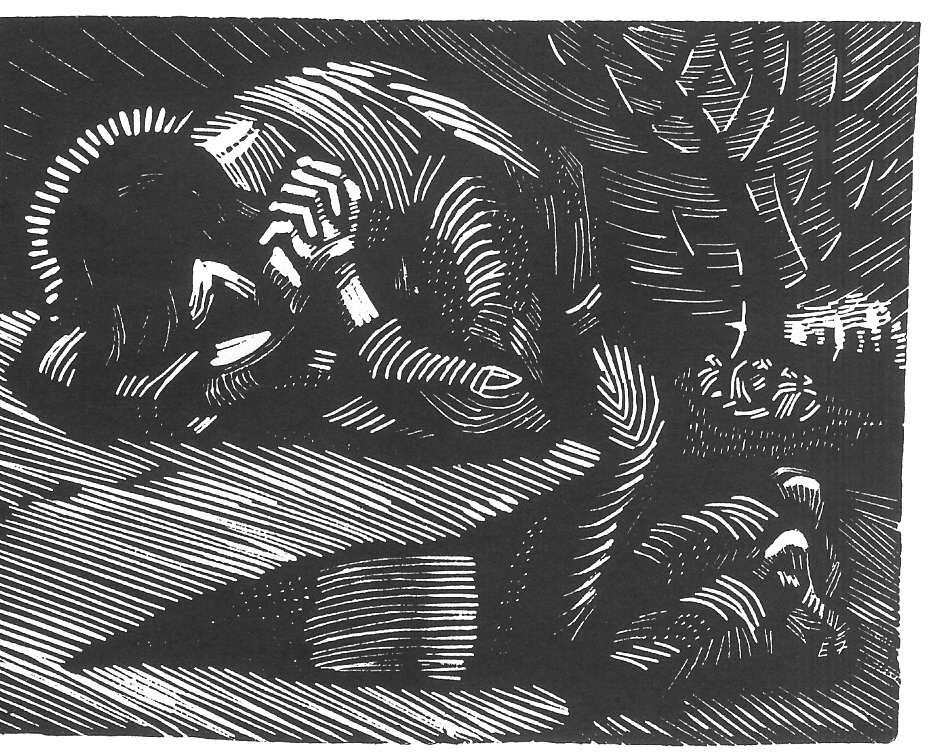
He said to the disciples, “Stay here while I go and pray over there.” When he took Peter and Zebedee’s two sons, he began to feel sad and anxious. Then he said to them, “I’m very sad. It’s as if I’m dying. Stay here and keep alert with me.” Then he went a short distance farther and fell on his face and prayed . .              Matthew 26: 36- 38 (CEV)


The season of lent invites us into wilderness solitude to encounter the wild things and places within us.  In a world of extraversion, solitude allows space for introspection and encounters with untamed and little known parts of ourselves.

On her way out of church one Sunday morning, a member told me a story about her granddaughter, who had come with her that day. My custom is to invite the congregation to a period of silent prayer before I offer the pastoral prayer. At the conclusion of my prayer, five year old Lindy whispered to her grandma, “Loretta took so long before she started praying, that I had to start praying for people I didn’t even like.”

Yes. Silence does that to us, doesn’t it? It brings us to the end of the list of our own needs and concerns and opens out our prayerful awareness of people and inner realities, which we do not even like. Many avoid solitude for this reason. When I stop doing, accomplishing, distracting, and numbing myself with various opiates, I am left with my wounds, enemies, and alienation. The wilderness of the self opens before us and we reach for the phone, turn on the television, or pour ourselves a glass of wine. 

He came back to the disciples and found them sleeping. He said to Peter, “Couldn’t you stay alert one hour with me? Stay alert and pray so that you won’t give in to temptation. The spirit is eager, but the flesh is weak.” Matthew 26: 40-41 (CEV)

The work of solitude includes the slow, patient task of befriending the darkness, of being present with compassion to my inner wildness, and of staying awake one hour with ourselves in our misery, as Jesus asked his disciples to do for him.

The followers of Jesus were unable to offer him such companionship. It is likewise very difficult for us to offer ourselves such gentle, present love. Yet if one can manage it, if only for a few minutes, that ache, that knife in the heart, the sick all encompassing grief  will begin to lessen just a bit, and a peace will slowly seep into the space of your silence.

This is where the deep work of contemplative transformation begins. The pleasant, consoling moments of contemplative prayer are important to our growth and infect us with the love of God. Sometimes they arrive unbidden, unexpected as sheer gifts. Other times we enter deeper communion with God through the ongoing practice of contemplation in some form: centering prayer, lectio divina, prayer of quiet, meditation.

Several years ago a friend confessed to me, “I am so over spiritual “disciplines.” She had reached a point beyond practicing prayer, because she wanted something from God, or because she ought to, or because it was interesting, or helpful to her daily life. Prayer for her was becoming much more demanding than a nice idea or exercise in personal improvement.

Thomas Merton wrote, “True prayer and love are learned in the hour when prayer becomes intolerable and the heart has turned to stone.” The deeper work begins when silence and solitude may be the last thing we want and the only thing we cannot live without. When just sitting still reveals to us a pervasive sadness, or the reality of a loss or truth we are denying or running from, silence is not some syrupy, cozy me-and-Jesus picnic. Silence is a summons to face into who I am and who God is becoming for me in a perilous confrontation with the truths of my life and who God will or will not be for me.

Again he came and found them sleeping.
Their eyes were heavy with sleep.
But he left them and again went
and prayed the same words for the third time.
Matthew 26: 43-44 (CEV)

Yet it is here – when facing fear, betrayal, or deep sorrow– that the encompassing and spreading love of God begins to open within us with its healing balm. Sometimes we need a companion to help us, as Jesus asked for from his friends in his hour of need. We may need to enter the silence in small doses at first. Tiny little sips of God may be all we can manage. Gradually that contact with God will begin to soothe our souls and bring a peace that will exceed our understanding.

It may not seem like much, this tiny bite of calm. You are still in your wilderness, up against a wall, facing an impasse, with little hope. Yet you keep going back for little sips of silence, as quiet fills you and you surrender to the moment.

My Forty Days in the Wilderness
One autumn over twenty years ago I spent forty days in the wilderness. I was sick and doctors were unable to diagnose or treat whatever was causing the unrelenting headaches and fatigue. Weary of the tests and drugs, I went off alone each day and several nights. I did not watch television, use the computer, talk on the phone, read mail or much of anything, except scripture. My only human interaction was with my immediate family.

Day after day and into the night I waited for that little sip of calm, that spark of life and hope. I learned to tend the spark, gather kindling, shavings, combustible scraps of living goodness: birdsong, the quail feeding along the lakeshore, the way a spider walked up the side of my tea cup. These and the stars over my head began to fuel the flame, which grew and illuminated the way for me.

Here is some of what happened as I tell it in my book, Letters from the Holy Ground:

I came to the wilderness in part because I heard Jesus crying and saying he was lonely for us.  I came out of a growing sense of God’s hunger and need for us and for one who would stay with him one hour.  I came to discover how it would be to delight in and enjoy God for God, and not for what God could do for me or the world.

And I found along with my brother, Simon Peter,  that the spirit is willing, but the flesh is weak.  And to pray with Christ is more difficult than praying to Christ.

Are there some among us who are willing to watch with Christ one hour? Are there some willing to turn in radical trust toward God and away from the forces within and without that seek to deny Christ?

Is there one willing to pay the cost of staying one hour, of tasting and knowing God’s suffering in her bones, of being bereft of all mortal assistance, of contending with a near constant onslaught of devils, of serving as a bridge between heaven and earth and thereby, bearing in his body, mind, and psyche on the one hand, the immaculate tenderness and the surging ferocity of Divine Love; and on the other hand, the immense ocean of mortal sorrow?

Like Peter, I couldn’t do it. For along with my good intentions I brought my weariness and poverty and dependence on God’s mercy.  And my eyes grew heavy and I slept.

But God slept too.  Christ rested too.  For Christ brought to the wilderness the same as I:  weariness and poverty and dependence on my mercy.  And so like two homeless children huddled in an alley, like two lovers entwined, we slept while the owl hooted and the bullfrogs boomed and the little grey mouse nibbled bread in the corner.

In the wilderness of solitude our suffering becomes bound up with, informed by, and transformed by the suffering of Jesus in his solitude.

By such fierce mercy and vulnerable love are we redeemed.


Solitude Practice:

  •  Have you had the experience of hurting too much to pray? Or have you avoided praying because you do not want to be still long enough to start feeling your pain?

  • What are some of the ways you distract yourself from entering silence and solitude?

  •  Have you found that place of peace in the midst of your chaos and suffering? How do you describe that experience? What would you tell someone who has never been there and is afraid to be alone in seeking it?

  •  Take some time today to be still and alone. Be with yourself with all the gentleness and love you can muster. Be with yourself as you would want to be with Jesus in his suffering. What do you notice or learn?

Next post in this series:
Exploring Solitude: Deadly Acedia, or Too Bored to Care 

I would love to hear about your experience of silence and facing the wild things within yourself, what you have learned, what helped ease your suffering and what did not. We offer our companionship to others as we tell our stories. You may comment below, on our Facebook Page, or email me at lross@fromholyground.org

Exploring Solitude: Where the Wild Things Are

Come away by yourselves to a lonely place,” Jesus

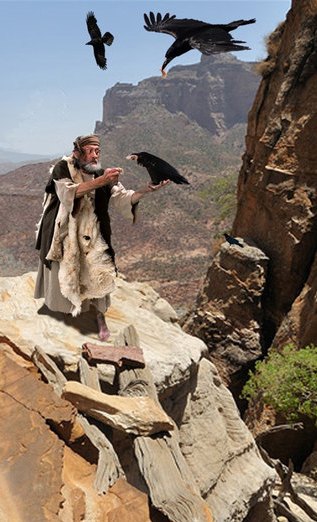
God then told Elijah, “Get out of here, and fast. Head east and hide out at the Kerith Ravine on the other side of the Jordan River. You can drink fresh water from the brook; I’ve ordered the ravens to feed you.”  Elijah obeyed God’s orders. He went and camped in the Kerith canyon on the other side of the Jordan. And sure enough, ravens brought him his meals, both breakfast and supper, and he drank from the brook. I Kings 17: 2-6 (Msg)

Nothing better expresses the urgent call of the wild for me than John Masefield’s Sea Fever.

I must  go down to the sea again, to the lonely sea and the sky,
And all I ask is a tall ship and a star to steer her by, . . .
I must go down to the sea again, for the call of the running tide
Is a wild call and a clear call that may not be denied; . . .
I must go down to the sea again, to the vagrant gypsy life,
To the gull’s way and the whale’s way where the wind’s like a whetted knife; . . .

Wild places and wild things invite us to themselves. If not the sea, perhaps, the mountains, the desert, the plains, or the forest draw you. The trout in the stream, the grizzly bear turning in his sleep, the mushroom popping up in the moist woods, the redwood tree dwarfing all else in its magnificence summon us to gaze in wonder and appreciation and share in the communion of all beings.

Shifting from Virtual Reality to Reality
In the wilderness we smell, and see, and touch, and hear, and taste – not a virtual reality, but reality. And here, we are likewise smelled, seen, touched, heard, and tasted. We not only change and act upon our surroundings, we are also changed and acted upon by those same surroundings. In the wilderness, we find again our place as a member of one of the species of beings on this planet. We leave our thermostatically, controlled environments and modern conveniences to feel the bracing chill of  the wind in our face, the tickling blurred vision through snow dusted eye lashes, the heavy ache in our calves after walking several miles.

In the process of wilderness dwelling, we shed the heavy brittle shells of our self importance and settle in with all our relations – brother sun, sister moon, and cousin fox. We discover the deer we are watching are also watching us.


Solitude may occur, of course, away from wilderness in the midst of a noisy crowd, in a beehive high rise apartment, or on the back porch with city sirens screaming past. However, many of us find solitude most easily and fully in a place apart in some natural setting. For over twenty years I found my wilderness solitude in a one room cabin with a stone floor, built into the side of hill on a small lake in northeast Kansas.

The call to the wilderness runs deep in some people, and expresses itself as unappeasable longing, or a palpable need to be in wild places among wild things. These persons often feel compelled to seek out remote spots away from power grids, traffic, concrete, and housing developments. Some struggle to explain and justify their desire to family and friends.

Wilderness as Arena for Spiritual Growth
The Biblical Hebrew word for wilderness is often used interchangeably with desert and includes many varied kinds of terrain, arid and semi arid, pasture land, mountains, and the sea.

The wilderness, a place uninhabited by the human species, is a significant location for the spiritual journey, both in its literal and figurative senses. The Bible understands transformation and spiritual growth as a process, which involves the experience of both physical and psychic dis-location and re-location. The experiences of being lost and being found, of moving from a familiar land to a strange new country appear over and over in the Biblical narratives.

An important aspect, then to solitude and our development in faith, is that exposure to wilderness, both in the physical geographic sense, and in the internal experience of the self. I will set aside consideration of internal wilderness to another post, and focus here on the external physical places and settings in which we find solitude.

As a species and as varied races and ethnicities, we have been formed in part by the land in which we and our ancestors have made our living. The lay of the land itself, the richness or poverty of its soil, the vegetation, wild-life, presence or absence of water, winds, and temperature have shaped our economies, our languages, our diets, our health, what we value, and our religions.

David Abram in his masterful book, The Spell of the Senses – Perception and Language  in a More-than-Human World, writes about this relationship of humankind to the earth and its features and all that dwell upon, within, above, and in its waters.

our bodily rhythms, our moods, cycles of creativity and stillness, and even our thoughts are readily engaged and influenced by shifting patterns of the land. Yet our organic attunement to the local earth is thwarted by our ever-increasing intercourse with our own signs. Transfixed by our technologies, we short-circuit the sensorial reciprocity between our breathing bodies and the bodily terrain. Human awareness folds in upon itself, and the senses – once the crucial site of our engagement with the wild and animate earth – become mere adjuncts of an isolate and abstract mind bent on overcoming an organic reality that now seems disturbingly aloof and arbitrary. (p. 267)

Abram writes of our relationship with the whole of creation as an interpenetration and mutuality in which all parties are affected, changed, and interdependent. The creation is not something I act upon, seek to dominate, or control, but rather the creation is a whole gathering of life with which I may enter into a relationship of mutual benefit.

In the past seven years the consequences of our lack of communion with nature has received attention and comment as Nature Deficit Disorder. The lack of time spent out doors by children and adults is suggested as a factor influencing several illnesses, including obesity.

Starving for the Undomesticated God


Over many years I have observed person after person starving for such connection and communion. Some would trek across the country just to sit in a simple cabin without  running water in a Kansas pasture in order to touch in to such a relationship. With some notable exceptions, namely camp and conference ministries, the church has largely ignored this fundamental need. Though our faith was formed in our ancestors in deserts, tents, mountain tops, sea shores, ship wrecks, storms, and many solitary encounters with the Holy One, we insist that most of our faith be nurtured in buildings and classrooms under florescent lights. We further claim that knowledge of God may be gained by memorizing a set of propositions articulated by theologians, who gained most of their credentials in similar buildings and classrooms.

In contrast, we meet an undomesticated God in the wilderness, an unpredictable, wholly other God, who is neither tamed by sedate doctrines, nor penned up in church polity, nor leashed to political issues. The waves and meadowlark give testimony, the stones hold the stories of the ancient ones, the Spirit hovers over the waters, the prophet emerges from his cave, and hears the still small voice of the Lord.

Most pastors have heard from the person, who apologetically recounts the familiar reason for his Sunday morning absence. “I am closer to God on the golf course or in my boat out on the lake.”  

But can’t you do that on Saturday, wonders the pastor, whose district superintendent keeps count of his worship attendance. He needs to show an increase this year. “You need to worship with the community too, and we need to have you with us,” he tells the fisherman.

Both are right, of course. We need the solitude and nature and we need the gathered  community of believers. Yet, perhaps, rather than feeling defensive, our pastor could become genuinely curious about her parishioner’s life in God and what he is telling her. “Could we get together sometime? I’d like to hear about what these times mean to you and how you experience the Lord.”

A Cabin in the Woods
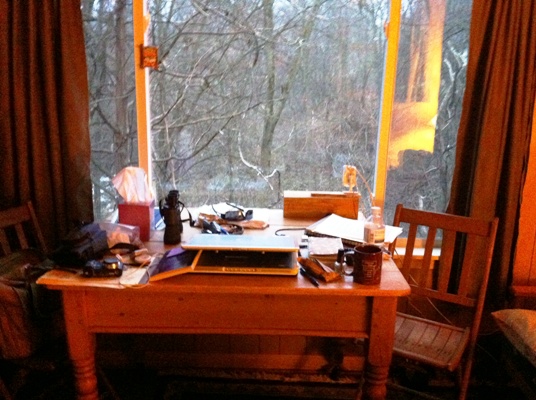
My brother and his wife recently moved and their first project was to build a small cabin in the woods behind their new home. The one room cabin perches part way down a steep ravine in the woods, above a pond and a river beyond. My brother spends hours down there and confesses, most of the time he just sits and looks out the window, watching the birds and critters, and resting his sore eyes on a vista absent of manipulation by his own species.

Formerly a hunter of deer, my brother is now living in more intimate and complementary relationship with his relatives. He rises early each day to put out food. Keeping track of them, he gives some of them names. He is respectful of the space they need and watches for signs of illness, or overcrowding of the herd. He worries about the invasive mustard grass, which chokes out the native plants.

Likewise the animals of this ravine are more intimate with my brother. They are eating well, unafraid, and willing to share more of themselves with this human. My brother is changing too. He has lost weight and strengthened his legs from making the steep climb down and back from the cabin to the house. He has become an evangelist for the gifts of that little structure. “Solitude is magnetic,” he tells me. Yes, indeed.

He shows me a little book he keeps for guests to write their impressions of time spent in his cabin. I open the cover and read the longing and gratitude in their comments.

The Force which Draws All Things Together
Solitude and the wilderness, where we find it, are magnetic. The wild things and places draw us to them by the force of our common relationship with each other as creatures on this earth. We are drawn by our desire to connect with and to enter into communion with Reality in a deeper, truer way than we find in the glib, sound bite assessments that surround us constantly. Such communion changes how we see ourselves and one another. Thomas Merton writes in his second chapter of Thoughts in Solitude that the wilderness invites us to stand back from our lives so we see things in a new perspective.

We cannot see things in perspective until we cease to hug them to our own bosom. When we let go of them, we begin to appreciate them as they really are. Only then can we begin to see God in them. Not until we find Him in them, can we start on the road to dark contemplation at whose end we shall be able to find them in Him.

 Get the Stink Blown Off
Do you postpone going down to your wild places until the time is right, until you have several days free, until you finish this or that project? I will tell you a secret. You don’t have to wait. Just go with whatever time you have. As Eugene Peterson, paraphrases I Kings 17: 2, “Get out of here and fast!” My mom’s version was, “You kids go on outside right now and get the stink blown off ya.” God receives what little time you can offer, a day, an afternoon, or ten minutes, and turns it into abundance with enough leftovers for you to eat on for the rest of week.

So go on. Get out. Go for a walk. Drive over to the lake or the beach. Take a blue highway home. Look around. Breathe. Smell.  Feel. Gaze into the eyes of a deer. Watch the eagle land and fold its wings on its perch above the river. Be seen by the squirrel, be blown by the wind. Be changed and shaped by the interplay and exchange of the animate world of which you are a beloved part.


Solitude Practice:

  • To what kind of wild places are you drawn? Have you been there recently? What keeps you from going?

  • What happens when you go? What changes or shifts do you notice in yourself?

  • Take some time to pray about your need for solitude and wilderness places. Listen for God’s response.

Next Post in this series on Exploring Solitude : The Wild Things Within


You can help support this series by donating to The Sanctuary Foundation for Prayer. Just five or ten dollars will make a difference and help pay some of our costs. Your gift is tax deductible. Donate Here. Thank you so much!

Exploring Solitude: Why Bother?

Come away by yourselves to a lonely place,” Jesus

 What is said here about solitude is not just a recipe for hermits.
It has a bearing on the whole future of humankind and the world:
and especially, of course, on the future of religion. Thomas Merton


Over the next several weeks I will be reflecting on selected passages from Thomas Merton’s little book, Thoughts in Solitude. First published in 1956 the book is a collection of Merton’s musings about time he spent alone in a hermitage at Gethsemane Abbey in Kentucky. Merton had been a monk for a while before he finally gained the Abbot’s permission to spend an extended time alone. An outgoing, gregarious fellow, he struggled throughout his life with finding a balance between his need for solitude and for community. His prolific, engaging writing brought seekers to the monastery and his ability to teach about the spiritual life attracted many followers.

If you have a copy of the book, you might want to get it out and follow along. You can easily find a used copy online, or check your local library for Thoughts in Solitude.

I confess that my relationship with this Trappist priest has been rocky. He has both deeply inspired and deeply disappointed me. There is much I admire in his life and writing and a few things I do not. Just as I decide I am finished with the man, I am drawn back. Like us all, Father Tom, as a friend calls him, has his sin and warts, yet God has used him mightily. We may all give thanks that falling short of the aim which God intends for us (the literal meaning of sin) has never been a road block to the power of God working through human lives.

I choose this book, not because I consider it among the best on the subject. We have over 2500 years of excellent material on the spiritual practice of solitude. I hope you will share your favorite resources in the comments section below, or on the Sanctuary Foundation Face Book Page, or email me. I will be happy to compile your suggestions with others and make them available to The Praying Life readers.

Thomas Merton
Thomas Merton (Photo credit: jimforest)

So let’s begin with the Preface. Here Merton lays out what he is up to in this book and makes his disclaimers. He tells us his “thoughts here are simply thoughts on the contemplative life, fundamental intuitions which seemed, at the time, to have a basic importance.” His writing comes from his “relationship with God in solitude and silence and that “interrelation of our personal solitudes with one another,” which are for Merton “essential to his own peculiar way of life.”

Then he launches into a broad societal justification for such peculiarity. A number of internal and external obstacles make it difficult for most of us to develop and nurture a practice of spiritual solitude. I have listened to many people who struggle to claim the “legitimacy” of the practice, to respond to this call of God, and to be consistent in the “coming away to a lonely place” with Jesus.

I feel guilty. Isn’t it selfish? Shouldn’t  I be doing something – working at the mission, helping out at church, serving on committees? My friends don’t understand. My pastor doesn’t get it. I can’t even explain why I do this or even what happens. Am I only fooling myself and being lazy and wasting time?

I hope this series will offer some support for your practice and a rationale which gives permission and value to a pursuit largely neglected in our culture and religious institutions, but sorely needed. In the end, though, you must come to your own rationale and your own “thoughts in solitude.” For each of us will experience solitude in different ways at different times, and God will speak within you the language of the unique nature of the intimacy you share. And each must make his or her own witness to the truth.

Merton begins his book by looking at the larger culture in which he found himself in 1956:

In an age when totalitarianism has striven, in every way, to devaluate and degrade the human person, we hope it is right to demand a hearing for any – and every sane reaction in favor of man’s [ok, from now on in this blog series I will make Merton’s gender nouns and pronouns neutral] inalienable solitude and interior freedom. The murderous din of our materialism cannot be allowed to silence the independent voices which will never cease to speak: whether they are the voices of Christian saints, Oriental sages like Lao-Tse or the Zen Masters, or the voices of persons like Thoreau, or Martin Buber, or Max Picard. It is all very well to insist that people are “social animals” – the fact is obvious enough. But that is no justification for making them into a mere cog in a totalitarian machine—or a religious one for that matter.”

Thomas Merton's hermitage at The Abbey of Our ...

Hermitage of Thomas Merton at Gethsemane Abbey

Society, for Merton, depends for its very existence on the inviolable solitude of its members. This is because, as he writes, “to be a person is to possess responsibility and freedom, and both of these imply a certain interior solitude, a sense of personal integrity, a sense of one’s own reality and of one’s own ability to give oneself to society – or to refuse that gift.”

He ends his preface with: “What is said here about solitude is not just a recipe for hermits. It has a bearing on the whole future of humankind and the world: and especially, of course, on the future of religion.”

One of my pet peeves about Merton, especially in his early writing, is his penchant for sweeping generalizations and pronouncements. I happen to agree with this one. How might such a claim be true?  Is there really a relationship between the time you take to create some space and time to be alone with God and our future as a race and the future of religion? I think so. And I am not alone.

When there is a crisis in the church, it is always a crisis of contemplation. The church wants to feel able to explain about her spouse even when she has lost sight of him; even when, although she has not been divorced, she no longer knows his embrace, because curiosity has gotten the better of her and she has gone searching for other people and other things.
Carlo Carretto


Might part of our struggle with keeping solitude be because we have our arms around the wrong lover?

Solitude Practice:

  • Ask the lover of your soul to show what you are hugging closer to yourself than the Holy One.

  • Identify competing lovers.

  • What might it take for you rediscover God’s embrace and forsake all others? It might be easier than you think.

As Paul Simon sang to us, there are fifty ways to leave your lover.

Next Post: The Wilderness of Solitude

You can help support this series by donating to The Sanctuary Foundation for Prayer. Just five or ten dollars will make a difference and help pay some of our costs. Your gift is tax deductible. Donate Here. Thank you so much!