
“The reason why pastors are so tired around Easter is because they have to preach about something they don’t really believe and it just wears them out,” announced a colleague to the group of clergy. Some clergy will tell you their fatigue is due to all the extra services, studies and observances that cluster around the season. One wonders what it is that calls out the sudden burst of piety and round of religious soirees, if it is not the need to reinforce our sagging faith.
Evelyn Underhill describes spiritual growth as a “series of oscillations between states of pleasure and states of pain which fatigue the immature transcendental powers.” (E. Underhill, Mysticism, p. 381.) Whatever the cause, the amazing truth of Good Friday and Easter is more than most of us can swallow, let alone integrate in such a way that we remain in possession of the power of the Risen Christ, while at the same time surrendered to that power.

Death is wearisome. Suffering is wearisome. Evil wears us down, grinds us down. As the opposite of creativity, evil employs repetition as one of its weapons. The slow steady accumulation of minor abuses and violations turn over time into an onslaught, which erodes our best intentions. Sick and tired of it all, we finally succumb with a yawn and let death have its way with us.
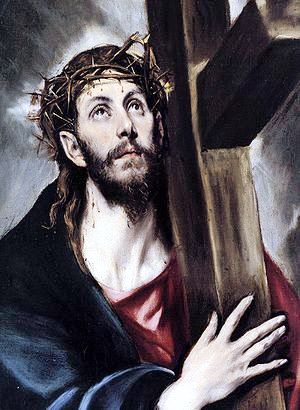
Jesus says, “It is lent. Come on. Take up your cross and follow me.” Jesus does not summon us to a quick easy death. He says cross – that slow torment that keeps you hanging around, conscious, gasping, while the body strains and sags against the nails that pin us to our own circumstances and the slow agonizing drag of gravity does its job.
We sink slowly into the earth, the forces of the universe pulverizing us over eons into dust. At such a prospect, heartily endorsed from pulpits far and wide, one’s transcendental powers, mature or immature, might well benefit from a swig of Geritol.

“Have a Happy Death,” my friend says. And I go read about those eccentric saints who extol the joy of suffering and actually prayed to share in Christ’s pain. What did they know I don’t know?
A while back I got a large envelope in the mail with the words SECRETS THAT CAN BANISH PAIN emblazoned across the front. Inside a Mr. Mark Bricklin promised to send me secrets that would save my life and show me HUNDREDS OF WAYS TO GET FAST RELIEF. I looked over his offer and decided to take a nap.
Our culture has little capacity to find anything redeeming in anyone who would deliberately seek to suffer. We have a difficult time distinguishing between the suffering of sacrificial love and suffering that is meaningless and self-defeating. It is hard for us to believe that suffering consciously chosen and accepted could be anything other than dysfunctional behavior.

This may be part of the reason why the season wears us out. This Jesus hanging on a cross for our sakes appears hardly functional. He makes none of the promises of Mr. Mark Bricklin who exhorts me not to deprive myself and my loved ones of the chance to truly banish pain. (Mail the enclosed card today!) The effort of leaning up against that cross in a culture that seeks to banish pain, and the real spiritual work of extending ourselves past our exposed doubt deeper into God is more than a little fatiguing.
Spiritual growth may be seen as slowly deepening belief, or the steady erosion of our hypocrisy. Layers of pretense and self deceit peel away to expose our fear. What is revealed is the limit of our belief, its edges. A good deal of our suffering is that raw exposure of our doubt, our unbelief, to the light of the Risen Christ. It stings, smarts. We think we are dying, losing everything.
Perhaps the difference between tragic suffering and the redemptive suffering in which Christ invites us to participate lies not in the amount, kind or quality of the pain, nor in its cause. What makes one kind of suffering sacred and healing, and another simply one more case of horror and abuse inflicted upon an innocent victim may lie in the extent of our personal freedom to choose how we respond to the pain we experience when others trespass against us.

And here we might look to Jesus, the pioneer and perfecter, “who for the joy that awaited him, endured the cross, despising the shame…” (Hebrews 12: 1-2) We do not have to love our suffering; we just have to bear it. We take up our crosses. We consciously receive the pain that comes our way, not for the pain we must endure, but for the joy that awaits. In this way we become martyrs, not in self abasing, whining, self-righteous martyrdom, but in the original sense of the word. Martyr in Greek means witness, one who has seen God and is willing to testify by one’s life that God lives – even in the midst of death and evil and defeat.
Perhaps what those long-suffering saints know that I and Mr. Mark Bricklin haven’t yet grasped, is that what makes suffering redemptive is enduring the cross despising the shame, making light of its disgrace. The self which dies is the ego, the grasping, controlling, faithless part of ourselves which believes everything is up to us. Unlike Jesus, we do not despise the shamefulness of our suffering. We despise ourselves instead. We are humiliated and contemptuous of ourselves in situations of disgrace, defeat and loss which expose our limits.
We want an explanation for our pain. The ego anxiously searches for meaning in the mistaken notion that in understanding we may find relief. Jesus does not seek to justify himself. His focus is not on the cause of his suffering, but on obedience to the One he loves and from whom he came and to whom he is headed in joyful reunion. Jesus does not despise himself, instead he despises that which seeks to humiliate and destroy his identity as the holy Child of God, in other words, his innate goodness and sanctity. Jesus does not stop loving himself or God in his suffering.

To be beaten, to be rejected, to be abandoned and despised without beating, rejecting, abandoning, and despising oneself is to know oneself as a child of the Holy One. To suffer, despising the shame, is to remain grounded in one’s essential goodness, even when one has reached the limits of one’s ability to do good.
A blessed lent to you and to Mr. Bricklin too. May we all enjoy a happy death, a good rest, and steadily maturing transcendental powers.
This post adapted from Letters from the Holy Ground, Sheed & Ward, 2000, written by Loretta F. Ross (Ross-Gotta).
Read more about prayer www.fromholyground.org
Contact the author lross@fromholyground.org, www.fbook.me/sanctuary
Follow at http://twitter.com/lfross
Posted in faith, Lent
Tagged Christianity, Easter, Evelyn Underhill, God, Good Friday, Hebrews 12: 1-2, Jesus, Religion & Spirituality, resurrection, suffering











 The Praying Life